Class 7 Maths Chapter 7 Solutions — A Tale of Three Intersecting Lines
These NCERT Ganita Prakash Class 7 Chapter 7 solutions explain triangle construction, triangle inequality, angle sums, exterior angles and altitudes. Original labelled diagrams accompany the construction steps and show why the geometric rules work.
Class: 7Subject: MathematicsBook: Ganita Prakash (Part I)Chapter: 7Exercises: 9 Figure it Out sets + Math Talk & Try ThisSession: 2026–27
Chapter 7 of Ganita Prakash, A Tale of Three Intersecting Lines, is all about the triangle — the simplest closed shape made of three vertices and three sides. It starts by constructing equilateral and general triangles with a compass, then discovers the triangle inequality (each side must be less than the sum of the other two) by reasoning about “direct” and “roundabout” paths and by visualising whether two circles intersect. The chapter then constructs triangles from two sides and the included angle and from two angles and the included side, proves the angle sum property (angles add to 180°) using a parallel line, introduces exterior angles, and finishes with altitudes and the classification of triangles by sides and by angles. The Class 7 Maths Ganita Prakash Chapter 7 solutions below work through every Figure it Out, Math Talk and Try This task step by step.
Key Concepts & Definitions
Triangle: the most basic closed shape, formed by three corner points (vertices) and three line segments (sides) joining the pairs of vertices. A triangle is named by its vertices, e.g. ∆ABC, and the vertices may be written in any order.
Triangle inequality: a set of three lengths can form a triangle only if each length is smaller than the sum of the other two. For lengths a, b, c this means a < b + c, b < a + c and c < a + b. (It is enough to check that the longest length is less than the sum of the other two.)
Equilateral triangle: all three sides equal. Isosceles triangle: exactly two sides equal. Scalene triangle: all three sides of different lengths.
Included angle / included side: the angle between two given sides is the included angle; the side that is a part of two given angles is the included side.
Angle sum property: the three angles of any triangle always add up to 180°.
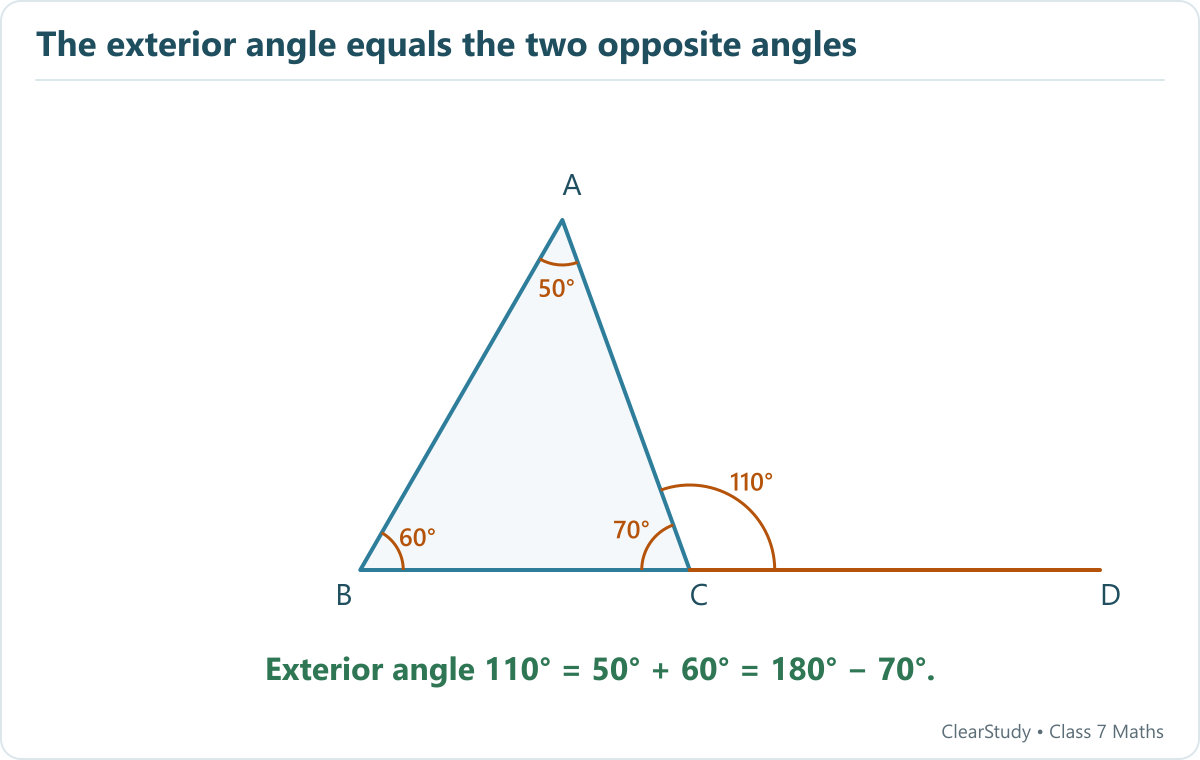
Exterior angle: the angle formed between the extension of one side of a triangle and the adjacent side. It is the supplement of the interior angle at that vertex.
Altitude: the perpendicular line segment from a vertex to its opposite side (or to the line containing that side). Its length is the height of that vertex from the base.
Triangles by angles: acute-angled (all three angles acute), right-angled (one 90° angle), obtuse-angled (one obtuse angle).
Important Formulas & Rules (Chapter 7)
Triangle inequality: a triangle with sides a, b, c exists if and only if each side < sum of the other two; equivalently, (longest side) < (sum of the other two).
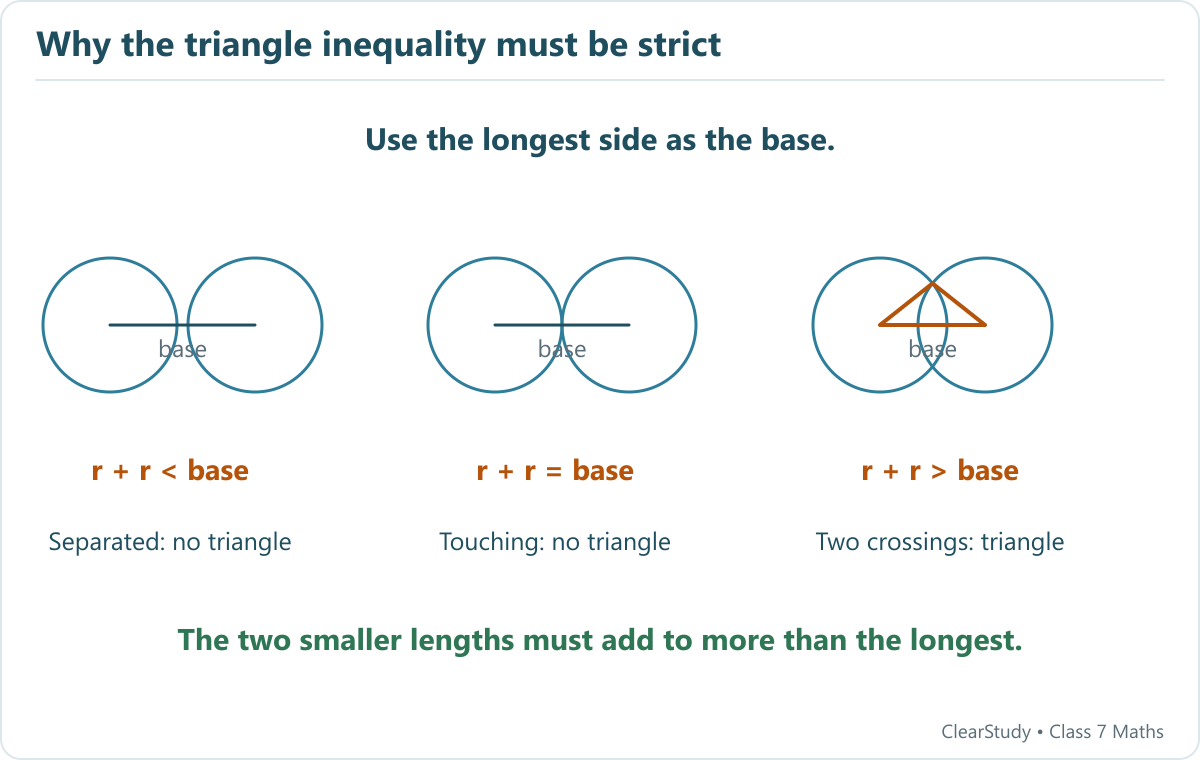
Circle test for construction: taking the longest length as base AB and the smaller two as radii — circles intersect internally (triangle exists) when sum of two radii > AB; they touch when sum = AB; they do not meet when sum < AB.
Angle condition for two angles + included side: a triangle exists only when the sum of the two given angles is less than 180°.
Angle sum property: ∠A + ∠B + ∠C = 180° for any triangle ABC.
Third angle: third angle = 180° − (sum of the other two angles).
Exterior angle property: an exterior angle = 180° − adjacent interior angle = sum of the two opposite (interior) angles.
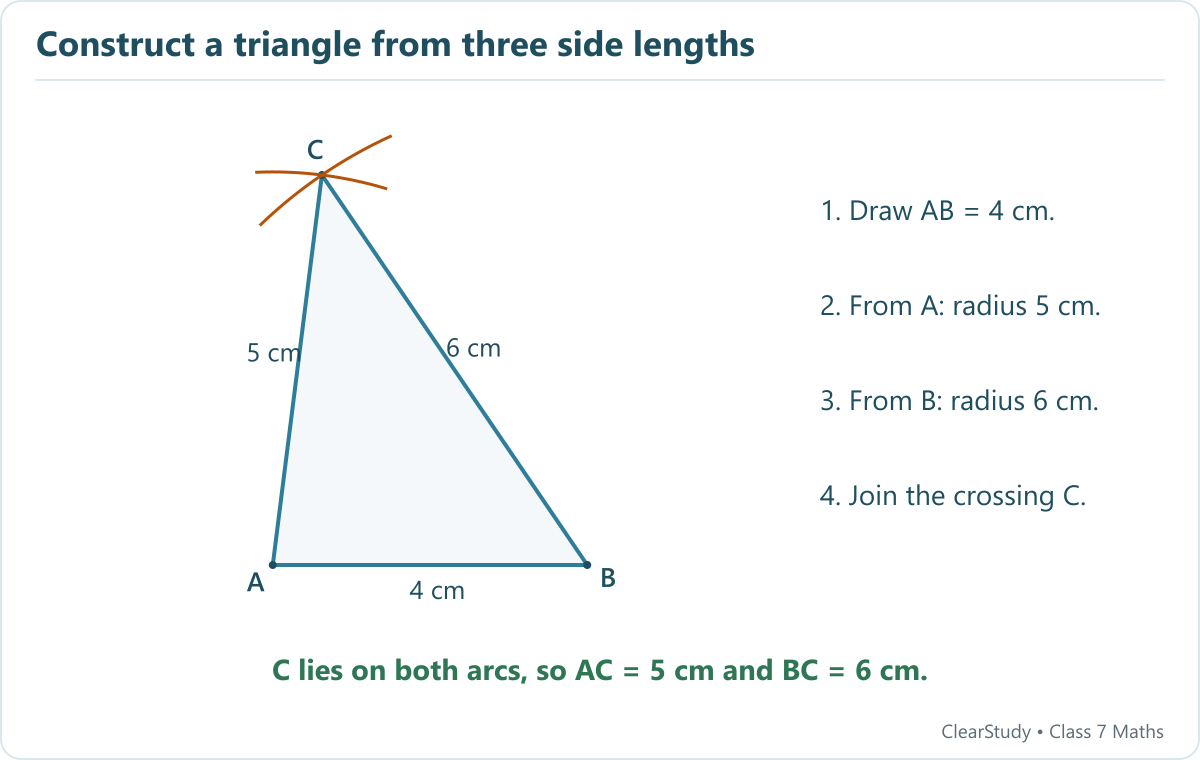
Constructing triangles with compass arcs — pages 146–150For an equilateral triangle of side 4 cm, draw AB=4 cm. Draw arcs of radius 4 cm from both A and B. Mark an intersection C and join AC and BC. All three sides are 4 cm because C lies on both arcs.For the example with AB=4 cm, AC=5 cm and BC=6 cm, use radius 5 cm from A and radius 6 cm from B. The drawing below shows the two arcs crossing at C. A mirror construction below AB gives a congruent triangle.
Draw AB=4 cm. Arcs of radius 5 cm from A and 6 cm from B meet at C. Join AC and BC. Diagrams are scaled teaching views; use the labelled lengths for construction.
Figure it Out — Isosceles & Equilateral Triangles from Circles (Page 150–151)
1. Use the points on the circle and/or the centre to form isosceles triangles.
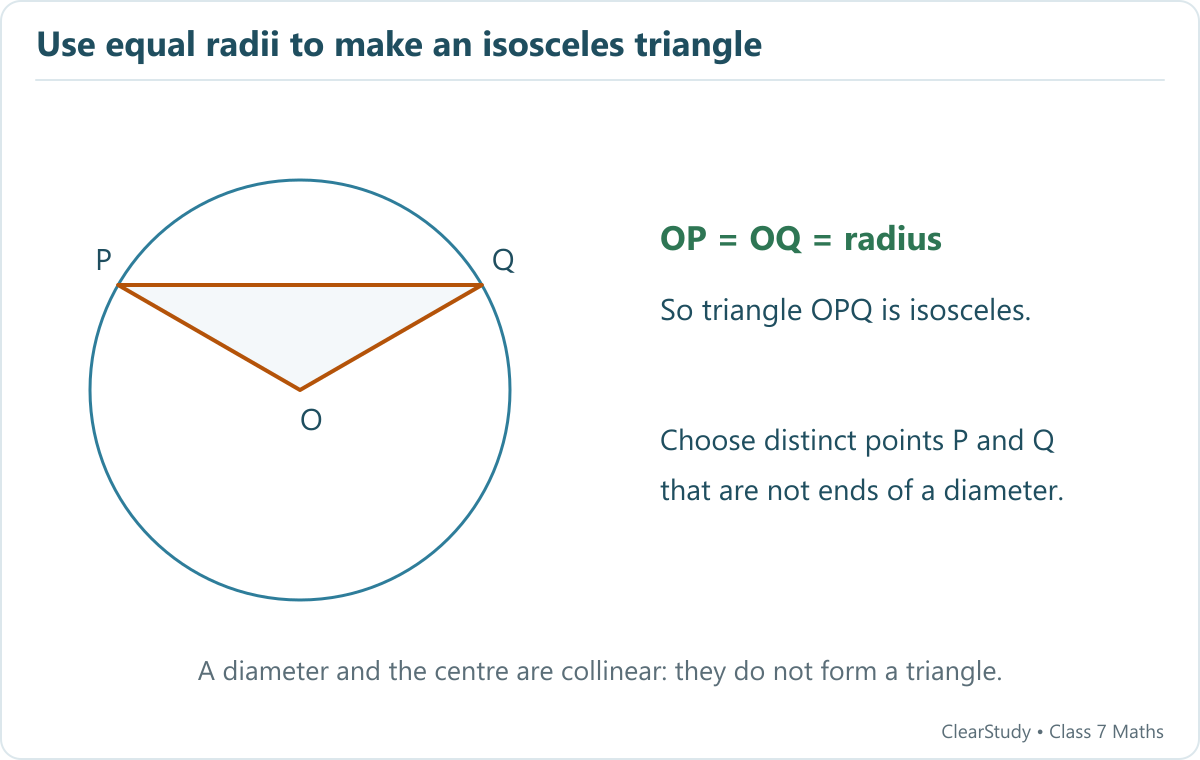
SOLUTIONLet O be the centre. Choose two distinct points P and Q that are not the ends of a diameter. Join OP, OQ and PQ.OP and OQ are equal radii, so triangle OPQ is isosceles. If P and Q were opposite ends of a diameter, O, P and Q would lie on one straight line and no triangle would form.If the chord PQ also equals the radius, all three sides are equal and the triangle is equilateral.
Join the centre O to two distinct, non-diametrically-opposite points P and Q. OP and OQ are equal radii, so OPQ is isosceles.
2. Use the points on the circles and/or their centres to form isosceles and equilateral triangles. The circles are of the same size.
(First figure) A and B are the centres of circles of the same size.(Second figure) A, B, and C are the centres of circles of the same size.
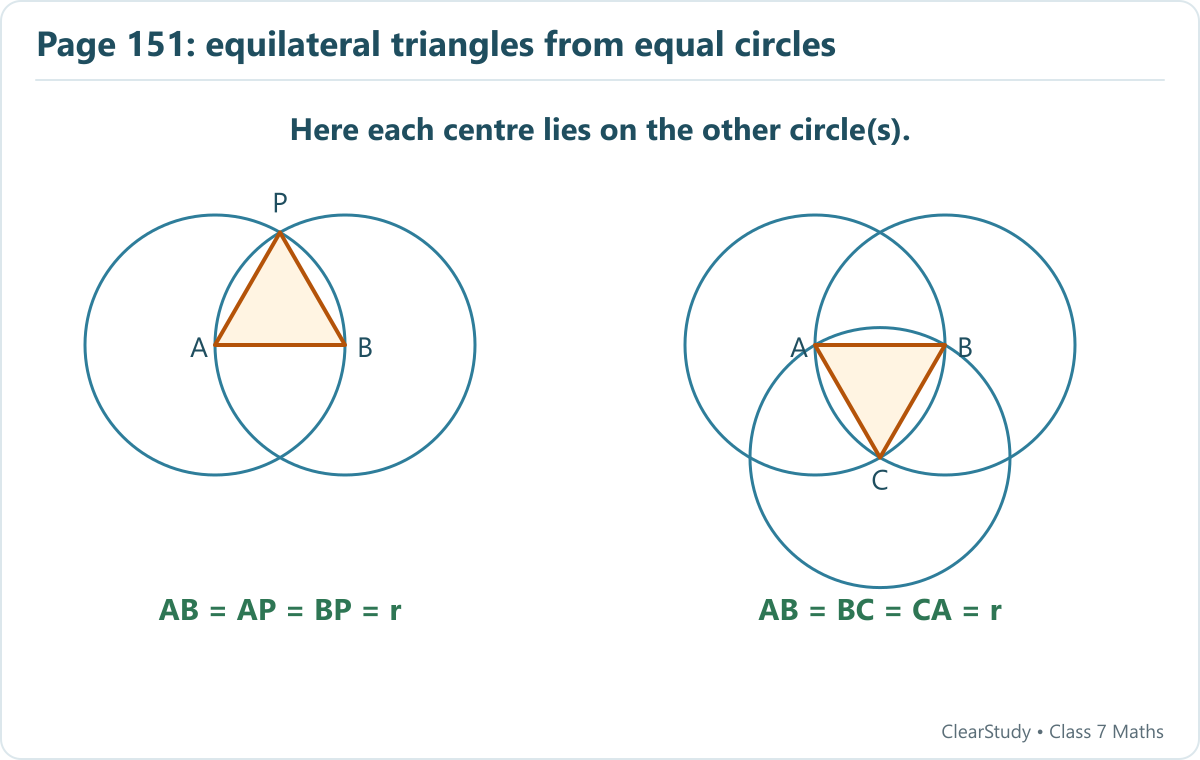
SOLUTIONEqual circles have equal radii. Their centre-to-centre distance is not automatically equal to the radius. In these textbook diagrams, each marked centre lies on the other circle or circles, which gives the additional equality.Two circles: label the intersections P and Q. Since AB=AP=BP=r, triangle ABP is equilateral. Triangle ABQ is also equilateral. Triangles APQ and BPQ are isosceles because AP=AQ=r and BP=BQ=r.Three circles: the centres A, B and C lie on one another’s circles, so AB=BC=CA=r and triangle ABC is equilateral. A centre joined to two distinct, non-opposite points on its own circle gives an isosceles triangle.
In the textbook arrangements, each centre lies on the other circle or circles. Thus AB equals the common radius: ABP and ABC are equilateral. Equal circle sizes alone would not guarantee this.
Figure it Out — Checking the Triangle Inequality (Page 154)
1. We checked by construction that there are no triangles having sidelengths 3 cm, 4 cm and 8 cm; and 2 cm, 3 cm and 6 cm. Check if you could have found this without trying to construct the triangle.
SOLUTIONUse the triangle inequality — the longest side must be less than the sum of the other two.3, 4, 8: longest = 8, and 3 + 4 = 7. Since 8 > 7, the inequality fails → no triangle. (Confirmed without construction.)2, 3, 6: longest = 6, and 2 + 3 = 5. Since 6 > 5, the inequality fails → no triangle.So yes — both cases can be settled instantly by comparing the longest side with the sum of the other two.
With the longest length as base, the construction circles must cross in two points. If the two smaller lengths sum to the base, the circles only touch and the vertices are collinear.
2. Can we say anything about the existence of a triangle for each of the following sets of lengths?
(a) 10 km, 10 km and 25 km(b) 5 mm, 10 mm and 20 mm(c) 12 cm, 20 cm and 40 cm
SOLUTIONCheck whether the longest length is less than the sum of the other two.(a) Longest = 25; other two: 10 + 10 = 20. Since 25 > 20, inequality fails → no triangle.(b) Longest = 20; other two: 5 + 10 = 15. Since 20 > 15, inequality fails → no triangle.(c) Longest = 40; other two: 12 + 20 = 32. Since 40 > 32, inequality fails → no triangle.None of the three sets can form a triangle.
Figure it Out — Which Lengths Can Be Sidelengths of a Triangle (Page 156)
1. Which of the following lengths can be the sidelengths of a triangle? Explain your answers. Note that for each set, the three lengths have the same unit of measure.
(a) 2, 2, 5 (b) 3, 4, 6(c) 2, 4, 8 (d) 5, 5, 8(e) 10, 20, 25 (f) 10, 20, 35(g) 24, 26, 28
SOLUTIONA triangle exists iff the longest length is less than the sum of the other two.(a) 2, 2, 5: longest 5 vs 2 + 2 = 4 → 5 > 4 → not possible.(b) 3, 4, 6: longest 6 vs 3 + 4 = 7 → 6 < 7 → possible.(c) 2, 4, 8: longest 8 vs 2 + 4 = 6 → 8 > 6 → not possible.(d) 5, 5, 8: longest 8 vs 5 + 5 = 10 → 8 < 10 → possible (isosceles).(e) 10, 20, 25: longest 25 vs 10 + 20 = 30 → 25 < 30 → possible.(f) 10, 20, 35: longest 35 vs 10 + 20 = 30 → 35 > 30 → not possible.(g) 24, 26, 28: longest 28 vs 24 + 26 = 50 → 28 < 50 → possible.Triangles possible: (b), (d), (e), (g). Not possible: (a), (c), (f).
Figure it Out — Existence of Triangles (Page 159)
1. Check if a triangle exists for each of the following set of lengths:
(a) 1, 100, 100 (b) 3, 6, 9(c) 1, 1, 5 (d) 5, 10, 12
SOLUTIONCompare the longest length with the sum of the other two.(a) 1, 100, 100: longest 100 vs 1 + 100 = 101 → 100 < 101 → triangle exists (a very thin isosceles triangle).(b) 3, 6, 9: longest 9 vs 3 + 6 = 9 → 9 = 9 (not strictly less) → no triangle (the circles only touch, so the three points lie on a line).(c) 1, 1, 5: longest 5 vs 1 + 1 = 2 → 5 > 2 → no triangle.(d) 5, 10, 12: longest 12 vs 5 + 10 = 15 → 12 < 15 → triangle exists.
2. Does there exist an equilateral triangle with sides 50, 50, 50? In general, does there exist an equilateral triangle of any sidelength? Justify your answer.
SOLUTIONFor 50, 50, 50: the longest side 50 vs 50 + 50 = 100 → 50 < 100, so the triangle inequality is satisfied → yes, an equilateral triangle with sides 50 exists.In general: for an equilateral triangle every side equals some length a. The check is a < a + a, i.e. a < 2a, which is true for every positive a.∴ an equilateral triangle exists for any positive sidelength.
3. For each of the following, give at least 5 possible values for the third length so there exists a triangle having these as sidelengths (decimal values could also be chosen):
(a) 1, 100 (b) 5, 5 (c) 3, 7
SOLUTIONIf two sides are p and q, the third side x must satisfy |p − q| < x < p + q (third side greater than the difference and less than the sum).(a) 1 and 100: need 99 < x < 101. Five values: 99.5, 100, 100.2, 100.5, 100.9.(b) 5 and 5: need 0 < x < 10. Five values: 1, 3, 5, 7, 9.(c) 3 and 7: need 4 < x < 10. Five values: 5, 6, 7, 8, 9.
Figure it Out — Two Sides and the Included Angle (Page 161)
1. Construct triangles for the following measurements where the angle is included between the sides:
(a) 3 cm, 75°, 7 cm(b) 6 cm, 25°, 3 cm(c) 3 cm, 120°, 8 cm
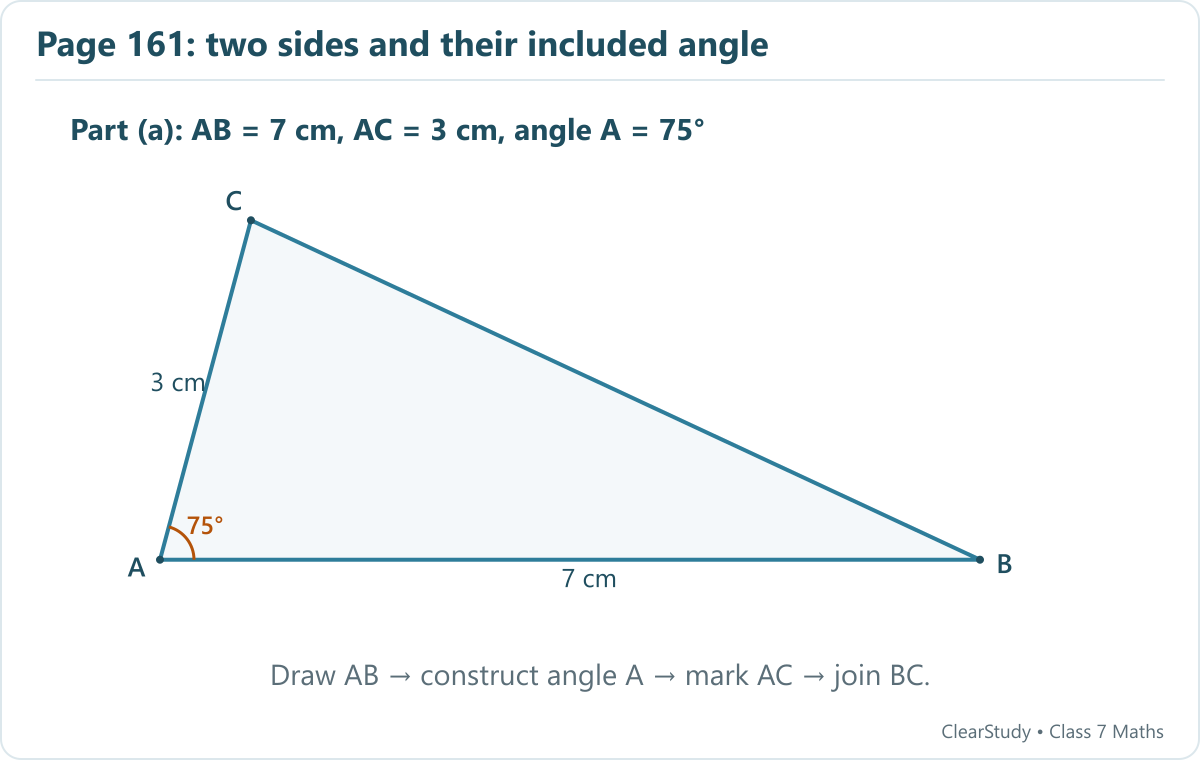
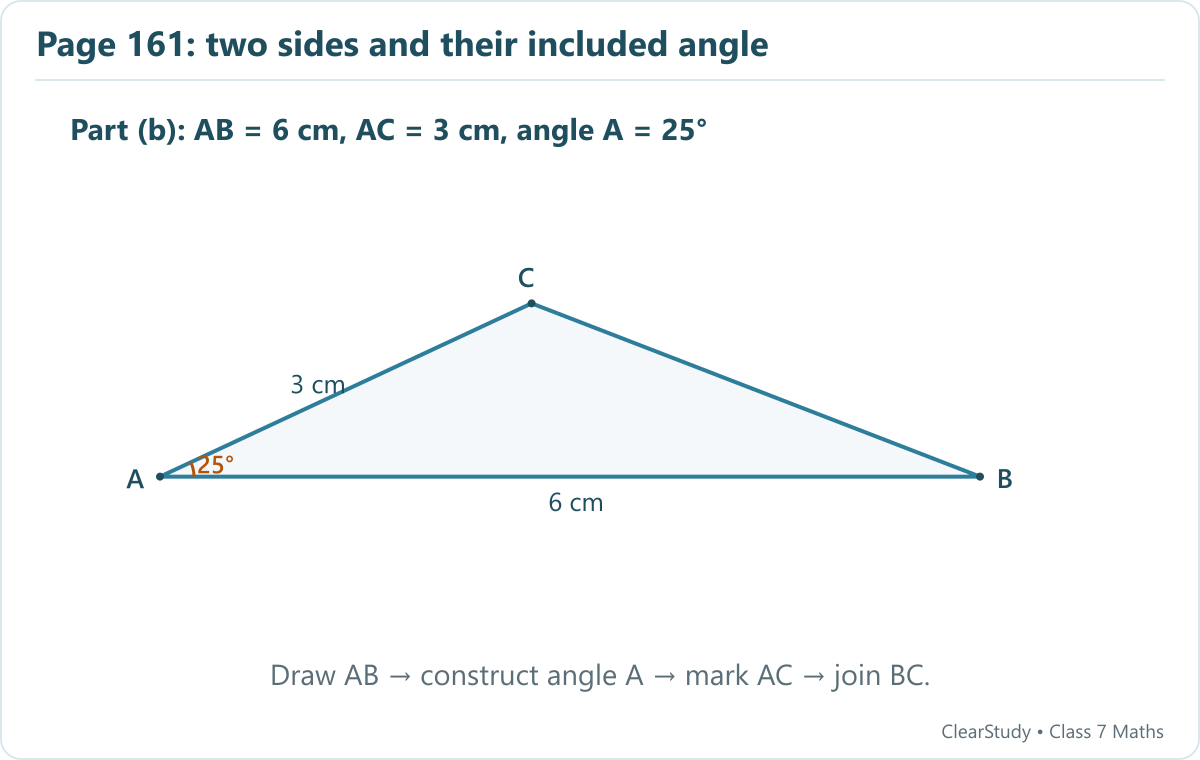
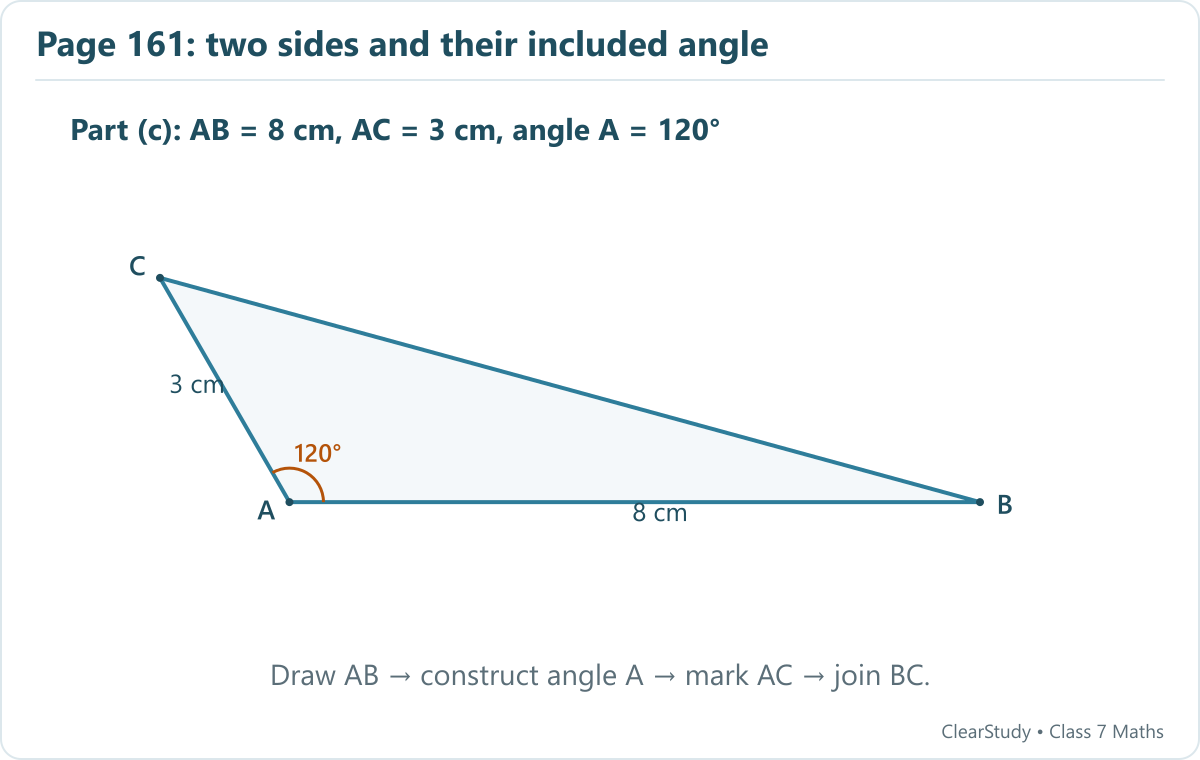
SOLUTION (steps of construction — SAS)General method (two sides + included angle): draw the first side as base; at one end construct the given angle; along that arm mark the second side; join the free end to the other base vertex.(a) 3 cm, 75°, 7 cm: Draw AB = 7 cm. At A, construct ∠A = 75°. Along the new arm mark AC = 3 cm. Join BC. ∆ABC is the required triangle.(b) 6 cm, 25°, 3 cm: Draw AB = 6 cm. At A, construct ∠A = 25°. Along the arm mark AC = 3 cm. Join BC to complete ∆ABC.(c) 3 cm, 120°, 8 cm: Draw AB = 8 cm. At A, construct ∠A = 120° (an obtuse angle). Along the arm mark AC = 3 cm. Join BC to complete ∆ABC.Condition: the two side lengths must be positive and the included angle must be strictly between 0° and 180°. Then the construction gives a unique triangle up to reflection and position. At 0° or 180°, the points are collinear and no triangle forms.
Part a: AB=7 cm, AC=3 cm and angle A=75 degrees. Join C to B after marking C on the angle arm.Part b: AB=6 cm, AC=3 cm and angle A=25 degrees. Join C to B after marking C on the angle arm.Part c: AB=8 cm, AC=3 cm and angle A=120 degrees. Join C to B after marking C on the angle arm.
Figure it Out — Two Angles and the Included Side (Page 162)
1. Construct triangles for the following measurements:
(a) 75°, 5 cm, 75°(b) 25°, 3 cm, 60°(c) 120°, 6 cm, 30°
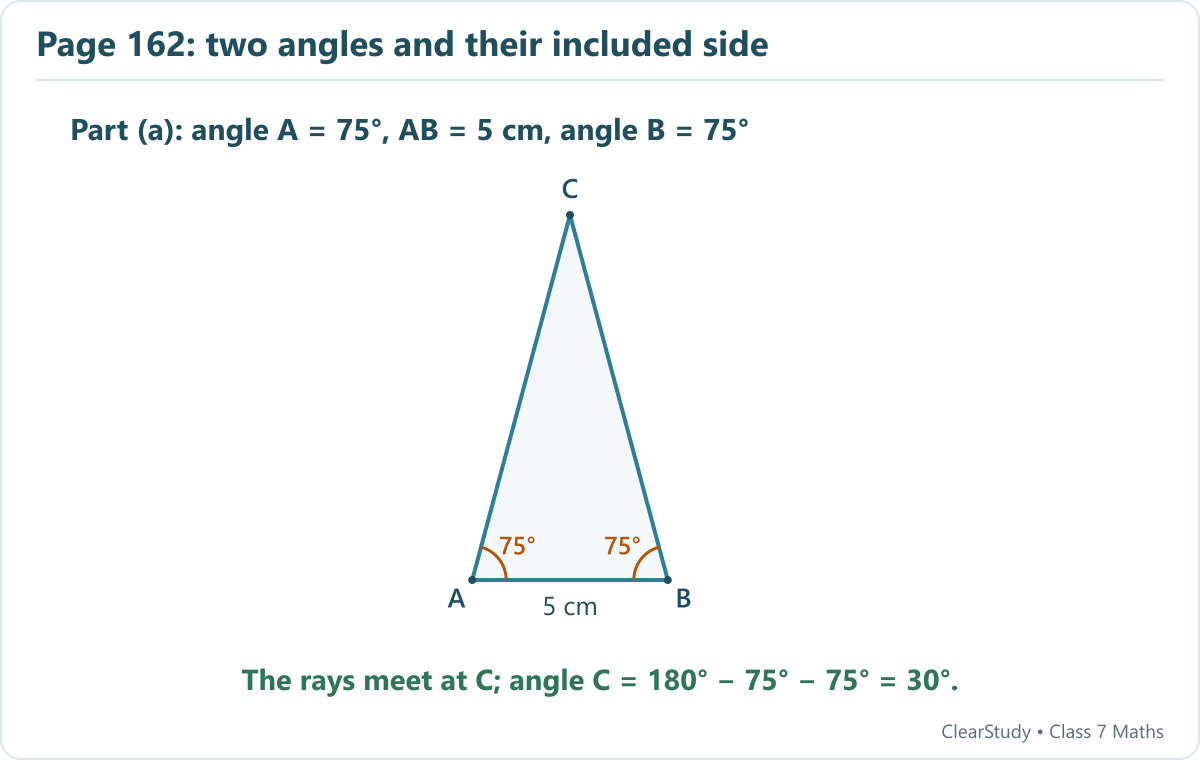
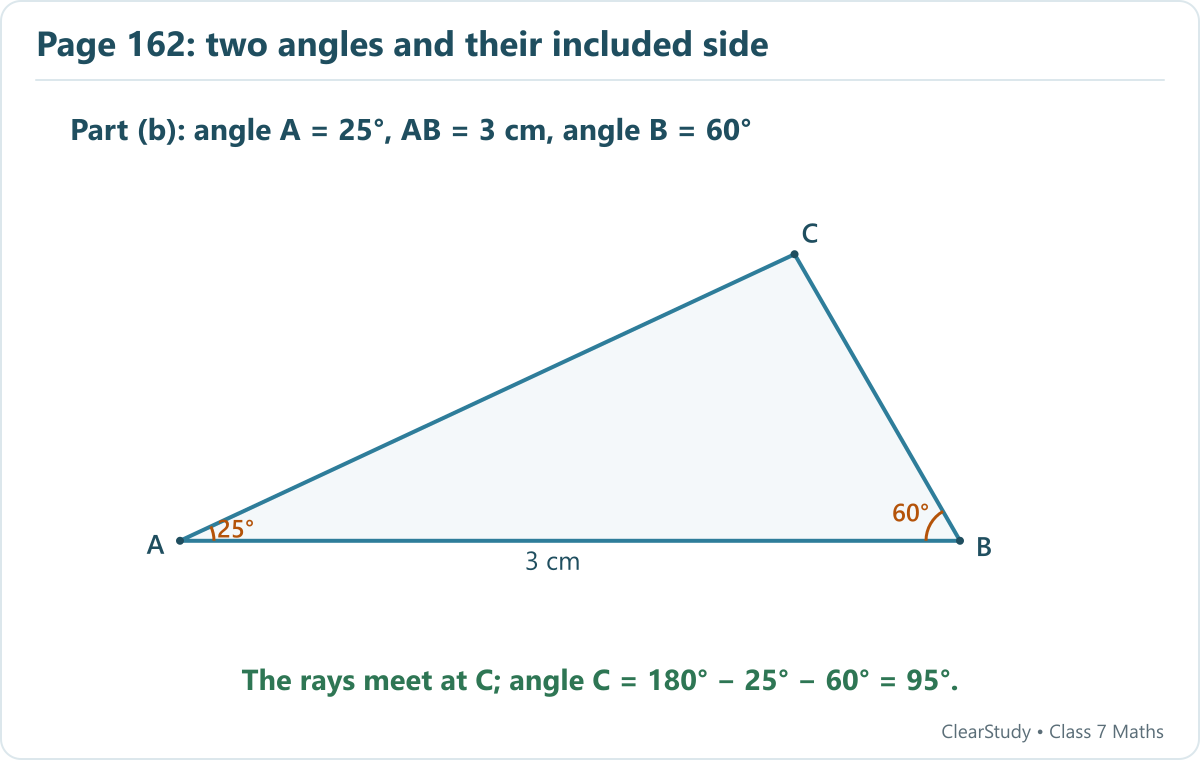
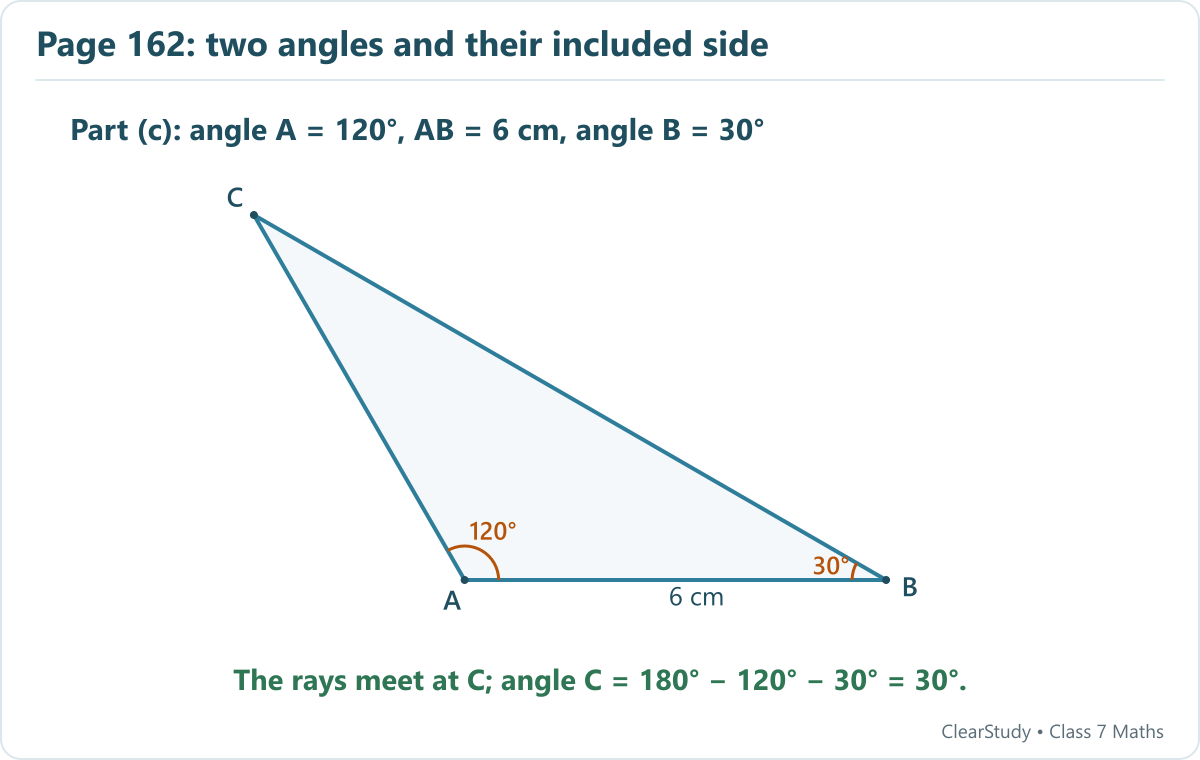
SOLUTION (steps of construction — ASA)General method (two angles + included side): draw the given side as base; construct both given angles on the same side of the base; their rays meet at the third vertex when both angles are positive and their sum is less than 180°.(a) 75°, 5 cm, 75°: Draw AB = 5 cm. At A make ∠A = 75° and at B make ∠B = 75°. The arms meet at C. (Sum 75 + 75 = 150 < 180, so the triangle exists; it is isosceles.)(b) 25°, 3 cm, 60°: Draw AB = 3 cm. At A make ∠A = 25° and at B make ∠B = 60°. The arms meet at C. (25 + 60 = 85 < 180, triangle exists.)(c) 120°, 6 cm, 30°: Draw AB = 6 cm. At A make ∠A = 120° and at B make ∠B = 30°. The arms meet at C. (120 + 30 = 150 < 180, triangle exists.)Check: all three pairs have angle sum < 180°, so each construction is possible.
Part a: draw AB=5 cm and rays making angles 75 and 75 degrees on the same side of AB. Their intersection is C, whose angle is 30 degrees.Part b: draw AB=3 cm and rays making angles 25 and 60 degrees on the same side of AB. Their intersection is C, whose angle is 95 degrees.Part c: draw AB=6 cm and rays making angles 120 and 30 degrees on the same side of AB. Their intersection is C, whose angle is 30 degrees.
Figure it Out — Angle Pairs for a Triangle (Page 163)
1. For each of the following angles, find another angle for which a triangle is (a) possible, (b) not possible. Find at least two different angles for each category:
(a) 30° (b) 70° (c) 54° (d) 144°
SOLUTIONRule: two angles can be the (base) angles of a triangle when their sum is less than 180°; if the sum is 180° or more, no triangle.(a) 30°: possible with 100° (sum 130°) or 60° (sum 90°); not possible with 150° (sum 180°) or 160° (sum 190°).(b) 70°: possible with 40° (sum 110°) or 60° (sum 130°); not possible with 110° (sum 180°) or 130° (sum 200°).(c) 54°: possible with 50° (sum 104°) or 100° (sum 154°); not possible with 126° (sum 180°) or 140° (sum 194°).(d) 144°: possible with 20° (sum 164°) or 30° (sum 174°); not possible with 40° (sum 184°) or 50° (sum 194°).
2. Determine which of the following pairs can be the angles of a triangle and which cannot:
(a) 35°, 150° (b) 70°, 30°(c) 90°, 85° (d) 50°, 150°
SOLUTIONCheck whether the sum of the two angles is less than 180°.(a) 35 + 150 = 185° > 180° → cannot be angles of a triangle.(b) 70 + 30 = 100° < 180° → can (third angle = 80°).(c) 90 + 85 = 175° < 180° → can (third angle = 5°).(d) 50 + 150 = 200° > 180° → cannot.
Figure it Out — Finding the Third Angle Using a Parallel Line (Page 165)
1. Find the third angle of a triangle (using a parallel line) when two of the angles are:
(a) 36°, 72° (b) 150°, 15°(c) 90°, 30° (d) 75°, 45°
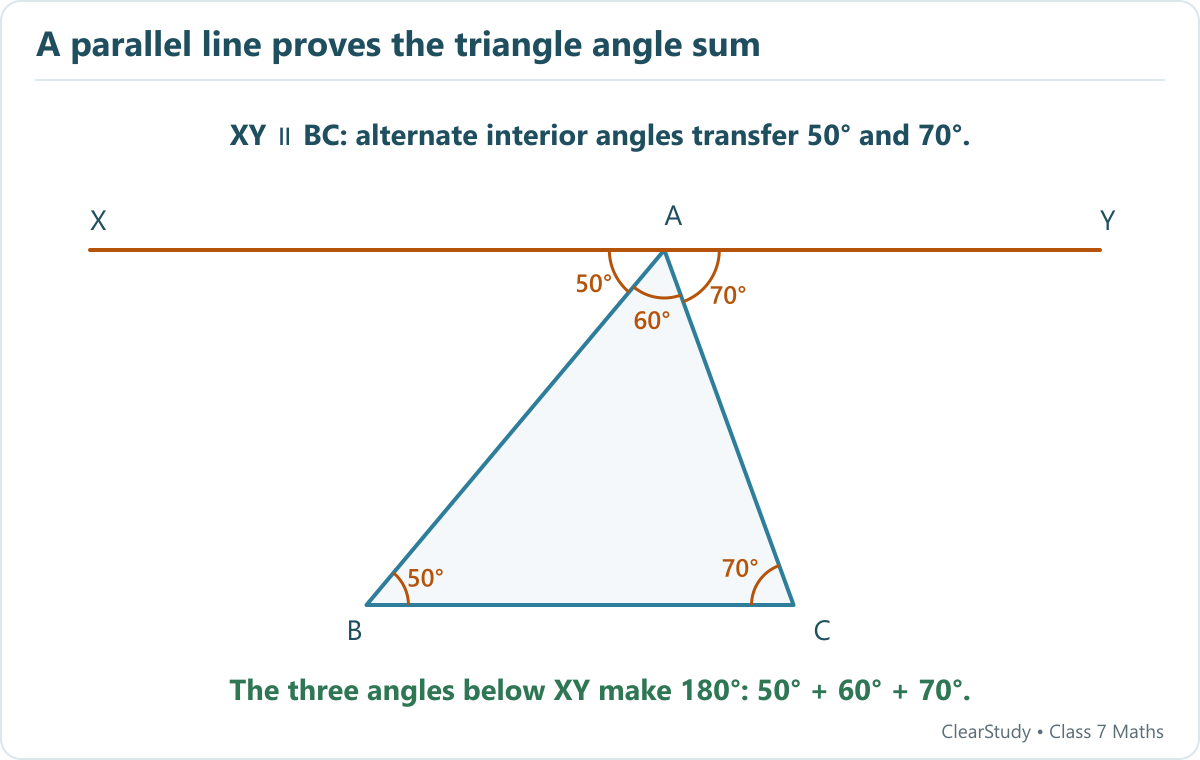
SOLUTIONDrawing a line through the apex parallel to the base shows the three angles together make a straight angle, so the angle sum is 180°. Hence third angle = 180° − (sum of the two given angles).(a) 180° − (36° + 72°) = 180° − 108° = 72°.(b) 180° − (150° + 15°) = 180° − 165° = 15°.(c) 180° − (90° + 30°) = 180° − 120° = 60°.(d) 180° − (75° + 45°) = 180° − 120° = 60°.
Draw XY through A parallel to BC. Alternate interior angles transfer B=50° and C=70° to A. Together with angle A they form a straight angle, so A=60°.
2. Can you construct a triangle all of whose angles are equal to 70°? If two of the angles are 70° what would the third angle be? If all the angles in a triangle have to be equal, then what must its measure be? Explore and find out.
SOLUTIONIf all three angles were 70°, their sum would be 70° × 3 = 210°, which is more than 180°. So no, a triangle with all angles 70° cannot exist.If two angles are 70°, the third = 180° − (70° + 70°) = 180° − 140° = 40°.If all three angles are equal, each = 180° ÷ 3 = 60° (this is an equilateral triangle).
3. Here is a triangle in which we know ∠B = ∠C and ∠A = 50°. Can you find ∠B and ∠C?
Figure it Out — Altitudes & Types of Triangles (Page 170–171)
1. Construct a triangle ABC with BC = 5 cm, AB = 6 cm, CA = 5 cm. Construct an altitude from A to BC.
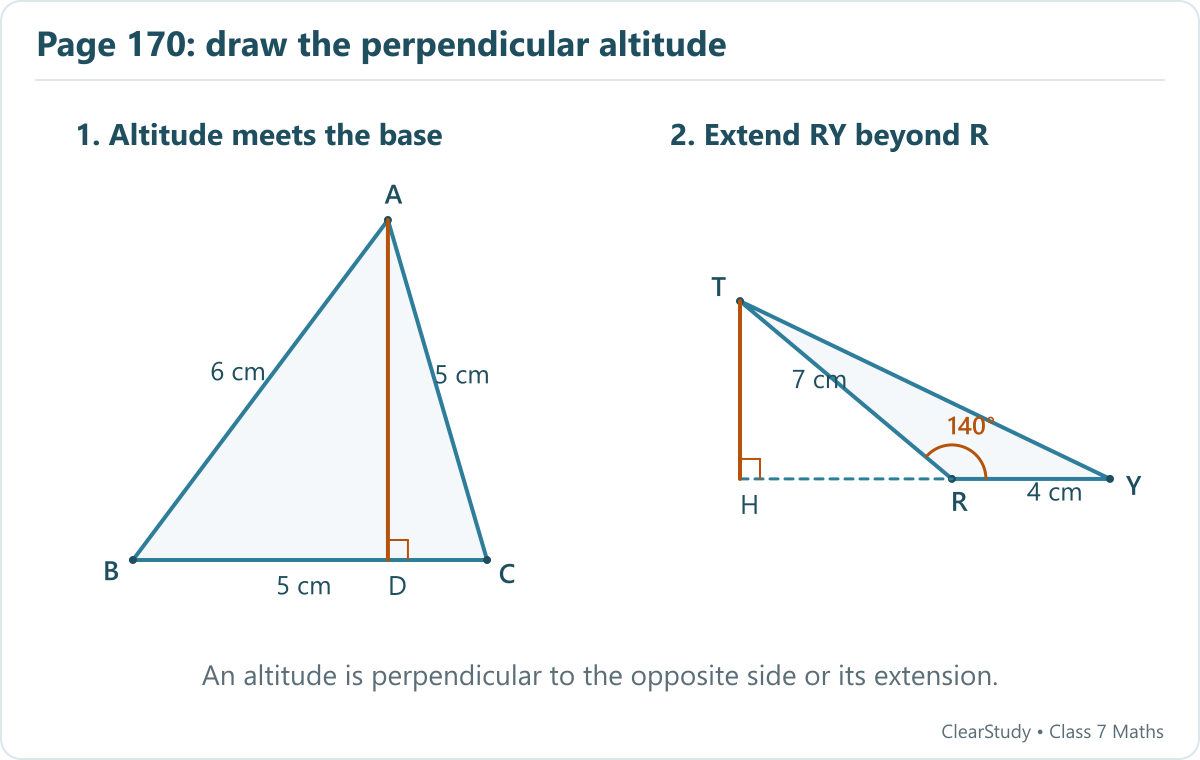
SOLUTION (steps of construction)Check: longest side 6 < 5 + 5 = 10, so the triangle exists.Step 1: Draw BC = 5 cm.Step 2: With B as centre and radius 6 cm, draw an arc; with C as centre and radius 5 cm (= CA), draw another arc cutting the first at A.Step 3: Join AB and AC to get ∆ABC.Step 4 (altitude): Keep a ruler along BC, slide a set square along it until its right-angle edge passes through A, and draw AD ⊥ BC, meeting BC at D. AD is the required altitude from A.
2. Construct a triangle TRY with RY = 4 cm, TR = 7 cm, ∠R = 140°. Construct an altitude from T to RY.
SOLUTION (steps of construction)Step 1: Draw RY = 4 cm.Step 2: At R, construct ∠R = 140° (an obtuse angle) and draw the arm.Step 3: Along this arm mark TR = 7 cm to fix T. Join TY to complete ∆TRY.Step 4 (altitude): Since ∠R is obtuse, the foot of the perpendicular from T to line RY falls outside the segment RY. Extend RY beyond R, then drop a perpendicular from T to this extended line (using a set square); the perpendicular segment is the required altitude from T to RY.
Left: BC=5 cm, AB=6 cm, CA=5 cm; AD is perpendicular to BC. Right: RY=4 cm, TR=7 cm and angle R=140°; TH meets the extension of RY beyond R.
3. Construct a right-angled triangle ∆ABC with ∠B = 90°, AC = 5 cm. How many different triangles exist with these measurements?
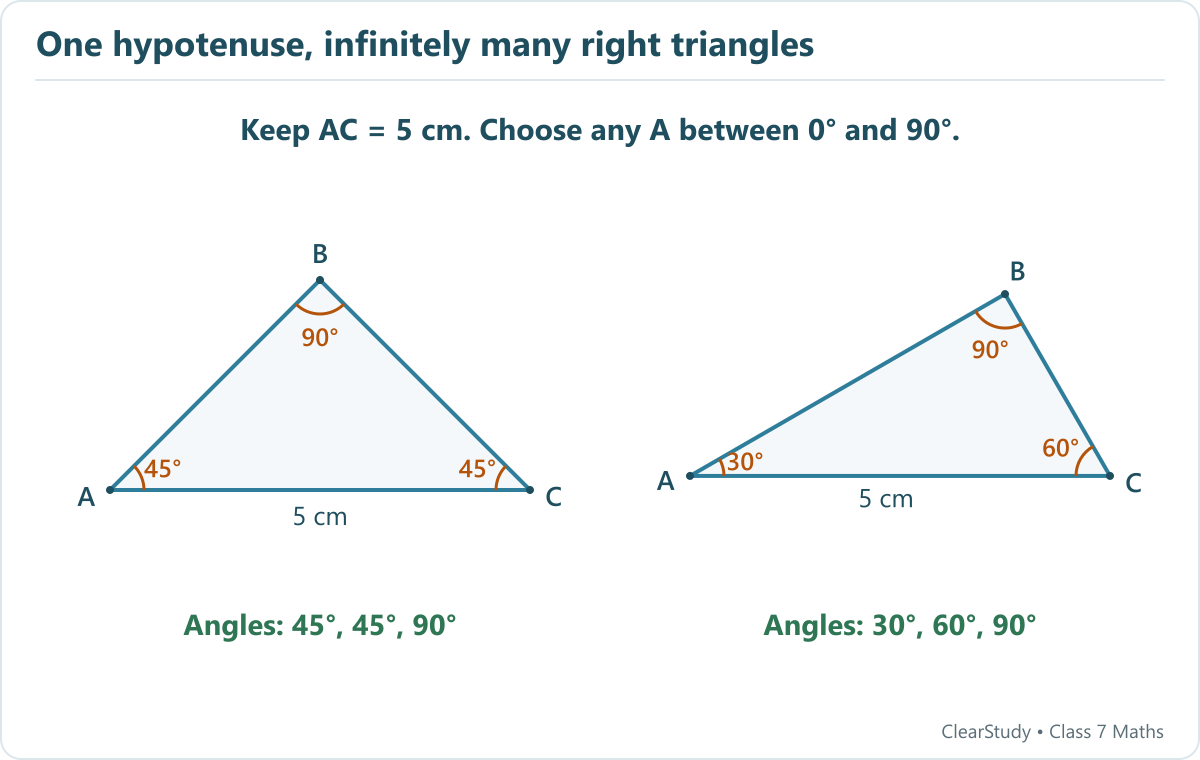
SOLUTIONDraw AC=5 cm. Choose any angle A strictly between 0° and 90°. Set C=90°−A. Construct these angles at A and C on the same side of AC; their rays meet at B.Then B=180°−(A+C)=90°. Examples are A=C=45°, or A=30° and C=60°. Since infinitely many choices of A are available, there are infinitely many right triangles with these measurements.This follows the textbook’s two-angle construction method. Only the hypotenuse and the right angle are fixed; the other sides and angles can vary.
Two examples with AC=5 cm and B=90°: choose A=C=45°, or choose A=30° and C=60°. Every choice 0°<A<90°, with C=90°−A, gives a construction.
4. Through construction, explore if it is possible to construct an equilateral triangle that is (i) right-angled (ii) obtuse-angled. Also construct an isosceles triangle that is (i) right-angled (ii) obtuse-angled.
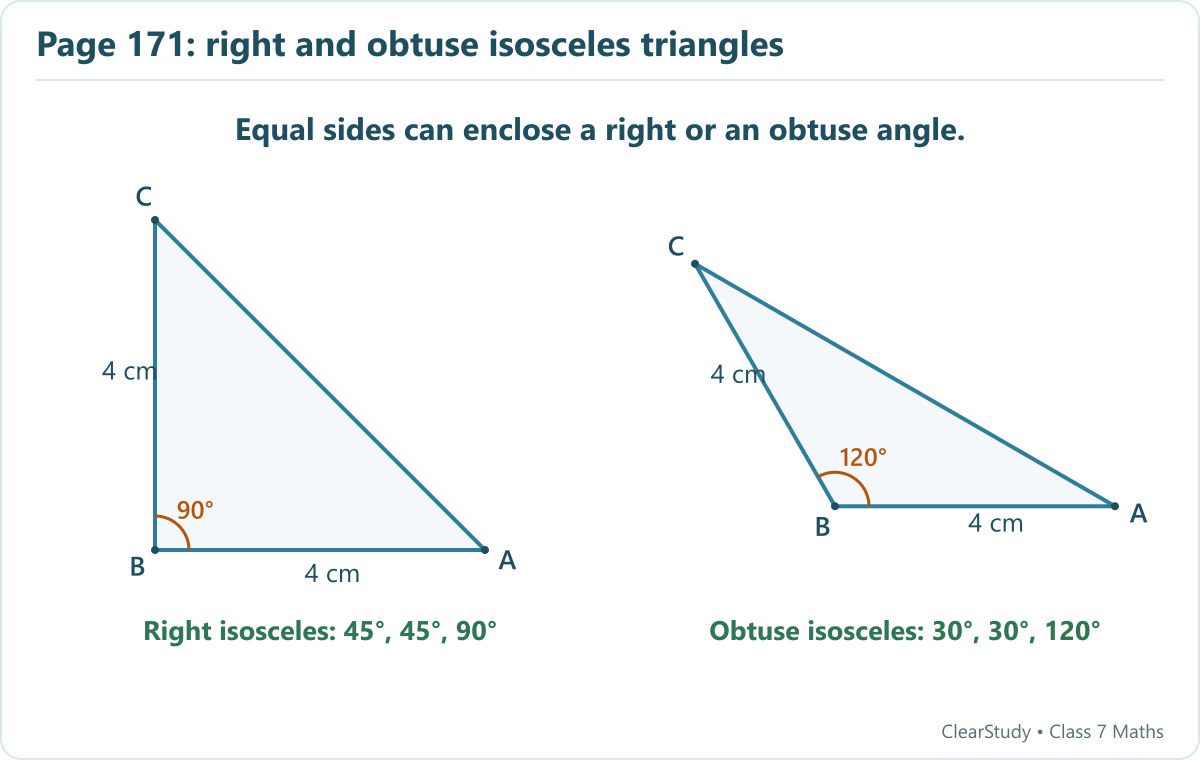
SOLUTIONEquilateral, right-angled:Not possible. An equilateral triangle has all angles 60°, so it can never contain a 90° angle.Equilateral, obtuse-angled:Not possible. All angles are 60° (acute), so there is no obtuse angle. (Every equilateral triangle is acute-angled.)Isosceles, right-angled:Possible. Take the two equal sides at right angles, e.g. legs of 4 cm each meeting at 90°; the two base angles are 45° each. Construction: draw a 90° angle at B, mark BA = BC = 4 cm, join AC — an isosceles right triangle.Isosceles, obtuse-angled:Possible. Take the included angle obtuse, e.g. two equal sides of 4 cm with a 120° angle between them; the two base angles are 30° each. Construction: draw ∠B = 120°, mark BA = BC = 4 cm, join AC — an isosceles obtuse triangle.
Two equal sides of 4 cm can enclose 90° or 120°. The corresponding base angles are 45° each or 30° each. Equilateral triangles, by contrast, have three 60° angles.
Math Talk & Try This — Answered
These are the in-text reflective and short tasks in the chapter; the determinate ones are answered, the open exploratory ones are guided.
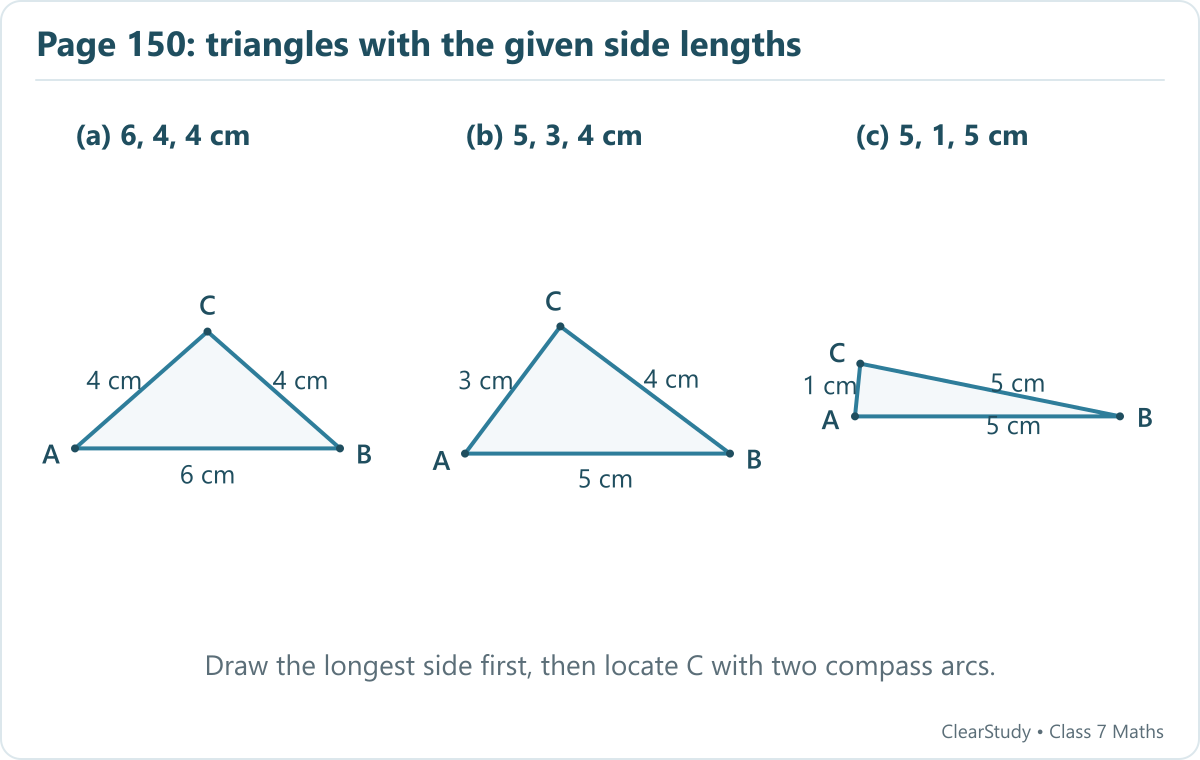
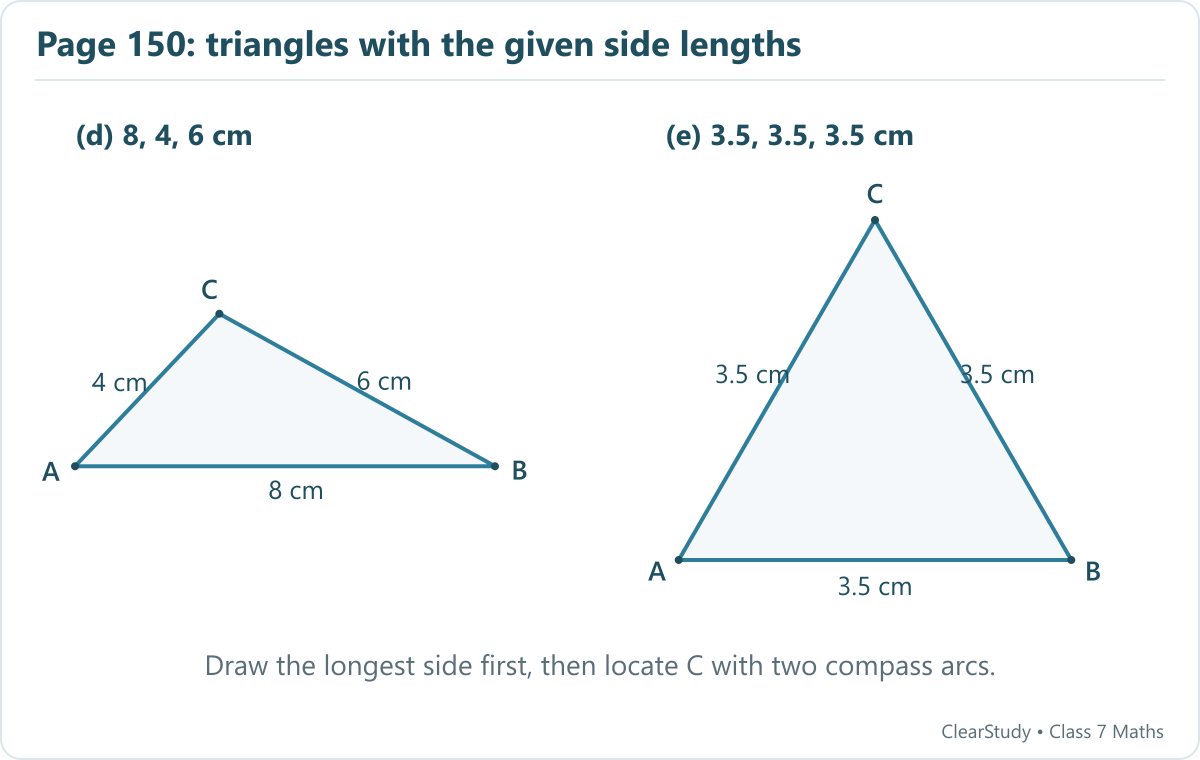
Try This (p. 150) — Construct triangles of given sidelengthsConstruct triangles having the following sidelengths (all the units are in cm): (a) 4, 4, 6 (b) 3, 4, 5 (c) 1, 5, 5 (d) 4, 6, 8 (e) 3.5, 3.5, 3.5.Answer. Each set satisfies the triangle inequality, so all five can be built with the “base + two arcs” method: 4,4,6 (isosceles), 3,4,5 (scalene, right-angled), 1,5,5 (isosceles), 4,6,8 (scalene), 3.5,3.5,3.5 (equilateral). Method for each: draw the longest side as base, then strike two arcs of the remaining lengths from its ends; their intersection is the third vertex. Quick checks — 6<4+4, 5<3+4, 5<1+5, 8<4+6, 3.5<3.5+3.5 — all hold.
Scaled examples for parts a, b and c: 4,4,6; 3,4,5; and 1,5,5. Each satisfies the strict triangle inequality.Scaled examples for parts d and e: 4,6,8 and 3.5,3.5,3.5. Each satisfies the strict triangle inequality.
Math Talk (p. 153) — Impossible lengths & rearrangingTry to find more sets of lengths for which a triangle construction is impossible. See if you can find any pattern. Also: in the rough diagram, is it possible to assign lengths in a different order so the direct paths always come out shorter than the roundabout paths?Answer. A triangle is impossible whenever one length is greater than (or equal to) the sum of the other two — e.g. 1,2,5 / 2,2,10 / 3,3,7. Rearranging the order does not help: the comparison that fails always involves the longest length, and rewriting the same three numbers in another order leaves the longest one still larger than the other two added together. So no reassignment can make all three direct paths shorter.
Try This (p. 153) — 3 cm, 3 cm, 7 cmCan we say anything about the existence of a triangle having sidelengths 3 cm, 3 cm and 7 cm? Verify by construction.Answer. Longest = 7, and 3 + 3 = 6. Since 7 > 6, the triangle inequality fails → no triangle exists. By construction, arcs of radius 3 cm from the two ends of a 7 cm base never meet (the circles fall short of each other), confirming it.
Try This (p. 154) — At least two comparisons holdFor any set of lengths, will there be at least two comparisons where the direct length is less than the sum of the other two? Can you identify which lengths are immediately less than the sum of the other two, without calculation?Answer. Yes — the two smaller lengths are always less than the sum of the other two, because each is no greater than the largest length, and adding another positive length makes the right-hand side strictly greater. So the only comparison that can ever fail is the one for the longest length. (Order the lengths increasingly; the smallest two pass automatically.)
Math Talk (p. 155) — Why check only the longest sideDoes a triangle exist with sidelengths 4 cm, 5 cm and 8 cm? Why don’t we need to check the other two sides?Answer. 8 < 4 + 5 = 9, so the longest side passes the test. The other two checks (4 < 5 + 8 and 5 < 4 + 8) involve smaller lengths and are automatically true, so checking the longest side alone is enough. A triangle with sides 4, 5, 8 exists.
Try This (p. 159) — Describing all possible third lengthsDescribe all possible lengths of the third side in each case so that a triangle exists: (a) 1, 100 (b) 5, 5 (c) 3, 7.Answer. The third side x must lie strictly between the difference and the sum of the two given sides: (a) 99 < x < 101; (b) 0 < x < 10; (c) 4 < x < 10. (For (a) this matches the book’s example: all numbers strictly between 99 and 101.)
Math Talk (p. 161) — Two sides & included angle: always a triangle?Is there a combination of two sides and the included angle where a triangle is not possible?Answer. For positive side lengths and an included angle strictly between 0° and 180°, a triangle always exists. But a 0° or 180° included angle gives collinear points, and a zero side length cannot form a triangle. Thus the conditions on the measurements matter.
Math Talk (p. 163) — Two angles & included side: when impossibleDo triangles exist for every combination of two angles and their included side? Find a rule using the sum of the two angles.Answer. A triangle exists only when the sum of the two angles is less than 180°. If the sum is 180° the two arms are parallel and never meet; if it is more than 180° the arms diverge. The base length plays no part in this. (For example, with a base angle of 40°, the other angle must be less than 140°.)
Math Talk (p. 164) — Relation between the three anglesIs there a relation between any two angles and the third? What data will you track and how will you organise it?Answer. Yes — the third angle = 180° − (sum of the other two). Record the three angles of several triangles in a table (Angle 1, Angle 2, Angle 3, Sum); the Sum column is always 180°, which is the angle sum property.
Math Talk (p. 164) — Third angle and base lengthFor a set like 60° and 70° (sum < 180°) with included side 5 cm, what is the third angle? Does it change if the base is 7 cm instead?Answer. Third angle = 180° − (60° + 70°) = 50°. Changing the base from 5 cm to 7 cm scales the triangle but does not change any angle — the third angle stays 50°, since the angle sum depends only on the angles, not the side length.
Exterior angle (p. 167) — The exterior-angle relationFind ∠ACD if ∠A = 50° and ∠B = 60°. Do you see a relation between the exterior angle and the two opposite interior angles?Answer. ∠ACB = 180° − (50° + 60°) = 70°, so ∠ACD = 180° − 70° = 110°. Notice 110° = 50° + 60°: the exterior angle equals the sum of the two opposite interior angles. (Reason: ∠A + ∠B + ∠ACB = 180° and ∠ACD + ∠ACB = 180°, so ∠ACD = ∠A + ∠B.)
Extending BC to D gives exterior angle ACD=110°. It equals angles A+B=50°+60° and is supplementary to the 70° interior angle at C.
Math Talk (p. 170) — Defining an acute-angled triangleCan we define an acute-angled triangle as a triangle with one acute angle? Why not?Answer. No — every triangle has at least two acute angles (since the angles add to 180°), so “one acute angle” would describe right and obtuse triangles too. An acute-angled triangle must have all three angles acute (each less than 90°).
Try This (p. 169) — A side that is also an altitudeDoes there exist a triangle in which a side is also an altitude? Visualise it.Answer. Yes — in a right-angled triangle. If ∠B = 90°, then side BA is perpendicular to base BC, so BA is itself the altitude from A to BC (the foot of the perpendicular is B). The two legs of a right triangle are altitudes to each other.
Circle cases and a complete existence test — page 159Take the longest length as base and the smaller two as compass radii. Touching examples: (1,2,3), (2,3,5), (3,6,9). In each, the smaller lengths add exactly to the base, so there is no triangle.Separated examples: (1,2,4), (2,3,6), (3,4,8). The radii add to less than the base, so the circles cannot meet.Procedure: first check that all lengths are positive and use the same unit. Arrange them as a≤b≤c. A triangle exists exactly when a+b>c.
Paper-folding an altitude — page 168Fold a paper triangle so that the crease passes through the chosen vertex and the base lies exactly over itself. Reflection in the crease sends the base to itself, so the crease is perpendicular to the base. It therefore marks the altitude. For an altitude outside the triangle, draw on a larger sheet and extend the base first.
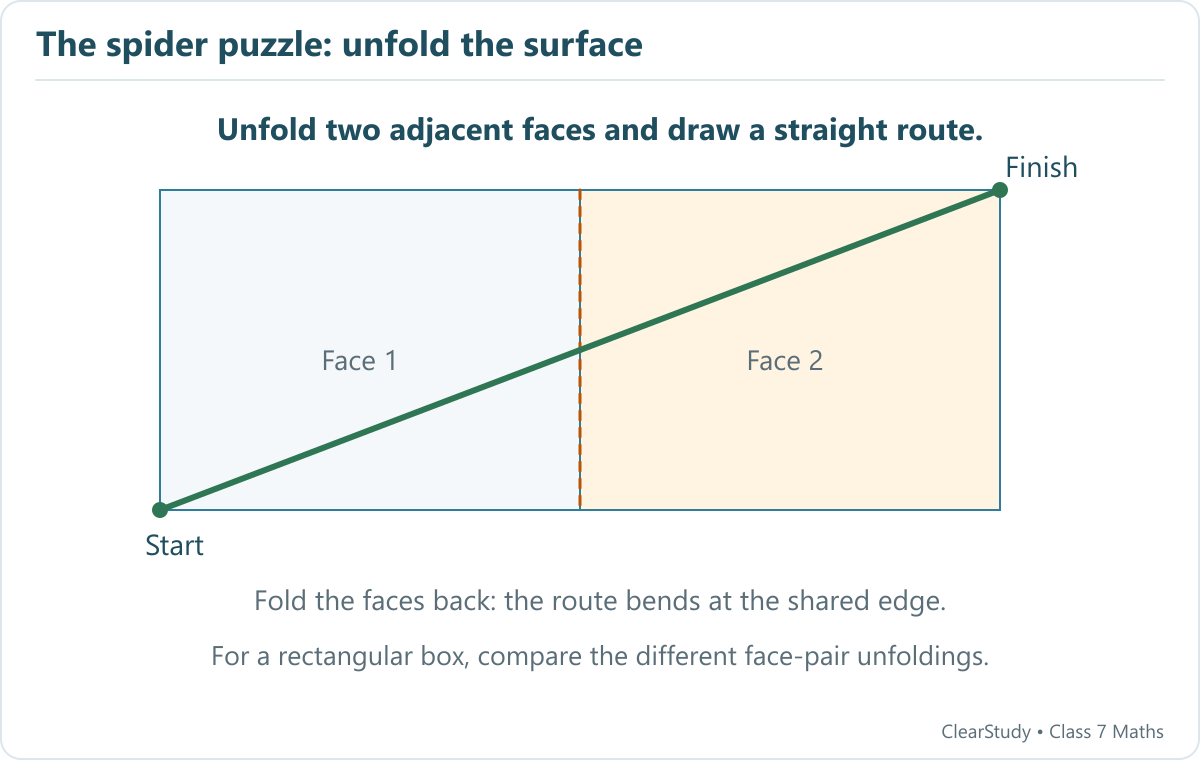
Shortest path in a box — page 172Unfold adjacent faces onto a plane. A straight line between the marked corners is the shortest route across that unfolded pair. Draw it, then fold the box back to trace the surface path.For a rectangular box, compare the different possible face-pair unfoldings and choose the shortest valid straight route. The book supplies no lengths, so a numerical answer is not determined. For a cube, equivalent unfoldings give equal shortest routes.
An unfolded pair of adjacent faces turns the surface route between opposite corners into a straight segment. Compare possible face-pair unfoldings for a rectangular box; no box dimensions are specified.
Common Mistakes to Avoid
Watch out for these
Forgetting that the triangle inequality must be strict — when the longest side equals the sum of the other two (e.g. 3, 6, 9), the points lie in a line and no triangle forms.
Checking all three inequalities when one is enough — just confirm the longest side < sum of the other two.
In “two angles + included side”, ignoring the rule that the two angles must add to less than 180°; thinking the base length affects existence (it does not).
Mixing up included angle (between two sides) and included side (between two angles).
Assuming the foot of an altitude is always inside the triangle — in an obtuse triangle, two altitudes meet extensions of the opposite sides, while the altitude from the obtuse vertex meets the opposite side itself.
Saying the exterior angle equals one interior angle — it equals the sum of the two opposite (interior) angles.
Thinking an equilateral triangle can be right- or obtuse-angled — all its angles are 60°, so it is always acute-angled.
For each Assertion–Reason question, choose: (A) Both Assertion and Reason are true and the Reason is the correct explanation of the Assertion; (B) Both are true but the Reason is not the correct explanation; (C) Assertion is true but Reason is false; (D) Assertion is false but Reason is true.
A-R 1. Assertion: A triangle cannot be formed with sidelengths 3 cm, 4 cm and 8 cm.
Reason: For a triangle, each side must be less than the sum of the other two, but 8 > 3 + 4.
A-R 2. Assertion: A triangle with angles 90°, 60° and 30° exists.
Reason: Any three positive angles whose sum is 180° can be the angles of a triangle.
A-R 3. Assertion: An equilateral triangle can be right-angled.
Reason: Each angle of an equilateral triangle measures 60°.
A-R 4. Assertion: The exterior angle of a triangle equals the sum of the two opposite interior angles.
Reason: Both the exterior-plus-adjacent pair and the three interior angles sum to 180°, so subtracting the adjacent interior angle gives the result.
A-R 5. Assertion: Two angles 35° and 150° cannot be the angles of a triangle.
Reason: Their sum 185° is greater than 180°.
Answer key: 1-(A), 2-(A), 3-(D), 4-(A), 5-(A).
Quick Revision Summary
A triangle has three vertices and three sides; it can be named by its vertices in any order.
Using a compass makes triangle construction efficient: take the longest length as base, then strike arcs for the other two lengths.
Triangle inequality: a triangle exists iff each side < sum of the other two — it is enough to check the longest side.
For two positive sides and an included angle between 0° and 180°, a triangle exists. For two positive angles and a positive included side, their angle sum must be less than 180°.
Angle sum property: the three angles of a triangle add up to 180°; third angle = 180° − (other two).
An exterior angle = 180° − adjacent interior angle = sum of the two opposite interior angles.
An altitude is the perpendicular from a vertex to the opposite side; in obtuse triangles its foot may lie on the side’s extension.
By sides: equilateral, isosceles, scalene. By angles: acute-, right- and obtuse-angled.
How to score full marks in this chapter
For existence questions, write the triangle-inequality check explicitly — compare the longest side with the sum of the other two and state your conclusion. In constructions, list clear numbered steps and name the tool used (compass for sidelengths, protractor for angles, set square for altitudes). For angle problems, quote the angle sum property (sum = 180°) or the exterior-angle rule before substituting, and always show the subtraction. Remember the boundary cases: equality in the triangle inequality (no triangle) and angle sum equal to 180° (lines parallel, no triangle).
Frequently Asked Questions
What is Class 7 Maths Ganita Prakash Chapter 7 about?
Chapter 7, A Tale of Three Intersecting Lines, is about triangles: constructing them with a compass, the triangle inequality, constructing triangles from two sides and the included angle or two angles and the included side, the angle sum property, exterior angles, altitudes, and the classification of triangles by sides and by angles.
What is the triangle inequality in Class 7 Maths?
The triangle inequality says a triangle can be formed from three lengths only if each length is less than the sum of the other two. In practice you just check that the longest length is less than the sum of the other two — if it is not, no triangle exists.
How many Figure it Out exercises are in Chapter 7?
There are nine “Figure it Out” sets in the chapter (on pages 150–151, 154, 156, 159, 161, 162, 163, 165 and 170–171), plus several Math Talk and Try This tasks. All of them are solved step by step on this page.
Are these Class 7 Maths Ganita Prakash Chapter 7 solutions free?
Yes. All solutions are free and follow the official NCERT Ganita Prakash (Part I) textbook for the 2026–27 session, with every answer worked out and verified.