Class 7 Maths Ganita Prakash Chapter 11 Solutions (NCERT 2026–27) – Finding Common Ground
These Class 7 Maths Ganita Prakash Chapter 11 solutions cover Finding Common Ground — Chapter 3 of Ganita Prakash Part II (the eleventh chapter in the continuous Class 7 sequence). Every Figure it Out question, Math Talk and Try This task is reproduced and solved step by step, with full prime factorisation working for the HCF and LCM, so you can master the chapter and revise it quickly.
Class: 7Subject: MathematicsBook: Ganita Prakash (Part II)Chapter: 11 (Part II, Ch 3)Exercises: Figure it Out (pp. 51, 53, 54, 58, 59, 63–64)Session: 2026–27
Chapter 11 of Ganita Prakash, Finding Common Ground (Part II, Chapter 3), uses everyday stories — Sameeksha tiling a floor, Lekhana packing rice, Anshu and Guna stitching torans — to build two big ideas: the Highest Common Factor (HCF) and the Lowest Common Multiple (LCM). The chapter first revisits primes and prime factorisation and the neat division method, then shows how every factor of a number is a “subpart” of its prime factorisation. Using this, it gives reliable methods to find the HCF (take the minimum power of each common prime) and the LCM (take the maximum power of every prime), an efficient combined division procedure, and the lovely property HCF × LCM = product of the two numbers. The Class 7 Maths Ganita Prakash Chapter 11 solutions below work through every Figure it Out, Math Talk and Try This question step by step.
Key Concepts & Definitions
Unless stated otherwise, the HCF, LCM and factor rules on this page concern positive whole numbers. The LCM is the least positive common multiple.
Prime number: a number greater than 1 whose only factors are 1 and itself, e.g. 2, 3, 5, 7, 11, …
Prime factorisation: writing a number as a product of primes, e.g. 90 = 2 × 3 × 3 × 5. The prime factors of a number are always the same (only the order can differ).
Factor as a subpart: every factor of a number is the product of some of the primes in its prime factorisation; combining all such subparts (and 1) lists every factor.
Highest Common Factor (HCF): the greatest of the common factors of two or more numbers — also called the Greatest Common Divisor (GCD).
Lowest Common Multiple (LCM): the smallest positive common multiple of two or more numbers.
Co-prime numbers: numbers whose only common factor is 1, i.e. their HCF is 1 (e.g. 7 and 11).
Conjecture: a statement made without proof. A single counterexample is enough to disprove it.
Generalisation: a general statement describing a pattern that holds in all cases, often written compactly using algebra.
Important Formulas & Patterns (Chapter 11)
HCF by prime factorisation: for each prime common to the numbers, take the minimum number of times it occurs; multiply these together.
LCM by prime factorisation: for every prime appearing in any number, take the maximum number of times it occurs; multiply these together.
Key relation: HCF × LCM = product of the two numbers (for two numbers a and b).
One divides the other: if a is a factor of b, then HCF(a, b) = a and LCM(a, b) = b.
Co-prime numbers: HCF = 1 and LCM = a × b.
Doubling: if both numbers are doubled, their HCF (and LCM) also doubles.
Common multiplier: HCF(k × p, k × q) = k × HCF(p, q); it equals k exactly when p and q are co-prime.
Figure it Out — Factors from Prime Factorisation (Page 51)
List all the factors of the following numbers:
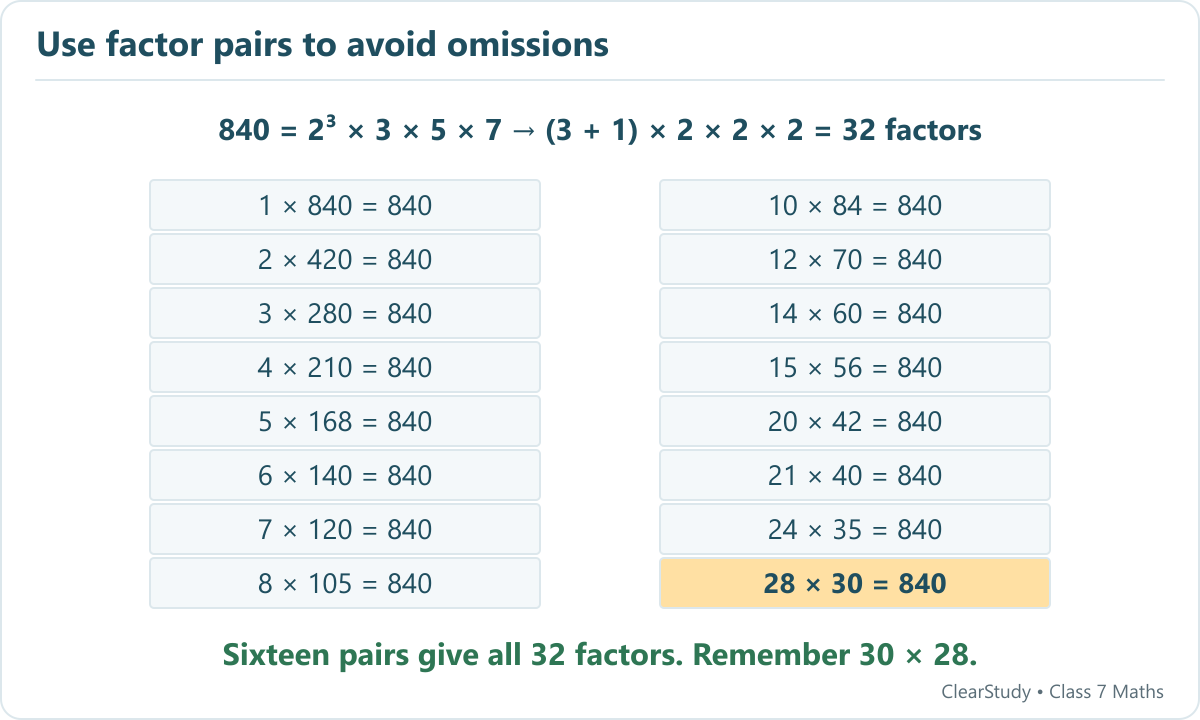
(a) 90 (b) 105 (c) 132 (d) 360 (this number has 24 factors) (e) 840 (this number has 32 factors)
The sixteen factor pairs of 840 give thirty-two distinct factors. The pair 28 and 30 was incomplete in the earlier list; both must be included.
Figure it Out — Common Factors & HCF (Page 53)
Find the common factors and the HCF of the following numbers:
(a) 50, 60 (b) 140, 275 (c) 77, 725 (d) 370, 592 (e) 81, 243
SOLUTION(a) 50 = 2 × 5 × 5; 60 = 2 × 2 × 3 × 5. Common primes: one 2, one 5. Common factors: 1, 2, 5, 10; HCF = 2 × 5 = 10.(b) 140 = 2 × 2 × 5 × 7; 275 = 5 × 5 × 11. Common prime: one 5. Common factors: 1, 5; HCF = 5.(c) 77 = 7 × 11; 725 = 5 × 5 × 29. No common prime. Common factor: 1; HCF = 1 (they are co-prime).(d) 370 = 2 × 5 × 37; 592 = 2 × 2 × 2 × 2 × 37. Common primes: one 2, one 37. Common factors: 1, 2, 37, 74; HCF = 2 × 37 = 74.(e) 81 = 3 × 3 × 3 × 3; 243 = 3 × 3 × 3 × 3 × 3. Common: four 3s. Common factors: 1, 3, 9, 27, 81; HCF = 34 = 81.
Figure it Out — Finding the HCF Directly (Page 54)
1. Find the HCF of the following numbers:
(a) 24, 180 (b) 42, 75, 24 (c) 240, 378 (d) 400, 2500 (e) 300, 800
SOLUTIONFor the HCF, take each common prime to its minimum power.(a) 24 = 23 × 3; 180 = 22 × 32 × 5. Common: 22, 3. HCF = 2 × 2 × 3 = 12.(b) 42 = 2 × 3 × 7; 75 = 3 × 52; 24 = 23 × 3. The only prime common to all three is 3. HCF = 3.(c) 240 = 24 × 3 × 5; 378 = 2 × 33 × 7. Common: one 2, one 3. HCF = 2 × 3 = 6.(d) 400 = 24 × 52; 2500 = 22 × 54. Common: 22, 52. HCF = 4 × 25 = 100.(e) 300 = 22 × 3 × 52; 800 = 25 × 52. Common: 22, 52. HCF = 4 × 25 = 100.
2. Consider the numbers 72 and 144. Suppose they are factorised into composite numbers as: 72 = 6 × 12 and 144 = 8 × 18. Seeing this, can one say that these two numbers have no common factor other than 1? Why not?
SOLUTIONNo. Writing a number as a product of two composite numbers (6 × 12, 8 × 18) does not show its prime factors, so merely comparing the displayed composite factors can hide common prime factors.In fact 72 = 23 × 32 and 144 = 24 × 32, so the common primes are 23 and 32, giving HCF = 8 × 9 = 72. (Indeed 144 = 72 × 2, so 72 itself is a common factor.) The two numbers share many common factors, not just 1.
Figure it Out — LCM by Prime Factorisation (Page 58)
Find the LCM of the following numbers:
(a) 30, 72 (b) 36, 54 (c) 105, 195, 65 (d) 222, 370
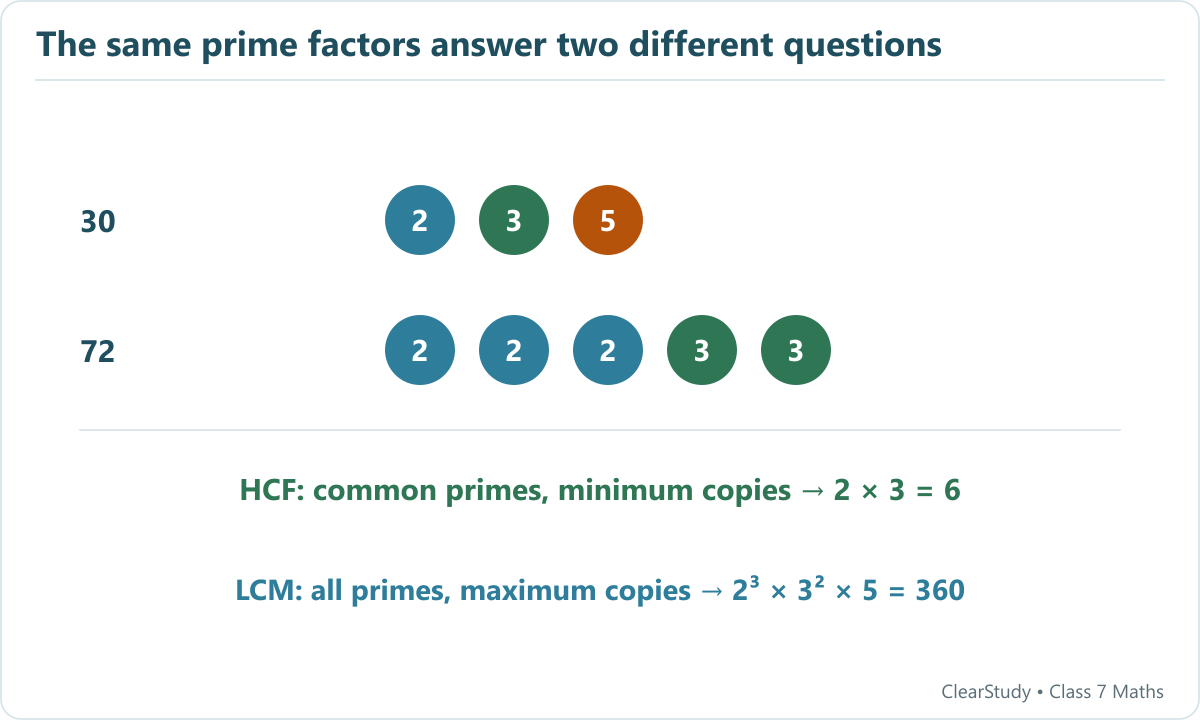
SOLUTIONFor the LCM, take every prime to its maximum power across the numbers.(a) 30 = 2 × 3 × 5; 72 = 23 × 32. Take 23, 32, 5. LCM = 8 × 9 × 5 = 360.(b) 36 = 22 × 32; 54 = 2 × 33. Take 22, 33. LCM = 4 × 27 = 108.(c) 105 = 3 × 5 × 7; 195 = 3 × 5 × 13; 65 = 5 × 13. Take 3, 5, 7, 13. LCM = 3 × 5 × 7 × 13 = 1365.(d) 222 = 2 × 3 × 37; 370 = 2 × 5 × 37. Take 2, 3, 5, 37. LCM = 2 × 3 × 5 × 37 = 1110.
For 30=2×3×5 and 72=2³×3², the HCF takes the minimum common powers, giving 6. The LCM takes the maximum powers of all primes, giving 360.
Figure it Out — General Statements on HCF & LCM (Page 59)
1. Make a general statement about the HCF for the following pairs of numbers. You could consider examples before coming up with general statements. Look for possible explanations of why they hold.
(a) Two consecutive even numbers(b) Two consecutive odd numbers(c) Two even numbers(d) Two consecutive numbers(e) Two co-prime numbers
SOLUTION(a) HCF = 2. Consecutive even numbers like 6 and 8, or 14 and 16, are both multiples of 2 but differ by 2, so their common factors are 1 and 2, and the greatest is 2.(b) HCF = 1. Consecutive odd numbers (e.g. 9 and 11) differ by 2; any common factor would divide their difference 2, but both are odd, so the common factor must be 1.(c) HCF is even (at least 2). Both numbers contain a factor of 2, so 2 always divides both; the HCF could be larger (e.g. 12 and 18 give HCF 6).(d) HCF = 1. Two consecutive numbers differ by 1, so any common factor divides 1 — meaning they are always co-prime (e.g. 14 and 15).(e) HCF = 1 — this is the definition of co-prime numbers (e.g. 8 and 9, 7 and 11).
2. The LCM of 3 and 24 is 24 (it is one of the two given numbers).
(a) Find more such number pairs where the LCM is one of the two numbers.(b) Make a general statement about such numbers. Describe such number pairs using algebra.
SOLUTION(a) For example: 5 and 30 (LCM 30), 4 and 12 (LCM 12), 7 and 7 (LCM 7), 9 and 45 (LCM 45).(b) The LCM is one of the numbers exactly when one number is a factor of (divides) the other. In algebra, the pair can be written as n and m×n (n is a factor of mn), and then LCM = mn, the larger number.
3. Make a general statement about the LCM for the following pairs of numbers. You could consider examples before coming up with these general statements. Look for possible explanations of why they hold.
(a) Two multiples of 3(b) Two consecutive even numbers(c) Two consecutive numbers(d) Two co-prime numbers
SOLUTION(a) The LCM is a multiple of 3. Each number has 3 as a factor, so 3 is a factor of the LCM too (e.g. LCM of 9 and 12 is 36).(b) Their HCF is 2, so LCM = (product) ÷ 2; for 2k and 2(k+1) this is 2k(k+1) (e.g. 6 and 8 give 24).(c) Consecutive numbers are co-prime (HCF 1), so LCM = product of the two numbers (e.g. LCM of 8 and 9 is 72).(d) For co-prime numbers HCF = 1, so LCM = product of the two numbers (e.g. LCM of 7 and 11 is 77).
Figure it Out — Mixed HCF & LCM Problems (Page 63–64)
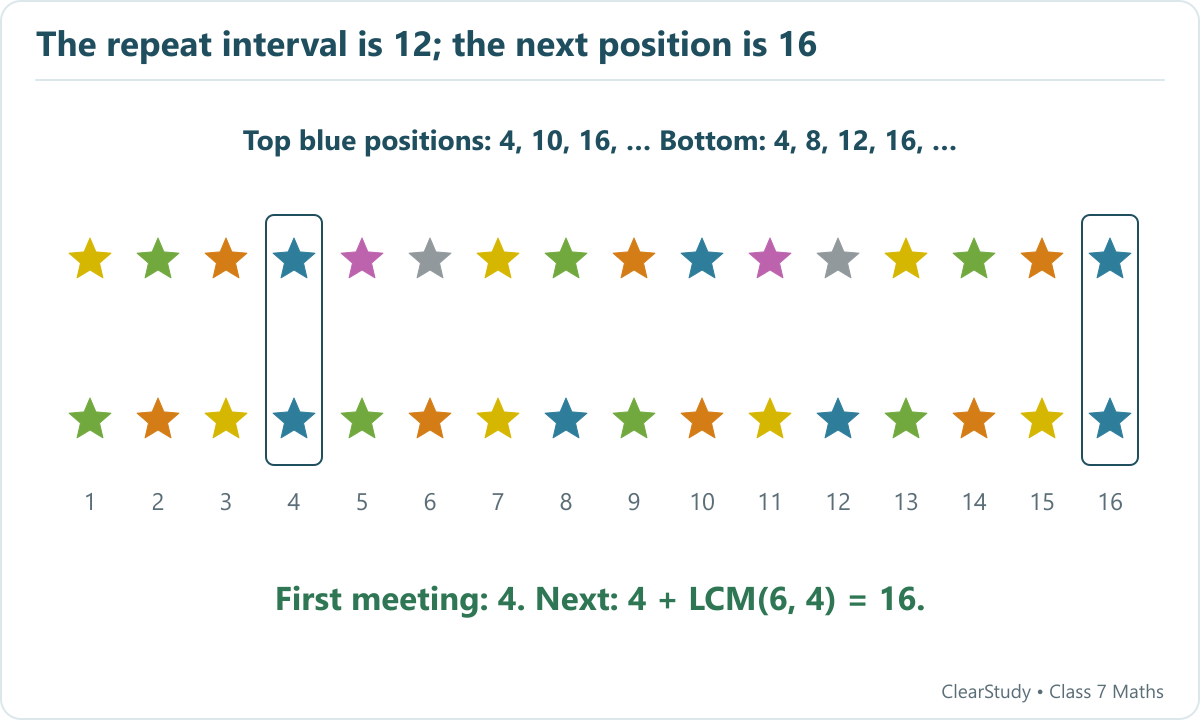
1. In the two rows below, colours repeat as shown. When will the blue stars meet next?
SOLUTIONThe top row repeats every 6 stars: yellow, green, orange, blue, purple, grey. Its blue stars are at positions 4, 10, 16, 22, …. The bottom row repeats every 4 stars, with blue at 4, 8, 12, 16, ….They first align at position 4. Their next alignment is LCM(6, 4) = 12 positions later, at 4 + 12 = position 16. The number 12 is the interval between meetings, not the next position in the displayed rows.
The top colour cycle has six stars and the bottom cycle four. Blue first aligns at position 4, so the next alignment is twelve positions later, at position 16.
2. (a) Is 5 × 7 × 11 × 11 a multiple of 5 × 7 × 7 × 11 × 2?
(b) Is 5 × 7 × 11 × 11 a factor of 5 × 7 × 7 × 11 × 2?
SOLUTIONLet A = 5 × 7 × 11 × 11 (two 11s, one 7, no 2) and B = 5 × 7 × 7 × 11 × 2 (two 7s, one 11, one 2).(a) For A to be a multiple of B, B must divide A. But B needs two 7s and a 2, which A does not have. No, A is not a multiple of B.(b) For A to be a factor of B, A must divide B. But A needs two 11s, while B has only one 11. No, A is not a factor of B.
3. Find the HCF and LCM of the following (state your answers in the form of prime factorisations):
(a) 3 × 3 × 5 × 7 × 7 and 12 × 7 × 11(b) 45 and 36
SOLUTIONSince HCF = 1, the numbers are co-prime, so HCF × LCM = product gives product = 1 × 66 = 66.Split 66 = 2 × 3 × 11 into two co-prime parts: e.g. 6 and 11 (6 = 2 × 3, 11 prime). Check: HCF(6, 11) = 1 and LCM(6, 11) = 66. ✓Other valid answers: 2 and 33, or 3 and 22, or 1 and 66.
5. A cowherd took all his cows to graze in the fields. The cows came to a crossing with 3 gates. An equal number of cows passed through each gate. Later at another crossing with 5 gates again an equal number of cows passed through each gate. The same happened at the third crossing with 7 gates. If the cowherd had less than 200 cows, how many cows did he have? (Based on the folklore mathematics from Karnataka.)
SOLUTIONThe number of cows must be exactly divisible by 3, by 5 and by 7, so it is a common multiple of 3, 5 and 7.LCM(3, 5, 7) = 3 × 5 × 7 = 105. The next common multiple is 210, which is more than 200.∴ the cowherd had 105 cows.
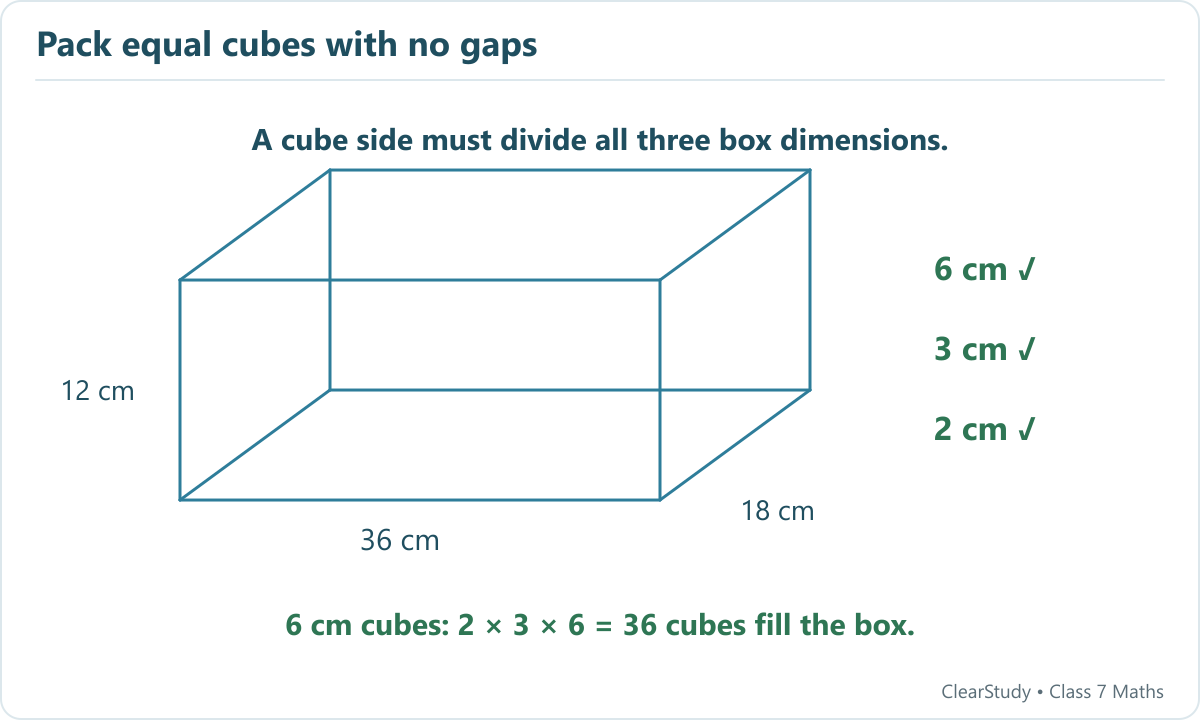
6. The length, width, and height of a box are 12 cm, 18 cm, and 36 cm respectively. Which of the following sized cubes can be packed in this box without leaving gaps?
(a) 9 cm (b) 6 cm (c) 4 cm (d) 3 cm (e) 2 cm
SOLUTIONA cube fits with no gaps only if its edge divides each of 12, 18 and 36 — i.e. the edge is a common factor of all three.12 = 22 × 3, 18 = 2 × 32, 36 = 22 × 32. Common factors of all three: 1, 2, 3, 6 (HCF = 6).Check: (a) 9 – does not divide 12 → no; (b) 6 – divides all → yes; (c) 4 – does not divide 18 → no; (d) 3 – divides all → yes; (e) 2 – divides all → yes.∴ cubes of 6 cm, 3 cm and 2 cm can be packed without gaps.
A box with dimensions 12,18,36 cm accepts cube sides 6,3 and 2 cm from the options. Sides 9 and 4 cm do not divide every dimension. With side 6 cm, 2×3×6=36 cubes fill it. Box sketch is schematic.
7. Among the numbers below, which is the largest number that perfectly divides both 306 and 36?
(a) 36 (b) 612 (c) 18 (d) 3 (e) 2 (f) 360
SOLUTIONThe largest number dividing both is their HCF. 306 = 2 × 32 × 17; 36 = 22 × 32. Common: one 2, 32.HCF = 2 × 3 × 3 = 18. ∴ the answer is (c) 18.
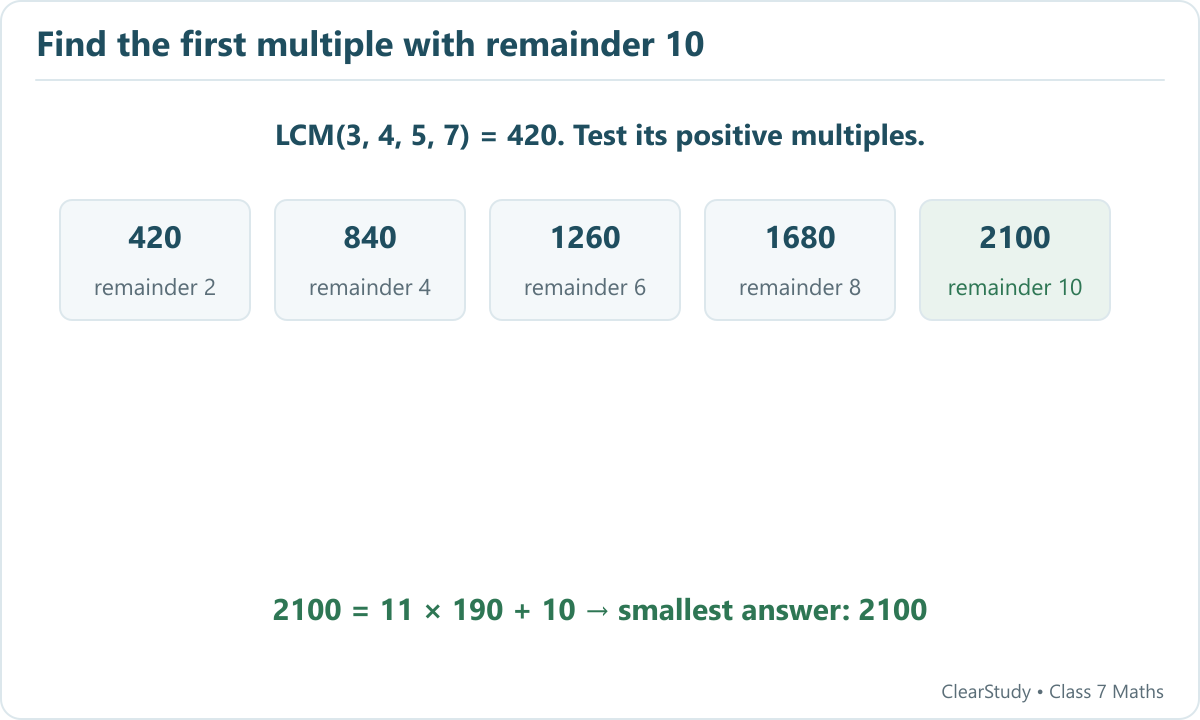
8. Find the smallest number that is divisible by 3, 4, 5 and 7, but leaves a remainder of 10 when divided by 11.
SOLUTIONThe number must be a positive multiple of LCM(3,4,5,7) = 420. Test these multiples in increasing order:420 = 11 × 38 + 2; 840 = 11 × 76 + 4; 1260 = 11 × 114 + 6; 1680 = 11 × 152 + 8; 2100 = 11 × 190 + 10.The first remainder 10 occurs at 2100, so this is the smallest required number.
The positive multiples of 420 have remainders 2, 4, 6, 8, 10 on division by 11. The first remainder 10 occurs at 2100.
9. Children are playing ‘Fire in the Mountain’. When the number 6 was called out, no one got out. When the number 9 was called out, no one got out. But when the number 10 was called out, some people got out. How many children could have been playing initially?
(a) 72 (b) 90 (c) 45 (d) 3 (e) 36 (f) None of these
SOLUTION“No one got out” for 6 and 9 means the total splits exactly into groups of 6 and of 9 — the total is divisible by both 6 and 9, i.e. by LCM(6, 9) = 18. “Some got out” for 10 means the total is not divisible by 10.(a) 72 = 18 × 4, not divisible by 10 → valid. (b) 90 = 18 × 5 but 90 is divisible by 10 → invalid. (c) 45 not divisible by 6 → invalid. (d) 3 not divisible by 6 or 9 → invalid. (e) 36 = 18 × 2, not divisible by 10 → valid.∴ the possible numbers are (a) 72 and (e) 36.
10. Tick the correct statement(s). The LCM of two different prime numbers (m, n) can be:
(a) Less than both numbers(b) In between the two numbers(c) Greater than both numbers(d) Less than m × n(e) Greater than m × n
SOLUTIONTwo different primes are co-prime, so LCM(m, n) = m × n exactly.Since m, n > 1, the product m × n is greater than each of m and n. So it is greater than both numbers, equal to (not less than, not greater than) m × n, and never between or below them.∴ only (c) Greater than both numbers is correct.
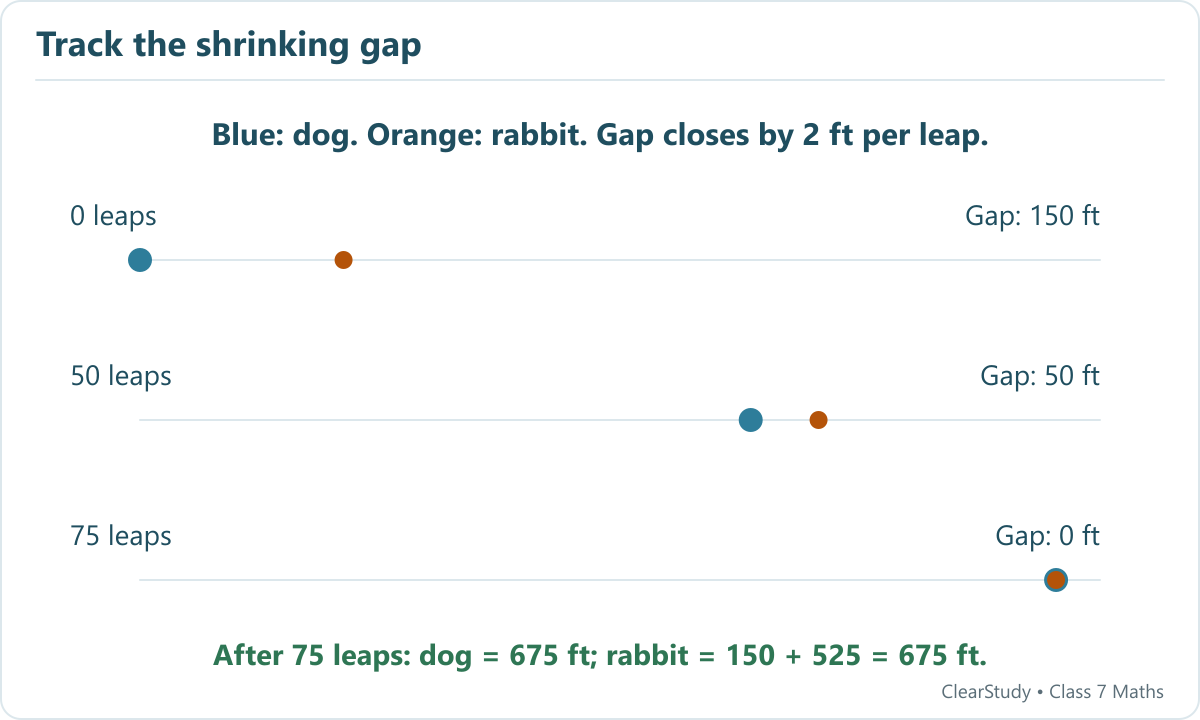
11. A dog is chasing a rabbit that has a head start of 150 feet. It jumps 9 feet every time the rabbit jumps 7 feet. In how many leaps does the dog catch up with the rabbit?
SOLUTIONIn each leap (made at the same time) the dog covers 9 ft and the rabbit covers 7 ft, so the dog gains 9 − 7 = 2 ft per leap.The gap to close is 150 ft. Number of leaps = 150 ÷ 2 = 75 leaps.
The initial gap is 150 ft. Each simultaneous pair of leaps closes 2 ft, so the dog catches the rabbit after 75 leaps at position 675 ft measured from the dog’s start.
12. What is the smallest number that is a multiple of 1, 2, 3, 4, 5, 6, 8, 9, 10? Do you remember the answer from Grade 6, Chapter 5?
SOLUTIONThe smallest such number is the LCM. Take the highest power of each prime: 23 (from 8), 32 (from 9), 5 (from 10).LCM = 8 × 9 × 5 = 360. It is divisible by every number in the list.
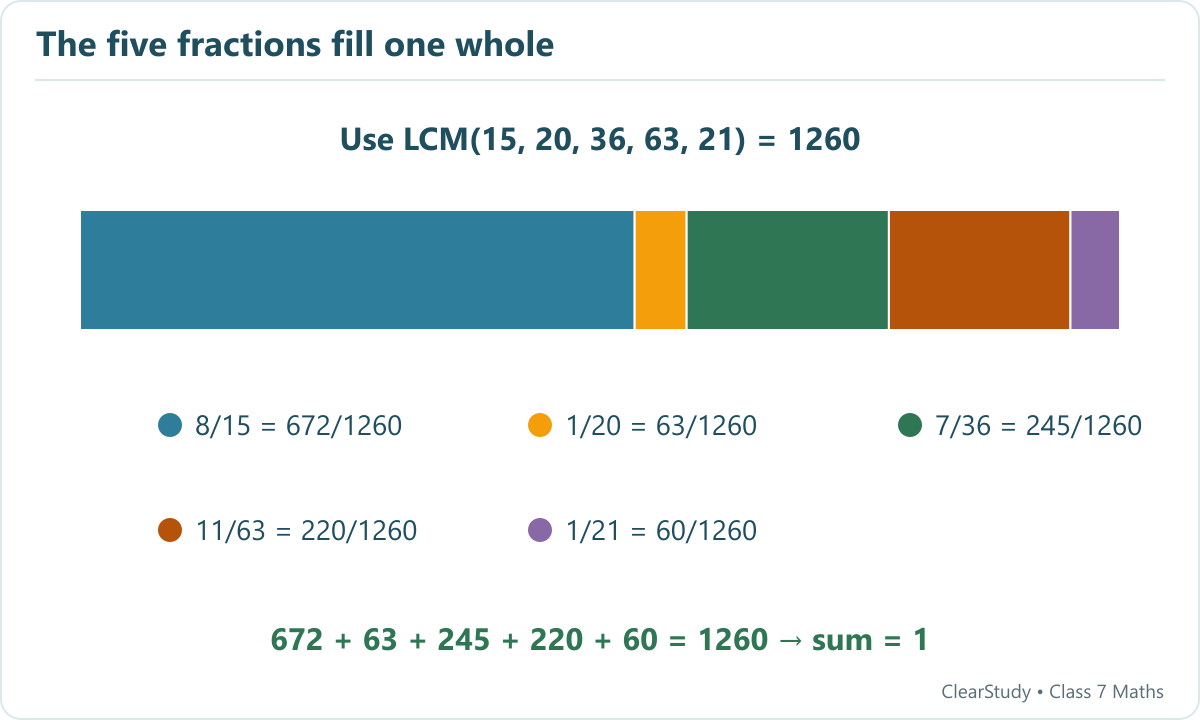
13. Here is a problem posed by the ancient Indian Mathematician Mahaviracharya (850 C.E.). Add together 8⁄15, 1⁄20, 7⁄36, 11⁄63 and 1⁄21. What do you get? How can we find this sum efficiently?
SOLUTIONUse the LCM of the denominators as a common denominator. 15 = 3×5, 20 = 22×5, 36 = 22×32, 63 = 32×7, 21 = 3×7. LCM = 22 × 32 × 5 × 7 = 1260.Convert: 8⁄15 = 672⁄1260, 1⁄20 = 63⁄1260, 7⁄36 = 245⁄1260, 11⁄63 = 220⁄1260, 1⁄21 = 60⁄1260.Sum of numerators = 672 + 63 + 245 + 220 + 60 = 1260. So the sum = 1260⁄1260 = 1. Using the LCM as the common denominator makes the addition efficient.
Converting the five fractions to denominator 1260 gives numerators 672,63,245,220,60. Their sum is 1260, so the fractions add to one. Coloured strip lengths are proportional to the fractions.
Math Talk & Try This — Answered
These are the in-text reflective and short tasks woven through the chapter; the determinate ones are answered and the open ones are guided.
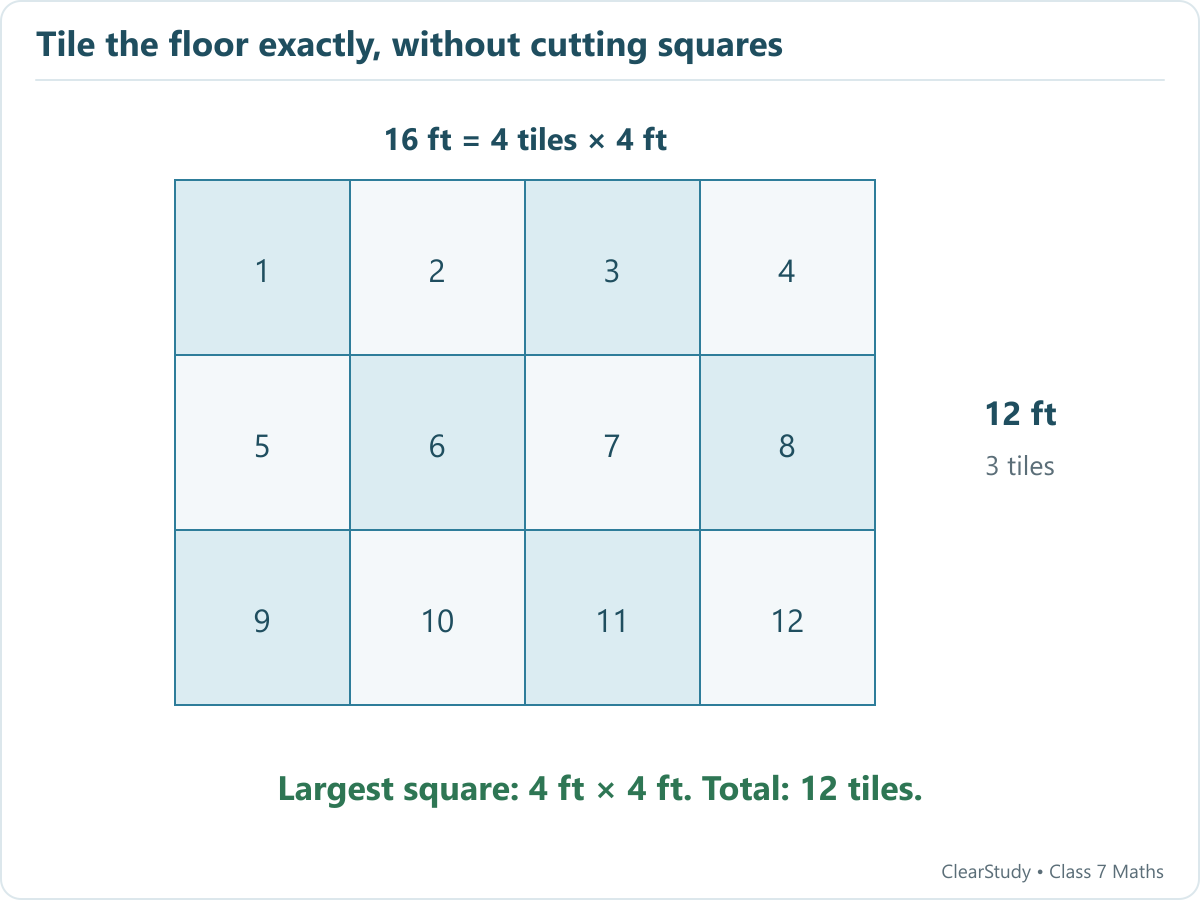
Sameeksha’s tiles — the largest tileWhat size square tile should Sameeksha buy for a 12 ft × 16 ft room, and why the largest? How many tiles are needed?Answer. The side must divide both room dimensions, 12 ft and 16 ft. HCF(12,16) = 4 ft, giving (12 ÷ 4) × (16 ÷ 4) = 12 square tiles. Allowing fractional side lengths does not change the largest tile. If the side is s feet, the numbers of tiles along the two edges, 12/s and 16/s, must both be positive integers. Their difference is 4/s, also a positive integer, so s cannot exceed 4. For example, 2/3 ft tiles fit but are smaller and require more tiles. Cutting tiles or replacing the floor with one rectangular piece would change the conditions of the problem.
A 12 ft by 16 ft rectangle fits three rows of four square tiles with side 4 ft. Twelve tiles are needed. Fractional side lengths cannot produce a larger equal square tile.
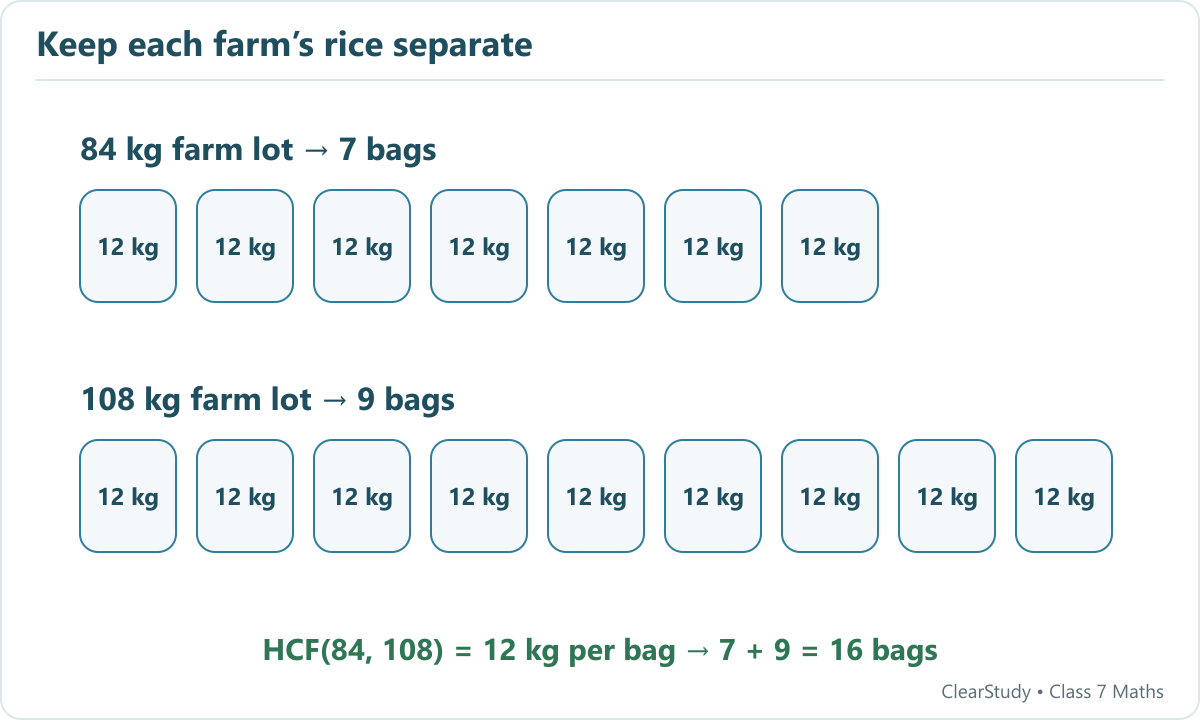
Lekhana’s rice bagsShe has 84 kg and 108 kg of rice and wants equal whole-kg bags using as few bags as possible. Which weight minimises the number of bags?Answer. The bag weight must be a common factor of 84 and 108. The largest common factor (HCF) gives the fewest bags. HCF(84, 108) = 22 × 3 = 12 kg, needing 84÷12 + 108÷12 = 7 + 9 = 16 bags in all.
The greatest equal bag weight is 12 kg. The 84 kg lot fills seven bags and the 108 kg lot fills nine bags, giving sixteen bags in all.
Math Talk — Jump Jackpot (longest jump)Find the longest jump size (starting from 0) that lands on both treasure numbers: (a) 14 and 30 (b) 7 and 11 (c) 30 and 50 (d) 28 and 42. Is it the same as their HCF?Answer. The jump size must divide both numbers, so the longest jump is their HCF. (a) HCF(14, 30) = 2; (b) HCF(7, 11) = 1; (c) HCF(30, 50) = 10; (d) HCF(28, 42) = 14. Yes — the longest jump is always the HCF, because Jumpy can land on a number only if the jump size is a factor of it.
Try This — quick factors and Anshu’s conjectureAnshu claims “The larger a number is, the longer its prime factorisation will be.” What do you think?Answer. The claim is false. A counterexample: 96 = 2 × 2 × 2 × 2 × 2 × 3 (six prime factors), while the larger number 121 = 11 × 11 has only two. One counterexample disproves a conjecture.
Math Talk — Idli-Vada (first common multiple)Find the first number for which ‘idli-vada’ is called out: (a) 4 and 6 (b) 7 and 11 (c) 14 and 30 (d) 15 and 55. Is the answer always the LCM?Answer. ‘Idli-vada’ is called at the first common multiple, i.e. the LCM. (a) LCM(4, 6) = 12; (b) LCM(7, 11) = 77; (c) LCM(14, 30) = 210; (d) LCM(15, 55) = 165. Yes — it is always the LCM.
Try This — Kabamai’s gajakThe shop gives free gajak every Monday (every 7 days); Kabamai visits once every 10 days. After how many days will both happen together again?Answer. Free-gajak days are multiples of 7; Kabamai’s visits are multiples of 10. They coincide at the first common multiple, LCM(7, 10) = 70 days.
Math Talk — HCF when one is a factor of the otherFor pairs where one number is the HCF: (a) if m is a number, what could be the other? (b) if 7k is a number, what could be the other?Answer. The HCF equals one number when that number is a factor of the other. (a) The other number can be any multiple of m, such as 2m, 5m, … (in general, p×m). (b) The other number can be any multiple of 7k, such as 14k, 21k, … (in general, p×7k). In each case HCF = m or 7k respectively.
Math Talk — Doubling both numbersWhat happens to the HCF of two numbers if both numbers are doubled?Answer. The HCF also doubles. Doubling each number adds one extra factor of 2 to both prime factorisations, so the largest common subpart gains that 2. E.g. HCF(270, 50) = 10, and HCF(540, 100) = 20.
Multiples of the same number — their HCFFind the HCF: (a) 18 × 10, 18 × 15 (b) 10 × 38, 10 × 21 (c) 5 × 13, 5 × 20 (d) 12 × 16, 12 × 20. In which is the HCF equal to the common multiplier?Answer. HCF(k×p, k×q) = k × HCF(p, q). (a) 18 × HCF(10, 15) = 18 × 5 = 90; (b) 10 × HCF(38, 21) = 10 × 1 = 10; (c) 5 × HCF(13, 20) = 5 × 1 = 5; (d) 12 × HCF(16, 20) = 12 × 4 = 48. The HCF equals the common multiplier only when the other parts are co-prime — cases (b) and (c).
Try This — quick removal of big common factorsUse the “divide by a big common factor first” method for: (a) 90 and 150 (b) 84 and 132.Answer. (a) Divide both by 30: 90, 150 → 3, 5 (co-prime). HCF = 30; LCM = 30 × 3 × 5 = 450. (b) Divide both by 12: 84, 132 → 7, 11 (co-prime). HCF = 12; LCM = 12 × 7 × 11 = 924.
Try This — LCM vs product, and HCF × LCM = productIs the LCM ever greater than the product? Then for 105 & 95, and for (a) 45, 105 (b) 275, 352 (c) 222, 370, find what the LCM is multiplied by to get the product.Answer. The LCM is never greater than the product, because the product of the two numbers is itself a common multiple, so the lowest common multiple cannot exceed it. For 105 & 95: LCM = 3×5×7×19, and 105 × 95 = LCM × 5, where 5 is their HCF. The multiplier is always the HCF: (a) 45, 105 → multiplier 15; (b) 275, 352 → multiplier 11; (c) 222, 370 → multiplier 74. This confirms HCF × LCM = product of the two numbers.
Try This — does HCF × LCM = product hold for 3 numbers?Explore whether HCF × LCM equals the product when three numbers are considered.Answer.No, it does not hold in general for three numbers. For example, take 2, 4 and 6: HCF = 2, LCM = 12, so HCF × LCM = 24, but the product 2 × 4 × 6 = 48. The clean relation HCF × LCM = product is guaranteed for two positive integers; for three numbers it may hold in special cases, such as 2, 3 and 5, but not in general.
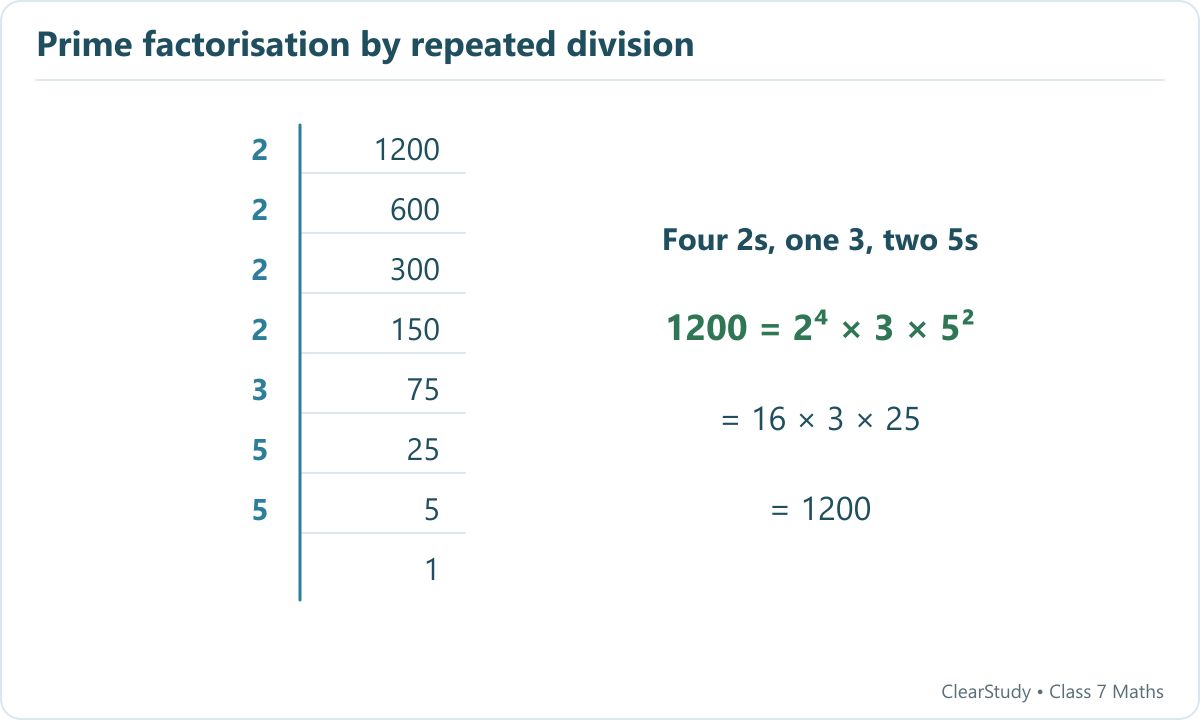
Prime-factorisation checks (Pages 49–51)105 = 3 × 5 × 7; 30 = 2 × 3 × 5. The repeated-division method gives 1200 = 24 × 3 × 52, shown below.Factors of 840: 14 is a factor because 14 × 60 = 840; 8 is a factor because 8 × 105 = 840; 27 = 33 is not a factor because 840 has only one factor of 3 in its prime factorisation.225 = 32 × 52. Choosing zero, one or two copies of each prime gives the nine factors 1, 3, 5, 9, 15, 25, 45, 75, 225.
Divide 1200 by primes successively: 1200,600,300,150,75,25,5,1. The divisors give 1200=2 to the fourth power times 3 times 5 squared.
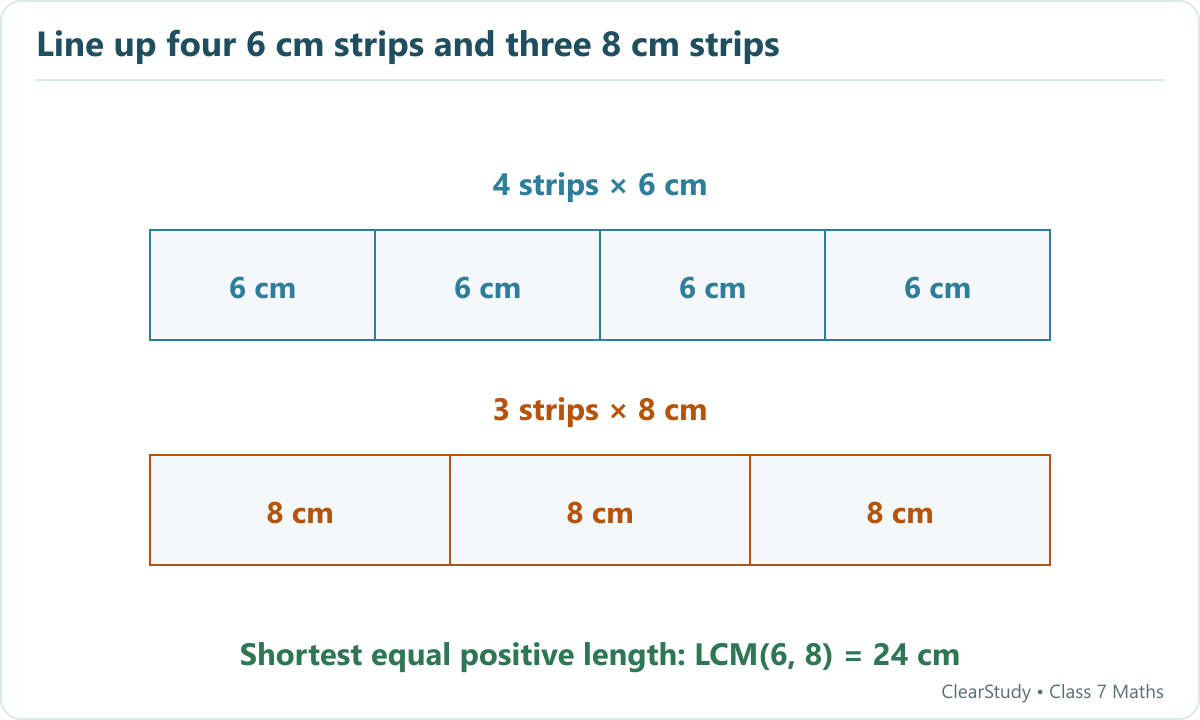
The shortest toran (Page 55)Four strips of 6 cm and three strips of 8 cm each make 24 cm, the shortest positive common length. There is no largest common multiple: after any common multiple, doubling it gives a larger one.
Four 6 cm strips and three 8 cm strips each form a 24 cm toran. Twenty-four is the least positive common multiple of 6 and 8.
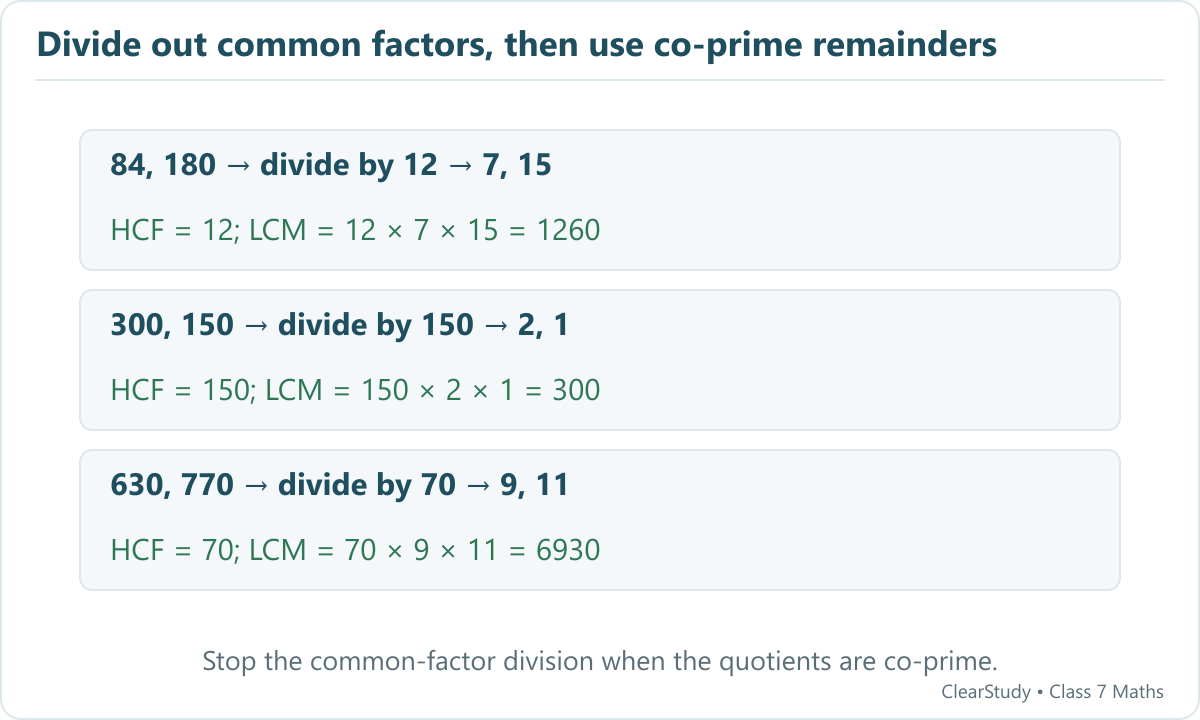
Common-factor division (Pages 60–62)Divide both numbers by the same common factor until the remaining pair is co-prime. The product of the removed factors is the HCF; multiply it by the two remaining quotients to get the LCM.For 84 and 180, remove 2, 2 and 3: the quotients are 7 and 15. Hence HCF = 12 and LCM = 12 × 7 × 15 = 1260. For 300 and 150 the answers are 150 and 300; for 630 and 770 they are 70 and 6930.
For 84 and 180, HCF=12 and LCM=1260. For 300 and 150, HCF=150 and LCM=300. For 630 and 770, HCF=70 and LCM=6930. Each pair has co-prime quotients after its HCF is removed.
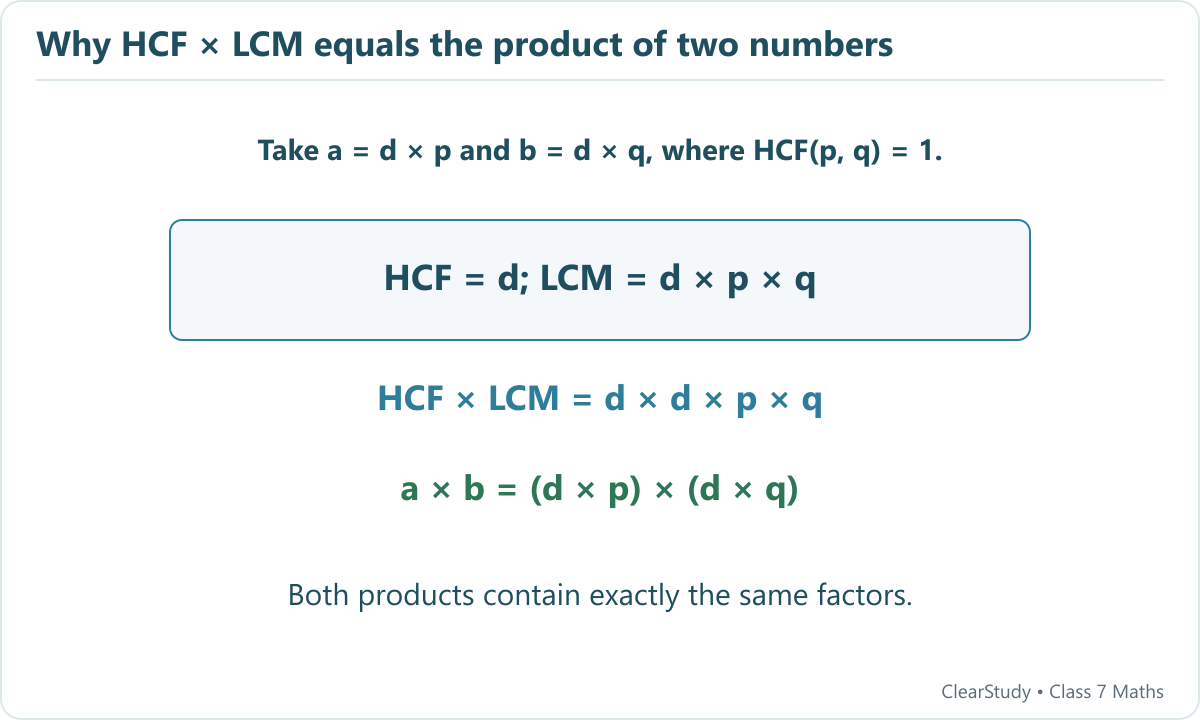
Why the product identity works (Page 63)Let d be the HCF of positive integers a and b. Write a = d × p and b = d × q. After removing the full HCF, p and q are co-prime. Therefore the LCM is d × p × q.HCF × LCM = d × d × p × q = (d × p) × (d × q) = a × b. Equivalently, for each prime, its smaller exponent plus its larger exponent equals the sum of the two exponents.
For positive integers a=dp and b=dq with co-prime p and q, HCF=d and LCM=dpq. Therefore HCF×LCM=d²pq=ab. The two-number identity is not a general identity for three numbers.
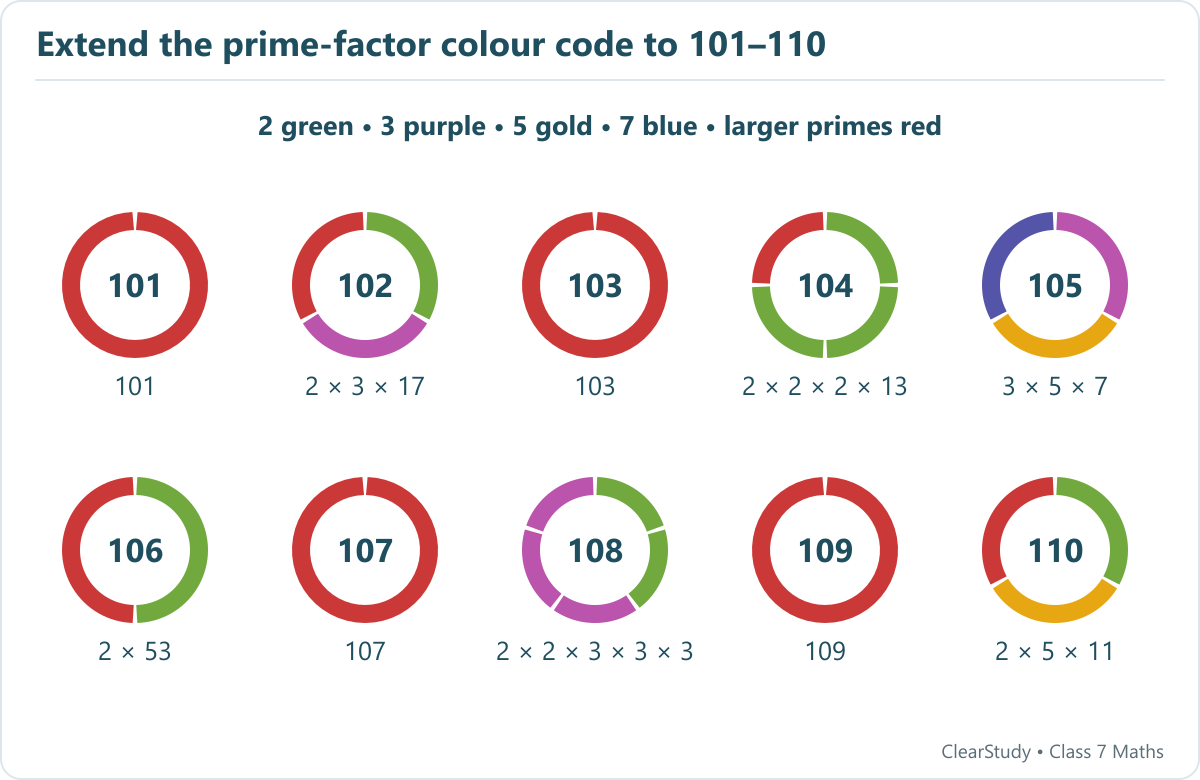
Mystery Colours! (Page 66)Each ring represents a prime factorisation. One sector is used for each prime factor, counting repeated factors: 2 is green, 3 purple, 5 gold, 7 blue, and primes greater than 7 red. The number 1 is grey. Larger prime factors can be labelled so different red sectors are distinguishable.101–105: 101 is prime; 102 = 2 × 3 × 17; 103 is prime; 104 = 2 × 2 × 2 × 13; 105 = 3 × 5 × 7.106–110: 106 = 2 × 53; 107 is prime; 108 = 2 × 2 × 3 × 3 × 3; 109 is prime; 110 = 2 × 5 × 11. The factorisations printed below the rings identify the red prime factors in our diagram.
Original decoding aid: 101 prime;102=2×3×17;103 prime;104=2×2×2×13;105=3×5×7;106=2×53;107 prime;108=2×2×3×3×3;109 prime;110=2×5×11. Each repeated prime gets a sector, and primes above 7 use red.
Common Mistakes to Avoid
Watch out for these
Confusing HCF and LCM — HCF uses the minimum power of common primes; LCM uses the maximum power of all primes.
Splitting a number into composite parts (like 72 = 6 × 12) and concluding there is no common factor — always go down to prime factors.
Forgetting to include a prime in the LCM that appears in only one number (e.g. the 5 in 360 when pairing with 96).
Including a prime in the HCF that is not common to every number, or using a higher power than the smaller number provides.
Applying HCF × LCM = product to three or more numbers — it is a general identity for two positive integers, not for arbitrary groups of three or more.
In word problems, mixing up the two ideas: “largest size / equal groups” needs the HCF; “next time together / smallest length” needs the LCM.
For each Assertion–Reason question, choose: (A) Both Assertion and Reason are true and the Reason is the correct explanation of the Assertion; (B) Both are true but the Reason is not the correct explanation; (C) Assertion is true but Reason is false; (D) Assertion is false but Reason is true.
A-R 1. Assertion: The HCF of two co-prime numbers is 1.
Reason: Co-prime numbers have no common factor other than 1.
A-R 2. Assertion: For two numbers, HCF × LCM equals the product of the numbers.
Reason: This relation also holds for any three numbers.
A-R 3. Assertion: The LCM of two different prime numbers is their product.
Reason: Two different primes are co-prime, so their LCM equals their product.
A-R 4. Assertion: The HCF of two consecutive even numbers is 2.
Reason: Both numbers are divisible by 2 and differ by 2, so 2 is the greatest common factor.
A-R 5. Assertion: To find the LCM, each prime is taken to its minimum power across the numbers.
Reason: To find the HCF, each common prime is taken to its minimum power.
Answer key: 1-(A), 2-(C), 3-(A), 4-(A), 5-(D).
Quick Revision Summary
Every integer greater than 1 is a unique product of primes, apart from the order; every factor is a “subpart” of that prime factorisation.
HCF (Highest Common Factor / GCD) = the greatest common factor; LCM (Lowest Common Multiple) = the smallest common multiple.
HCF by primes: take the minimum power of each common prime; LCM by primes: take the maximum power of every prime.
If one number divides the other: HCF = smaller, LCM = larger; for co-prime numbers HCF = 1 and LCM = product.
The combined division method finds the HCF and LCM together; you may divide out big common factors at once.
For two numbers, HCF × LCM = product of the two numbers (not a general identity for three or more).
“Largest size / equal sharing” problems use the HCF; “together again / shortest common length” problems use the LCM.
How to score full marks in this chapter
Always start by writing the full prime factorisation of each number using the division method. For the HCF, ring the primes common to all numbers and take the lowest power of each; for the LCM, take the highest power of every prime that appears. In word problems, decide first whether you need the HCF (biggest equal size / fewest pieces) or the LCM (next common time / shortest common length). Use HCF × LCM = product to find a missing value quickly for two numbers, and keep your working tidy so each step earns its mark.
Frequently Asked Questions
What is Class 7 Maths Ganita Prakash Chapter 11 about?
Chapter 11, Finding Common Ground (Ganita Prakash Part II, Chapter 3), teaches prime factorisation and uses it to find the Highest Common Factor (HCF) and Lowest Common Multiple (LCM) of numbers, along with their properties and the relation HCF × LCM = product of the two numbers.
How do you find the HCF and LCM using prime factorisation?
Write each number as a product of primes. For the HCF, multiply the common primes taken to their lowest power. For the LCM, multiply every prime that appears, taken to its highest power.
Is HCF × LCM always equal to the product of the numbers?
It is true for any two positive integers: HCF × LCM = product of the two numbers. It does not hold in general for three or more numbers — for example, with 2, 4 and 6 the HCF × LCM is 24 but the product is 48.
Are these Class 7 Maths Ganita Prakash Chapter 11 solutions free?
Yes. All solutions are free and follow the official NCERT Ganita Prakash (Part II) textbook for the 2026–27 session, with answers worked out and verified step by step.