Class 7 Maths Ganita Prakash Chapter 10 Solutions (NCERT 2026–27) – Operations with Integers
These Class 7 Maths Ganita Prakash Chapter 10 solutions cover Operations with Integers — Chapter 9 of the book’s continuous count is followed by this chapter, which is Ganita Prakash Part II, Chapter 2. Every Figure it Out question, Math Talk prompt and Try This task is solved step by step, with verified working for multiplication and division of integers, the distributive property, and word problems, so you can master the chapter and revise it quickly.
Class: 7Subject: MathematicsBook: Ganita Prakash (Part II)Chapter: 10 (Part II, Chapter 2)Exercises: Figure it Out (pp. 25, 31, 33–34, 39, 42–44)Session: 2026–27
Chapter 10 of Ganita Prakash, Operations with Integers (Part II, Chapter 2), begins with Rakesh’s sum-and-difference number game and a quick recap of integer addition and subtraction using the number line and the green/red token model. It then builds multiplication of integers from the token bag idea, discovers the sign rules through clear patterns and times tables, and connects them to Brahmagupta’s rules for fortunes (positive) and debts (negative) from 628 CE. From there it develops division of integers as the inverse of multiplication, and explores the commutative, associative and distributive properties for integers, finishing with rich word problems on marks, temperature, profit/loss, pattern machines and alien ‘pibs’ currency. These Class 7 Maths Ganita Prakash Chapter 10 solutions work through every Figure it Out, Math Talk and Try This question step by step.
Key Concepts & Definitions
Integer: any whole number together with its negative — … −3, −2, −1, 0, 1, 2, 3, … A positive integer shows a rightward/upward/fortune quantity; a negative integer shows a leftward/downward/debt quantity.
Additive inverse: the additive inverse of an integer a is −a; together they sum to 0. So −(18) = −18 and −(−18) = 18. Subtracting a number is the same as adding its additive inverse.
Token model: a green token = +1 and a red token = −1; one green and one red form a zero pair that cancels out. Placing tokens models a positive multiplier; removing tokens models a negative multiplier.
Multiplication of integers: multiply the magnitudes, then fix the sign — for non-zero factors, same signs give a positive product and different signs a negative product. A zero factor makes the product zero.
Division of integers: the inverse of multiplication. “a ÷ b” asks “what times b gives a?” For non-zero numbers the sign rule is the same as for multiplication. Division by zero is undefined, while 0 divided by any non-zero number is 0. A quotient need not be an integer: 1 ÷ 2 = 1/2.
Brahmagupta’s rule (628 CE): the product or quotient of two fortunes, or of two debts, is a fortune (positive); the product or quotient of a fortune and a debt is a debt (negative).
Important Formulas & Rules (Chapter 10)
Sum & difference of two numbers: if sum = S and difference = D, then first = (S + D) ÷ 2 and second = (S − D) ÷ 2. Both answers are integers when S and D have the same parity (both even or both odd).
Sign rules (× and ÷): (+)×(+) = + • (−)×(−) = + • (+)×(−) = − • (−)×(+) = −. These rules concern non-zero numbers and hold for division too.
Special products: 1 × a = a • (−1) × a = −a (the additive inverse of a), for every integer a.
Sign of a long product: if any factor is 0, the product is 0; otherwise an even number of negative factors gives a positive product; an odd number of negative factors gives a negative product.
Commutative:a × b = b × a. Associative:a × (b × c) = (a × b) × c.
Distributive over addition:a × (b + c) = (a × b) + (a × c).
Division signs (b ≠ 0):a ÷ (−b) = −(a ÷ b); (−a) ÷ b = −(a ÷ b); (−a) ÷ (−b) = a ÷ b.
Figure it Out — Sums & Differences (Page 25)
Let us try to find a few more pairs of numbers from their sums and differences:
(a) Sum = 27, Difference = 9 (b) Sum = 4, Difference = 12(c) Sum = 0, Difference = 10 (d) Sum = 0, Difference = −10(e) Sum = −7, Difference = −1 (f) Sum = −7, Difference = −13
Carrom Coin Integers — Based on this new model, answer the following questions:
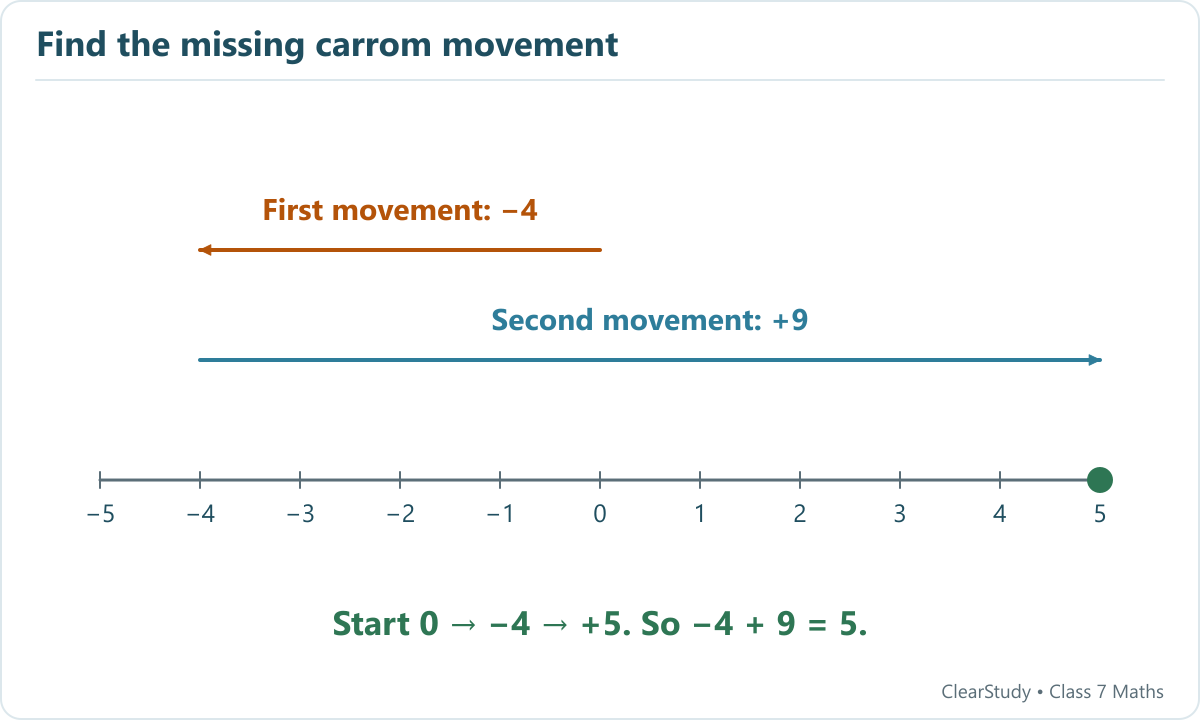
1. If the first movement is −4 and the final position is 5, what is the second movement?2. If there are multiple strikes causing movements in the order 1, −2, 3, −4, …, −10, what is the final position of the coin?
SOLUTION1. Final position P = first movement + second movement, so second = P − first = 5 − (−4) = 9 units (rightward).2. The movements are 1, −2, 3, −4, 5, −6, 7, −8, 9, −10. Pair them: (1 − 2) + (3 − 4) + (5 − 6) + (7 − 8) + (9 − 10) = (−1) + (−1) + (−1) + (−1) + (−1) = −5. The coin ends at −5 (5 units left of 0).
The first strike moves from 0 to -4. A rightward movement of 9 units then reaches +5: -4+9=5.
Figure it Out — Multiplication with Tokens (Page 31)
1. Using the token interpretation, find the values of:
(a) 3 × (−2) (b) (−5) × (−2)(c) (−4) × (−1) (d) (−7) × 3
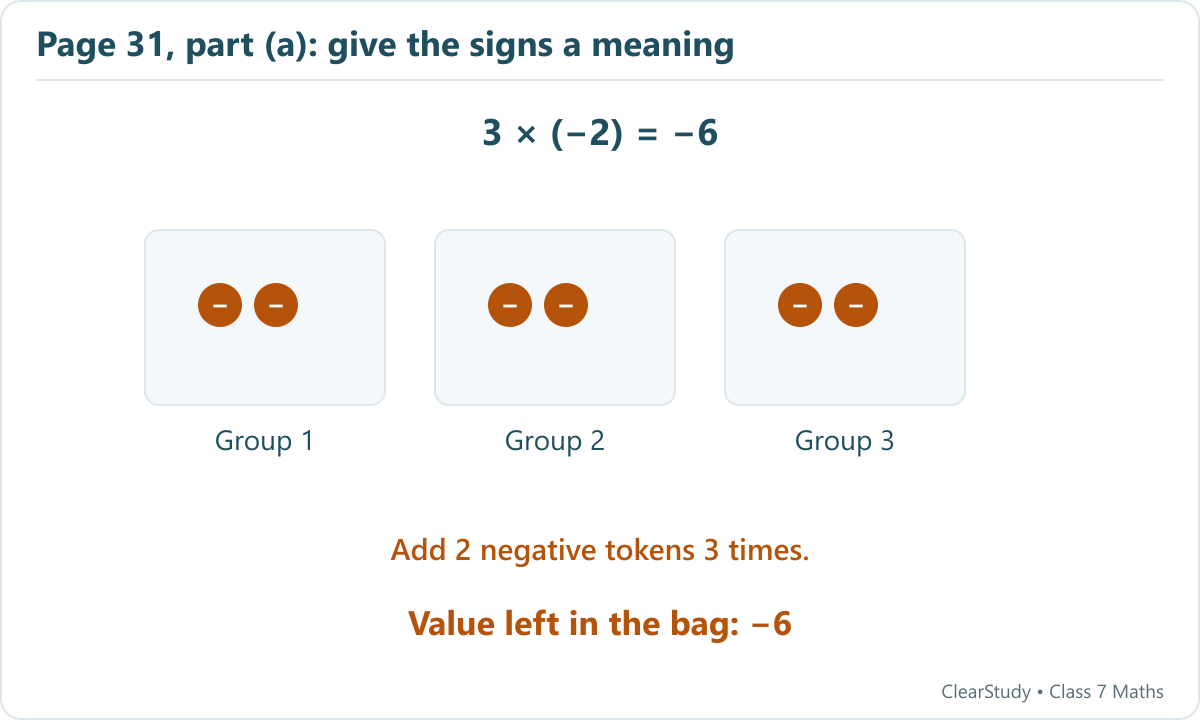
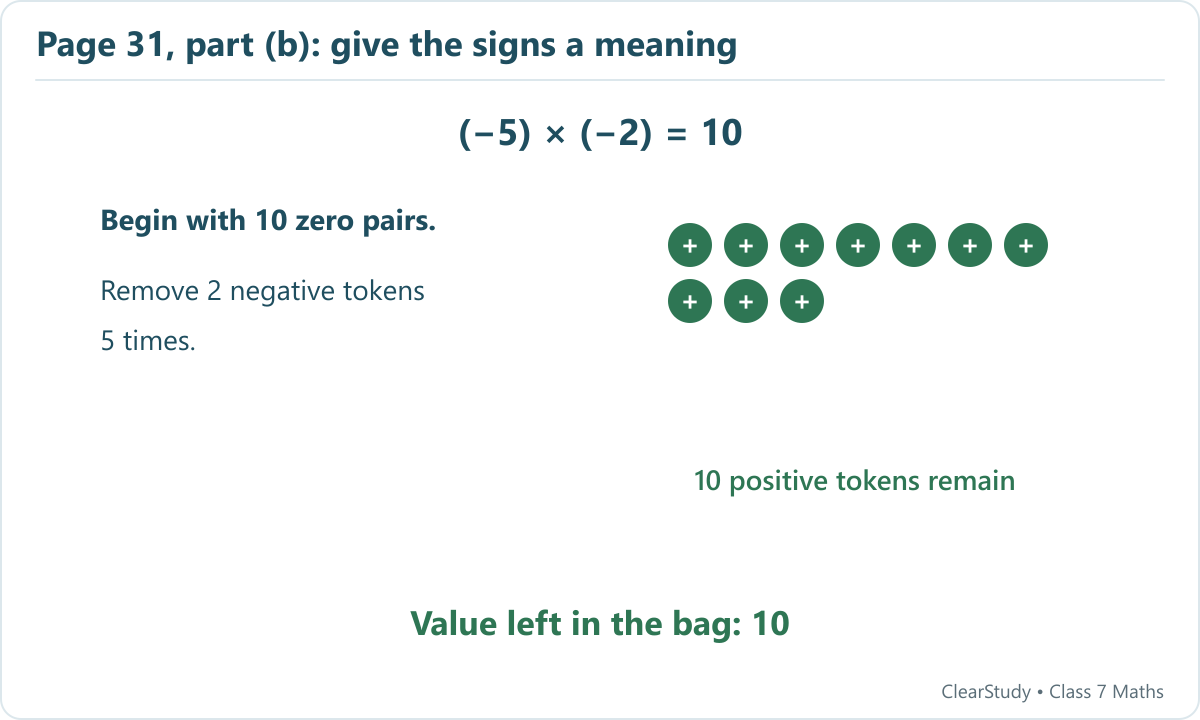
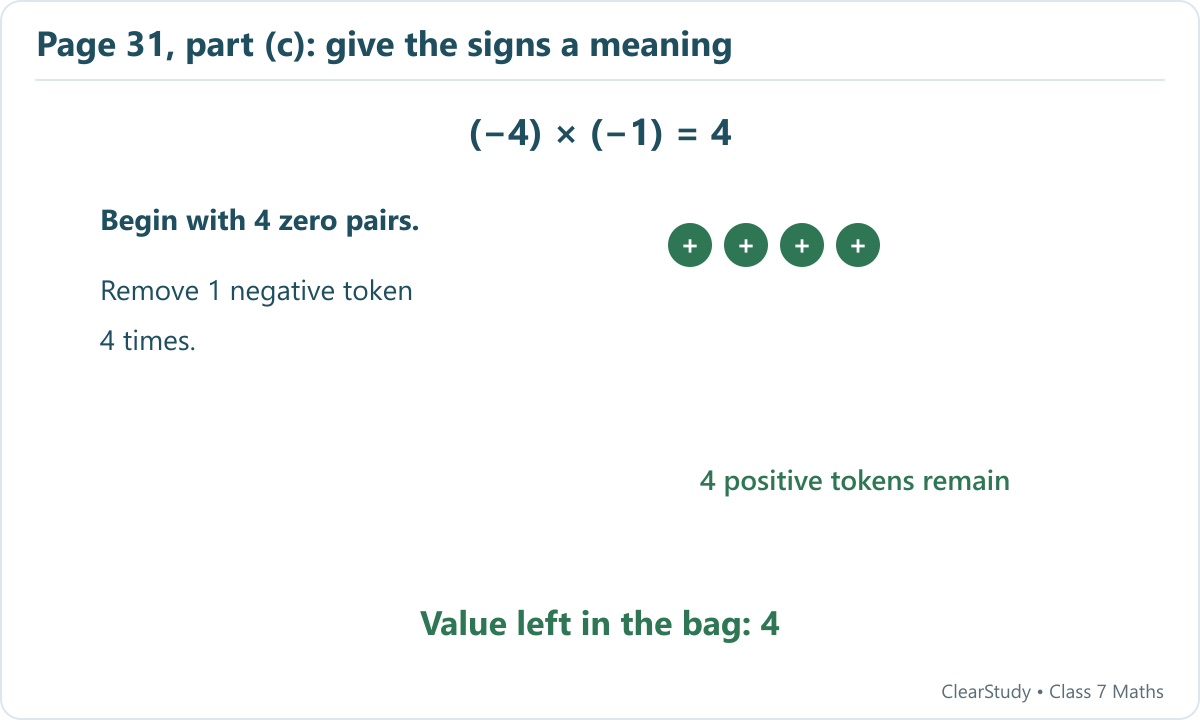
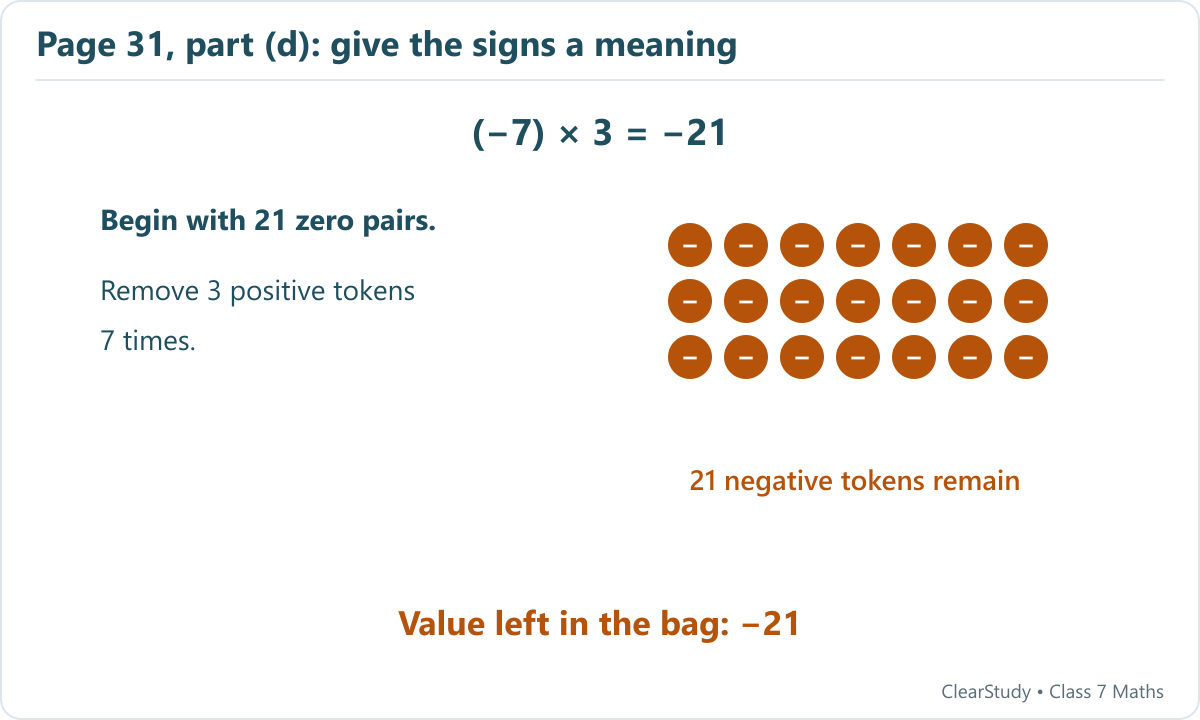
SOLUTION(a) 3 × (−2): place 2 red tokens into the bag 3 times → 6 negatives = −6.(b) (−5) × (−2): remove 2 red tokens 5 times (after putting in zero pairs) → 10 positives left = 10.(c) (−4) × (−1): remove 1 red token 4 times → 4 positives left = 4.(d) (−7) × 3: remove 3 green tokens 7 times → 21 negatives left = −21.
For 3 times -2, add 2 negative tokens 3 times. The remaining value is -6.For -5 times -2, start with 10 zero pairs and remove 2 negative tokens 5 times. The remaining value is 10.For -4 times -1, start with 4 zero pairs and remove 1 negative tokens 4 times. The remaining value is 4.For -7 times 3, start with 21 zero pairs and remove 3 positive tokens 7 times. The remaining value is -21.
2. If 123 × 456 = 56088, without calculating, find the value of:
(a) (−123) × 456 (b) (−123) × (−456) (c) (123) × (−456)
SOLUTIONThe magnitude stays 56088; only the sign changes by the sign rule.(a) different signs → −56088.(b) same signs (both negative) → 56088.(c) different signs → −56088.
3. Try to frame a simple rule to multiply two integers.
SOLUTIONRule: first multiply the magnitudes (ignore signs) to get the size of the product. If either factor is zero, the product is zero. Otherwise choose the sign: if the two integers have the same sign the product is positive; if they have different signs the product is negative.For example, (−6) × (−4): 6 × 4 = 24, same signs → +24; and 7 × (−5): 7 × 5 = 35, different signs → −35.
SOLUTION(a) different signs, 14 × 15 = 210 → −210.(b) same signs, 16 × 5 = 80 → 80.(c) different signs, 36 ÷ 18 = 2 → −2.(d) same signs, 46 ÷ 23 = 2 → 2.
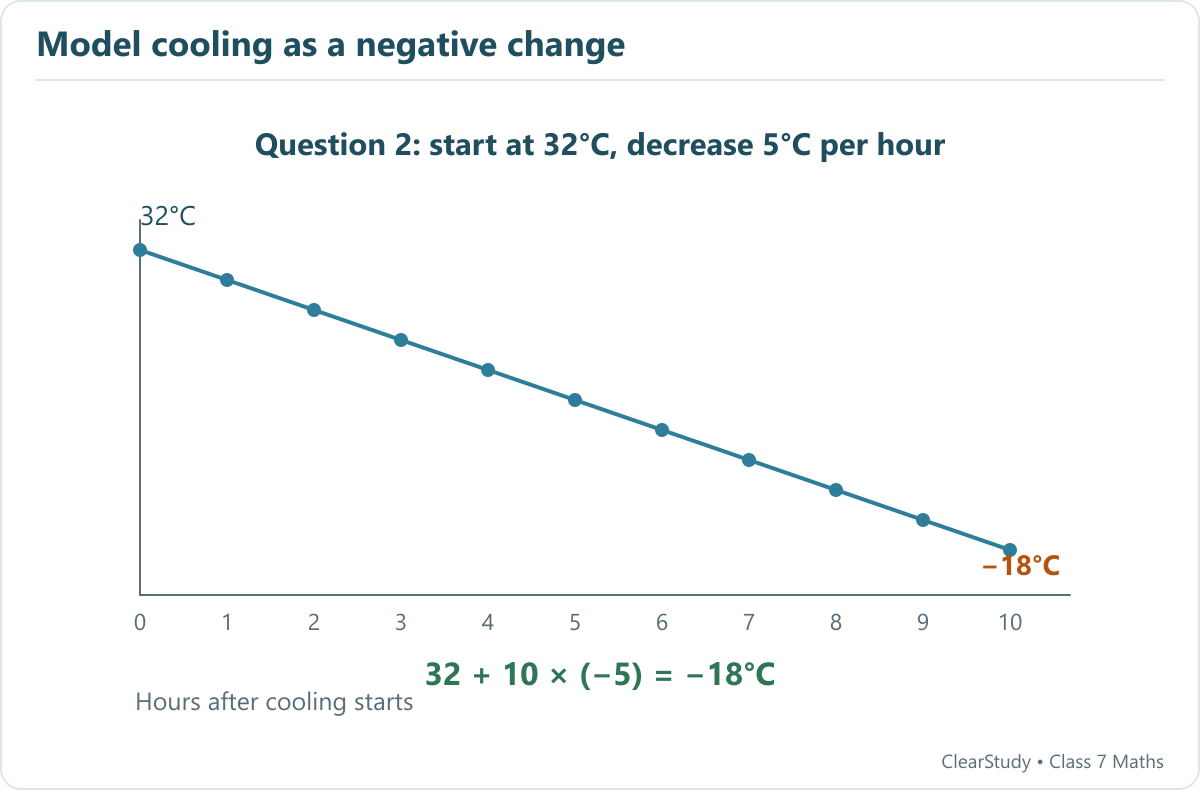
2. A freezing process requires that the room temperature be lowered from 32°C at the rate of 5°C every hour. What will be the room temperature 10 hours after the process begins?
SOLUTIONEach hour the change is −5°C, so in 10 hours the change is 10 × (−5) = −50°C.Final temperature = 32 + (−50) = −18°C.
At a constant decrease of 5 degrees Celsius each hour, the temperature falls from 32 degrees to -18 degrees in 10 hours. The model is T=32-5t.
3. A cement company earns a profit of ₹8 per bag of white cement sold and a loss of ₹5 per bag of grey cement sold. [Represent the profit/loss as integers.]
(a) The company sells 3,000 bags of white cement and 5,000 bags of grey cement in a month. What is its profit or loss?(b) If the number of bags of grey cement sold is 6,400 bags, what is the number of bags of white cement the company must sell to have neither profit nor loss.
SOLUTIONProfit on white = +8 per bag; loss on grey = −5 per bag.(a) Total = 3000 × 8 + 5000 × (−5) = 24000 + (−25000) = −1000, i.e. a loss of ₹1000.(b) For no profit/loss, white earnings must cancel grey loss: 8 × (white bags) = 5 × 6400 = 32000.White bags = 32000 ÷ 8 = 4000 bags.
4. Replace the blank with an integer to make a true statement.
(a) (−3) × _____ = 27 (b) 5 × _____ = (−35)(c) _____ × (−8) = (−56) (d) _____ × (−12) = 132(e) _____ ÷ (−8) = 7 (f) _____ ÷ 12 = −11
Figure it Out — Expressions Using Integers (Page 42–44)
1. Find the values of the following expressions:
(a) (−5) × (18 + (−3)) (b) (−7) × 4 × (−1)(c) (−2) × (−1) × (−5) × (−3)
SOLUTION(a) 18 + (−3) = 15, so (−5) × 15 = −75. (Check by distribution: (−5)×18 + (−5)×(−3) = −90 + 15 = −75.)(b) (−7) × 4 = −28; then −28 × (−1) = 28.(c) Four negative factors (even count) → positive. 2 × 1 × 5 × 3 = 30, so the answer is 30.
2. Find the values of the following expressions:
(a) (−27) ÷ 9 (b) 84 ÷ (−4) (c) (−56) ÷ (−2)
SOLUTION(a) different signs, 27 ÷ 9 = 3 → −3.(b) different signs, 84 ÷ 4 = 21 → −21.(c) same signs, 56 ÷ 2 = 28 → 28.
3. Find the integer whose product with (−1) is:
(a) 27 (b) −31 (c) −1 (d) 1 (e) 0
SOLUTIONSince (−1) × a = −a, the required integer is the additive inverse of each given value.(a) −27 (b) 31 (c) 1 (d) −1 (e) 0 (since −1 × 0 = 0).
4. If 47 − 56 + 14 − 8 + 2 − 8 + 5 = −4, then find the value of −47 + 56 − 14 + 8 − 2 + 8 − 5 without calculating the full expression.
SOLUTIONThe second expression is exactly the first expression with every term’s sign reversed, i.e. it equals −1 times the first expression.So its value = −(−4) = 4.
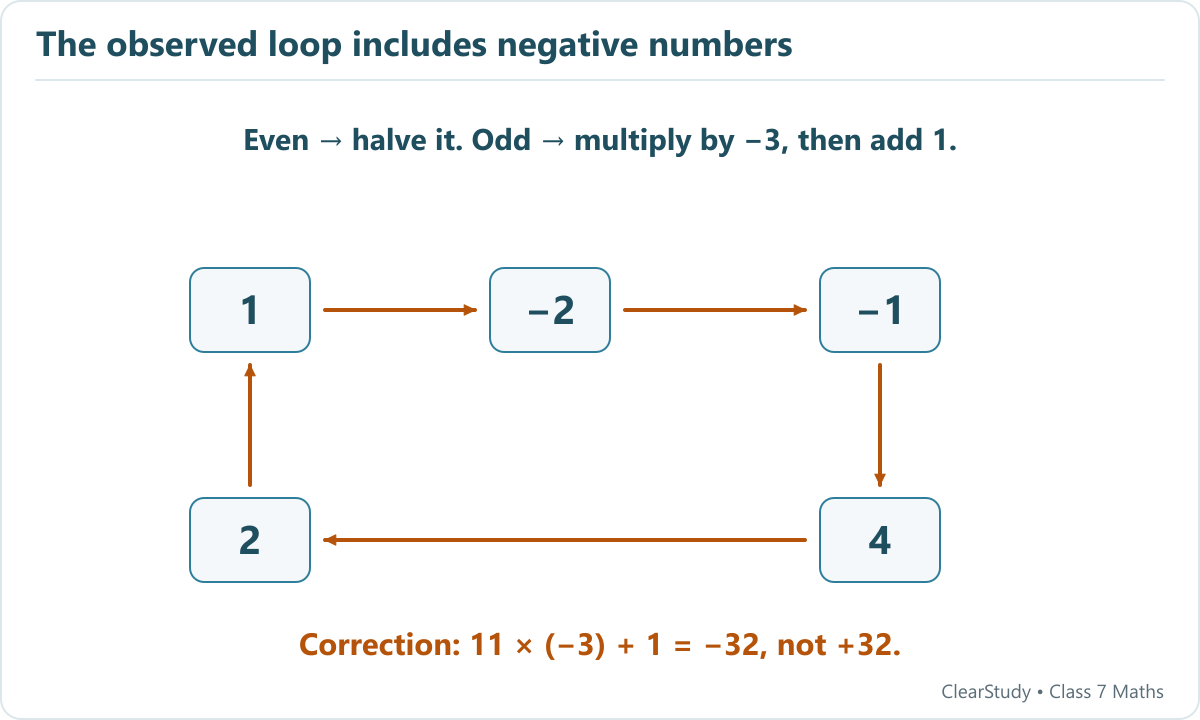
5. Do you remember the Collatz Conjecture from last year? Try a modified version with integers. The rule is — start with any number; if the number is even, take half of it; if the number is odd, multiply it by −3 and add 1; repeat. An example sequence is shown below.
−7, 22, 11, −32, −16, −8, −4, −2, −1, 4, 2, 1Try this with different starting numbers: (−21), (−6), and so on. Describe the patterns you observe.
SOLUTIONUse the stated modified rule: even → divide by 2; odd → multiply by −3, then add 1. The printed example has a sign error after 11: 11 × (−3) + 1 = −32, not +32.Starting at −21: −21 → 64 → 32 → 16 → 8 → 4 → 2 → 1 → −2 → −1 → 4 → ….Starting at −6: −6 → −3 → 10 → 5 → −14 → −7 → 22 → 11 → −32 → −16 → −8 → −4 → −2 → −1 → 4 → 2 → 1 → −2 → ….These examples enter the five-number loop 1 → −2 → −1 → 4 → 2 → 1. A positive power of 2 halves down to 1. These observations do not prove that all integers enter this loop; for example, 0 stays at 0.
Under the stated modified Collatz rule, 1 goes to -2, then -1, 4, 2 and back to 1. The example’s step after 11 must be -32. These observed examples do not prove that every integer reaches this loop.
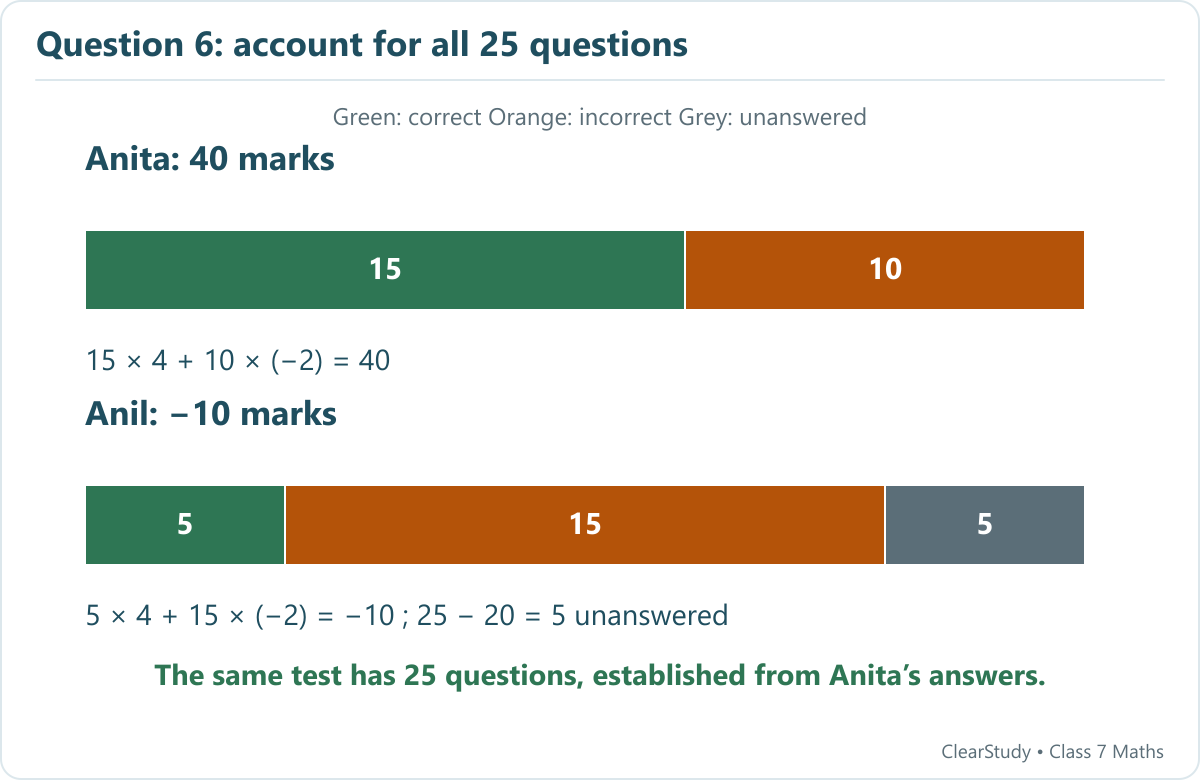
6. In a test, (+4) marks are given for every correct answer and (−2) marks are given for every incorrect answer.
(a) Anita answered all the questions in the test. She scored 40 marks even though 15 of her answers were correct. How many of her answers were incorrect? How many questions are in the test?(b) Anil scored (−10) marks even though he had 5 correct answers. How many of his answers were incorrect? Did he leave any questions unanswered?
SOLUTION(a) Anita earns 15 × 4 = 60 marks from correct answers. Her incorrect answers cost 60 − 40 = 20 marks, so she has 20 ÷ 2 = 10 incorrect answers. She answered all questions, so the test has 15 + 10 = 25 questions.(b) Anil earns 5 × 4 = 20 marks from correct answers and loses 20 − (−10) = 30 marks. Thus he has 30 ÷ 2 = 15 incorrect answers. He attempted 5 + 15 = 20 of the same 25 questions, leaving 5 unanswered.
Anita has 15 correct and 10 incorrect answers, totalling 25 questions and 40 marks. Anil has 5 correct and 15 incorrect, scoring -10; he leaves 5 of the same 25 questions unanswered.
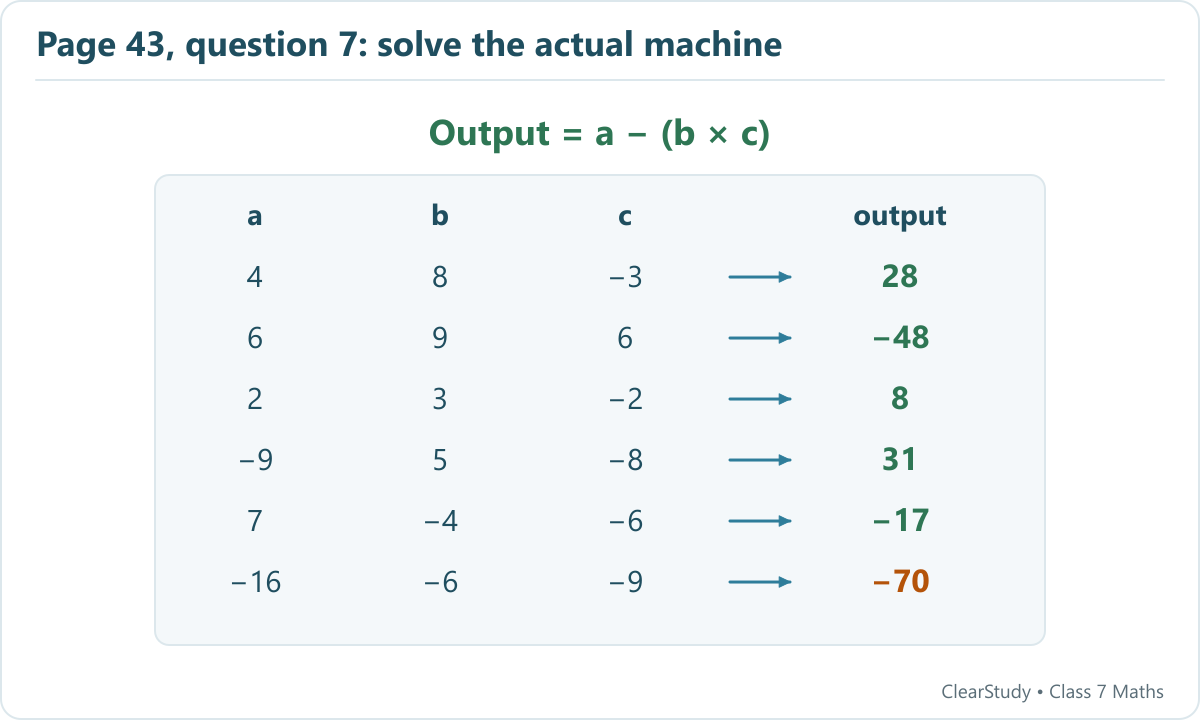
7. Pick the pattern — find the operations done by the machine shown below.
SOLUTIONThe rule is output = a − (b × c), where a, b and c are the first, second and third inputs.Checks: 4 − 8 × (−3) = 28; 6 − 9 × 6 = −48; 2 − 3 × (−2) = 8; −9 − 5 × (−8) = 31; 7 − (−4) × (−6) = −17.The missing output is −16 − ((−6) × (−9)) = −16 − 54 = −70.
The machine subtracts the product of the second and third inputs from the first. Every printed row fits. The missing output is -16-((-6)×(-9))=-70.
8. Imagine you’re in a place where the temperature drops by 5°C each hour. If the temperature is currently at 8°C, write an expression which denotes the temperature after 4 hours.
SOLUTIONEach hour the change is −5°C, so after 4 hours the change is 4 × (−5).Expression: 8 + 4 × (−5) = 8 + (−20) = −12°C.
9. Find 3 consecutive numbers with a product of (a) −6, (b) 120.
SOLUTION(a) Since 1 × 2 × 3 = 6, use three consecutive negative integers: −3, −2, −1. Their product is 6 × (−1) = −6.(b) Try consecutive numbers around 5: 4, 5, 6. Their product is 4 × 5 × 6 = 20 × 6 = 120.
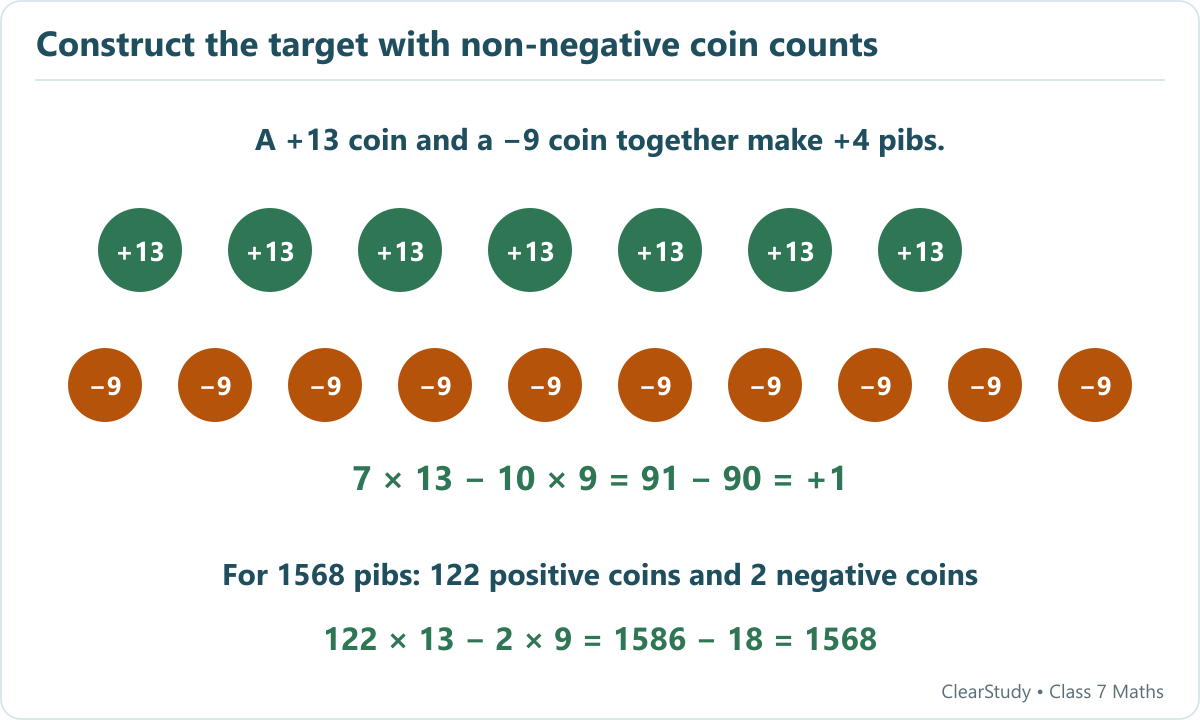
10. An alien society uses a peculiar currency called ‘pibs’ with just two denominations of coins — a +13 pibs coin and a −9 pibs coin. You have several of these coins. Is it possible to purchase an item that costs +85 pibs? … Using the two denominations, try to get the following totals:
(a) +20 (b) +40 (c) −50 (d) +8(e) +10 (f) −2 (g) +1(h) Is it possible to purchase an item that costs 1568 pibs?
SOLUTIONWe look for whole numbers of coins (counts cannot be negative) so that 13 × (number of +13 coins) + (−9) × (number of −9 coins) equals the target. The given example uses 10 coins of +13 and 5 coins of −9: 130 − 45 = +85. ✓(a) +20: 5 of (+13) and 5 of (−9) → 65 − 45 = +20. ✓(b) +40: 10 of (+13) and 10 of (−9) → 130 − 90 = +40. ✓(c) −50: 1 of (+13) and 7 of (−9) → 13 − 63 = −50. ✓(d) +8: 2 of (+13) and 2 of (−9) → 26 − 18 = +8. ✓(e) +10: 7 of (+13) and 9 of (−9) → 91 − 81 = +10. ✓(f) −2: 4 of (+13) and 6 of (−9) → 52 − 54 = −2. ✓(g) +1: 7 of (+13) and 10 of (−9) → 91 − 90 = +1. ✓(h) Yes. Use 122 coins of +13 and 2 coins of −9: 122 × 13 − 2 × 9 = 1586 − 18 = 1568 pibs. All coin counts are non-negative. More generally, repeating the +1 construction from (g) makes any non-negative whole-number amount.
Seven +13 coins and ten -9 coins make +1 pib. A direct combination for 1568 is 122 coins of +13 and two coins of -9: 1586-18=1568.
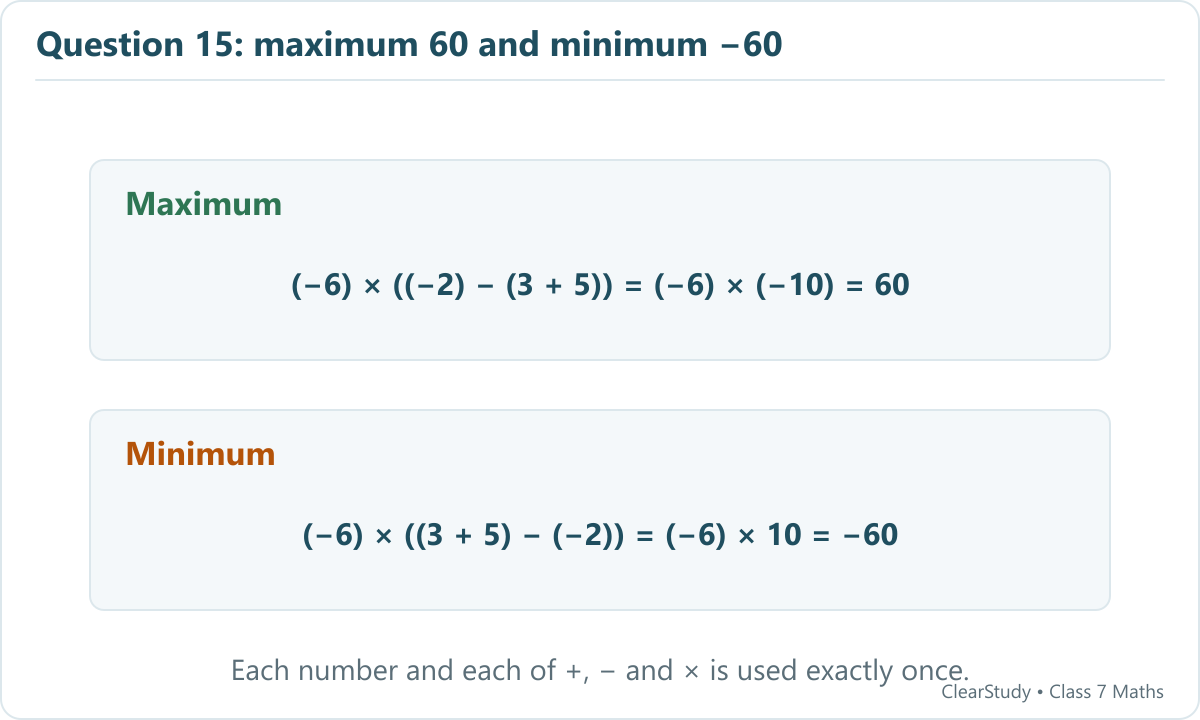
15. Use the numbers 3, −2, 5, −6 exactly once and the operations ‘+’, ‘−’, and ‘×’ exactly once and brackets as necessary to write an expression such that —
(a) the result is the maximum possible(b) the result is the minimum possible
SOLUTION(a) Maximum = 60: (−6) × ((−2) − (3 + 5)) = (−6) × (−10) = 60.(b) Minimum = −60: (−6) × ((3 + 5) − (−2)) = (−6) × 10 = −60.Each expression uses all four numbers and each of +, − and × exactly once.Why these are the limits: if multiplication is the last operation, a single number multiplied by a group of three has magnitude at most 6 × (2 + 3 + 5) = 60; the other single-number choices give bounds 55, 39 and 28. For two groups of two, using one addition and one subtraction gives a largest magnitude of 32 across the three possible pairings. If an addition or subtraction is outside the product, the magnitude is at most 50 (for example, the bound 6 × (5 + 3) + 2). Thus no permitted grouping goes above 60 or below −60.
Maximum: (-6)×((-2)-(3+5))=60. Minimum: (-6)×((3+5)-(-2))=-60. Each expression uses 3,-2,5,-6 and the three required operations exactly once.
16. Fill in the blanks in at least 5 different ways with integers:
(a) ___ + ___ × ___ = −36(b) (___ − ___) × ___ = 12(c) (___ − (___ − ___)) = −1
These are the in-text reflective and short tasks in the chapter; the determinate ones are answered, the open ones are guided.
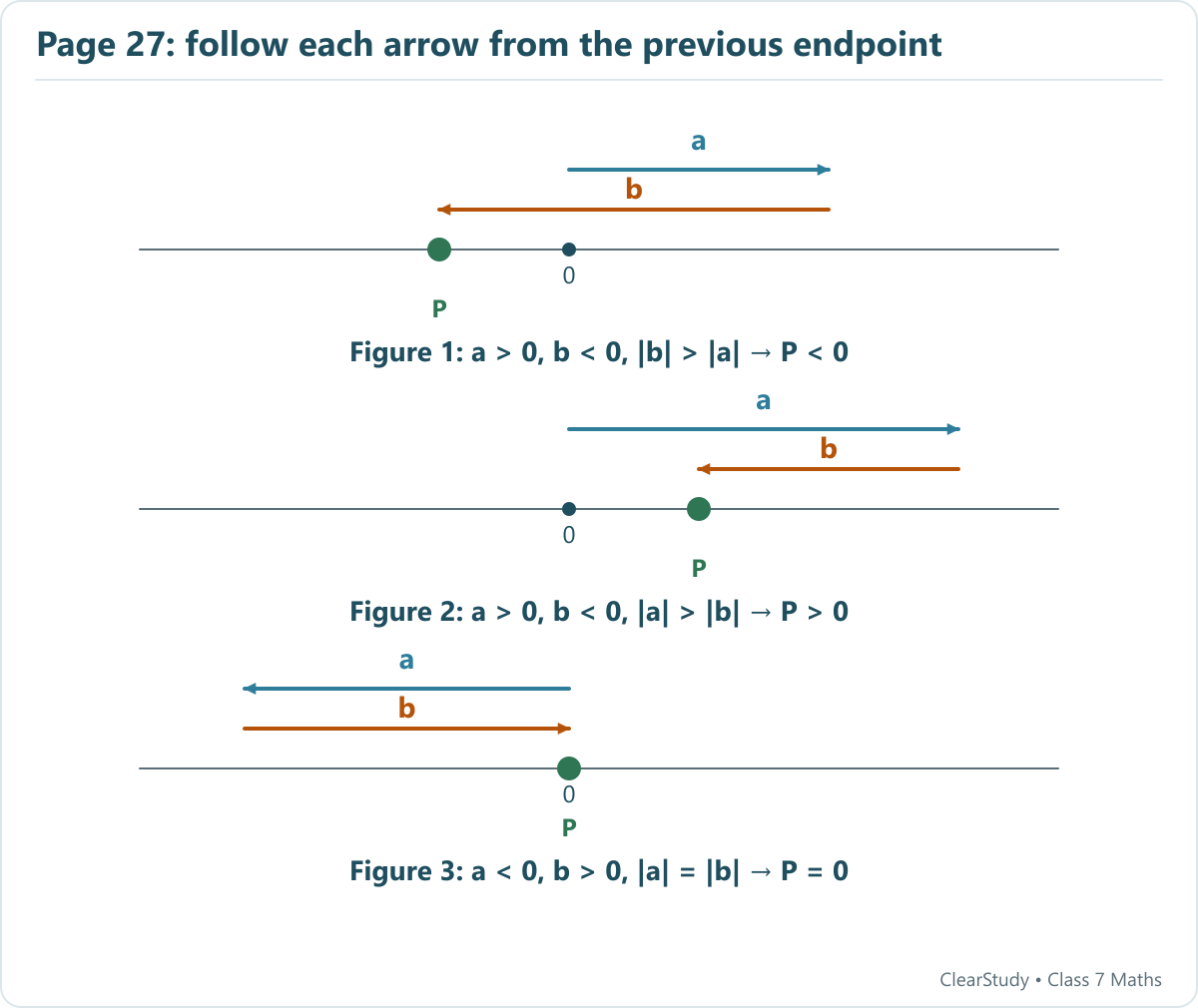
Try This — Comparing movements a and bFrom the figures (carrom strikes from 0), what can you conclude about the magnitudes of a and b compared to each other, and what are their directions? (Three diagrams ending at P.)Answer. In each figure P = a + b. Figure 1: a is positive (rightward), b is negative (leftward), and |b| > |a|, so P < 0. Figure 2: a > 0, b < 0 and |a| > |b|, so P > 0. Figure 3: a < 0, b > 0 and |a| = |b|, so the coin returns to P = 0. Follow each arrow from the endpoint of the preceding movement.
Schematic examples preserving the directions in the three textbook figures. Figure 1 has positive a and a larger-magnitude negative b. Figure 2 has positive a and a smaller-magnitude negative b. Figure 3 returns to zero: a is negative, b positive and their magnitudes are equal.
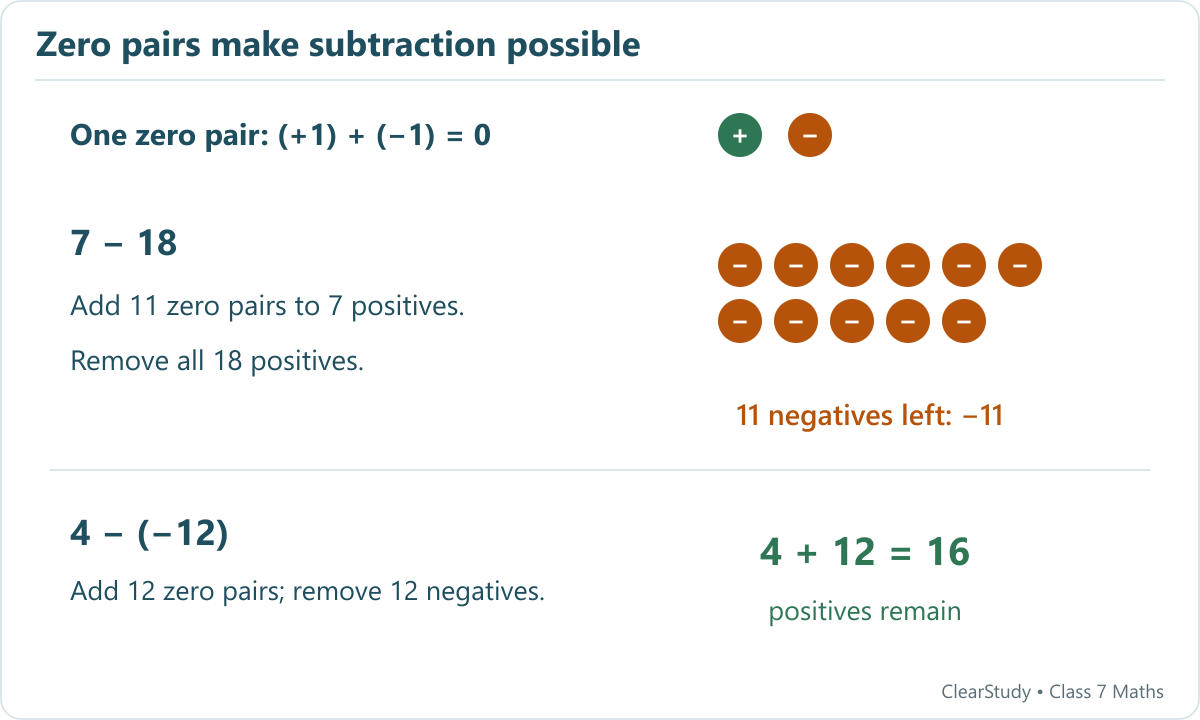
Math Talk — Subtraction as adding the inverseUsing tokens, argue out the following statements: (a) 7 − 18 = 7 + (−18); (b) 4 − (−12) = 4 + 12.Answer. (a) To do 7 − 18 we must remove 18 positives from 7 positives; we add 11 zero pairs (each is +1 and −1), remove the 18 positives, and 11 negatives remain → −11. Adding 7 + (−18) gives the same −11, because subtracting 18 equals adding its inverse −18. (b) Removing 12 negatives from 4 needs 12 zero pairs added first; after removing the negatives, 4 + 12 = 16 positives remain. So 4 − (−12) = 4 + 12 = 16 — subtracting −12 equals adding its inverse 12.
Adding a positive-negative pair does not change a number. For 7-18, add eleven zero pairs and remove eighteen positives, leaving -11. For 4-(-12), add twelve zero pairs and remove twelve negatives, leaving 16.
Math Talk — Removing green tokens for (−4) × 2Why are we trying to remove green tokens and not red tokens (for (−4) × 2)?Answer. The multiplicand is 2 (two positives), so each ‘set’ is two green tokens. A negative multiplier (−4) means “remove that set 4 times,” so we remove green tokens. From an empty bag we first add 2 zero pairs each time, then remove the 2 greens; after 4 rounds, 8 negatives remain, giving (−4) × 2 = −8.
Math Talk — Different token sets for the same numberTake 4 times each of three token sets that all represent −2. What integer do we get in each case? Do we get different answers because the sets look different, or the same answer because they all represent −2? Check this for 5 × 4 too.Answer. Each set equals −2 (extra green–red zero pairs do not change the value), so placing any of them into the bag 4 times gives 4 × (−2) = −8 every time. The answer depends only on the value −2, not on how the set looks. Similarly, any sets that each represent 4 give 5 × 4 = 20.
Math Talk — (−4) × 2 by additionCan −4 × 2 be defined through a process of addition of tokens instead of removal of tokens?Answer. Yes. Removing 2 positive tokens is the same as adding 2 negative tokens. So instead of removing 2 greens 4 times, we add 2 reds 4 times, giving 8 negatives = −8. Hence (−4) × 2 = −8 either way.
Math Talk — Sign of a product of many integersUsing the series −1 × −1 = 1, −1 × −1 × −1 = −1, …, can you give a simple rule to find the sign of the product of many integers?Answer. First check for a zero factor: if there is one, the product is 0. Otherwise count the negative factors: an even count gives a positive product and an odd count gives a negative product. For example, (−2) × (−1) × (−5) × (−3) = +30 because four factors are negative.
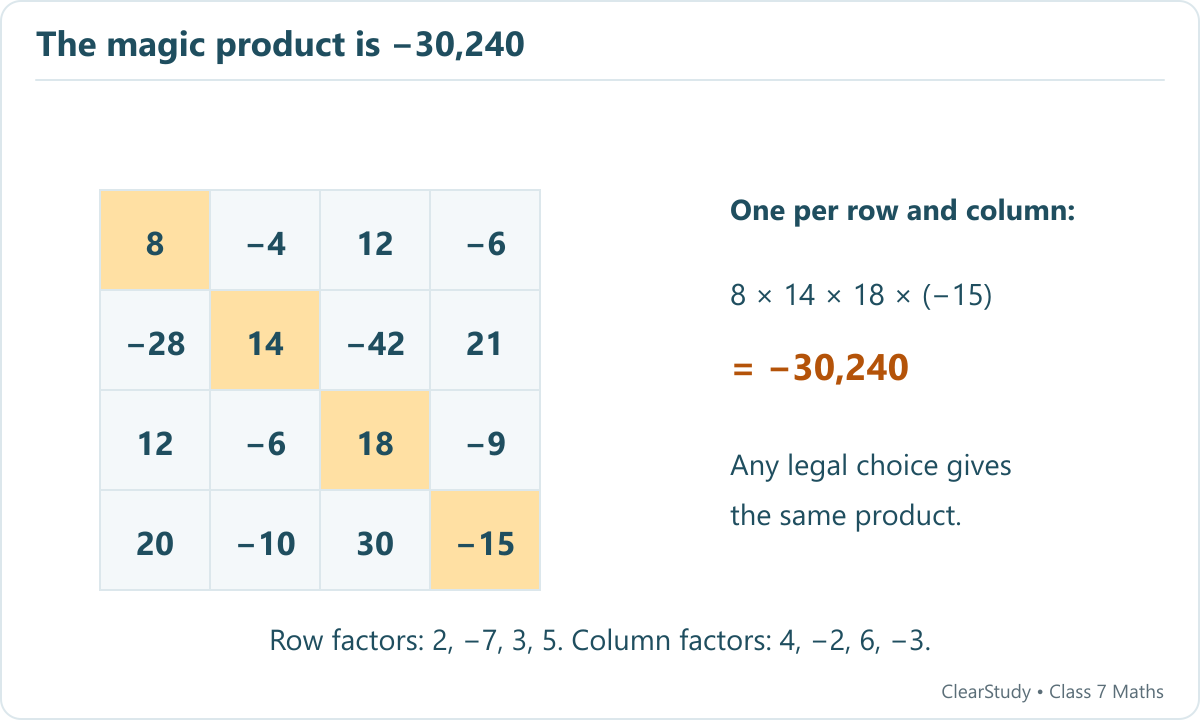
Try This — The magic gridsPlay the grid game (circle a number, strike its row and column, repeat, then multiply the circled numbers). Try different choices. What product do you get? What is so special about these grids — is the magic in the numbers or the way they are arranged, or both? Can you make more such grids?Answer. The constant product is −30,240. For example, the diagonal gives 8 × 14 × 18 × (−15) = −30,240. Each entry is a row factor times a column factor: row factors are 2, −7, 3, 5 and column factors are 4, −2, 6, −3. Choosing exactly one entry from each row and column uses all eight factors once, so every legal choice has the same product. To make another grid, choose four row factors and four column factors and multiply them to fill the cells.
Choose one entry from each row and each column. The diagonal gives 8×14×18×(-15)=-30240. Every legal choice has the same product because every row factor and every column factor is used once.
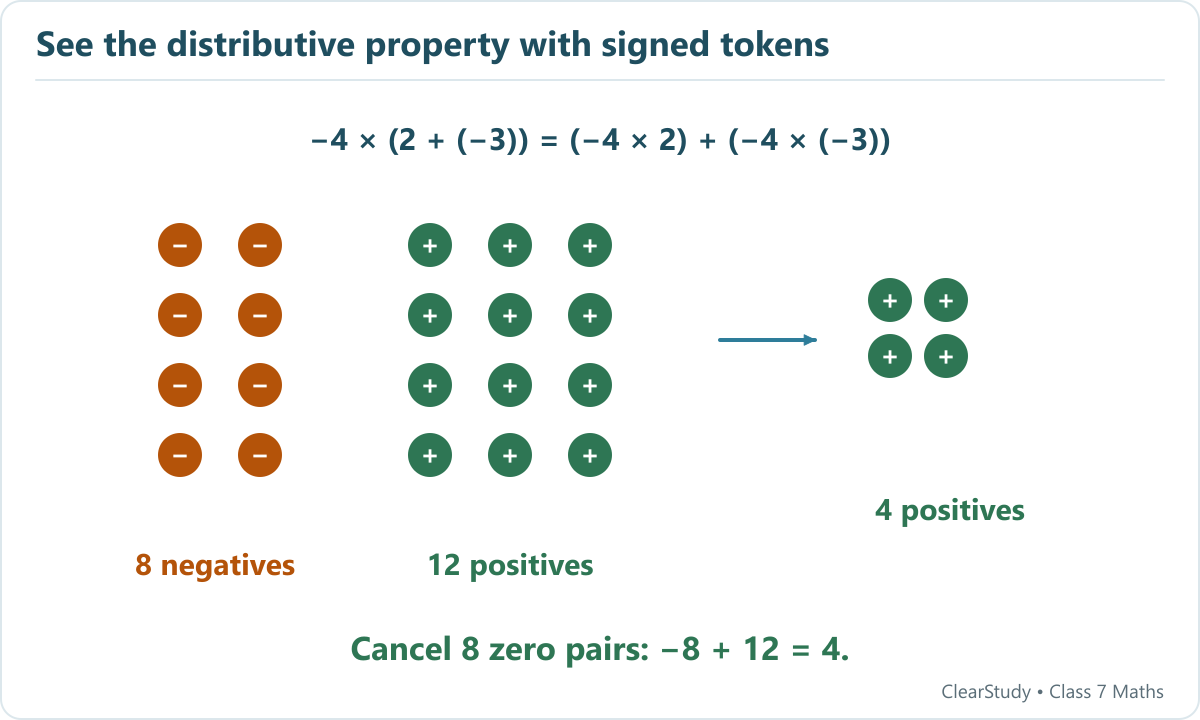
Try This — Distributive property for −4 × (2 + (−3))Can you visually show the distributive property for an expression like −4 × (2 + (−3))? [Hint: multiplying by −4 is adding the inverse of the number 4 times.]Answer. 2 + (−3) = −1, so −4 × (−1) = 4. By distribution, −4 × 2 + (−4) × (−3) = −8 + 12 = 4 — the same answer. With tokens, multiplying by −4 means adding the inverse of each token 4 times: the ‘2 greens’ column adds 8 reds (−8) and the ‘3 reds’ column adds 12 greens (+12), leaving 4 positives. This shows −4 × (2 + (−3)) = (−4 × 2) + (−4 × (−3)).
Four copies of the inverse of 2+(-3) give 8 negative tokens and 12 positive tokens. Cancel eight zero pairs to leave 4, matching (-4)×(-1)=4.
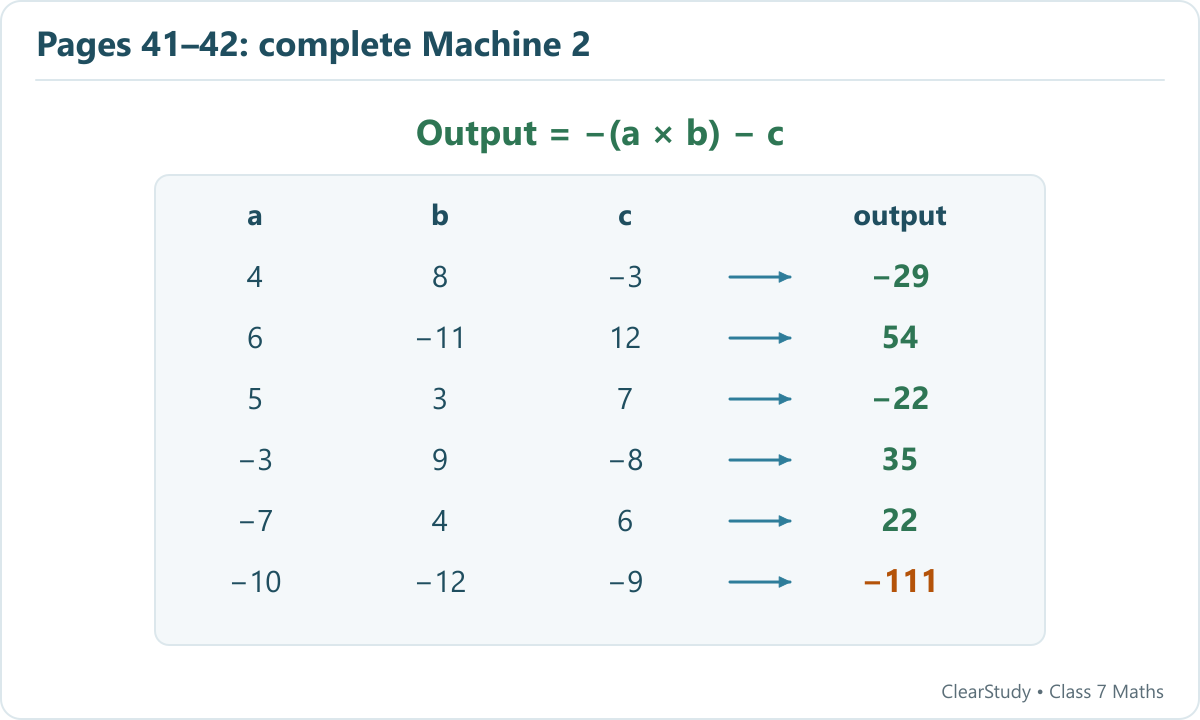
Math Talk — Pattern machinesFor Machine 1 the rule is a + b − c, so (−10) + (−12) − (−9) = ___. Find the operations done by Machine 2 and fill in the blank.Answer.Machine 1: a + b − c gives (−10) + (−12) − (−9) = −13. Machine 2: the rule is −(a × b) − c. It gives −29, 54, −22, 35 and 22 for the five printed input rows, as shown below. The final output is −((−10) × (−12)) − (−9) = −120 + 9 = −111.
Machine 2 uses minus the product of the first two inputs, then subtracts the third. All five printed rows fit. The missing output for -10,-12,-9 is -111.
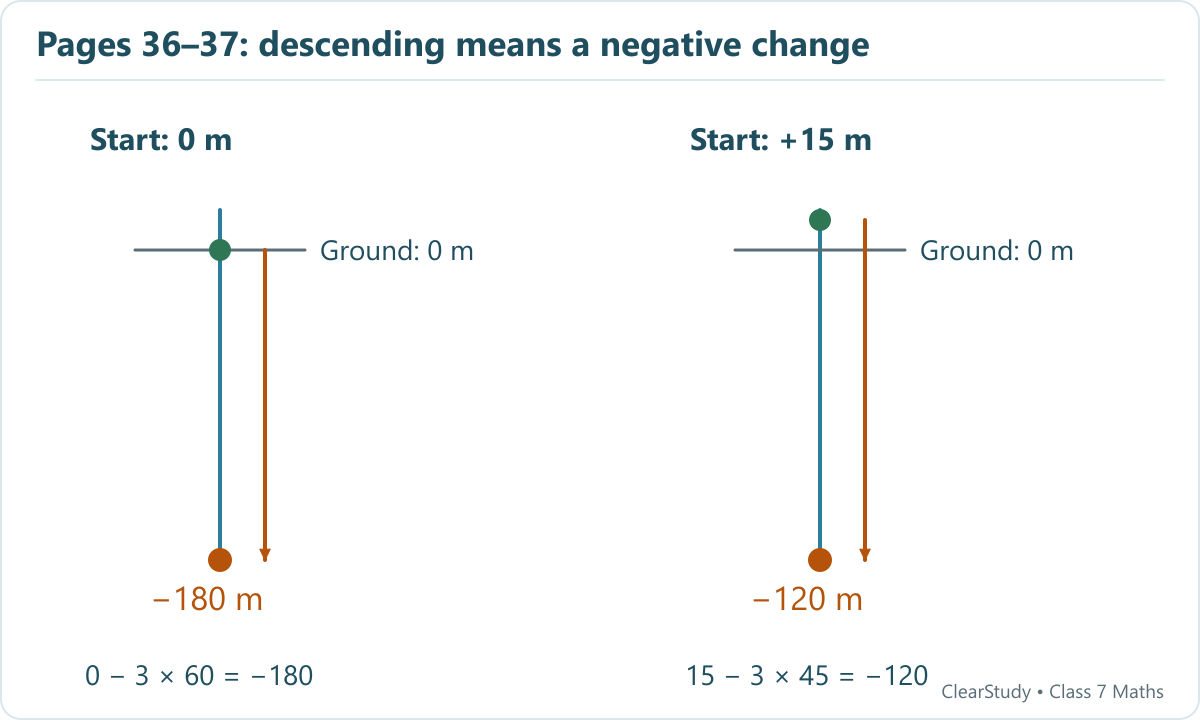
Further in-text checks: numbers, patterns, marks and liftsRakesh: 18 and 7 have sum 25 and difference 11. Reversing the order gives 7 − 18 = −11, while the sum stays 25.Multiplication patterns: when a multiplier decreases by 1, the product changes by the negative of the fixed multiplicand. With multiplicand +3 it decreases by 3; with −3 it increases by 3. Also 4 × (−6) = −24 and 9 × (−7) = −63.Mala: in a 50-question test scoring +5 for a correct answer and −2 for an incorrect answer, the maximum is 50 × 5 = 250 and the minimum is 50 × (−2) = −100. For 30 correct and 20 incorrect, Mala scores 150 − 40 = 110.Descending elevator: at 3 m per minute, a descent lasting 60 minutes from ground level ends at 0 − 3 × 60 = −180 m. Starting at +15 m and descending for 45 minutes ends at 15 − 3 × 45 = −120 m.Associativity: (5 × (−3)) × 4 = −15 × 4 = −60, and 5 × ((−3) × 4) = 5 × (−12) = −60. Regrouping preserves the product.
Left: descending 3 m per minute from ground level for 60 minutes ends at -180 m. Right: descending from +15 m for 45 minutes ends at -120 m. Schematic, not to scale.
Common Mistakes to Avoid
Watch out for these
Forgetting the sign rule: same signs → positive, different signs → negative — this holds for both multiplication and division.
Thinking two negatives make a negative — (−6) × (−3) = +18, not −18.
Mishandling double negatives in subtraction: 4 − (−12) = 4 + 12 = 16 (subtracting a negative adds).
Ignoring order of operations: in 8 + 4 × (−5), multiply first (−20), then add → −12, not 8 + 4 = 12 then ×.
Mixing up the sum/difference formula: first = (S + D) ÷ 2 and second = (S − D) ÷ 2.
Counting negatives carelessly — for non-zero factors, an even count of negative factors gives +, an odd count gives −.
Practice MCQs & Assertion–Reason
1. The value of (−6) × (−3) is:
(a) −18 (b) 18 (c) −9 (d) 9
2. The value of (−56) ÷ (−2) is:
(a) −28 (b) 28 (c) −112 (d) 112
3. For all integers a, the product (−1) × a equals:
(a) a (b) 1 (c) −a (d) 0
4. Two numbers have sum 4 and difference 12. The numbers are:
(a) 8 and −4 (b) 8 and 4 (c) −8 and 4 (d) 6 and −6
5. The product (−2) × (−1) × (−5) × (−3) is:
(a) −30 (b) 30 (c) −11 (d) 11
6. Which property does a × (b + c) = a × b + a × c describe?
For each Assertion–Reason question, choose: (A) Both Assertion and Reason are true and the Reason is the correct explanation of the Assertion; (B) Both are true but the Reason is not the correct explanation; (C) Assertion is true but Reason is false; (D) Assertion is false but Reason is true.
A-R 1. Assertion: (−8) × (−7) = 56.
Reason: The product of two negative integers is positive.
A-R 2. Assertion: 5 − (−3) = 8.
Reason: Subtracting an integer is the same as adding its additive inverse.
A-R 3. Assertion: For every integer a, 1 × a = a and (−1) × a = −a.
Reason: 1 is the multiplication identity, and multiplying by −1 gives the additive inverse of the number.
A-R 4. Assertion: The product (−2) × 3 × (−4) is negative.
Reason: A product of non-zero integers with an odd number of negative factors is negative.
A-R 5. Assertion: Integer multiplication is commutative, so a × b = b × a.
Reason: The magnitude and sign of a product are unchanged when the two factors are swapped.
Answer key: 1-(A), 2-(A), 3-(A), 4-(D), 5-(A). (A-R 4: the assertion is false — (−2)×3×(−4) = 24 is positive because it has two negative factors; the reason is a true general statement.)
Quick Revision Summary
From sum S and difference D: first number = (S + D) ÷ 2, second number = (S − D) ÷ 2.
Multiply/divide magnitudes, then fix the sign: same signs → positive, different signs → negative.
1 × a = a and (−1) × a = −a (the additive inverse) for every integer a.
Sign of a long product: if any factor is 0, the product is 0; otherwise even number of negatives → positive; odd number → negative.
Integer multiplication is commutative (a × b = b × a), associative (a × (b × c) = (a × b) × c) and distributive (a × (b + c) = a × b + a × c).
Division is the inverse of multiplication and follows the same sign rules; Brahmagupta (628 CE) first stated these rules using fortunes and debts.
How to score full marks in this chapter
Always write the magnitude first and then decide the sign with the “same/different” rule, and count negative factors to fix the sign of long products. In word problems, turn each phrase into an integer (profit +, loss −, descent −, drop in temperature −) before computing, and respect order of operations — multiply and divide before you add or subtract. Use the distributive property and known products (like 13) to shortcut big multiplications, and show each step so every mark is earned.
Frequently Asked Questions
What is Class 7 Maths Ganita Prakash Chapter 10 about?
Chapter 10, Operations with Integers (Ganita Prakash Part II, Chapter 2), covers a quick recap of integer addition and subtraction, multiplication and division of integers with sign rules, Brahmagupta’s historical rules, and the commutative, associative and distributive properties — all through the token model, number line and word problems.
How many Figure it Out exercises are there in Chapter 10?
There are five “Figure it Out” sets — on page 25 (sums and differences), page 31 and pages 33–34 (multiplication), page 39 (multiplication and division) and pages 42–44 (expressions using integers) — plus several Math Talk and Try This tasks, all solved on this page.
What is the rule for multiplying and dividing integers?
For non-zero integers, multiply or divide magnitudes, then use the signs: same signs give a positive answer, different signs a negative answer. A zero factor makes a product zero. Otherwise an even number of negative factors gives a positive product, and an odd number gives a negative product. Division by zero is undefined; zero divided by a non-zero number is zero.
Are these Class 7 Maths Ganita Prakash Chapter 10 solutions free?
Yes. All solutions are free and follow the official NCERT Ganita Prakash (Part II) textbook for the 2026–27 session, with every Figure it Out, Math Talk and Try This answer worked out and verified.