These Class 7 Maths Ganita Prakash Chapter 9 solutions cover Geometric Twins, which is Chapter 1 of Ganita Prakash Part II (on ClearStudy it is listed as Chapter 9 with continuous numbering across both parts). Every Figure it Out question, Math Talk and Try This task from the chapter is solved step by step — congruent figures, the SSS, SAS, ASA, AAS and RHS conditions, and the angle properties of isosceles and equilateral triangles — so you can master the chapter and revise it fast.
Class: 7Subject: MathematicsBook: Ganita Prakash (Part II)Chapter: 9 (Part II, Ch 1)Exercises: Figure it Out (p. 3–4, pp. 8–9, p. 13–14, p. 20–21)Session: 2026–27
Chapter 9 of Ganita Prakash, Geometric Twins (Part II, Chapter 1), is about congruence — figures that have exactly the same shape and size so that one can be superimposed on the other. Starting from recreating a symbol on a signboard, the chapter shows that the right measurements (arm lengths and the included angle) fix a figure’s shape and size. It then builds the five conditions for congruence of triangles — SSS, SAS, ASA, AAS and RHS — and explains why SSA does not guarantee congruence. Finally, using congruence as a tool, it proves that angles opposite equal sides are equal, and that every angle of an equilateral triangle is 60°. The Class 7 Maths Ganita Prakash Chapter 9 solutions below work through all four Figure it Out sets plus the Math Talk and Try This tasks.
Key Concepts & Definitions
Congruent figures: two figures that have the same shape and size. They can be placed exactly one over the other (superimposed) — after rotating or flipping if needed. The symbol ≅ means “is congruent to”.
Corresponding parts: when two figures are congruent, the matching vertices, sides and angles that fit over each other are called corresponding parts.
SSS condition: if the three sides of one triangle equal the three sides of another, the triangles are congruent.
SAS condition: if two sides and the included angle of one triangle equal those of another, the triangles are congruent.
ASA condition: if two angles and the included side are equal, the triangles are congruent.
AAS condition: if two angles and a non-included side are equal, the triangles are congruent (the third angle is fixed since angles sum to 180°).
RHS condition: in two right-angled triangles, if the hypotenuse and one side are equal, the triangles are congruent.
SSA (not valid): two sides and a non-included angle do not guarantee congruence — two different triangles can fit the same data.
Isosceles-triangle property: in a triangle, angles opposite equal sides are equal.
Important Conditions & Patterns (Chapter 9)
Congruence symbol: ΔABC ≅ ΔXYZ means A↔X, B↔Y, C↔Z — the order of letters shows which vertices correspond.
CPCTC: corresponding parts of congruent triangles are equal — once triangles are congruent, every matching pair of sides and angles is equal.
Five tests that work: SSS • SAS • ASA • AAS • RHS.
Angle sum of a triangle: ∠A + ∠B + ∠C = 180° (used to find a third angle, turning AAS into ASA).
Equilateral triangle: all sides equal ⇒ all angles equal ⇒ each angle = 180° ÷ 3 = 60°.
Vertically opposite angles are equal — often the included angle in SAS for figures with crossing segments.
Figure it Out — Congruent Figures (Page 3–4)
1. Check if the two figures are congruent.
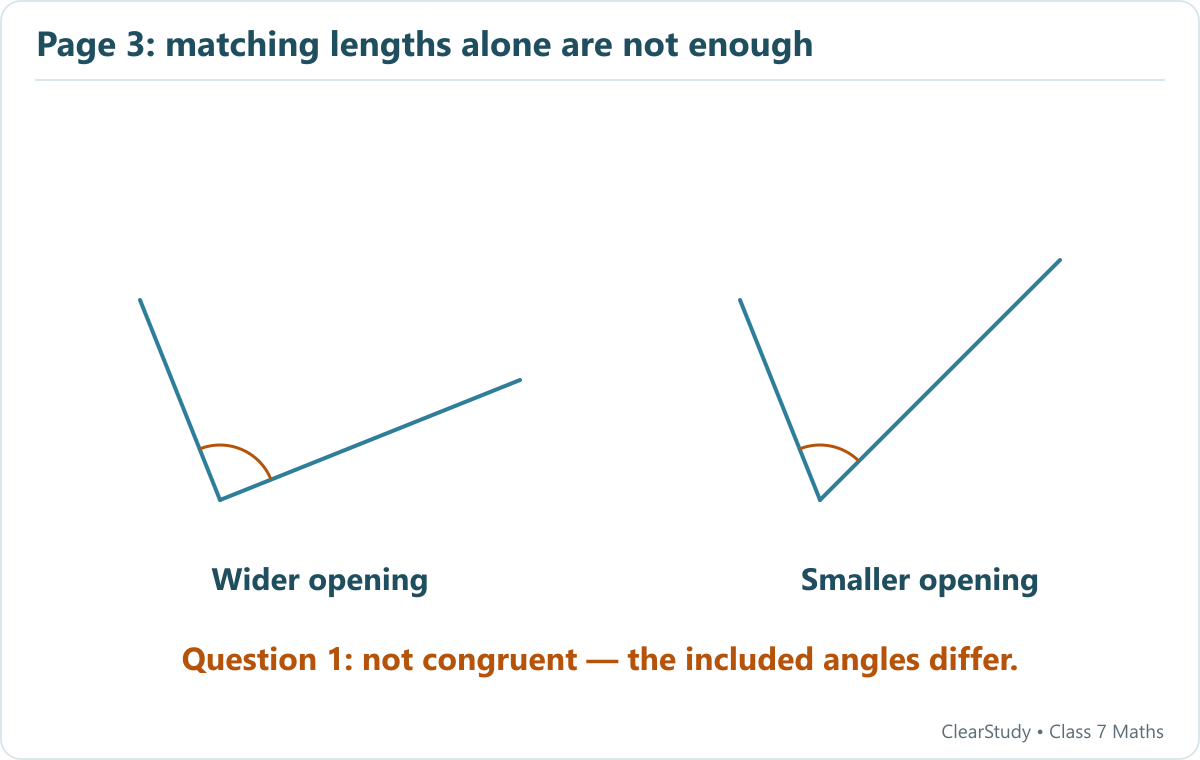
SOLUTIONNo, the two open-arm figures are not congruent. Their included angles are different. A tracing of one cannot fit both arms of the other exactly, even after a slide, turn or flip. Equal arm lengths alone would not be sufficient.
Schematic of the two open-arm figures in question 1. Their included angles differ, so rotating or flipping cannot make them coincide.
2. Circle the pairs that appear congruent.
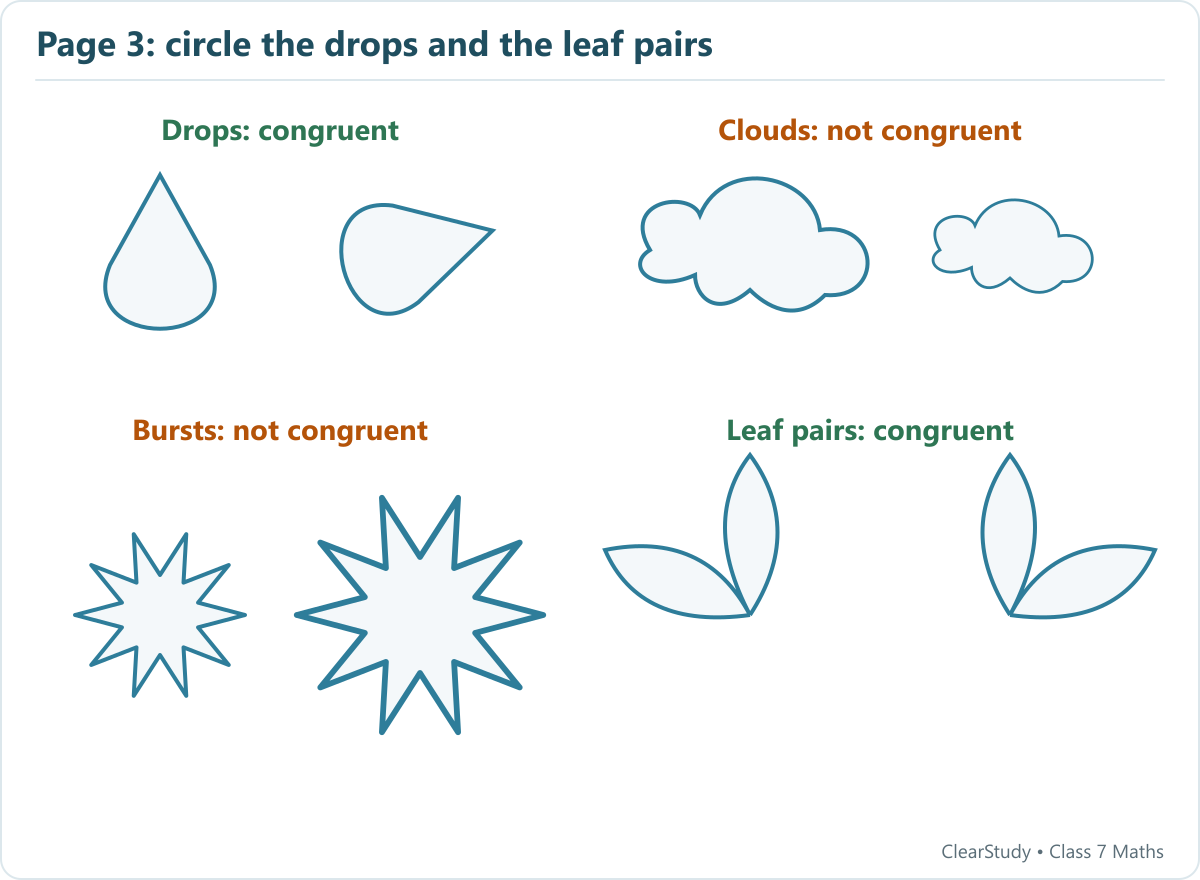
SOLUTIONCircle the drop-shaped pair (upper left) and the leaf pair (lower right). They match in shape and size after turning or flipping.The cloud pair and the burst-shaped pair differ in size, so leave those pairs uncircled. Trace and overlay the printed figures to check. The illustration below is an original schematic of the four comparisons.
Original schematic examples matching the textbook identification task: the drops and leaf pairs appear congruent; the clouds and bursts differ in size. Confirm by tracing, with rotation or reflection allowed.
3. What measurements would you take to create a figure congruent to a given:
(a) Circle (b) Rectangle
Using this, state how would you check if two —
(a) Circles are congruent?(b) Rectangles are congruent?
SOLUTIONTo recreate: (a) a circle — only the radius (or the diameter) is needed; (b) a rectangle — its length and breadth are needed (the angles are already 90°).To check congruence: (a) two circles are congruent if and only if they have equal radii.(b) two rectangles are congruent if and only if their lengths are equal and their breadths are equal (same length and same breadth).
4. How would we check if two figures like the one below are congruent? Use this to identify whether each of the following pairs are congruent.
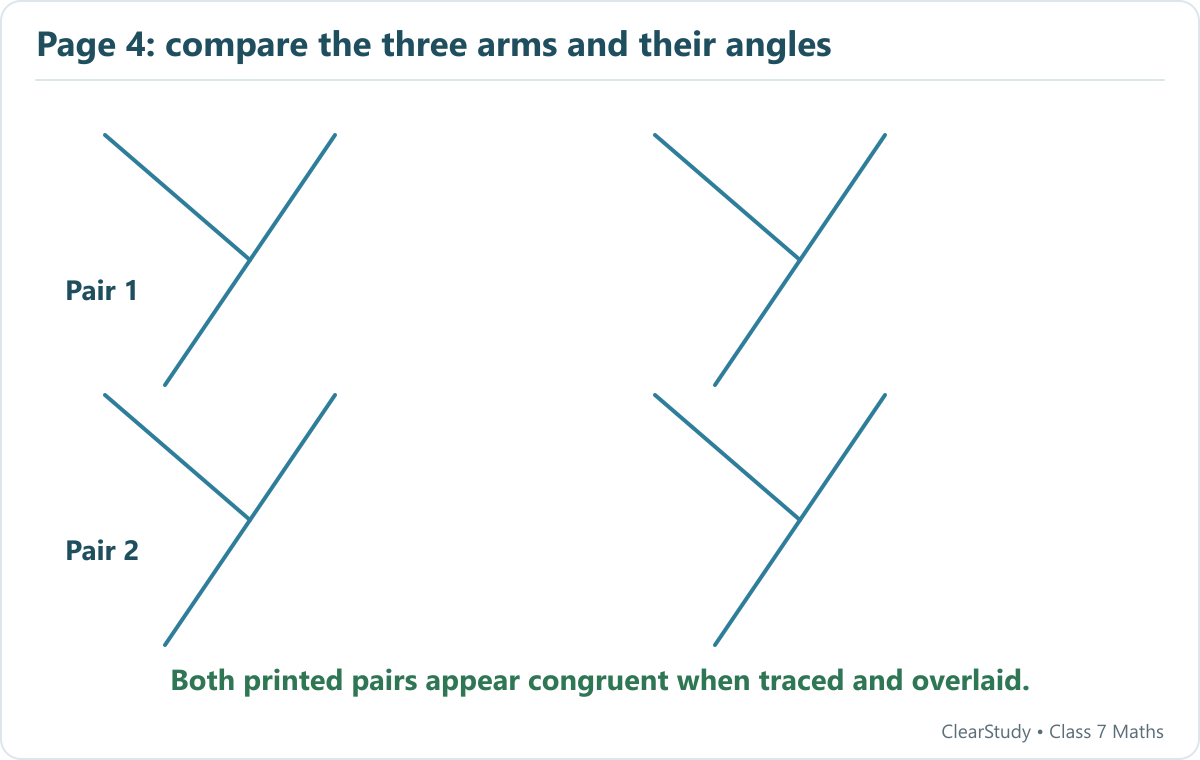
SOLUTIONMatch the junction and the three endpoints. Measure the three arm lengths from the junction and the angle between the branch and the straight line. The two collinear arms must also correspond correctly.Both pairs printed on page 4 appear congruent. In each pair the corresponding arms and angles match when one is traced and placed over the other. A slide, turn or flip is allowed; stretching or resizing is not.
The two pairs of branched figures on page 4 each appear congruent. Match the junction and the three endpoints, allowing a turn or flip. Check all three arm lengths and the angle made by the branch.
Figure it Out — Naming Congruence (Pages 8–9)
1. Suppose ΔHEN is congruent to ΔBIG. List all the other correct ways of expressing this congruence.
SOLUTIONIn ΔHEN ≅ ΔBIG the matching vertices are H↔B, E↔I, N↔G. Any correct statement must keep these pairs together (write both triangles’ letters in the same matched order).Listing the matched vertices in every order gives all correct forms:ΔHEN ≅ ΔBIG • ΔHNE ≅ ΔBGI • ΔEHN ≅ ΔIBG • ΔENH ≅ ΔIGB • ΔNHE ≅ ΔGBI • ΔNEH ≅ ΔGIB.∴ there are 5 other ways with the HEN triangle on the left, or 6 forms including the given one. Reversing the two sides of any congruence statement also gives an equivalent statement.
2. Determine whether the triangles are congruent. If yes, express the congruence.
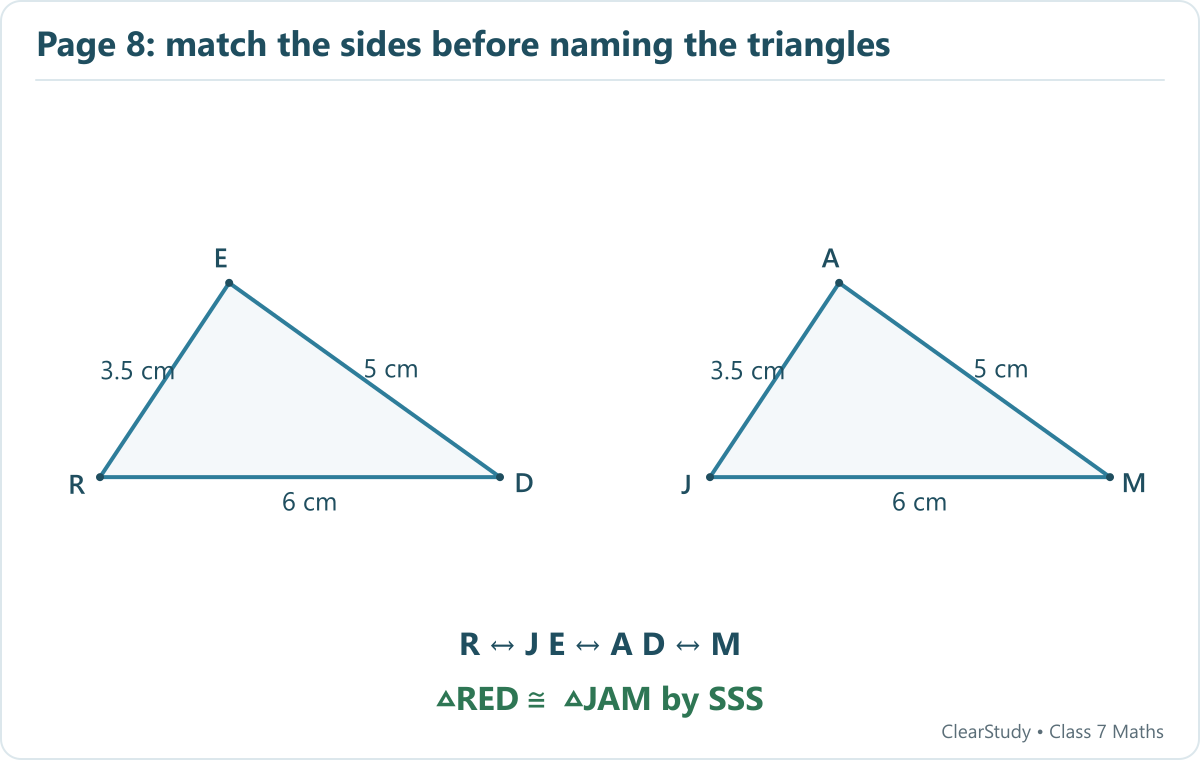
SOLUTIONRead the labels carefully: RE = JA = 3.5 cm, ED = AM = 5 cm, and RD = JM = 6 cm. The three corresponding side pairs are equal, so the triangles are congruent by SSS.R is the endpoint shared by the 3.5 cm and 6 cm sides, so R matches J. Similarly, E matches A and D matches M.Therefore ΔRED ≅ ΔJAM. The order ΔMJA would mismatch the side lengths.
RE=JA=3.5 cm, ED=AM=5 cm and RD=JM=6 cm. Therefore R matches J, E matches A and D matches M: triangle RED is congruent to JAM.
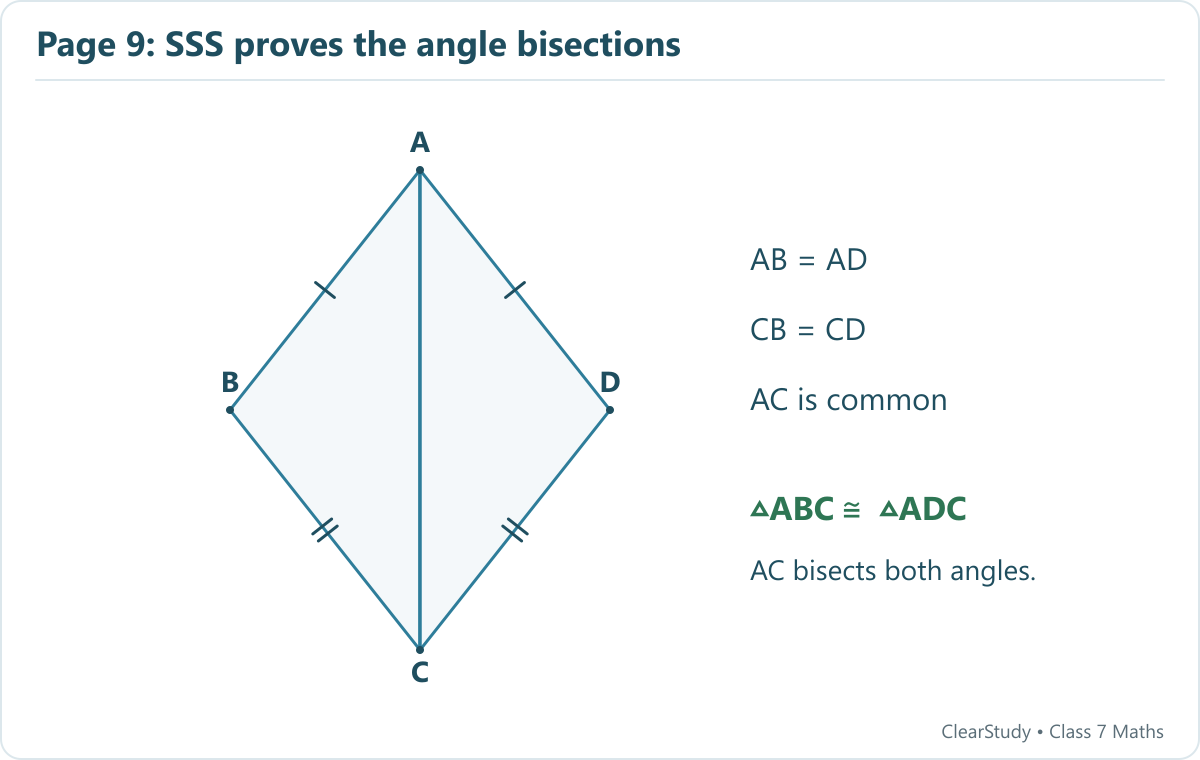
3. In the figure below, AB = AD, CB = CD. Can you identify any pair of congruent triangles? If yes, explain why they are congruent. Does AC divide ∠BAD and ∠BCD into two equal parts? Give reasons.
SOLUTIONConsider ΔABC and ΔADC. We are given AB = AD and CB = CD, and AC is a side common to both triangles (AC = AC).So all three pairs of sides are equal ⇒ by the SSS condition, ΔABC ≅ ΔADC.By CPCTC, the corresponding angles are equal: ∠BAC = ∠DAC and ∠BCA = ∠DCA.Therefore AC does divide both ∠BAD and ∠BCD into two equal parts — that is, AC bisects ∠BAD and ∠BCD.
AB=AD, CB=CD and AC is common, so ABC and ADC are congruent by SSS. The equal corresponding angles show that AC bisects BAD and BCD.
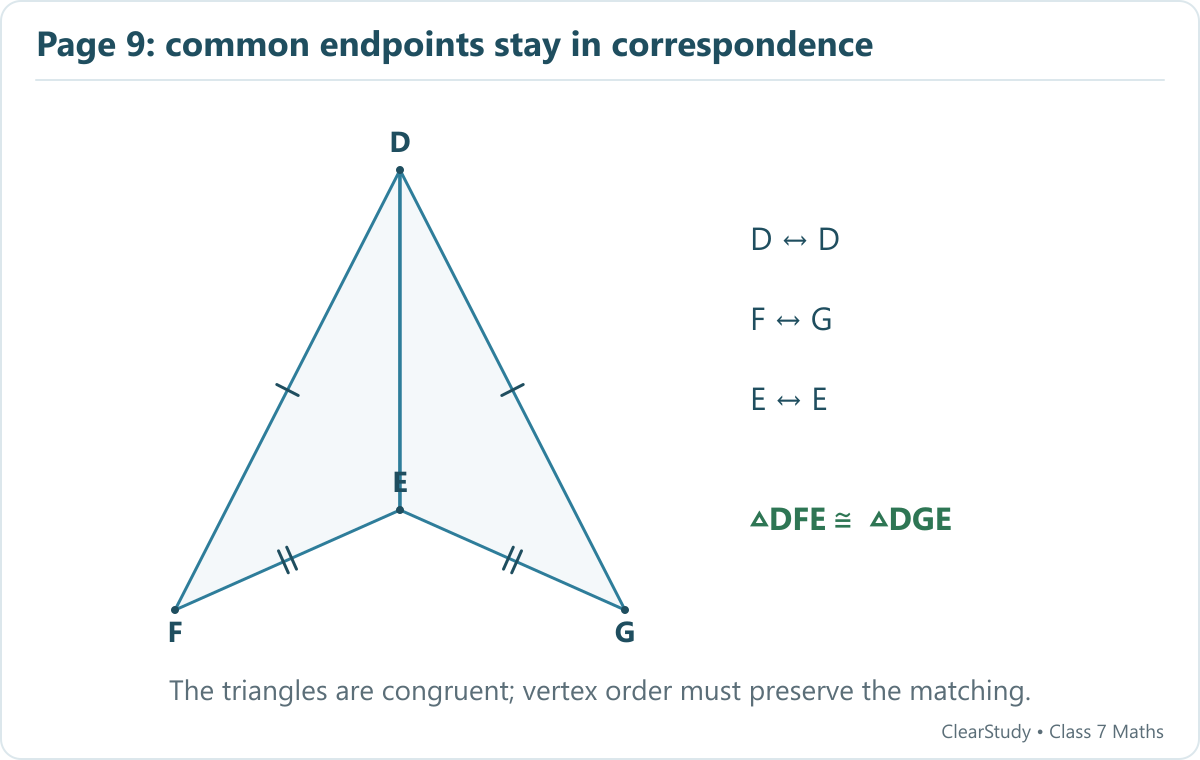
4. In the figure below, are ΔDFE and ΔGED congruent to each other? It is given that DF = DG and FE = GE.
SOLUTIONYes, the two triangles are congruent as figures. We have DF = DG and FE = GE (given), and DE = DE (common side), so SSS applies.The corresponding vertices are D ↔ D, F ↔ G, E ↔ E. Thus the correctly ordered statement is ΔDFE ≅ ΔDGE, or equivalently ΔFED ≅ ΔGED.The wording names the two triangles, but writing ΔDFE ≅ ΔGED would assert a different, generally incorrect vertex correspondence.
DF=DG, FE=GE and DE is common. The correct ordered statement is DFE congruent to DGE by SSS, with D matching D, F matching G and E matching E.
Figure it Out — ASA and More (Page 13–14)
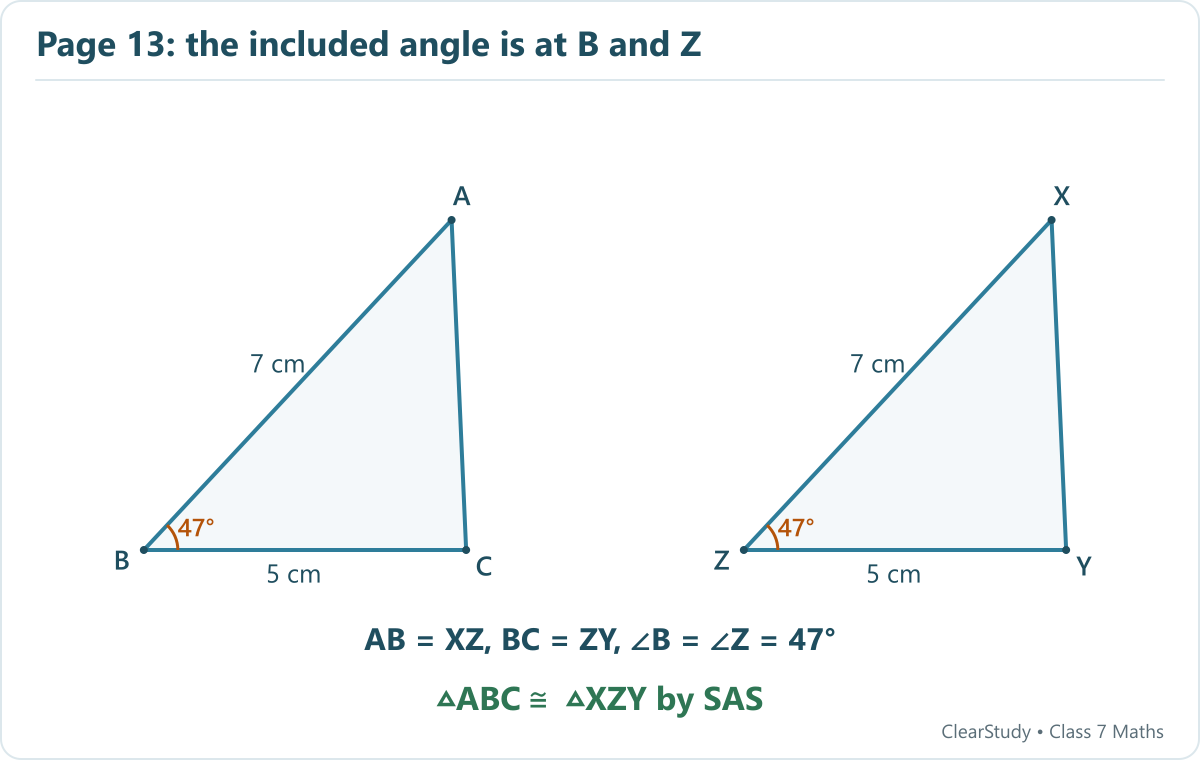
1. Identify whether the triangles below are congruent. What conditions did you use to establish their congruence? Express the congruence.
SOLUTIONIn the printed figure, AB = XZ = 7 cm, BC = ZY = 5 cm, and ∠ABC = ∠XZY = 47°. The equal angle lies between the two marked sides.The SAS condition holds. A matches X, B matches Z and C matches Y, so ΔABC ≅ ΔXZY.
The 7 cm sides are AB and XZ; the 5 cm sides are BC and ZY. The included 47-degree angles are B and Z, so ABC is congruent to XZY.
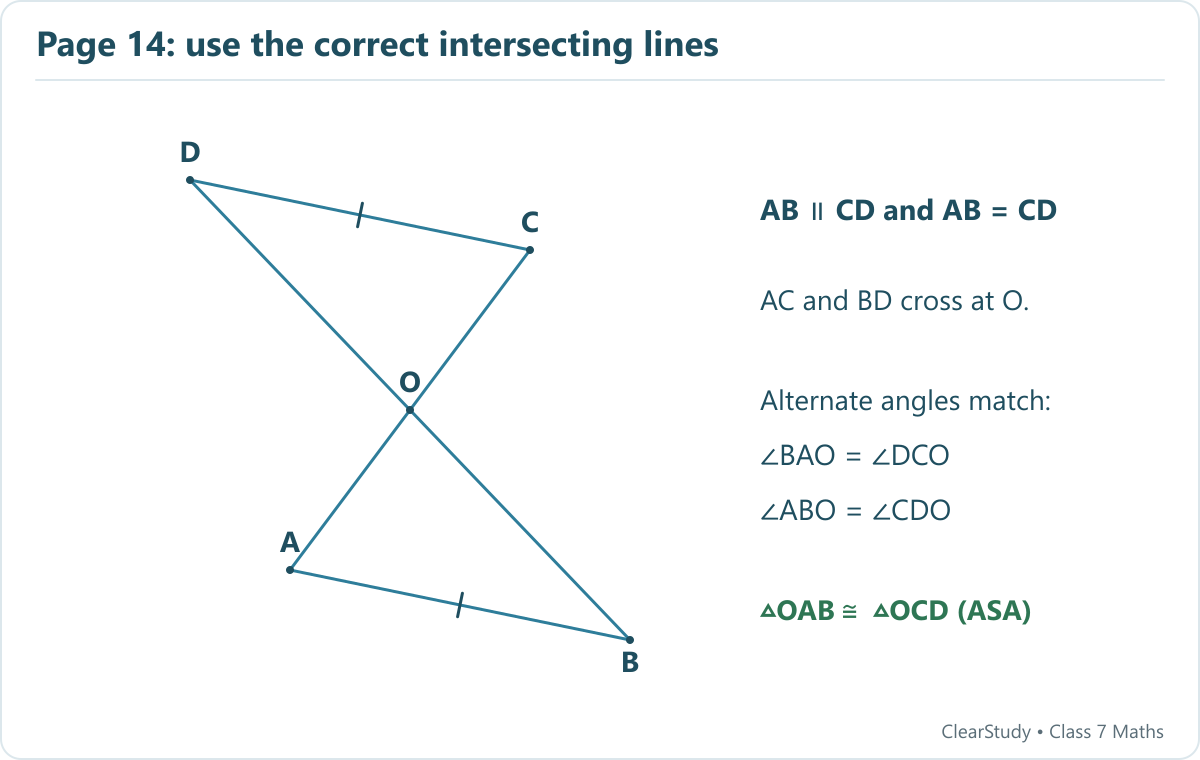
2. Given that CD and AB are parallel, and AB = CD, what are the other equal parts in this figure? (Hint: When the lines are parallel, the alternate angles are equal. Are the two resulting triangles congruent? If so, express the congruence.)
SOLUTIONAC and BD intersect at O. The lines AB and CD are parallel; they do not cross.Using AC as a transversal gives ∠BAO = ∠DCO. Using BD as a transversal gives ∠ABO = ∠CDO. These are alternate interior angle pairs.Together with AB = CD, the ASA condition gives ΔOAB ≅ ΔOCD.Corresponding parts therefore give OA = OC and OB = OD. Also ∠AOB = ∠COD (vertically opposite). Hence O is the midpoint of AC and BD.
AC and BD intersect at O, while AB and CD are parallel. Alternate angles and AB=CD give OAB congruent to OCD by ASA. Thus OA=OC and OB=OD.
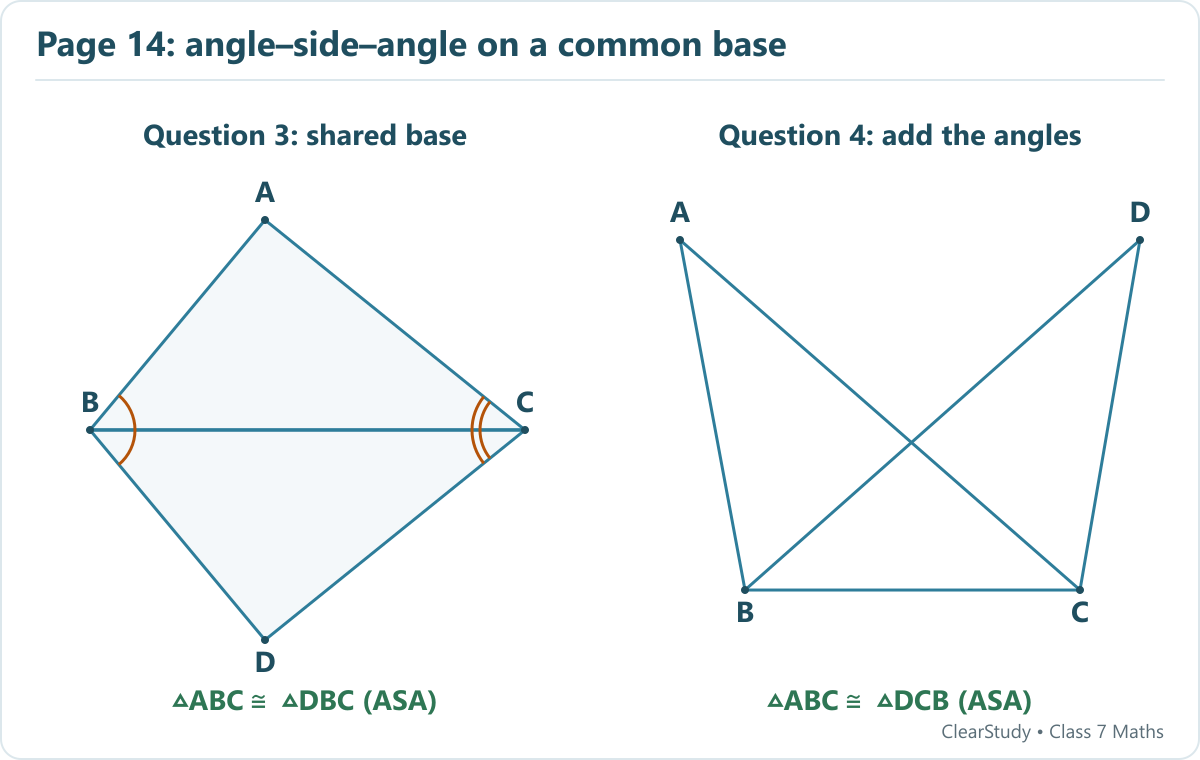
3. Given that ∠ABC = ∠DBC and ∠ACB = ∠DCB, show that ∠BAC = ∠BDC. Are the two triangles congruent?
SOLUTIONCompare ΔABC and ΔDBC. Given: ∠ABC = ∠DBC and ∠ACB = ∠DCB, and BC is the side common to both (BC = BC).Two angles and the included side BC are equal ⇒ by the ASA condition, ΔABC ≅ ΔDBC. So yes, the triangles are congruent.By CPCTC the remaining corresponding angles are equal, so ∠BAC = ∠BDC. (We can also see it from the angle sum: in each triangle the third angle = 180° − (the two equal angles), so the third angles are equal.)
4. Identify the equal parts in the following figure, given that ∠ABD = ∠DCA and ∠ACB = ∠DBC.
SOLUTIONLook at ΔABC and ΔDCB (they share the base BC). Add the equal angle pairs at B and at C:∠ABC = ∠ABD + ∠DBC and ∠DCB = ∠DCA + ∠ACB. Since ∠ABD = ∠DCA and ∠DBC = ∠ACB, adding gives ∠ABC = ∠DCB.Now in ΔABC and ΔDCB: ∠ABC = ∠DCB, ∠ACB = ∠DBC, and BC = CB (common). By the ASA condition, ΔABC ≅ ΔDCB.Equal parts (CPCTC): AB = DC, AC = DB and ∠BAC = ∠CDB, together with the given ∠ABD = ∠DCA and ∠ACB = ∠DBC.
Left: equal angles at B and C and common BC give ABC congruent to DBC. Right: adding the given angles gives ABC=DCB; with ACB=DBC and common BC, ABC is congruent to DCB.
Figure it Out — Conditions & Angle Properties (Page 20–21)
1. ΔAIR ≅ ΔFLY. Identify the corresponding vertices, sides and angles.
SOLUTIONThe order of letters gives the matching: A↔F, I↔L, R↔Y.Corresponding vertices: A and F, I and L, R and Y.Corresponding sides: AI and FL, IR and LY, AR and FY.Corresponding angles: ∠A and ∠F, ∠I and ∠L, ∠R and ∠Y.
2. Each of the following cases contains certain measurements taken from two triangles. Identify the pairs in which the triangles are congruent to each other, with reason. Express the congruence whenever they are congruent.
(a) AB = DE, BC = EF, CA = DF(b) AB = EF, ∠A = ∠E, AC = ED(c) AB = DF, ∠B = ∠D = 90°, AC = FE(d) ∠A = ∠D, ∠B = ∠E, AC = DF(e) AB = DF, ∠B = ∠F, AC = DE
SOLUTION(a) Three pairs of sides equal: AB = DE, BC = EF, CA = DF ⇒ SSS condition. Matching endpoints A↔D, B↔E, C↔F. Congruent: ΔABC ≅ ΔDEF.(b) Sides AB and AC meet at vertex A, and the equal angle is ∠A — the included angle. AB = EF, AC = ED, ∠A = ∠E ⇒ SAS condition. Matching A↔E, B↔F, C↔D. Congruent: ΔABC ≅ ΔEFD.(c) Right angles ∠B = ∠D = 90°; AC and FE are the hypotenuses (opposite the right angles) and are equal; AB = DF is one side. This is the RHS condition. Matching A↔F, B↔D, C↔E. Congruent: ΔABC ≅ ΔFDE.(d) Two angles ∠A = ∠D, ∠B = ∠E and a side AC = DF. AC is opposite ∠B and DF is opposite ∠E, so the equal side is a non-included side placed the same way in both ⇒ AAS condition. Matching A↔D, B↔E, C↔F. Congruent: ΔABC ≅ ΔDEF.(e) AB = DF, ∠B = ∠F, AC = DE. Here the equal angle (∠B / ∠F) is not the angle included between the two equal sides, so this is the SSA case — not a valid test. Not necessarily congruent.
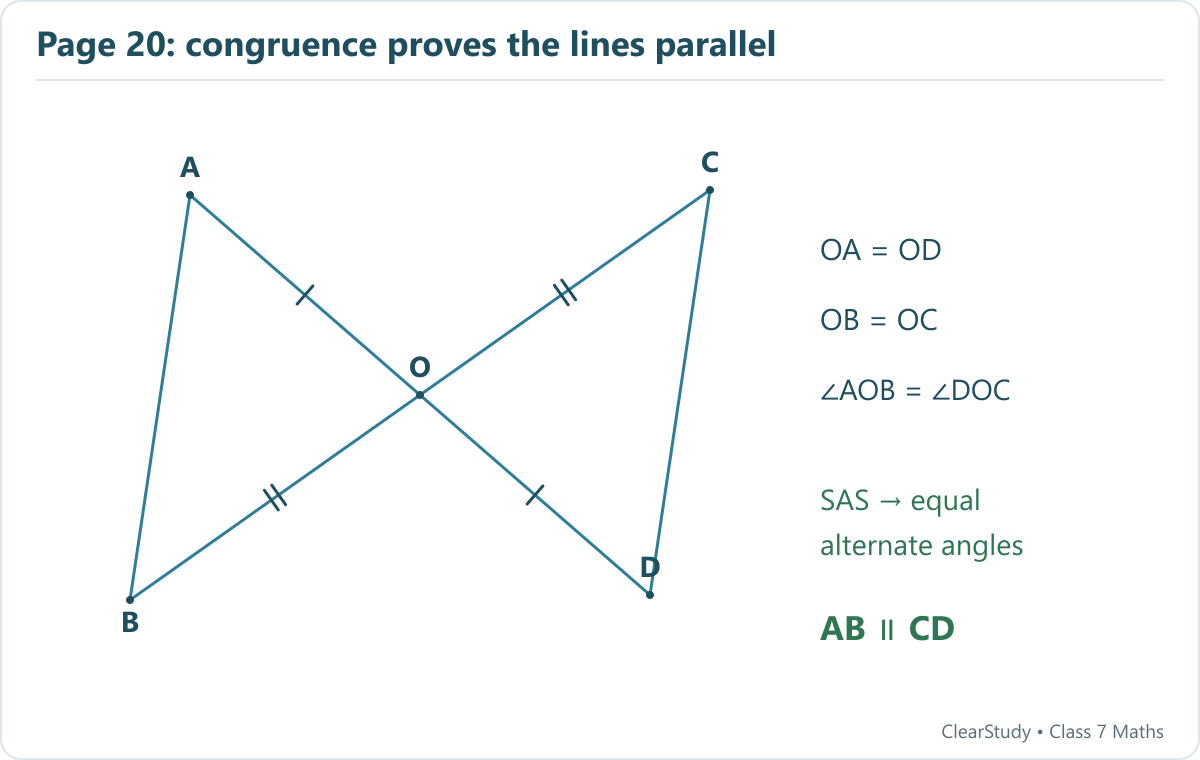
3. It is given that OB = OC, and OA = OD. Show that AB is parallel to CD. [Hint: AD is a transversal for these two lines. Are there any equal alternate angles?]
SOLUTIONAD and BC cross at O. In ΔOAB and ΔODC: OA = OD (given), OB = OC (given), and ∠AOB = ∠DOC (vertically opposite angles).Two sides and the included angle are equal ⇒ by the SAS condition, ΔOAB ≅ ΔODC.By CPCTC, ∠OAB = ∠ODC. Taking AD as a transversal of lines AB and CD, these are equal alternate interior angles.Equal alternate angles ⇒ the lines are parallel. Hence AB ∥ CD.
OA=OD, OB=OC and vertically opposite AOB=DOC establish OAB congruent to ODC by SAS. Corresponding angles OAB and ODC are equal, so AB and CD are parallel.
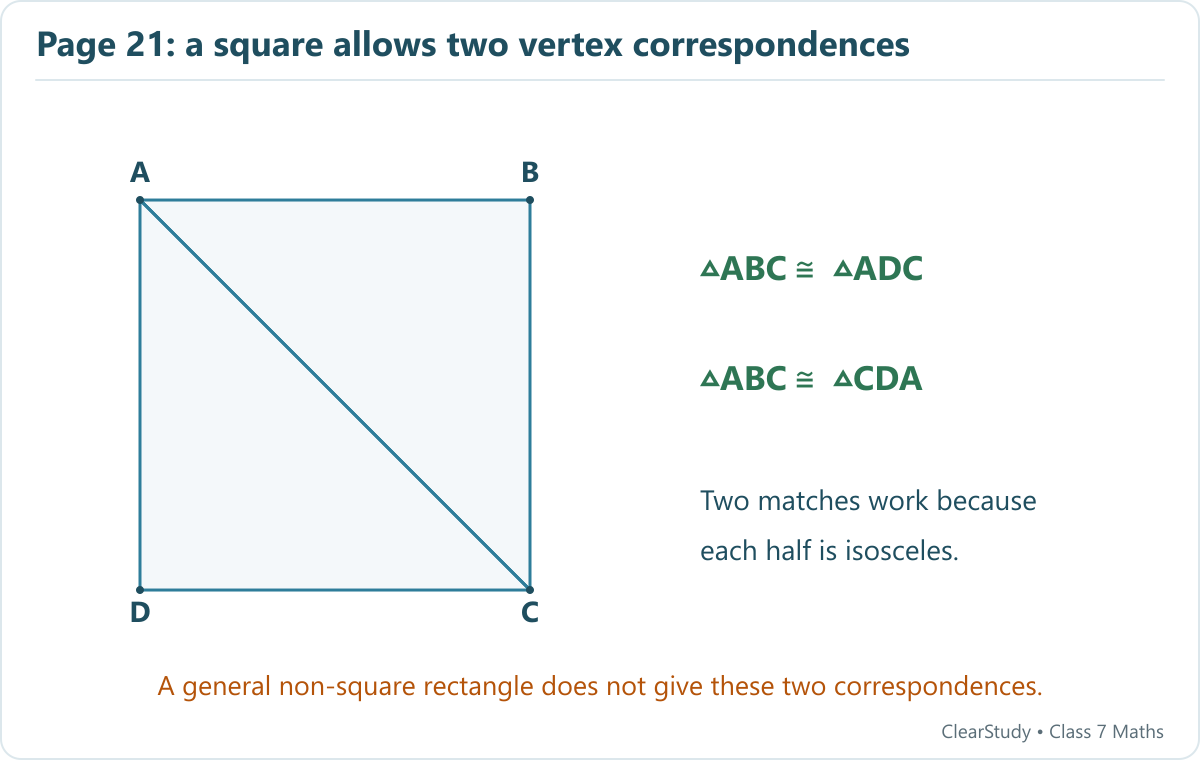
4. ABCD is a square. Show that ΔABC ≅ ΔADC. Is ΔABC also congruent to ΔCDA? Give more examples of two triangles where one triangle is congruent to the other in two different ways, as in the case above. Can you give an example of two triangles where one is congruent to the other in six different ways?
SOLUTIONIn square ABCD all sides are equal: AB = BC = CD = DA. Consider ΔABC and ΔADC with the common diagonal AC.AB = AD (sides of the square), BC = DC (sides of the square), AC = AC (common) ⇒ SSS condition, so ΔABC ≅ ΔADC.Is ΔABC ≅ ΔCDA? Yes. Match A↔C, B↔D, C↔A: AB = CD, BC = DA, CA = AC — all equal, so ΔABC ≅ ΔCDA too. Thus one triangle is congruent to the other in two ways.More examples (two ways): two congruent non-equilateral isosceles triangles allow their equal-side endpoints to be exchanged. For example, triangles with AB = AC = DE = DF = 5 cm and BC = EF = 6 cm satisfy both ΔABC ≅ ΔDEF and ΔABC ≅ ΔDFE. A diagonal of a non-equilateral rhombus gives another such pair. A general non-square rectangle gives scalene halves and does not allow two distinct vertex correspondences.Six different ways: take two equilateral triangles of the same size (e.g. side 5 cm each). Because all sides and all angles are equal, the vertices of one can be matched to the other in any of the 6 possible orders, giving six valid congruences.
The diagonal AC divides square ABCD into congruent isosceles right triangles. Both ABC congruent to ADC and ABC congruent to CDA are valid.
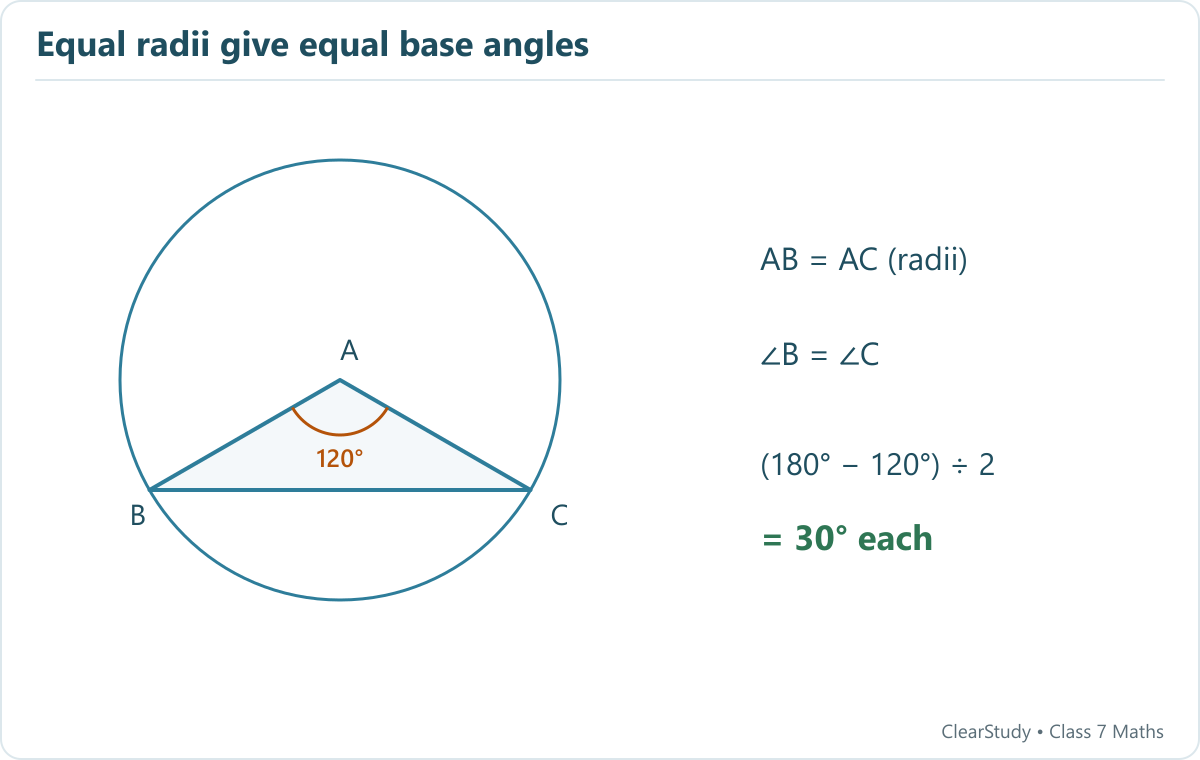
5. Find ∠B and ∠C, if A is the centre of the circle.
SOLUTIONSince A is the centre and B, C lie on the circle, AB and AC are radii, so AB = AC — the triangle is isosceles with apex angle ∠A = 120°.Angles opposite equal sides are equal, so ∠B = ∠C.By the angle sum: ∠B + ∠C + 120° = 180° ⇒ ∠B + ∠C = 60° ⇒ 2∠B = 60°.∴ ∠B = ∠C = 30°.
A is the centre. AB and AC are equal radii and angle BAC is 120 degrees, so the two remaining angles B and C are each 30 degrees.
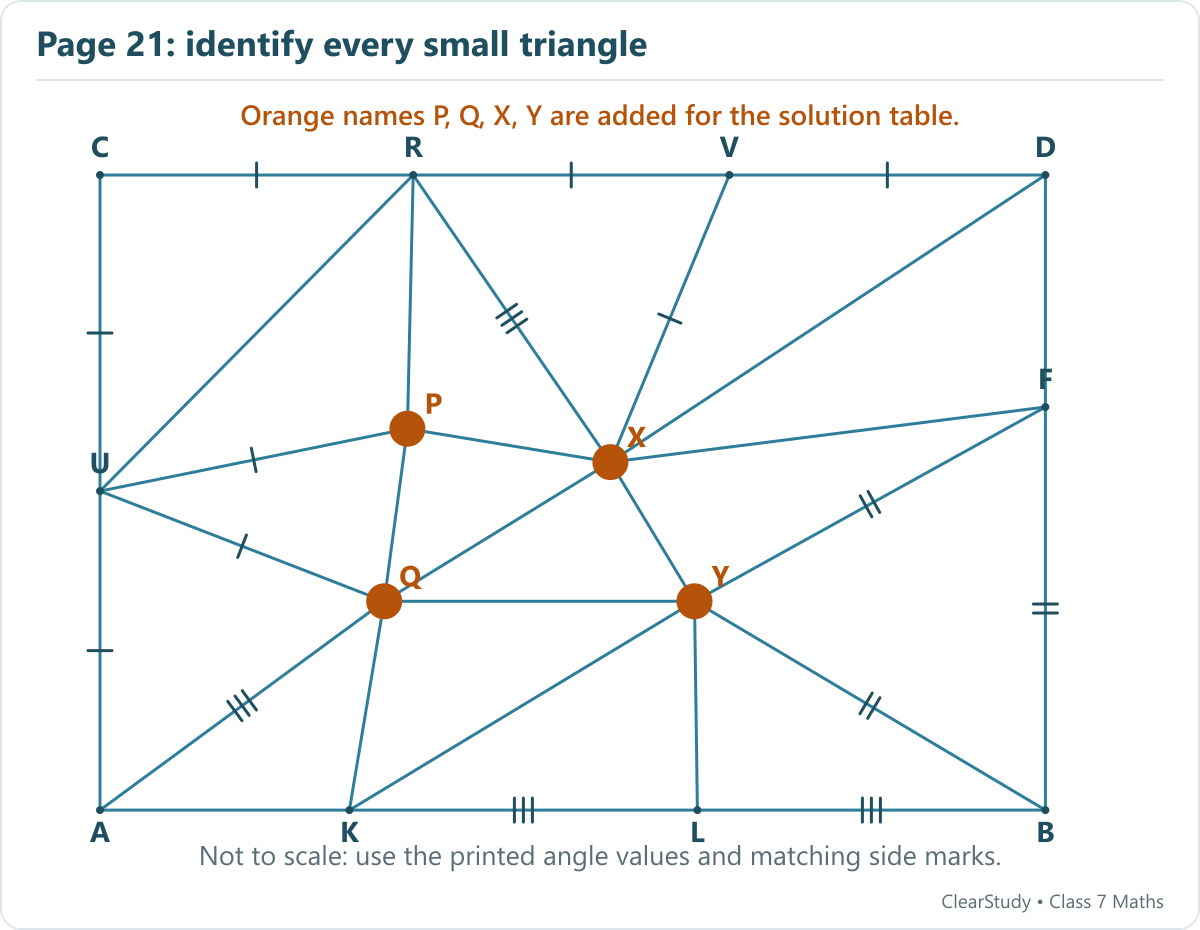
6. Find the missing angles. As per the convention that we have been following, all line segments marked with a single ‘|’ are equal to each other and those marked with a double ‘|’ are equal to each other, etc.
SOLUTIONTo name the unlabelled interior points, use P for the point joined to U and R, Q for the lower-left point on AD, X for the central junction on AD, and Y for the lower-right point on KF. These orange labels are added in our diagram.Use the angle sum, equal base angles in isosceles triangles, and angles on a straight line. The given 98° angle is ∠DFX; the 68° angle is ∠RVX. They belong to different small triangles. Their sum is 166°, which is not impossible, but combining them as if they belonged to one triangle is incorrect.Left side: CU = CR makes ∠CUR = ∠CRU = 45°. UA = UQ makes ∠UQA = 56° and ∠AUQ = 68°. UP = UQ gives the two base angles 73°. Then ∠RUP = 180 − 45 − 34 − 68 = 33°.Top: RV = VX gives ∠VRX = ∠RXV = 56°. Hence ∠URP = 180 − 45 − 56 − 34 = 45°. In RPX, the angle at P is 102°.Bottom and right: QXY gives ∠XQY = 34°. Along AD, ∠KQY = 180 − 44 − 34 = 102°, so ∠QKY = 48°. Along AB, ∠YKL = 180 − 102 − 48 = 30°. The RHS-congruent triangles YLK and YLB give ∠YBL = 30°. Triangle YBF is equilateral, so all its angles are 60°.Complete angle table: the three numbers in each row are in the same vertex order as the triangle name. Given angles are included so each row can be checked against 180°.
Triangle
Angles in vertex order (°)
Reason / calculation
CUR
90, 45, 45
CU = CR and the angle at C is 90°.
URP
33, 45, 102
Use the straight line CRV and the angles at R, then the triangle sum.
UPQ
34, 73, 73
UP = UQ; (180 − 34) ÷ 2 = 73.
UAQ
68, 56, 56
UA = UQ, so the angles at A and Q are equal.
AQK
34, 44, 102
180 − 34 − 44 = 102.
RPX
34, 102, 44
180 − 34 − 44 = 102.
PQX
83, 51, 46
At Q, 180 − 56 − 73 = 51; then use the triangle sum.
RHS matches YLK with YLB: KL = LB, KY = YB and both angles at L are 90°.
YBF
60, 60, 60
YB = YF = BF: the triangle is equilateral.
XYF
64, 94, 22
At Y, 180 − 56 − 30 = 94; at F, 180 − 60 − 98 = 22.
XDF
26, 56, 98
At X, 90 − 64 = 26; then D = 56.
XVD
34, 112, 34
At V, 180 − 68 = 112; VX = VD gives equal base angles.
RVX
56, 68, 56
RV = VX; (180 − 68) ÷ 2 = 56.
Teaching redraw of the angle network. P is the interior point joined to U and R; Q lies below P on AD; X is the central junction on AD; Y lies below-right of X on KF. The solution table lists all 16 small triangles. Added orange labels identify the previously unnamed points.
Math Talk & Try This — Answered
These are the in-text reflective questions and short tasks in the chapter; the determinate ones are answered, the open/figure-based ones are guided.
Math Talk — Recreating the signboard symbolAre the arm lengths AB and BC sufficient to exactly recreate this figure? Would another measurement help?Answer.No — with only AB = 4 cm and BC = 8 cm many different symbols can be drawn, because the angle between the arms can vary. Adding the included angle ∠ABC (say 80°) fixes the shape and size, so AB, BC and ∠ABC together give an exact replica. This is exactly the SAS idea.
Math Talk — Same arm lengths onlyIf both symbols have the same arm lengths, can we conclude that the two symbols are congruent?Answer.No. Equal arm lengths alone are not enough — the angle between the arms can differ, giving non-congruent figures. Only when the arm lengths and the angle between them are equal can we be sure the symbols are congruent.
Math Talk — Do you agree with Meera?Meera says the three side lengths (40 cm, 60 cm, 80 cm) are enough to make a congruent triangle, without measuring angles. Do you agree?Answer.Yes. By the SSS condition, three given side lengths fix a triangle’s shape and size completely. So the angles need not be measured — any triangle with sides 40 cm, 60 cm, 80 cm is congruent to the original. Meera is right.
Try This — Two circles intersecting (ΔABE and ΔABF)Examine whether ΔABE and ΔABF are congruent.Answer.They are congruent. AB is common, AE = AF (radii of the circle drawn from A) and BE = BF (radii of the circle drawn from B), so by SSS ΔABE ≅ ΔABF. AB acts as a line of symmetry, so the two triangles formed above and below AB are mirror copies — this is why three side lengths always give congruent triangles (SSS).
Math Talk — Three equal angles (30°, 70°, 80°)If two triangles have the same three angles (30°, 70°, 80°), must they be congruent?Answer.No. Many triangles can have the same set of angles — they have the same shape but different sizes (they are similar, not congruent). So “AAA” is not a congruence condition; at least one side length must also be known.
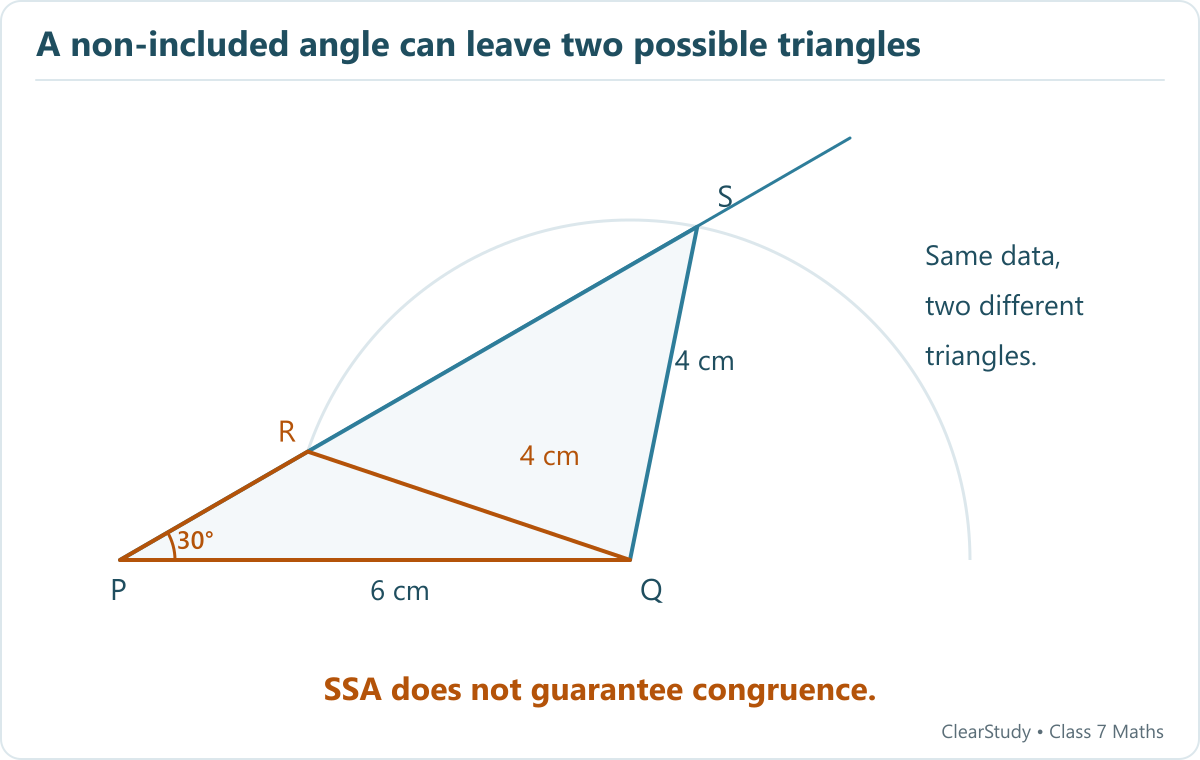
Try This — SSA case (two sides & a non-included angle)With AB = XY = 6 cm, AC = XZ = 4 cm and ∠B = ∠Y = 30°, can there be non-congruent triangles?Answer.Yes. When the arc of radius 4 cm is drawn, it cuts the line at two points R and S, giving two different triangles ΔPQR and ΔPQS with the same measurements. So the SSA condition does not guarantee congruence.
With PQ=6 cm and a 30-degree ray from P, a circle of radius 4 cm from Q meets the ray at R and S. Both PQR and PQS fit the data but are not congruent.
Math Talk — O is the midpoint of AD and BCPoint O is the midpoint of AD and of BC. What can we say about the lengths AB and CD?Answer. AO = OD and BO = OC (O is the midpoint), and ∠AOB = ∠DOC (vertically opposite). By SAS, ΔAOB ≅ ΔDOC, so the corresponding sides AB = DC — the two lengths are equal.
Try This — AAS case (35°, 75°, BC = 4 cm)With ∠A = ∠X = 35°, ∠C = ∠Z = 75° and BC = YZ = 4 cm, are the triangles congruent?Answer.Yes. Find the third angle: ∠B = 180° − (35° + 75°) = 70°, and similarly ∠Y = 70°. Now ∠B = ∠Y, BC = YZ, ∠C = ∠Z — the ASA condition — so ΔABC ≅ ΔXYZ. This is why the AAS condition guarantees congruence.
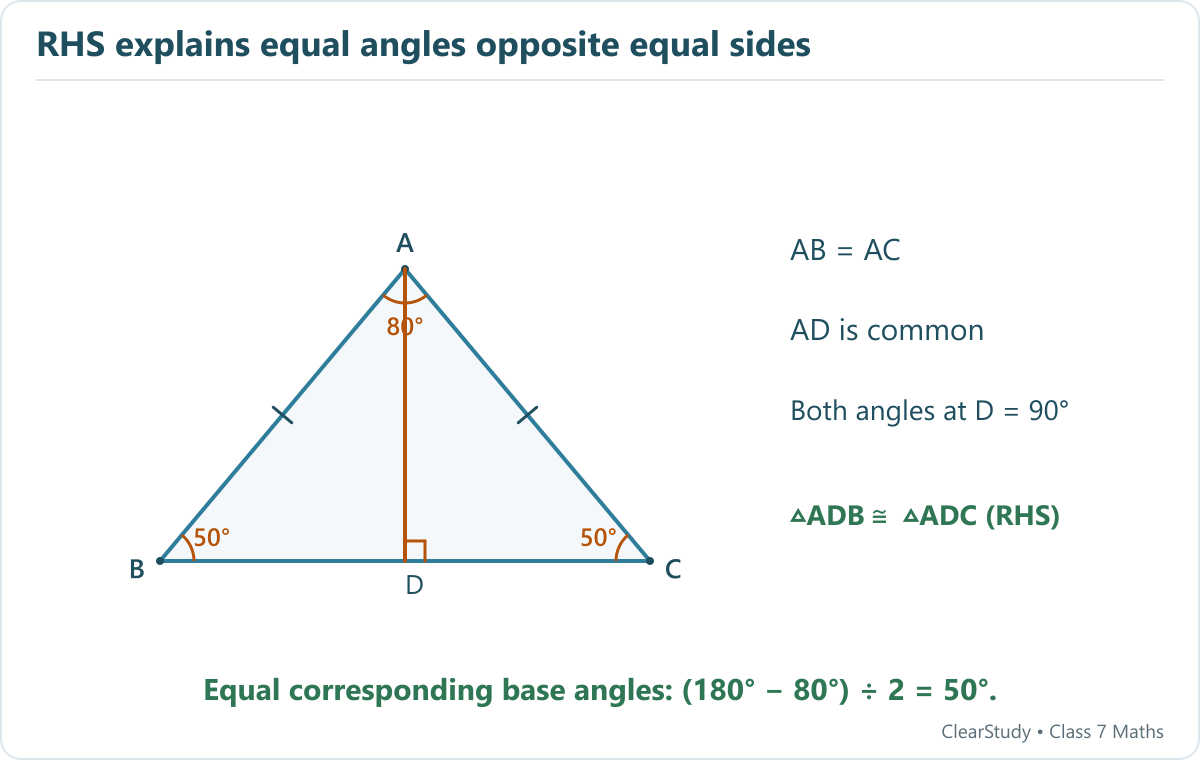
Math Talk — Isosceles triangle, ∠A = 80°ΔABC is isosceles with AB = AC and ∠A = 80°. What can we say about ∠B and ∠C?Answer. Angles opposite equal sides are equal, so ∠B = ∠C. Then ∠B + ∠C = 180° − 80° = 100°, giving ∠B = ∠C = 50°.
In isosceles ABC with apex angle 80 degrees, draw altitude AD. The two right triangles have equal hypotenuses AB and AC and common AD, so RHS makes the base angles equal: B=C=50 degrees.
Math Talk — Angles of an equilateral triangleWhat are the measures of the angles of an equilateral triangle?Answer. All three sides are equal, so all three angles are equal. Since they add to 180°, each angle = 180° ÷ 3 = 60°.
Further construction checks (Pages 10, 12 and 16–17)SAS: AB = XY = 6 cm, AC = XZ = 5 cm and ∠A = ∠X = 30° determine congruent triangles. Draw one side, the included angle, then mark the second side and join the endpoints.ASA: BC = YZ = 5 cm, ∠B = ∠Y = 50° and ∠C = ∠Z = 30° determine congruent triangles. The third angle is 100°.RHS: BC = YZ = 4 cm, ∠B = ∠Y = 90° and hypotenuse AC = XZ = 5 cm determine congruent triangles. The possible construction below the base is a reflection of the one above, so it is congruent too.
Rectangle cutouts and real-life trianglesRectangle ABCD: diagonal BD gives ΔABD ≅ ΔCDB by SSS: AB = CD, AD = CB and BD is common. The match A ↔ C, B ↔ B, D ↔ D generally fails because it would pair AB with CB.Photographs on pages 19–20: look for repeated triangular panels in a structure or repeated triangular units in a design. They may be congruent when the actual corresponding measurements agree; perspective in a photograph alone is not a proof of equal lengths.
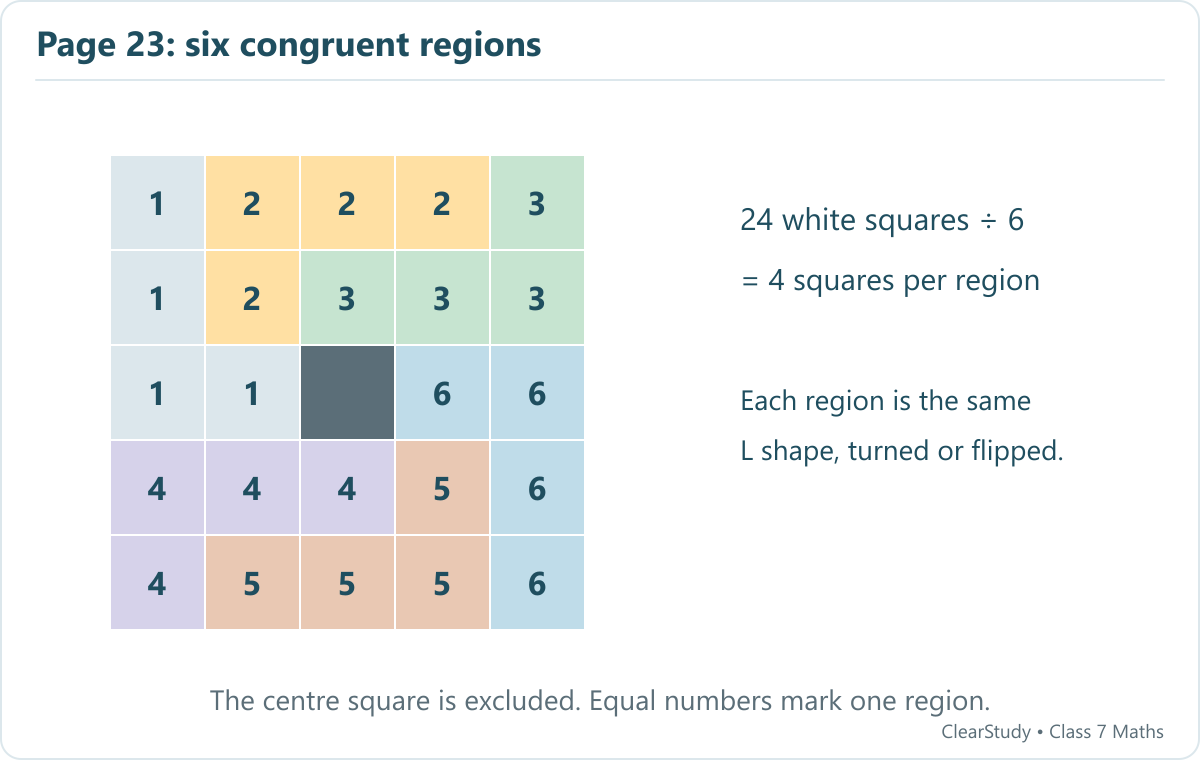
Expression Engineer! — six congruent regions (Page 23)The 5 × 5 board has 25 cells, and the centre is excluded. The 24 white cells must form six equal-area regions of 4 cells each.The numbered diagram below gives one solution using six L-shaped tetrominoes. Each region is connected, contains four cells and can be rotated or flipped to fit any other region. Equal area alone would not prove congruence; here the shapes also match.
Split the 5 by 5 board excluding its centre into six congruent L-shaped regions of four cells each. Matching numbers and colours identify the six regions; each is a rotation or reflection of the same L tetromino.
Common Mistakes to Avoid
Watch out for these
Treating SSA (two sides + a non-included angle) as a valid test — it is not; two different triangles can fit the same SSA data.
Thinking equal angles (AAA) make triangles congruent — they only make them the same shape (similar), not the same size.
Writing the congruence in the wrong vertex order — in ΔABC ≅ ΔXYZ the letters must be matched so that equal sides and angles line up (A↔X, B↔Y, C↔Z).
Forgetting the common side or vertically opposite angle that often supplies the third equal part needed for SSS, SAS or ASA.
For RHS, forgetting that the equal long side must be the hypotenuse (opposite the right angle), not just any side.
Confusing “angles opposite equal sides are equal” with the converse direction — identify which sides are equal first, then their opposite angles.
Practice MCQs & Assertion–Reason
1. Two figures are congruent if they have the same:
(a) shape only (b) size only (c) shape and size (d) colour
2. The symbol ≅ stands for:
(a) is parallel to (b) is congruent to (c) is greater than (d) is similar to
3. Two circles are congruent if and only if they have equal:
(a) colours (b) positions (c) radii (d) centres
4. Which of these is NOT a valid condition for congruence of triangles?
(a) SSS (b) SAS (c) SSA (d) ASA
5. If two sides and the included angle of one triangle equal those of another, the triangles are congruent by:
For each Assertion–Reason question, choose: (A) Both Assertion and Reason are true and the Reason is the correct explanation of the Assertion; (B) Both are true but the Reason is not the correct explanation; (C) Assertion is true but Reason is false; (D) Assertion is false but Reason is true.
A-R 1. Assertion: If the three sides of one triangle equal the three sides of another, the triangles are congruent.
Reason: This is the SSS condition for congruence.
A-R 2. Assertion: Two triangles with the same three angles are always congruent.
Reason: Triangles with equal angles have the same shape but may differ in size.
A-R 3. Assertion: The SSA condition always guarantees congruence of triangles.
Reason: An arc drawn for the non-included side can cut a line at two different points, giving two triangles.
A-R 4. Assertion: Each angle of an equilateral triangle is 60°.
Reason: All three angles are equal and the angles of a triangle add up to 180°.
A-R 5. Assertion: In a triangle, angles opposite equal sides are equal.
Reason: Dropping the altitude from the apex of such a triangle creates two congruent triangles (RHS).
Answer key: 1-(A), 2-(D), 3-(D), 4-(A), 5-(A).
Quick Revision Summary
Congruent figures have the same shape and size; they superimpose exactly, even after a rotation or flip (≅ means “is congruent to”).
Circles are congruent if radii are equal; rectangles if lengths and breadths are equal.
The five valid triangle-congruence conditions are SSS, SAS, ASA, AAS and RHS.
The SSA condition (two sides + a non-included angle) does not guarantee congruence; equal angles alone (AAA) only give the same shape.
In ΔABC ≅ ΔXYZ the vertex order shows correspondence; corresponding parts of congruent triangles are equal (CPCTC).
Angles opposite equal sides are equal; so an isosceles triangle has equal base angles.
Every angle of an equilateral triangle is 60°.
How to score full marks in this chapter
State the congruence condition by name (SSS / SAS / ASA / AAS / RHS) and list the three equal parts you are using before writing ≅. Always look for a common side or a vertically opposite angle — it is often the missing third part. Write the congruence with vertices in matching order, and quote CPCTC whenever you read off equal sides or angles afterwards. For angle questions, combine “equal sides → equal opposite angles” with the 180° angle sum.
Frequently Asked Questions
What is Class 7 Maths Ganita Prakash Chapter 9 about?
Chapter 9, Geometric Twins (Ganita Prakash Part II, Chapter 1), is about congruence — figures with the same shape and size. It develops the SSS, SAS, ASA, AAS and RHS conditions for congruent triangles, shows why SSA fails, and uses congruence to prove properties of isosceles and equilateral triangles.
What are the five conditions for congruence of triangles?
They are SSS (three sides), SAS (two sides and the included angle), ASA (two angles and the included side), AAS (two angles and a non-included side) and RHS (right angle, hypotenuse and one side). SSA is not a valid condition.
Why is Chapter 9 the same as Part II Chapter 1?
Ganita Prakash for Class 7 is published in two parts. Part I has Chapters 1–8 and Part II restarts numbering from 1. On ClearStudy we use continuous numbering, so Part II Chapter 1 (Geometric Twins) is listed as Chapter 9.
Are these Class 7 Maths Ganita Prakash Chapter 9 solutions free?
Yes. All solutions are free and follow the official NCERT Ganita Prakash (Part II) textbook for the 2026–27 session, with every Figure it Out, Math Talk and Try This task solved step by step.