
NCERT Solutions for Class 7 Science (Curiosity) Chapter 1: The Ever-Evolving World of Science (NCERT 2026–27)
These Class 7 Science Curiosity Chapter 1 solutions cover The Ever-Evolving World of Science from the new NCF-2023 textbook (2026–27). Chapter 1 is the year’s opening chapter: it invites you to continue the journey begun in Grade 6 and to see science as an ongoing process of asking questions, doing experiments and exploring the world, rather than presenting a single science topic.
Note: Chapter 1 of Curiosity is an introductory chapter and does not have an end-of-chapter “Let us enhance our learning” / “Keep the curiosity alive” exercise. Its only task is Activity 1.1: Question the Answer, for which model questions are given below. This page was checked against pages 1–6 of the NCERT Curiosity Class 7 textbook, Reprint 2026–27. The additional practice is written by ClearStudy.
Class 7 Science Curiosity Chapter 1 Solutions – Overview
Chapter 1 of Curiosity, The Ever-Evolving World of Science, sets the tone for Grade 7 science. It reminds us that science is not just a collection of facts but a process — a way of thinking that welcomes curiosity, asks questions and stays open to the unknown. The chapter takes a quick journey through the whole book: we begin with the properties of materials (why some fruits are sour, what removes a haldi stain), then play with batteries, lamps and wires, classify metals and non-metals, study reversible and irreversible changes, follow how heat flows and how water moves, explore life processes in animals and plants, learn to measure time and motion, and finally investigate light, shadows, eclipses and the movements of the Earth, Moon and Sun. The big message is that all these fields are interconnected, that human activities are linked to the natural world, and that science can help build a more sustainable world. The page numbers, drawn as a butterfly and a paper plane, capture this spirit — learning takes flight when curiosity leads the way.
Key Concepts & Ideas
Science as a process: science is not just facts to memorise — it is a way of thinking that welcomes curiosity, asks questions and is open to the unknown.
Asking deeper questions: in Grade 7 we ask How do things work? Why do events happen the way they do? What can we learn from patterns in nature?
Learning by doing: we step out of the book and classroom to experience the world through activities and experiments that lead to deeper understanding.
Interconnected fields: physics, chemistry, biology and earth science look like separate chapters, but ideas in one area inspire discoveries or questions in another.
Science and responsibility: human activities are linked to the natural world and to society, and science can help address environmental challenges and create a more sustainable world.
Curiosity and questioning: “To be a wise person, you must be a whys person” — great scientists do not just answer questions, they ask amazing ones.
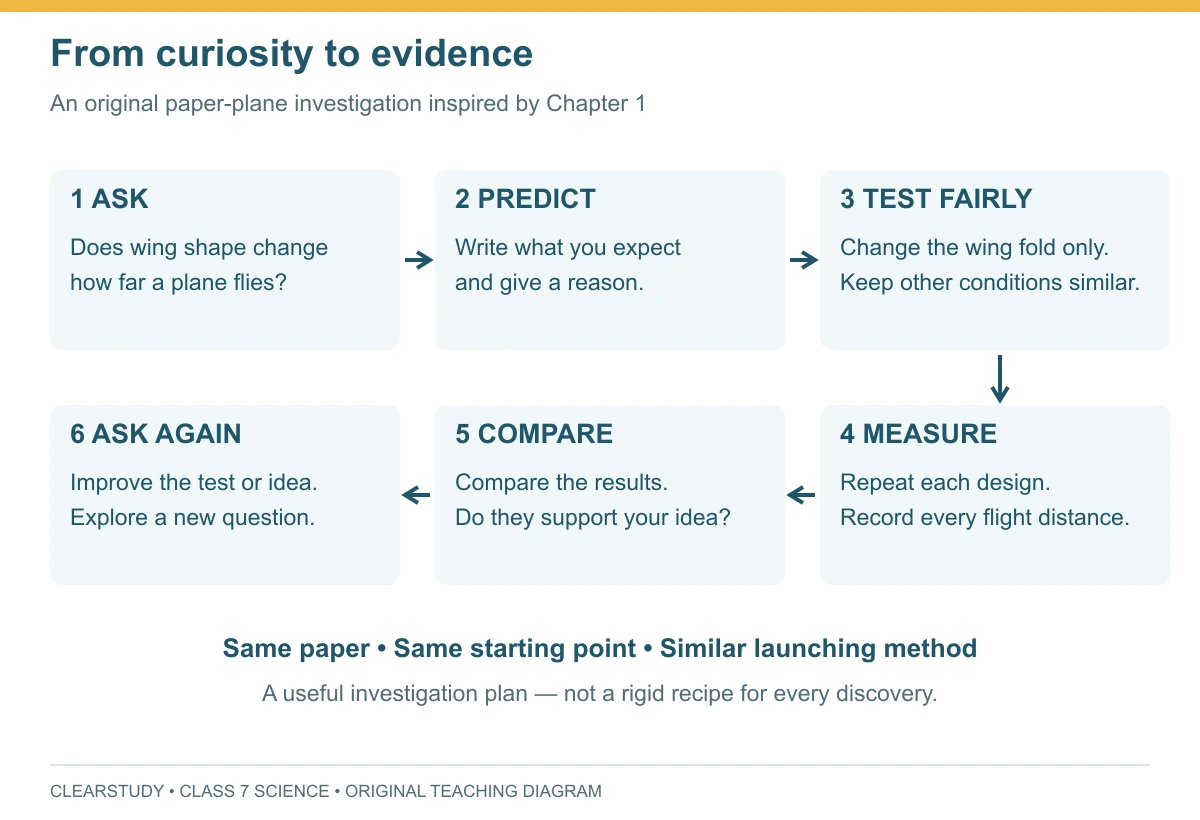
Scientific work is flexible: observations, comparisons, models and experiments can all supply evidence. A result may support an explanation, challenge it or suggest a new question. Fly only in a clear space, away from people’s faces.
Activity 1.1 — “Question the Answer” (Solved)
In tests we are usually given a question and asked for the answer. This activity turns that around: you are given an answer, and your task is to invent a curious, creative question that could lead to it. There are never any wrong questions here, so any sensible, imaginative question is correct. The book’s four answers are reproduced verbatim below, each with a model question (and a few extra ideas) to show the kind of thinking expected.
Tip from the book: avoid obvious questions like “What is 32 + 10?” — aim for interesting, fun ones.
Q. Question: ____________ ? Answer: Just add some milk.
Q. Question: ____________ ? Answer: Because the cat’s teeth were crooked.
Q. Question: ____________ ? Answer: Don’t panic, I have my towel.
Q. Question: ____________ ? Answer: 42
Q. What does this activity teach us about thinking like a scientist?
Common Misconceptions to Avoid
Watch out for these
- Thinking science is only a list of facts to memorise — it is really a process of questioning, experimenting and exploring.
- Believing the chapters of the book are unrelated — physics, chemistry, biology and earth science are all interconnected.
- Thinking science happens only in a laboratory — we can observe and experiment at home, in the kitchen and outdoors too.
- Assuming there are “wrong” questions in Activity 1.1 — the activity has no wrong questions; creativity is what matters.
- Forgetting that science carries responsibility — our activities affect the natural world and society.
- Treating an experiment as the end — even results that confirm what we expected can lead to new questions and more experiments.
Extra Practice Questions
These questions and MCQs are ClearStudy practice, separate from the NCERT exercise.
Very Short / Short Answer Type Questions
Q1. Science is best described as a collection of facts or as a process. Which is correct?
Q2. Write the kinds of “deeper questions” the chapter says we will ask in Grade 7.
Q3. What do the butterfly and paper plane drawn near the page numbers stand for?
Q4. Give one example from the chapter of a material question we will explore this year.
Q5. What does the saying “To be a wise person, you must be a whys person” mean?
Long Answer Type Questions
Q1. “The different chapters of this book are all interconnected.” Explain this idea with examples.
Q2. The chapter says science is “not just about discovery alone, but also about responsibility.” Discuss.
Q3. Why does the chapter encourage us to ask questions and do experiments rather than only read the book?
MCQs & Assertion–Reason
1. According to Chapter 1, science is best understood as:
(a) only a set of facts (b) a process and a way of thinking (c) a list of formulas (d) something only adults can do
2. The page numbers in the Curiosity book are drawn as:
(a) a bird and a fish (b) a butterfly and a paper plane (c) a kite and a root (d) a Sun and a Moon
3. Which question is an example of the “material” questions the chapter says we will explore?
(a) Why are some fruits sour? (b) How does the heart beat? (c) Why is the sky blue? (d) How do plants make food?
4. The chapter says the different fields of science are:
(a) completely separate (b) interconnected (c) unrelated to daily life (d) only about physics
5. “To be a wise person, you must be a ______ person.”
(a) busy (b) quiet (c) whys (d) clever
6. In Activity 1.1, “Question the Answer”, the student is asked to:
(a) find the answer to a question (b) invent a question for a given answer (c) copy the answer (d) ignore the answer
7. In Activity 1.1, which of these is given as one of the answers?
(a) Just add some salt (b) 42 (c) Run away quickly (d) Switch off the light
8. The chapter says human activities are linked to:
(a) nothing in nature (b) the natural world and society (c) only the kitchen (d) only machines
9. With the heat from the Sun, water from the seas:
(a) freezes (b) evaporates and falls as rain (c) disappears forever (d) turns into oil
10. The chapter says even experiments that confirm what we expect:
(a) prove science is finished (b) should be forgotten (c) may lead to new questions and more experiments (d) are a waste of time
For each Assertion–Reason question, choose: (A) Both true and the Reason correctly explains the Assertion; (B) Both true but the Reason is not the correct explanation; (C) Assertion true, Reason false; (D) Assertion false, Reason true.
A-R 1. Assertion: Science is a process, not just a collection of facts.
Reason: Science is a way of thinking that welcomes curiosity, asks questions and is open to the unknown.
A-R 2. Assertion: The chapters of the Curiosity book are interconnected.
Reason: A scientific idea in one field often inspires discoveries or questions in another.
A-R 3. Assertion: In Activity 1.1 there are right and wrong questions.
Reason: The activity encourages creative thinking and says there are never any wrong questions.
A-R 4. Assertion: Science is about discovery as well as responsibility.
Reason: Human activities are linked to the natural world and science can help build a sustainable world.
A-R 5. Assertion: Doing experiments and activities helps us understand the world more deeply than reading alone.
Reason: Experiences serve as stepping stones to a deeper understanding and can lead to new questions.
Quick Revision Summary
- Science is a process — a way of thinking that welcomes curiosity, asks questions and stays open to the unknown.
- In Grade 7 we ask deeper questions: How do things work? Why do events happen? What patterns do we see in nature?
- We learn by doing activities and experiments, not only by reading.
- The book’s fields — materials, electricity, metals/non-metals, changes, heat, water, life processes, time and motion, light, and the Earth–Moon–Sun — are all interconnected.
- Science carries responsibility: human activities affect nature and society, and science can help create a sustainable world.
- Activity 1.1 “Question the Answer”: invent a creative question for each given answer; there are no wrong questions. “To be a wise person, you must be a whys person.”
Real-life Applications
The habit of seeing science everywhere works far beyond the classroom. A cook who wonders why some fruits are sour, a parent removing a stubborn haldi stain, a child watching ice melt in a glass, or a family noticing rain after a hot day — all of these are science at work. The same curiosity that asks “why?” helps a gardener find why one plant grows better, helps an engineer improve a paper plane’s flight, and helps scientists study big questions like climate change and a sustainable future. Chapter 1 prepares you to carry this questioning, experimenting spirit into every later topic in Curiosity — materials, electricity, heat, life processes, light and the sky.
How to write a clear answer
Remember the chapter’s big ideas in your own words: science is a process, the fields are interconnected, and science means both discovery and responsibility. For Activity 1.1, write a creative question or situation that fits each given answer. These are sample responses, not a compulsory answer key or a promise of marks. Quote the textbook’s own touches (the butterfly-and-paper-plane page numbers, the sour-fruit and haldi-stain examples, and “to be a wise person, you must be a whys person”) to show you have read the chapter closely.
Frequently Asked Questions
What is Class 7 Science Curiosity Chapter 1 about?
Chapter 1, The Ever-Evolving World of Science, is an introductory chapter. It explains that science is a process of curiosity, questioning and experimenting, takes a quick journey through all the topics in the book, and shows that the different fields of science are interconnected and tied to responsibility for the natural world.
Does Chapter 1 of Curiosity have an exercise?
No. It is an introductory chapter, so instead of an end-of-chapter “Let us enhance our learning” exercise it has only Activity 1.1: Question the Answer, which is reproduced and modelled in full on this page along with extra practice questions.
What is Activity 1.1 “Question the Answer”?
It is an activity that reverses the usual test: you are given an answer (such as “Just add some milk” or “42”) and must invent a curious, creative question that could lead to it. There are no wrong questions — it teaches you that asking good questions is as important as finding answers.
Are these Class 7 Science Curiosity Chapter 1 solutions free?
Yes. All solutions are free and follow the official NCERT Curiosity textbook for 2026–27.