
NCERT Solutions for Class 7 Science (Curiosity) Chapter 2: Exploring Substances: Acidic, Basic, and Neutral (NCERT 2026–27)
These Class 7 Science Curiosity Chapter 2 solutions cover Exploring Substances: Acidic, Basic, and Neutral from the new NCF-2023 textbook (2026–27). The chapter shows how everyday substances can be sorted into acidic, basic and neutral using acid-base indicators such as litmus, red rose extract and turmeric, and explains how an acid and a base cancel each other out in a neutralisation reaction. Every question of the “Let Us Enhance Our Learning” exercise is reproduced verbatim and solved below.
Class 7 Science Curiosity Chapter 2 Solutions – Overview
Chapter 2 of Curiosity, Exploring Substances: Acidic, Basic, and Neutral, treats nature as a science laboratory. By testing common samples — lemon juice, vinegar, amla and tamarind water, soap and baking-soda solutions, lime water, tap water, sugar and salt solutions — we learn that substances are of three kinds: acidic (sour, turn blue litmus red), basic (bitter and slippery, turn red litmus blue) and neutral (affect neither litmus). Substances that show different colours in acids and bases are called acid-base indicators; the chapter prepares three of them — litmus (from lichens), red rose extract and turmeric paper — and even meets olfactory indicators such as onion. Finally it shows that when an acid and a base are mixed in the right amount they neutralise to give salt, water and heat, a process used to treat ant bites, acidic or basic soil and acidic factory waste.
Use teacher-approved dilute samples. Never identify substances by tasting, touching or directly sniffing unknown chemicals. The taste and touch descriptions below are properties, not instructions for testing.
Key Concepts & Definitions
Acidic substance: tastes sour and turns blue litmus paper red — e.g. lemon juice, amla juice, tamarind water, vinegar.
Basic substance: tastes bitter, feels soapy/slippery and turns red litmus paper blue — e.g. soap solution, baking-soda solution, lime water, washing-powder solution.
Neutral substance: neither acidic nor basic; does not change the colour of either litmus paper — e.g. tap water, sugar solution, salt solution.
Acid-base indicator: a substance that shows different colours in acidic and basic solutions. Litmus (obtained from lichens), red rose extract and turmeric are natural indicators.
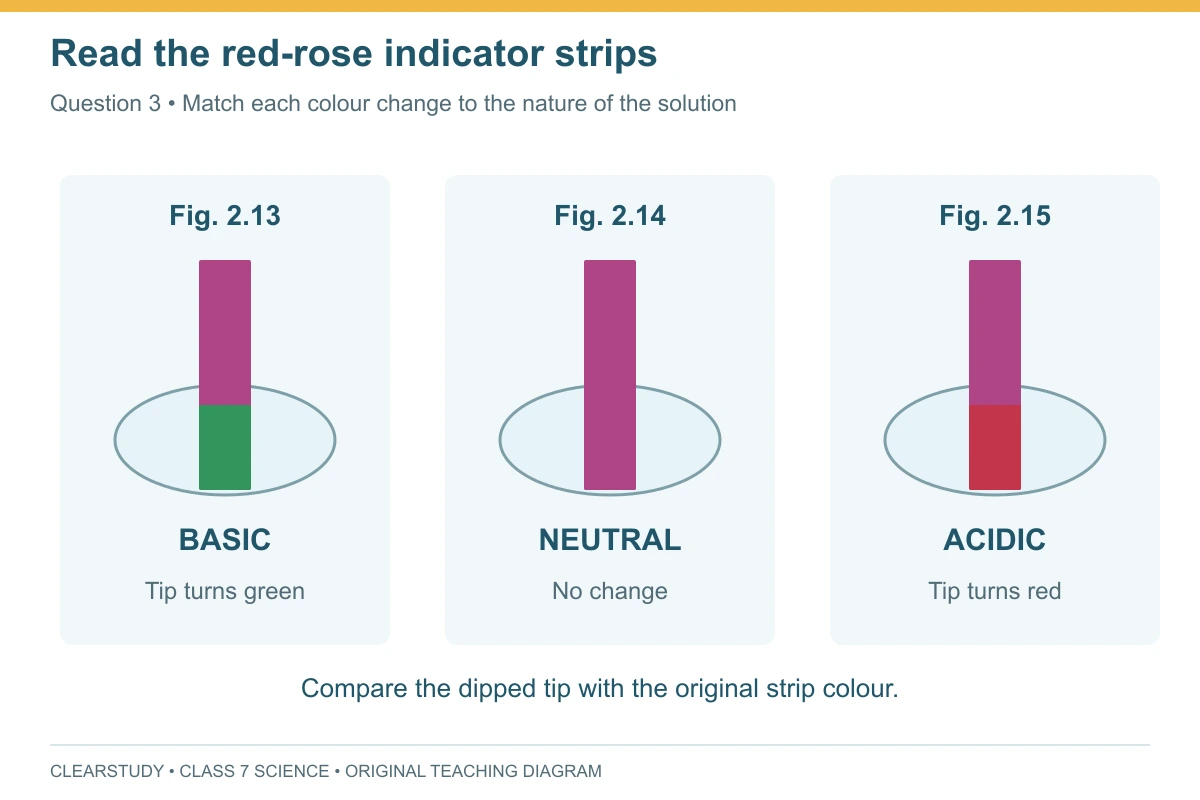
Red rose extract: gives a red shade in acidic solutions and a green shade in basic solutions.
Turmeric: its yellow colour turns red in basic solutions but stays unchanged in acidic and neutral solutions, so fresh yellow paper detects bases but cannot directly distinguish acids from neutral solutions.
Olfactory indicator: a substance (e.g. onion) whose odour changes in an acidic or basic medium.
Neutralisation: an acid reacts with a base. The chapter’s simplified equation is Acid + Base → Salt + Water + Heat. Excess acid or base can leave the mixture acidic or basic; equal volumes are not necessarily the required amounts.
“Let Us Enhance Our Learning” — NCERT Solutions
Original explanations for Questions 1–12 on pages 20–21 of NCERT Curiosity, Reprint 2026–27. Diagram labels have been checked against the printed figures.
1. A solution turns the red litmus paper to blue. Excess addition of which of the following solution would reverse the change? (i) Lime water (ii) Baking soda (iii) Vinegar (iv) Common salt solution
2. You are provided with three unknown solutions labelled A, B, and C, but you do not know which of these are acidic, basic, or neutral. Upon adding a few drops of red litmus solution to solution A, it turns blue. When a few drops of turmeric solution are added to solution B, it turns red. Finally, after adding a few drops of red rose extract to solution C, it turns green. Based on the observations, which of the following is the correct sequence for the nature of solutions A, B, and C? (i) Acidic, acidic, and acidic (ii) Neutral, basic, and basic (iii) Basic, basic, and acidic (iv) Basic, basic, and basic
3. Observe and analyse Figs. 2.13, 2.14, and 2.15, in which red rose extract paper strips are used. Label the nature of solutions present in each of the containers.
4. A liquid sample from the laboratory was tested using various indicators:
| Indicator | Red litmus | Blue litmus | Turmeric |
|---|---|---|---|
| Change | No change | Turned red | No change in colour |
Based on the tests, identify the acidic or basic nature of the liquid and justify your answer.
5. Manya is blindfolded. She is given two unknown solutions to test and determine whether they are acidic or basic. Which indicator should Manya use to test the solutions and why?
6. Could you suggest various materials which can be used for writing the message on the white sheet of paper (given at the beginning of the chapter) and what could be in the spray bottle? Make a table of various possible combinations and the colour of the writing obtained.
| Writing material | Spray (indicator) | Colour of the writing |
|---|---|---|
| Soap / baking-soda solution (basic) | Turmeric solution | Red |
| Soap / lime water (basic) | Red rose extract | Green |
| Lemon juice / vinegar (acidic) | Red rose extract | Red |
| Soap solution (basic) | Red litmus solution | Blue |
| Lemon juice (acidic) | Blue litmus solution | Red |
7. Grape juice was mixed with red rose extract; the mixture got a tint of red colour. What will happen if baking soda is added to this mixture? Justify your answer.
8. Keerthi wrote a secret message to her grandmother on her birthday using orange juice. Can you assist her grandmother in revealing the message? Which indicator would you use to make it visible?
9. How can natural indicators be prepared? Explain by giving an example.
10. Three liquids are given to you. One is vinegar, another is a baking soda solution, and the third is a sugar solution. Can you identify them only using turmeric paper? Explain.
11. The extract of red rose turns the liquid X to green. What will the nature of liquid X be? What will happen when excess of amla juice is added to liquid X?
12. Observe and analyse the information given in the following flowchart. Complete the missing information. Imagine a garden with plants showing signs of poor health. The soil can be ______ in nature / The soil can be ______ in nature. Which indicator can be used to test the nature of the soil? _________________ The acidic soil can be treated with ________________. The basic soil can be treated with ________________.
Dive Deeper — Answer
Aman accidentally spilt vinegar on some pieces of an eggshell or marble and noticed bubbling. He then poured a soap solution on another piece of eggshell or marble, but no bubbles appeared. Why did bubbles occur with vinegar but not with soap solution?
Common Mistakes to Avoid
Watch out for these
- Mixing up the litmus rule — remember Acid turns blue litmus red; base turns red litmus blue.
- Using fresh yellow turmeric paper to tell an acid from a neutral sample: both leave it yellow. The two-stage method in Question 10 uses paper first made reddish-brown by a base.
- Swapping the red rose colours — it is red in acid and green in base.
- Treating tap water as always neutral. Its nature can vary; test it. Sugar and common-salt solutions in neutral water are classroom examples that change neither red nor blue litmus.
- Confusing “lime water” (calcium hydroxide solution, a base) with the fruit “lime”.
- Writing neutralisation products incompletely — it gives salt + water + heat, not just salt and water.
- Tasting unknown substances to test them — never do this; use indicators instead.
Extra Practice Questions
These questions and MCQs are ClearStudy practice, separate from the NCERT exercise.
Short Answer Type Questions
Q1. From which living organism is litmus obtained?
Q2. Name two substances that are neutral in nature.
Q3. Why are basic substances said to feel different to touch?
Q4. What is an olfactory indicator? Give one example.
Q5. Write the general word equation for a neutralisation reaction.
Long Answer Type Questions
Q1. Describe how you would prepare turmeric paper and explain what it can and cannot test.
Q2. Explain, with three examples, how neutralisation is useful in daily life.
Q3. A solution gives no colour change with turmeric paper but turns blue litmus red. Identify its nature and justify, and name one safe way to make it neutral.
MCQs & Assertion–Reason
1. A substance that turns blue litmus paper red is:
(a) basic (b) neutral (c) acidic (d) an indicator
2. Litmus is obtained from:
(a) roses (b) lichens (c) turmeric (d) onions
3. Red rose extract in a basic solution turns:
(a) red (b) yellow (c) green (d) colourless
4. Turmeric paper turns red in:
(a) acidic solutions (b) basic solutions (c) neutral solutions (d) all solutions
5. Which of the following is a neutral substance?
(a) lemon juice (b) lime water (c) sugar solution (d) vinegar
6. The products of a neutralisation reaction are:
(a) only salt (b) salt and water and heat (c) only water (d) acid and base
7. In the textbook’s ant-bite neutralisation model, baking soda represents a substance that is:
(a) acidic (b) neutral (c) basic (d) an olfactory indicator
8. Onion can be used as an indicator because it is:
(a) acidic (b) an olfactory indicator (c) a synthetic indicator (d) basic
9. Excessively acidic soil is best treated with:
(a) vinegar (b) lime (c) lemon juice (d) common salt
10. Basic substances generally feel:
(a) rough (b) sticky (c) soapy/slippery (d) gritty
For each Assertion–Reason question, choose: (A) Both true and the Reason correctly explains the Assertion; (B) Both true but the Reason is not the correct explanation; (C) Assertion true, Reason false; (D) Assertion false, Reason true.
A-R 1. Assertion: Lemon juice turns blue litmus paper red.
Reason: Lemon juice is acidic in nature.
A-R 2. Assertion: Fresh yellow turmeric paper can directly distinguish an acid from a neutral substance.
Reason: Turmeric turns red only in basic solutions.
A-R 3. Assertion: A neutralisation reaction releases heat.
Reason: In neutralisation an acid and a base react to form salt and water with the evolution of heat.
A-R 4. Assertion: Sugar solution turns red litmus blue.
Reason: Sugar solution in neutral water is neutral in nature.
A-R 5. Assertion: A blindfolded person can use an olfactory indicator to test solutions.
Reason: Olfactory indicators show a change in odour in acidic and basic media.
Quick Revision Summary
- Substances are acidic, basic or neutral in nature.
- Indicators show different colours in acids and bases — litmus (from lichens), red rose extract, turmeric, purple cabbage, hibiscus.
- Acids turn blue litmus red; bases turn red litmus blue; neutral substances change neither.
- Red rose extract: red in acid, green in base. Turmeric: red in base, unchanged in acid/neutral.
- Olfactory indicators (e.g. onion) change odour in acidic/basic media.
- Neutralisation: Acid + Base → Salt + Water + Heat — used for ant bites, treating acidic/basic soil and acidic factory waste.
How to write a clear answer
Memorise the colour-change rules in a table (litmus, red rose extract, turmeric for acid/base/neutral) and practise explaining each result. Always state the full neutralisation equation salt + water + heat. In “identify the nature” questions, justify each answer with the indicator result, and remember turmeric and an olfactory indicator have special uses (turmeric for bases only; onion for a blindfolded test). Mention real-life neutralisation examples — ant bite, soil, factory waste — to strengthen long answers.
Frequently Asked Questions
What is Class 7 Science Curiosity Chapter 2 about?
Chapter 2, Exploring Substances: Acidic, Basic, and Neutral, explains how to classify everyday substances as acidic, basic or neutral using acid-base indicators such as litmus, red rose extract and turmeric, and how an acid and a base neutralise each other to form salt, water and heat.
What is the difference between an acid and a base in this chapter?
Acids taste sour and turn blue litmus red (e.g. lemon juice, vinegar). Bases taste bitter, feel slippery and turn red litmus blue (e.g. soap solution, lime water). Neutral substances such as sugar and salt solutions affect neither litmus paper.
What is a neutralisation reaction?
When an acid and a base are mixed in sufficient quantity, the result is neither acidic nor basic. The reaction forms salt and water along with the release of heat: Acid + Base → Salt + Water + Heat.
Are these Class 7 Science Curiosity Chapter 2 solutions free?
Yes. All solutions are free and follow the official NCERT Curiosity textbook for session 2026–27.