
NCERT Solutions for Class 7 Science (Curiosity) Chapter 6: Adolescence: A Stage of Growth and Change (NCERT 2026–27)
These Class 7 Science Curiosity Chapter 6 solutions cover Adolescence: A Stage of Growth and Change from the new NCF-2023 textbook (2026–27). The chapter explains how the human body grows from infancy to adulthood, what happens during adolescence and puberty, the physical, emotional and reproductive changes that occur, and how to stay healthy and responsible during these years. Every question of the “Let Us Enhance Our Learning” exercise is presented in textbook order and answered step by step below.
Class 7 Science Curiosity Chapter 6 Solutions – Overview
The journey of human life can be divided into stages — infancy, childhood, adolescence, adulthood and old age. Until about 10–12 years of age, most changes are simply in height and weight. After this, the body begins to prepare for adulthood, marking the onset of adolescence (usually between 10 and 19 years). During this stage, boys and girls undergo significant physical, emotional, behavioural and reproductive changes. Some changes — like a change in voice, facial hair in boys or the development of breasts in girls — are visible secondary sexual characteristics, while others, such as the maturation of reproductive parts and the onset of the menstrual cycle in girls, are internal. The chapter teaches that these changes vary from person to person, are completely normal, and are mainly controlled by chemicals called hormones. It also explains how good nutrition, personal and menstrual hygiene, physical activity, a balanced social life and saying ‘NO’ to harmful substances make adolescence a healthy and joyful experience.
Key Concepts & Definitions
Adolescence: the period of change from childhood to adulthood, generally beginning around 10 years of age and usually lasting until about 19 years.
Puberty: the stage in which the body of an adolescent undergoes external and internal changes to develop into an adult capable of reproduction.
Secondary sexual characteristics: features that help distinguish males from females but are not directly involved in reproduction — e.g. change in voice, facial and chest hair in boys, development of breasts in girls.
Voice box (larynx): a structure in the throat that helps us speak; its growth in adolescent boys makes the voice hoarse and may appear as a bump called the Adam’s apple.
Acne & pimples: a skin condition (acne) in which small reddish pimples appear, caused by increased oily secretions clogging skin pores during adolescence.
Menstrual cycle: the repeating changes counted from the first day of one period to the first day of the next. NCERT gives 28–30 days as a typical example. In adolescents, cycles often range from 21–45 days and can be irregular during the first few years. Menstruation is the bleeding phase, when the uterine lining is shed. See American Academy of Pediatrics guidance.
Hormones: certain chemicals produced in different parts of the body that regulate growth, development, mood and behaviour, and cause most changes of puberty.
“Let Us Enhance Our Learning” — NCERT Solutions
All questions below are presented in textbook order from the NCERT Curiosity textbook; the answers are original and exam-ready.
1. Ramesh, an 11-year-old boy, developed a few pimples on his face. His mother told him that this is because of ongoing biological changes in his body. (i) What could be the possible reasons for the development of these pimples on his face? (ii) What can he do to get some relief from these pimples?
2. Which of the following food groups would be a better option for adolescents and why? (i) A meal mainly of fried, sugary snacks and soft drinks. (ii) A balanced meal of cereals/millets, pulses, milk products, fruits and green vegetables.
3. Unscramble the underlined word in the following sentences: (i) The discharge of blood in adolescent girls which generally occurs every 28–30 days is nstmnoiaretu. (ii) The hoarseness in the voice of adolescent boys is due to enlarged iceov xob. (iii) Secondary sexual characteristics are natural signs that the body is preparing for adulthood and mark the onset of urtypeb. (iv) We should say NO to lahoclo and srugd as they are addictive.
4. Shalu told her friend, “Adolescence brings only physical changes, like growing taller or developing body hair.” Is she correct? What would you change in this description of adolescence?
5. During a discussion in the class, some of the students raised the following points. What questions would you ask them to check the correctness of these points? (i) Adolescents do not need to worry about behavioural changes. (ii) If someone tries a harmful substance once, they can stop anytime they want.
6. Adolescents sometimes experience mood swings. On some days, they feel very energetic and happy, while on other days, they may feel low. What other behavioural changes are associated with this age?
Persistent sadness, anxiety or changes that interfere with daily life deserve support from a trusted adult or health professional. Puberty does not by itself imply emotional readiness for adult responsibilities.
7. While using a toilet, Mohini noticed that used sanitary pads were scattered near the bin. She got upset and shared her feelings with her friends. They discussed the importance of menstrual hygiene and healthy sanitary habits. What menstrual hygiene and sanitary habits would you suggest to your friends?
8. Mary and Manoj were classmates and good friends. On turning 11, Mary developed a little bulge on the front of her neck. She visited the doctor who gave her medication and asked to take iodine-rich diet. Similarly, a bump was developed on the front of Manoj’s neck when he turned 12. However, the doctor told him that it was a part of growing up. According to you, what could be the possible reason for advising Mary and Manoj differently?
9. During adolescence, the boys and girls undergo certain physical changes, a few of which are given below. (i) Change in voice (ii) Development of breasts (iii) Growth of moustache (iv) Growth of facial hair (v) Pimples on the face (vi) Growth of hair in the pubic region (vii) Growth of hair in armpits Categorise these changes in the table given below:
| Typically more marked in boys | Typically associated with girls | Common to boys and girls |
|---|---|---|
| (iii) Moustache (iv) Facial hair | (ii) Breast development | (i) Voice change (v) Pimples (vi) Pubic hair (vii) Armpit hair |
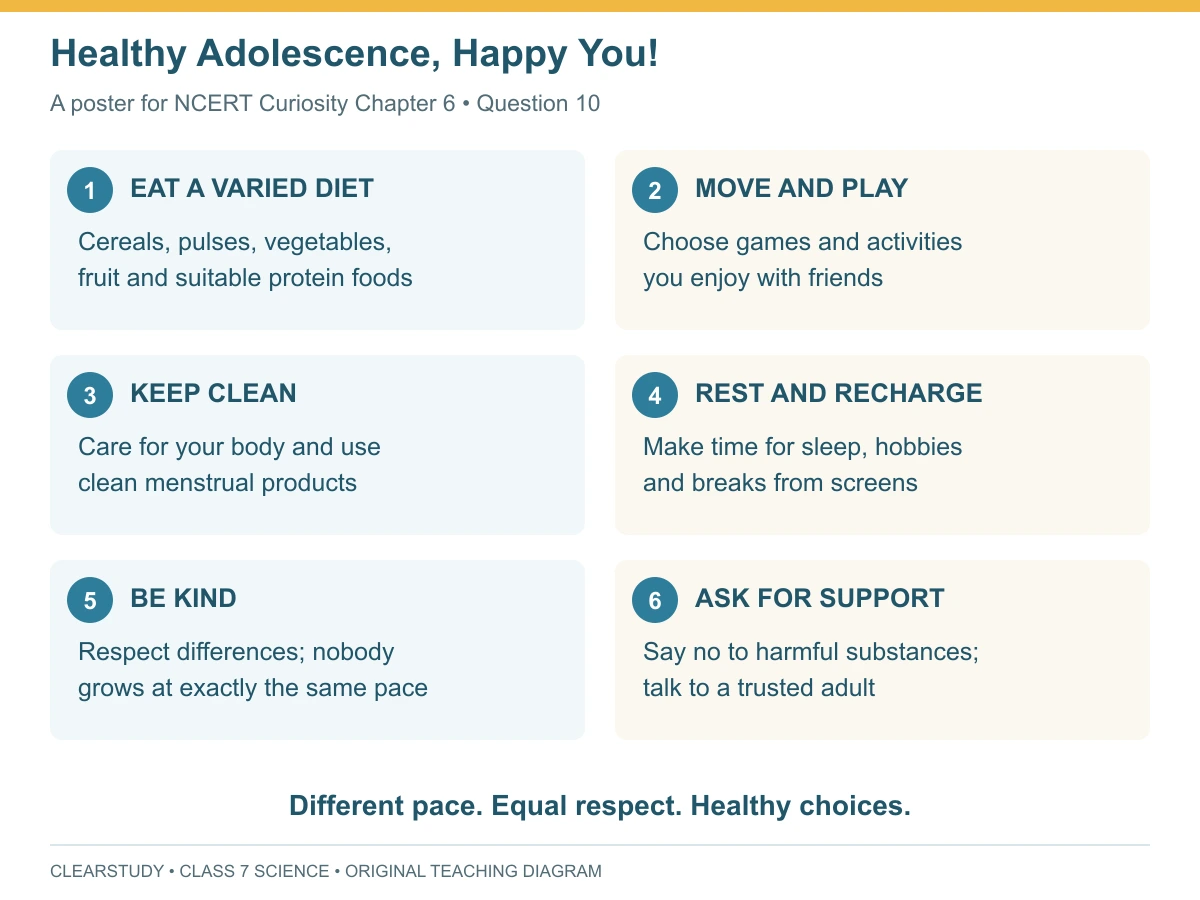
10. Prepare a poster mentioning the tips for adolescents to live a healthy lifestyle.
Extra Practice Questions
These questions and MCQs are ClearStudy practice, separate from the NCERT exercise.
Short Answer Type Questions
Q1. Define adolescence and state the usual age range during which it occurs.
Q2. What is the Adam’s apple? In whom is it more prominent?
Q3. Why is menstruation called a sign of good reproductive health?
Q4. What are hormones and what role do they play during adolescence?
Q5. How should used sanitary pads be disposed of, and why?
Long Answer Type Questions
Q1. Explain the various physical changes that occur in boys and girls during adolescence.
Q2. Describe the different ways in which an adolescent can make this stage a healthy and joyful experience.
Q3. What is meant by “substance abuse”? Why are addictive substances dangerous, and how can an adolescent stay away from them?
MCQs & Assertion–Reason
1. Adolescence generally occurs between the ages of:
(a) 5 and 9 years (b) 10 and 19 years (c) 20 and 30 years (d) 45 and 55 years
2. The hoarseness in the voice of adolescent boys is due to the growth of the:
(a) lungs (b) heart (c) voice box (d) brain
3. Features that help distinguish males from females but are not directly involved in reproduction are called:
(a) primary characteristics (b) secondary sexual characteristics (c) hormones (d) reflexes
4. Which typical menstrual-cycle interval is given in the NCERT chapter?
(a) 7–10 days (b) 14–18 days (c) 28–30 days (d) 60–90 days
5. Acne (pimples) during adolescence is caused mainly by:
(a) eating too many fruits (b) increased oily secretions clogging skin pores (c) drinking water (d) too much sleep
6. The changes of puberty are mainly controlled by:
(a) vitamins (b) minerals (c) hormones (d) enzymes only
7. Which change is typically associated with girls during puberty?
(a) growth of moustache (b) development of breasts (c) growth of facial hair (d) prominent Adam’s apple
8. Menstruation usually stops naturally (marking the end of reproductive capability) by the age of:
(a) 25–30 years (b) 35–40 years (c) 45–55 years (d) 60–70 years
9. Which of the following should an adolescent say ‘NO’ to?
(a) a balanced diet (b) physical exercise (c) tobacco, alcohol and drugs (d) personal hygiene
10. The National De-addiction Helpline number launched by the government is:
(a) 100 (b) 14446 (c) 1098 (d) 108
For each Assertion–Reason question, choose: (A) Both true and the Reason correctly explains the Assertion; (B) Both true but the Reason is not the correct explanation; (C) Assertion true, Reason false; (D) Assertion false, Reason true.
A-R 1. Assertion: Change in voice and facial hair in boys are called secondary sexual characteristics.
Reason: They help distinguish males from females but are not directly involved in reproduction.
A-R 2. Assertion: Adolescents may develop pimples on the face.
Reason: Oily secretions from the skin increase during adolescence and can clog the skin pores.
A-R 3. Assertion: Every adolescent experiences the changes of puberty at exactly the same age and in the same way.
Reason: The timing, nature and extent of these changes vary from one individual to another.
A-R 4. Assertion: Used sanitary pads should be wrapped in newspaper and disposed of inside a dustbin.
Reason: Proper disposal ensures community health and environmental cleanliness.
A-R 5. Assertion: It is safe to try an addictive substance once because one can stop anytime.
Reason: Addictive substances can cause dependence and make stopping difficult.
Quick Revision Summary
- Human life has stages: infancy, childhood, adolescence, adulthood and old age; each person passes through them at their own pace.
- Adolescence is the change from childhood to adulthood, usually from about 10 to 19 years.
- It brings physical, biological, emotional and behavioural changes plus the ability to reproduce.
- Secondary sexual characteristics (voice change, facial/chest hair in boys, breast development in girls) distinguish males from females but are not directly involved in reproduction; they mark puberty.
- In girls, puberty brings the menstrual cycle — menstruation is its bleeding phase. NCERT uses a 28–30 day example; adolescent cycles can vary. Menopause usually occurs around 45–55 years.
- A balanced diet, good personal & menstrual hygiene, physical activity and a balanced social life keep adolescents healthy.
- Say ‘NO’ to addictive substances like tobacco, alcohol and drugs.
- Most changes of adolescence are controlled by chemicals called hormones.
Common Mistakes to Avoid
Watch out for these
- Thinking adolescence brings only physical changes — it also brings emotional, behavioural and reproductive changes.
- Confusing menstruation (the few days of blood discharge) with the whole menstrual cycle (counted from the start of one period to the start of the next).
- Treating every neck bump as an Adam’s apple — a thyroid enlargement can occur in either sex and needs assessment; iodine deficiency is one possible cause.
- Believing the changes happen at the same age for everyone — their timing and extent vary and that is completely normal.
- Assuming an addictive substance can be tried “just once” safely — addiction often starts with one try.
- Forgetting that hormones, not just diet or exercise, are the main cause of puberty changes.
How to write a clear answer
Learn the exact definitions of adolescence, puberty, secondary sexual characteristics, menstruation and hormones, and distinguish age ranges from cycle intervals. Voice changes occur in both boys and girls, usually more noticeably in boys. Moustache and facial hair are typically more marked in boys; breast development is typically associated with girls. Pimples and underarm/pubic hair occur in both. Always mention that the timing of changes varies and is normal, and link the changes to hormones. For lifestyle questions, list nutrition, hygiene, physical activity, balanced social life and saying ‘NO’ to harmful substances.
Frequently Asked Questions
What is Class 7 Science Curiosity Chapter 6 about?
Chapter 6, Adolescence: A Stage of Growth and Change, explains how the human body grows from childhood to adulthood. It covers the physical, emotional, behavioural and reproductive changes of adolescence and puberty, secondary sexual characteristics, the menstrual cycle, the role of hormones, and how to stay healthy through good nutrition, hygiene, physical activity and saying ‘NO’ to harmful substances.
What is the difference between adolescence and puberty?
Adolescence is the whole period of change from childhood to adulthood, usually from about 10 to 19 years. Puberty is the stage within adolescence in which the body undergoes external and internal changes to become capable of reproduction; its onset is marked by secondary sexual characteristics.
What are secondary sexual characteristics?
They are features that help distinguish males from females but are not directly involved in reproduction — for example, change in voice and growth of facial and chest hair in boys, and the development of breasts in girls. They are natural signs that the body is preparing for adulthood.
Are these Class 7 Science Curiosity Chapter 6 solutions free?
Yes. All solutions are free and follow the official NCERT Curiosity textbook for session 2026–27.