
NCERT Solutions for Class 7 Science (Curiosity) Chapter 5: Changes Around Us – Physical and Chemical (NCERT 2026–27)
These Class 7 Science Curiosity Chapter 5 solutions cover Changes Around Us: Physical and Chemical from the new NCF-2023 textbook (session 2026–27). Every question of the end-of-chapter exercise “Let Us Enhance Our Learning” is reproduced exactly as printed and solved step by step, along with key concepts, extra practice, MCQs, assertion–reason questions and FAQs to help you explain the changes clearly.
Class 7 Science Curiosity Chapter 5 Solutions – Overview
Chapter 5 of Curiosity, Changes Around Us: Physical and Chemical, explores the many changes we observe every day — ice melting, a bud blooming, a banana ripening, water boiling. It groups all such changes into two big types. In a physical change, only physical properties like shape, size or state change and no new substance is formed (folding paper, melting ice, crushing chalk). In a chemical change, one or more new substances are formed through a chemical reaction (lime water turning milky, rusting, burning of magnesium, curdling of milk). The chapter also studies combustion and the fire triangle (fuel + oxygen + ignition temperature), explains how some changes can be reversed while others cannot, looks at desirable vs undesirable changes, and ends with slow natural changes — the weathering and erosion of rocks that finally form soil.
Key Concepts & Definitions
Physical change: a change in which a substance undergoes a change in its physical properties (shape, size, state) and no new substance is formed. Examples: melting ice, folding paper, crushing chalk, boiling water.
Chemical change: a change in which one or more new substances are formed through a chemical reaction; it can be shown by a chemical equation. Examples: lime water turning milky, rusting, burning magnesium, curdling of milk.
Test for carbon dioxide: the gas turns colourless lime water milky (cloudy) due to the formation of insoluble calcium carbonate.
Calcium hydroxide (lime water) + Carbon dioxide → Calcium carbonate (insoluble) + Water.
Combustion: a chemical reaction in which a substance reacts with oxygen and produces heat and/or light. Substances that undergo combustion are combustible substances (wood, paper, cotton, kerosene).
Ignition temperature: the lowest (minimum) temperature at which a substance catches fire.
Fire triangle: combustion needs three things together — (i) a combustible substance (fuel), (ii) oxygen, and (iii) heat to reach the ignition temperature.
Reversible vs irreversible: some changes can be reversed to get the original substance back (melting ice); some cannot (making popcorn).
Weathering: physical and chemical changes that break large rocks into smaller pieces, eventually forming soil. Erosion: the breaking and carrying away of rock, soil and sediments by wind and flowing water (a physical change).
“Let Us Enhance Our Learning” — NCERT Solutions
Original explanations for Questions 1–10 on pages 69–71 of NCERT Curiosity, Reprint 2026–27. The completed classification diagram is provided below.
1. Which of the following statements are the characteristics of a physical change? (i) The state of the substance may or may not change. (ii) A substance with different properties is formed. (iii) No new substance is formed. (iv) The substance undergoes a chemical reaction. (a) (i) and (ii) (b) (ii) and (iii) (c) (i) and (iii) (d) (iii) and (iv)
2. Predict which of the following changes can be reversed and which cannot be reversed. If you are not sure, you may write that down. Why are you not sure about these? (i) Stitching cloth to a shirt (ii) Twisting of straight string (iii) Making idlis from a batter (iv) Dissolving sugar in water (v) Drawing water from a well (vi) Ripening of fruits (vii) Boiling water in an open pan (viii) Rolling up a mat (ix) Grinding wheat grains to flour (x) Forming of soil from rocks
| Change | Reversed? | Reason |
|---|---|---|
| (i) Stitching cloth to a shirt | Yes | Stitching alone can be undone by removing the thread. If making the shirt also involved cutting cloth, the original uncut piece cannot be restored merely by unstitching. |
| (ii) Twisting of straight string | Yes | The string can be untwisted to its original form (physical). |
| (iii) Making idlis from a batter | No | Cooking forms new substances; idlis cannot become batter again (chemical). |
| (iv) Dissolving sugar in water | Yes | Sugar can be recovered by slow evaporation or crystallisation without heating it until it decomposes (physical). |
| (v) Drawing water from a well | Yes | In principle its position can be restored; only location changed. Do not pour used or contaminated water into a drinking-water source. |
| (vi) Ripening of fruits | No | New substances form; a ripe fruit cannot become unripe (chemical). |
| (vii) Boiling water in an open pan | Yes | The steam (water vapour) can be condensed back to water (physical). |
| (viii) Rolling up a mat | Yes | The mat can be unrolled to its original shape (physical). |
| (ix) Grinding wheat grains to flour | No | The flour cannot be put back together into whole grains. |
| (x) Forming of soil from rocks | No | Soil cannot be turned back into the original rock (weathering, very slow). |
3. State whether the following statements are True or False. In case a statement is False, write the correct statement. (i) Melting of wax is necessary for burning a candle. (True/False) (ii) Collecting water vapour by condensing involves a chemical change. (True/False) (iii) The process of converting leaves into compost is a chemical change. (True/False) (iv) Mixing baking soda with lemon juice is a chemical change. (True/False)
4. Fill in the blanks in the following statements: (i) Nalini observed that the handle of her cycle has got brown deposits. The brown deposits are due to ________, and this is a ________ change. (ii) Folding a handkerchief is a ________ change and can be ________. (iii) A chemical process in which a substance reacts with oxygen with evolution of heat is called ________, and this is a ________ change. (iv) Magnesium, when burnt in air, produces a substance called ________. The substance formed is ________ in nature. Burning of magnesium is a ________ change.
5. Are the changes of water to ice and water to steam, physical or chemical? Explain.
6. Is curdling of milk a physical or chemical change? Justify your statement.
7. Natural factors, such as wind, rain, etc., help in the formation of soil from rocks. Is this change physical or chemical and why?
8. Read the following story titled ‘Eco-friendly Prithvi’, and tick the most appropriate option(s) given in the brackets. Provide a suitable title of your choice for the story. Prithvi is preparing a meal in the kitchen. He chops vegetables, peels potatoes, and cuts fruits (physical changes/chemical changes). He collects the seeds, fruits, and vegetable peels into a clay pot (physical change/chemical change). The fruits, vegetable peels, and other materials begin to decompose due to the action of bacteria and fungi, forming compost (physical change/chemical change). He decides to plant seeds in the compost and water them regularly. After a few days, he notices that the seeds begin to germinate and small plants start to grow, eventually blooming into colourful flowers (physical change/chemical change). His efforts are appreciated by all his family members.
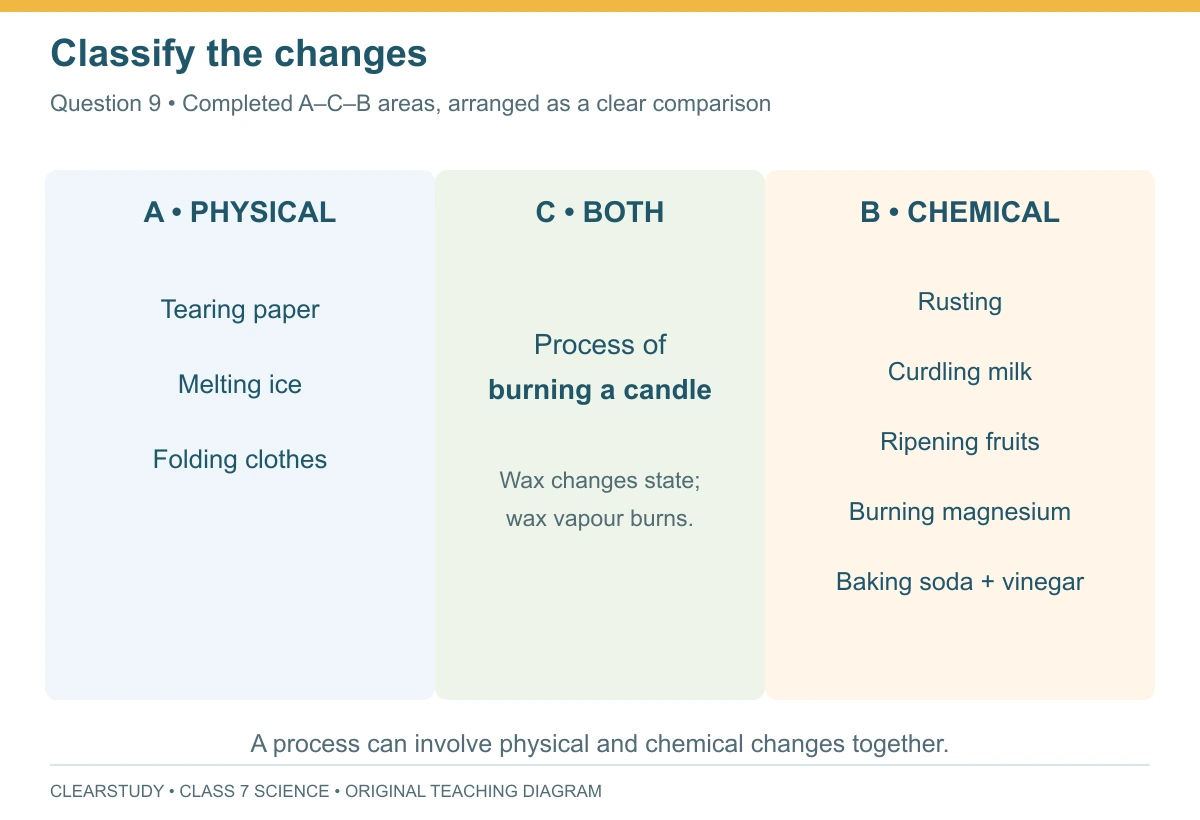
9. Some changes are given here. Write physical changes in the area marked ‘A’ and chemical changes in the area marked ‘B’. Enter the changes which are both physical and chemical in the area marked ‘C’. Process of burning a candle; Tearing of paper; Rusting; Curdling of milk; Ripening of fruits; Melting of ice; Folding of clothes; Burning of magnesium and Mixing baking soda with vinegar.
| A — Physical changes | B — Chemical changes | C — Both physical & chemical |
|---|---|---|
| Tearing of paper; Melting of ice; Folding of clothes | Rusting; Curdling of milk; Ripening of fruits; Burning of magnesium; Mixing baking soda with vinegar | Process of burning a candle |
10. The experiments shown in Fig. 5.11a, b, c, and d were performed. Find out in which case(s) did lime water turn milky and why? (a) Vinegar and baking soda — Lime water (b) Lemon juice and vinegar — Lime water (c) Vinegar and common salt — Lime water (d) Lemon juice and baking soda — Lime water
Extra Practice Questions
These questions and MCQs are ClearStudy practice, separate from the NCERT exercise.
Short Answer Type Questions
Q1. Define a physical change with one example.
Q2. How can you test whether a gas is carbon dioxide?
Q3. What are the three requirements for combustion (the fire triangle)?
Q4. Why does a candle covered with a glass tumbler stop burning after some time?
Q5. Why are some changes called undesirable? Give one example.
Long Answer Type Questions
Q1. Distinguish between physical and chemical changes with two examples of each.
Q2. Explain, with the activity of blowing air into lime water, how a chemical change is identified.
Follow the teacher’s lime-water demonstration. Never suck liquid through a straw; lime water must not enter the mouth or eyes. Bubbling alone does not prove a chemical reaction—for example, boiling water forms bubbles without making a new substance.
Q3. Describe the slow natural changes of weathering and erosion and how soil is formed.
MCQs & Answer Key
1. Which of the following is a chemical change?
(a) Melting of ice (b) Folding of paper (c) Rusting of iron (d) Tearing of cloth
2. In a physical change:
(a) a new substance is formed (b) no new substance is formed (c) the substance always burns (d) heat and light are always given out
3. Lime water turns milky when we pass through it:
(a) oxygen (b) hydrogen (c) carbon dioxide (d) nitrogen
4. The white substance that makes lime water milky is:
(a) calcium carbonate (b) calcium hydroxide (c) magnesium oxide (d) sodium chloride
5. Burning of magnesium ribbon produces:
(a) magnesium chloride (b) magnesium oxide (c) magnesium carbonate (d) calcium oxide
6. The lowest temperature at which a substance catches fire is called its:
(a) boiling point (b) melting point (c) ignition temperature (d) freezing point
7. Which gas of air supports combustion?
(a) Nitrogen (b) Oxygen (c) Carbon dioxide (d) Hydrogen
8. The burning of a candle involves:
(a) only a physical change (b) only a chemical change (c) both physical and chemical changes (d) no change
9. Which of the following changes can be reversed?
(a) Curdling of milk (b) Making popcorn (c) Melting of ice (d) Rusting of iron
10. The breaking and carrying away of rock and soil by wind and flowing water is called:
(a) combustion (b) erosion (c) condensation (d) rusting
Assertion–Reason Questions
For each question, choose: (A) Both true and the Reason correctly explains the Assertion; (B) Both true but the Reason is not the correct explanation; (C) Assertion true, Reason false; (D) Assertion false, Reason true.
A-R 1. Assertion: Rusting of iron is a chemical change.
Reason: During rusting a new substance, iron oxide, is formed.
A-R 2. Assertion: Melting of ice is a physical change.
Reason: A new substance is formed when ice melts.
A-R 3. Assertion: A candle covered with a glass tumbler stops burning after some time.
Reason: The supply of oxygen needed for combustion is cut off.
A-R 4. Assertion: Lime water turns milky when carbon dioxide is passed through it.
Reason: Carbon dioxide reacts with lime water to form insoluble calcium carbonate.
A-R 5. Assertion: Curdling of milk is a physical change.
Reason: Curd formation involves chemical reactions and cannot be undone by a simple physical process.
How to write a clear answer
Always justify whether a change is physical or chemical by checking the single test — was a new substance formed? If yes, it is chemical (rusting, burning, curdling, ripening); if not, it is physical (melting, folding, dissolving). Remember the exact word equations for the lime-water test and the burning of magnesium, and note that the burning of a candle is both physical and chemical. For combustion answers, name all three parts of the fire triangle and define ignition temperature precisely.
Common Mistakes to Avoid
Watch out for these
- Thinking a change of state (water to steam) is chemical — it is physical, since no new substance forms.
- Saying dissolving sugar in water is irreversible — sugar can be recovered by evaporation, so it is reversible and physical.
- Forgetting why lime water turns milky in these experiments: carbon dioxide reacts with it to form insoluble calcium carbonate. This is a useful classroom test in the stated context, not an infallible identification of any unknown gas.
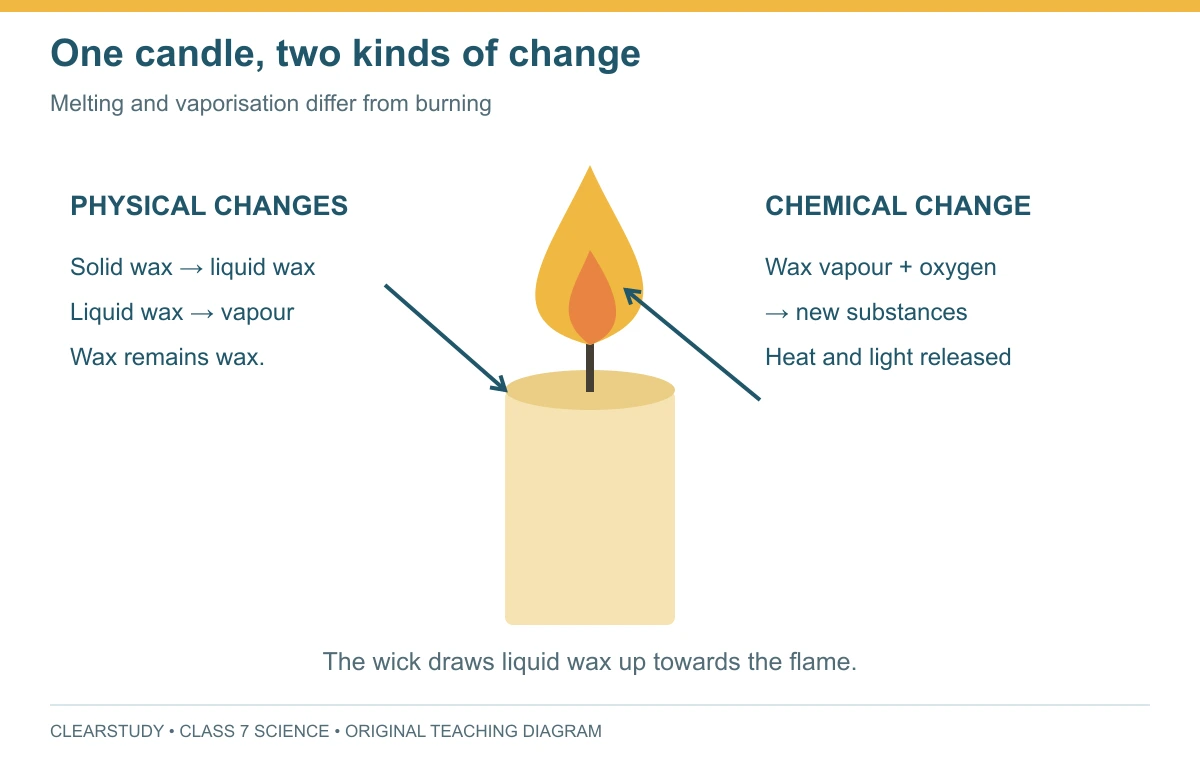
- Writing that burning a candle is purely chemical — the melting and evaporation of wax are physical, so it is both.
- Confusing weathering (breaking and chemically altering rock in place) with erosion (carrying the broken material away).
- Assuming all chemical changes are undesirable — cooking food and forming compost are useful chemical changes.
Frequently Asked Questions
What is Class 7 Science Curiosity Chapter 5 about?
Chapter 5, Changes Around Us: Physical and Chemical, explains the two main types of changes — physical changes (no new substance, e.g. melting ice) and chemical changes (new substances form, e.g. rusting). It also covers the carbon dioxide and lime-water test, combustion and the fire triangle, reversible and irreversible changes, desirable and undesirable changes, and slow natural changes like weathering and erosion.
How do you tell a physical change from a chemical change?
Ask whether a new substance is formed. In a physical change only properties like shape, size or state change and no new substance is formed (and it is usually reversible). In a chemical change one or more new substances form through a chemical reaction, and it is usually irreversible.
Why does lime water turn milky?
Lime water (calcium hydroxide) turns milky when carbon dioxide is passed through it, because the gas reacts to form insoluble calcium carbonate, which makes the liquid look cloudy. This is the standard test for carbon dioxide.
Are these Class 7 Science Curiosity Chapter 5 solutions free?
Yes. All solutions are free and follow the official NCERT Curiosity textbook for session 2026–27.