
NCERT Solutions for Class 7 Science (Curiosity) Chapter 4: The World of Metals and Non-metals (NCERT 2026–27)
These Class 7 Science Curiosity Chapter 4 solutions cover The World of Metals and Non-metals from the new NCF-2023 textbook (2026–27). The chapter explores the typical physical properties of metals — malleability, ductility, sonority and conduction of heat and electricity — and how metals and non-metals behave in the presence of air and water. Every question of the end-of-chapter exercise, “Let Us Enhance Our Learning”, is reproduced verbatim and solved step by step below.
Class 7 Science Curiosity Chapter 4 Solutions – Overview
Chapter 4 of Curiosity, The World of Metals and Non-metals, begins with a visit to an ironsmith’s workshop and uses everyday materials — copper, aluminium, an iron nail, coal, sulfur and a block of wood — to discover what makes a metal a metal. Through simple activities, you learn that metals are usually lustrous, hard, malleable, ductile, sonorous and good conductors of heat and electricity, while samples such as coal and the non-metal sulfur are generally dull, brittle and poor conductors. The chapter then studies how metals react with air and water: iron forms a brown deposit called rust only in the presence of both air and water (rusting and the wider process of corrosion), metal oxides like magnesium oxide are basic, while non-metal oxides like the one formed from sulfur are acidic. It closes by showing why non-metals such as oxygen, carbon, nitrogen, chlorine and iodine are essential in everyday life.
Metals and non-metals classify elements. Sulfur and carbon are elements; coal is a carbon-rich mixture, and wood, plastic and glass are materials rather than non-metal elements. Properties described here are general trends: graphite, a form of carbon, conducts electricity.
Key Concepts & Definitions
Metallic lustre: the shine shown by metals such as copper, aluminium and iron in their pure, fresh state.
Malleability: the property by which materials can be beaten into thin sheets. Most metals are malleable; gold and silver are the most malleable.
Ductility: the property by which materials can be drawn into wires. Metals like copper and aluminium are ductile; gold is the most ductile.
Brittle: materials such as coal and sulfur that break into pieces on hammering instead of flattening.
Sonority: the property of metals by which they produce a ringing sound; such metals are said to be sonorous.
Conduction: the transfer of heat (or electricity) through a material. Metals are good conductors of heat and electricity; non-metals are generally poor conductors.
Rusting & corrosion: rust is the brown deposit formed on iron in the presence of both air and water. The gradual deterioration of any metal surface by air, water or other substances is called corrosion.
Metal vs non-metal oxides: many metal oxides, such as magnesium oxide, are basic; many non-metal oxides, such as sulfur dioxide, are acidic. Exceptions exist: aluminium oxide reacts with both acids and bases, while carbon monoxide is neutral.
“Let Us Enhance Our Learning” — NCERT Solutions
Original explanations for Questions 1–12 on pages 55–56 of NCERT Curiosity, Reprint 2026–27, with completed diagrams and additional ClearStudy practice.
1. Which metal is commonly used to make food packaging materials as it is cheaper, and its thin sheets can be folded easily into any shape? (i) Aluminium (ii) Copper (iii) Iron (iv) Gold
2. Which of the following metal catches fire when it comes in contact with water? (i) Copper (ii) Aluminium (iii) Zinc (iv) Sodium
3. State with reason(s) whether the following statements are True [T] or False [F]. (i) Aluminium and copper are examples of non-metals used for making utensils and statues. [ ] (ii) Metals form oxides when combined with oxygen, the solution of which turns blue litmus paper to red. [ ] (iii) Oxygen is a non-metal essential for respiration. [ ] (iv) Copper vessels are used for boiling water because they are good conductors of electricity. [ ]
4. Why are only a few metals suitable for making jewellery?
5. Match the uses of metals and non-metals given in Column I with the jumbled names of metals and non-metals given in Column II.
| Column I (use) | Column II (unscrambled) | Match |
|---|---|---|
| (i) Used in electrical wiring | (c) P E P O R C → Copper | (i) → (c) |
| (ii) Most malleable and ductile | (e) O G D L → Gold | (ii) → (e) |
| (iii) Living organisms cannot survive without it. | (a) E N X Y G O → Oxygen | (iii) → (a) |
| (iv) Plants grow healthy when fertilisers containing it are added to the soil. | (d) T E N G O I N R → Nitrogen | (iv) → (d) |
| (v) Used in water purification | (b) N E C O H I R L → Chlorine | (v) → (b) |
6. What happens when oxygen reacts with magnesium and sulfur. What are the main differences in the nature of products formed?
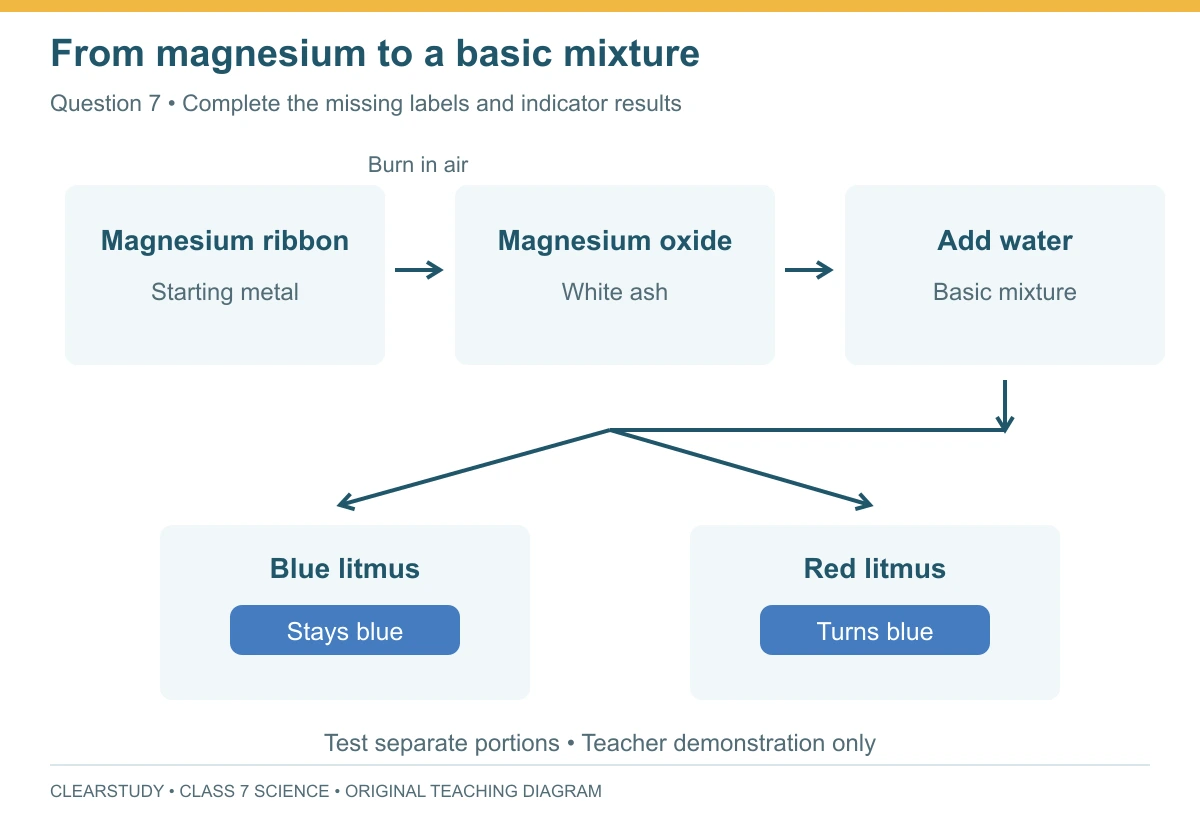
7. Complete the following flow chart: ? → Air → Heat → Ash → (+ Water) → ? → Add blue and red litmus solutions separately → Change in blue litmus solution = ? ; Change in red litmus solution = Blue
8. You are provided with the following materials. Discuss which material would be your choice to make a pan that is most suitable for boiling water and why? Iron copper sulfur coal plastic wood cardboard
9. You are provided with three iron nails, each dipped in oil, water and vinegar. Which iron nail will not rust, and why?
10. How do the different properties of metals and non-metals determine their uses in everyday life?
11. One of the methods of protecting iron from getting rusted is to put a thin coating of zinc metal over it. Since sulfur does not react with water, can it be used for this purpose? Justify your answer.
12. An ironsmith heats iron before making tools. Why is heating necessary in this process?
Reactive sodium, burning magnesium and burning sulfur are not home experiments. The teacher must handle reactive substances and use the textbook’s protective equipment and ventilation precautions.
Extra Practice Questions
These questions and MCQs are ClearStudy practice, separate from the NCERT exercise.
Short Answer Type Questions
Q1. Define malleability and give one example of a malleable metal.
Q2. Why are the handles of cooking vessels often made of wood or plastic?
Q3. What is rust, and under what conditions does it form on iron?
Q4. Why is sodium stored in kerosene?
Q5. Give two reasons why metals are preferred for making electrical wires.
Long Answer Type Questions
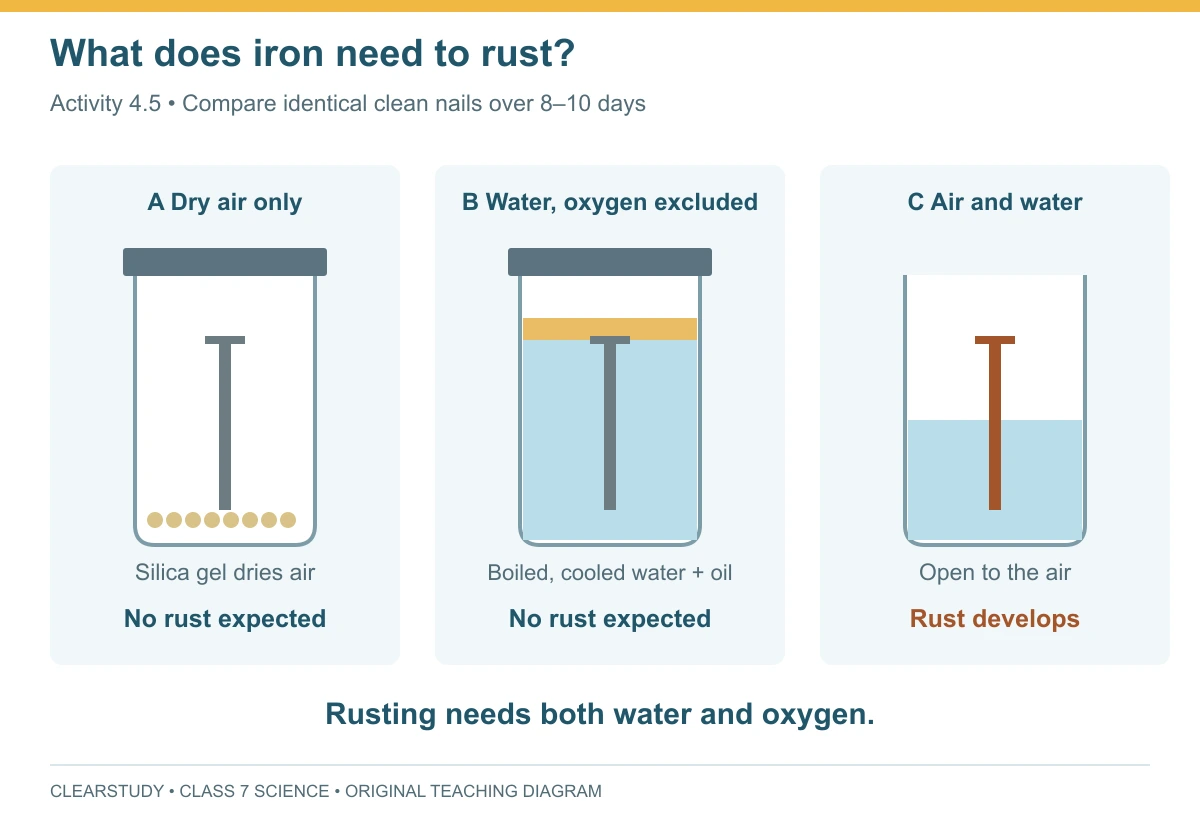
Q1. Describe Activity 4.5 and explain what it tells us about the conditions needed for rusting.
Q2. Compare the general properties of metals and non-metals with suitable examples.
Q3. Explain why non-metals, though less obvious in daily life than metals, are essential for living things.
MCQs & Assertion–Reason
1. The property by which a metal can be beaten into thin sheets is called:
(a) ductility (b) sonority (c) malleability (d) conduction
2. Which of the following is the most ductile metal?
(a) iron (b) gold (c) copper (d) aluminium
3. The metal that is liquid at room temperature is:
(a) sodium (b) mercury (c) zinc (d) copper
4. Rust forms on iron when it is in contact with:
(a) dry air only (b) water only (c) both air and water (d) kerosene
5. The oxide of a metal is generally:
(a) acidic (b) basic (c) neutral (d) brittle
6. When sulfur burns in air and the gas is dissolved in water, the solution is:
(a) basic (b) neutral (c) acidic (d) sonorous
7. Which of the following is a non-metal?
(a) copper (b) aluminium (c) sulfur (d) iron
8. Coating iron with a thin layer of zinc to prevent rusting is called:
(a) galvanisation (b) ductility (c) corrosion (d) sonority
9. The property of metals to produce a ringing sound is:
(a) malleability (b) ductility (c) sonority (d) lustre
10. Which non-metal is commonly used in the purification of water?
(a) oxygen (b) chlorine (c) nitrogen (d) carbon
For each Assertion–Reason question, choose: (A) Both true and the Reason correctly explains the Assertion; (B) Both true but the Reason is not the correct explanation; (C) Assertion true, Reason false; (D) Assertion false, Reason true.
A-R 1. Assertion: Aluminium is used to make foil for wrapping food.
Reason: Aluminium is malleable and can be beaten into thin sheets.
A-R 2. Assertion: The handles of cooking vessels are often made of wood or plastic.
Reason: Wood and plastic are poor conductors of heat.
A-R 3. Assertion: Coal and sulfur are sonorous materials.
Reason: Coal and sulfur are not sonorous and give a dull sound rather than a metallic ring.
A-R 4. Assertion: An iron nail kept in oil does not rust easily.
Reason: Oil forms a layer that keeps air and moisture away from the iron surface.
A-R 5. Assertion: The oxide of sulfur dissolved in water turns blue litmus red.
Reason: Sulfur dioxide forms an acidic solution when it dissolves in water.
Quick Revision Summary
- Metals and non-metals are differentiated on the basis of their properties.
- Metals are generally lustrous, hard, malleable (beaten into sheets), ductile (drawn into wires) and sonorous; non-metals are usually dull and brittle.
- Metals are good conductors of heat and electricity; non-metals are generally poor conductors.
- Metal oxides are generally basic (turn red litmus blue); non-metal oxides are generally acidic (turn blue litmus red).
- Iron rusts only in the presence of both air and water; the wider damage of metals by air/water is called corrosion. Rusting can be prevented by painting, oiling, greasing or galvanisation.
- Some metals are exceptions: sodium and potassium are soft, mercury is a liquid metal. Non-metals like oxygen, carbon, nitrogen, chlorine and iodine are essential in everyday life.
Common Mistakes to Avoid
Watch out for these
- Calling aluminium or copper a non-metal — they are metals widely used for utensils and statues.
- Mixing up the oxides — metal oxides are basic (red litmus → blue), non-metal oxides are generally acidic (blue litmus → red).
- Confusing malleability and ductility — malleable = beaten into sheets; ductile = drawn into wires.
- Saying copper vessels boil water because they conduct electricity — it is because they conduct heat.
- Thinking iron rusts in dry air or in water alone — both air and water are needed.
- Assuming all metals are hard solids — sodium and potassium are soft, and mercury is liquid.
How to write a clear answer
Learn the five typical properties of metals — lustre, malleability, ductility, sonority and conduction of heat/electricity — with one clear example each, and always pair a property with its use (malleable → foil, ductile → wires, good conductor → cooking vessels). Remember the litmus rule: metal oxide → basic (red turns blue), non-metal oxide → acidic (blue turns red). For rusting questions, state firmly that both air and water are needed and name prevention methods (painting, oiling, greasing, galvanisation).
Frequently Asked Questions
What is Class 7 Science Curiosity Chapter 4 about?
Chapter 4, The World of Metals and Non-metals, explains the properties of metals (lustre, malleability, ductility, sonority and good conduction of heat and electricity) and non-metals, and how they react with air and water — including rusting of iron, corrosion, and the basic nature of metal oxides versus the acidic nature of non-metal oxides.
What is the name of the exercise in this chapter?
The end-of-chapter exercise is titled “Let Us Enhance Our Learning” and has 12 questions. All of them are reproduced verbatim and answered step by step on this page.
Under what conditions does iron rust?
Iron rusts only when it is in contact with both air and water (moist air). Dry air alone or water without dissolved air does not cause rusting, as shown by Activity 4.5 in the textbook.
Are these Class 7 Science Curiosity Chapter 4 solutions free?
Yes. All solutions are free and follow the official NCERT Curiosity Grade 7 textbook for session 2026–27.