NCERT Solutions for Class 7 Social Science (Exploring Society) Part 2 Chapter 2: India and Her Neighbours (NCERT 2026–27)
These Class 7 Social Science Exploring Society Part 2 Chapter 2 solutions cover India and Her Neighbours from Exploring Society: India and Beyond (Part 2), the NCERT textbook (first edition, November 2025), used here for the 2026–27 session. The chapter belongs to the theme India and the World: Land and the People and explains who a neighbour is — both by land and across the seas — how India’s geography and history shape her ties with land-based neighbours (China, Pakistan, Bangladesh, Nepal, Bhutan, Myanmar, Afghanistan) and maritime neighbours (Sri Lanka, the Maldives, Thailand, Malaysia, Singapore, Indonesia, Iran, Oman), and how these countries stay interconnected today through culture, trade, religion and cooperation. Below you get step-by-step answers to all Questions and activities, clear notes on key terms, extra practice, MCQs, Assertion–Reason and FAQs.
Class: 7Subject: Social ScienceBook: Exploring Society: India and Beyond (Part 2)Textbook chapter: Part 2, 2Theme: India and the World: Land and the PeopleSession: 2026–27
NCERT numbers this as Part 2 Chapter 2. ClearStudy previously used Chapter 14 by continuing Part 1; its existing address is retained.
Class 7 Social Science Exploring Society Part 2 Chapter 2 – Overview
Part 2 Chapter 2, India and Her Neighbours, broadens the idea of a ‘neighbour’ beyond shared land borders. India’s land boundary stretches over 15,100 km, touching Pakistan and Afghanistan in the north-west; Tibet (China), Nepal and Bhutan in the north; and Bangladesh and Myanmar in the east. But India has always been a maritime nation, with a coastline of about 11,100 km, so Sri Lanka and the Maldives are immediate sea neighbours, and Iran, Oman, Thailand, Malaysia, Singapore and Indonesia form a wider maritime neighbourhood. The chapter shows how geography and history shape each relationship — the Himalayas separating India and China, Partition shaping ties with Pakistan and Bangladesh, the open border with Nepal, the Buddhist bond with Bhutan and Myanmar. Threads of culture, religion, trade and cooperation — especially the spread of Buddhism and Hinduism, ancient routes like the Uttarāpatha and Silk Route, and modern projects such as the Kartarpur Corridor, Chabahar Port and the India–Myanmar–Thailand Trilateral Highway — keep India and her neighbours interconnected, reminding us that being good neighbours is “not just about borders, but also about working together.”
Key Concepts & Terms
Neighbour: traditionally, a country that shares a land boundary with us. The chapter widens this to include maritime neighbours connected across the sea, even without a land border.
Maritime neighbour: a country connected to another by a shared sea or ocean, even without a direct land border. For India, Sri Lanka and the Maldives are the nearest; Iran, Oman, Thailand, Malaysia, Singapore and Indonesia are part of the wider maritime neighbourhood.
Land-based neighbours: China (across the Himalayas), Pakistan and Afghanistan (north-west), Nepal and Bhutan (north), and Bangladesh and Myanmar (east).
Regionalism: involvement and cooperation among countries of a region — trade, humanitarian aid, disaster relief — to create peace, stability and shared progress.
Open border: the India–Nepal arrangement facilitates movement of the two countries’ citizens for family visits, work and other purposes. It does not remove all identity checks, customs rules or security requirements; rules differ for air travel and third-country nationals.
SAARC (South Asian Association for Regional Cooperation): formed in 1985 to promote sociocultural and economic progress; members are Afghanistan, Bangladesh, Bhutan, India, the Maldives, Nepal, Pakistan and Sri Lanka.
Kartarpur Corridor: a visa-free border crossing (opened 2019) letting Indian pilgrims visit Gurdwara Darbar Sahib in Kartarpur, Pakistan — the resting place of Guru Nānak Dev.
Schools of Buddhism:Theravāda (‘School of the Elders’), Mahāyāna (‘Great Vehicle’) and Vajrayāna (‘Diamond Vehicle’, Tantric Buddhism) — all grew in ancient India and spread to her neighbours.
Other key terms:Suvarṇabhūmi/Suvarṇadvīpa (the ‘golden land/island’ — Southeast Asia), archipelago (an extensive group of islands, like Indonesia), ingot (a block of metal shaped for transport, as in Oman’s copper trade), and Gross National Happiness (Bhutan’s holistic measure of progress).
“The Big Questions” — Answered
These framing questions appear at the start of the chapter. Answers are based on the chapter content.
1. What defines a ‘neighbour’? Is it just shared land borders?
ANSWERIn the traditional view, a neighbour is a country that shares a land boundary with us, such as Pakistan, China’s region of Tibet, Nepal, Bhutan, Bangladesh and Myanmar. But a neighbour is not defined only by shared land borders.Since India is a maritime nation surrounded by the sea on three sides, countries connected to her across the waters — like Sri Lanka, the Maldives, and even Iran, Oman, Thailand, Malaysia, Singapore and Indonesia — are also her neighbours. So a neighbour can be a land neighbour or a maritime neighbour.
2. How do geography and history influence the nature of India’s relationships with her neighbours?
ANSWERGeography shapes relationships through borders, mountains, rivers and seas. The Himalayas separate India and China; an open-border arrangement facilitates movement between India and Nepal; shared rivers from the Ganga and Brahmaputra link India and Bangladesh; and the narrow Palk Strait (only about 32 km) keeps India and Sri Lanka close.History shapes them through shared pasts and events: the 1947 Partition created tension with Pakistan and, later, the birth of Bangladesh in 1971; ancient trade routes and the spread of Buddhism and Hinduism created deep cultural bonds with almost all neighbours. Together, geography and history make each relationship unique — some close and friendly, others complex and tense.
3. In what ways are India and her neighbours interconnected today?
ANSWERIndia and her neighbours are connected today through trade (India is Nepal’s largest trading partner and a major partner of China and Malaysia), culture and religion (shared festivals, pilgrimage sites and the legacy of Buddhism and Hinduism), and cooperation through groups like SAARC and the International Solar Alliance.They are also linked by connectivity projects such as the Kartarpur Corridor, the Chabahar Port in Iran, the India–Myanmar–Thailand Trilateral Highway, and shared efforts in defence, disaster relief (the Indian Tsunami Early Warning Centre) and environmental protection (the shared Sundarbans ecosystem). Indian films, music and television further strengthen these people-to-people bonds.
“Questions and activities” — Full Solutions
All questions below are reproduced verbatim from the NCERT textbook’s end-of-chapter Questions and activities section. Answers are original, written in exam-ready style.
1. Explain who a maritime neighbour is with two examples with respect to India.
ANSWERA maritime neighbour is a country that is connected to another by a shared sea or ocean, even without a direct land border. The ocean acts as a link that has carried trade, cultural exchange and historical ties between such neighbours for centuries.Two examples for India: (i) Sri Lanka, an island nation to the southeast, separated from India only by the narrow Palk Strait (about 32 km at its nearest point); and (ii) the Maldives, a group of over 1,100 islets only about 130 km from Minicoy in India’s Lakshadweep. Both are immediate maritime neighbours across the waters.
2. How has Buddhism created links with India’s neighbours? Give examples to explain your answer.
ANSWERBuddhism developed in the ancient Indian subcontinent and spread through monks, traders, scholars, pilgrims and local patrons. The Buddha’s birthplace, Lumbini, is in present-day Nepal; Bodh Gaya, where he attained enlightenment, is in India.Faxian and Xuanzang travelled from China to study in India. Translators and teachers linked South, Central and East Asia; Kumārajīva came from Kucha in Central Asia, so describing all these teachers simply as Indian obscures their backgrounds.Sri Lankan tradition associates Mahinda (Mahendra) and Sanghamitta with the introduction of Buddhism in the third century BCE. Guru Padmasambhava is associated with Vajrayana traditions in Bhutan in the eighth century CE. Myanmar and Thailand have strong Theravada traditions, while Borobudur in Indonesia preserves a major Buddhist heritage.These exchanges created enduring connections in learning, art and pilgrimage, with local communities adapting ideas in their own ways.
3. What does ‘open border’ policy mean? How does the India–Nepal ‘open border’ policy affect the lives of people living along the border?
ANSWERThe India–Nepal open border allows the two countries’ citizens to maintain close family, economic and cultural ties without an ordinary visa requirement for crossing their shared border.People can access education, healthcare, work, markets and pilgrimage sites across the border. Such everyday movement supports livelihoods and social connections.Open does not mean unregulated. Identity, customs and security requirements still apply; goods are not automatically duty-free. Air travel and third-country nationals have separate requirements. For travel, consult the Embassy of India’s current document guidance. The textbook provides a simplified classroom explanation.
4. The chapter says, “Being neighbours is not just about geography.” Explain this statement with an example.
ANSWERThis statement means that good neighbourhood is built not only on shared borders but also on shared culture, history, trade and cooperation — on working together for the benefit of everyone in the region (the idea of regionalism).Example: India and Indonesia do not share a land border, yet they are close neighbours because of over 2,000 years of cultural and trade ties — the Borobudur Stūpa, Garuḍa on Indonesian currency, Rāmāyaṇa performances — and today they cooperate in maritime security and disaster relief. Similarly, even though India and Bangladesh share a tense history of Partition, they cooperate over rivers, trade and the shared Sundarbans ecosystem. This shows that being neighbours is about bonds of culture and cooperation, not geography alone.
5. What are the different ways in which India has helped smaller countries in her neighbourhood? Explain with examples.
ANSWERIndia is often called the region’s ‘trusted first responder’ and has helped smaller neighbours in many ways — through disaster relief, development projects, infrastructure, healthcare and cultural restoration.Examples: India helped the Maldives during the 2004 tsunami, the 2014 water crisis in Malé, and the COVID-19 pandemic. In Afghanistan, India supported education, healthcare and infrastructure, building the Afghan Parliament building and the Zaranj–Delaram highway. In Bhutan, India helped build hydroelectric projects like the Tala project, supplying renewable energy and supporting Bhutan’s economy. India helped restore the Ananda temple in Bagan, Myanmar, and gifted a replica of the Sarnath Buddha statue. India is also developing Iran’s Chabahar Port. Such help reflects India’s wish to build friendship and shared progress in the region.
6. How do shared challenges become opportunities for cooperation? Were there examples in this chapter to illustrate this?
ANSWERShared risks can encourage neighbours to exchange information, coordinate plans and help each other. Cooperation requires sustained effort; it is not an automatic result of being neighbours.The 2004 Indian Ocean tsunami showed the need for better warnings. India’s warning centre at INCOIS, Hyderabad, became operational in October 2007 and contributes advisories to the wider regional system. Warnings need effective local communication and preparedness. INCOIS.India and Bangladesh share the Sundarbans ecosystem and conservation challenges, but UNESCO lists Sundarbans National Park in India and The Sundarbans in Bangladesh as separate properties. Cooperation does not make them one jointly administered national park.Solar-energy cooperation involving the Maldives, and maritime-security cooperation with Indonesia, are other examples. Mangroves can reduce coastal impacts but do not prevent every cyclone or flood.
7. If borders were drawn only by culture and connections, how would the map look different?
ANSWERImaginative response: a map of connections would show overlapping networks, rather than one new boundary around supposedly uniform cultures. People in each country have many languages, religions and identities.Possible connections include Bangla-speaking communities across India and Bangladesh, Tamil-speaking communities in India, Sri Lanka and Singapore, Buddhist pilgrimage routes, and maritime trading networks.Use coloured lines or shaded zones with a legend. These represent relationships, not proposed territorial changes. Keep existing country boundaries on an official outline map and respect the identities and sovereignty of each country. Cultural exchange works in several directions.
8. On blank maps:
• Label India’s neighbours.• Draw arrows showing cultural flows (e.g., food, festivals, languages) between India and her neighbours.• Imagine and redraw new “borders of friendship” that connect neighbours through rivers, trade routes, or cultural zones.• Collect pictures of the flags of the countries listed in this chapter and write your observations.
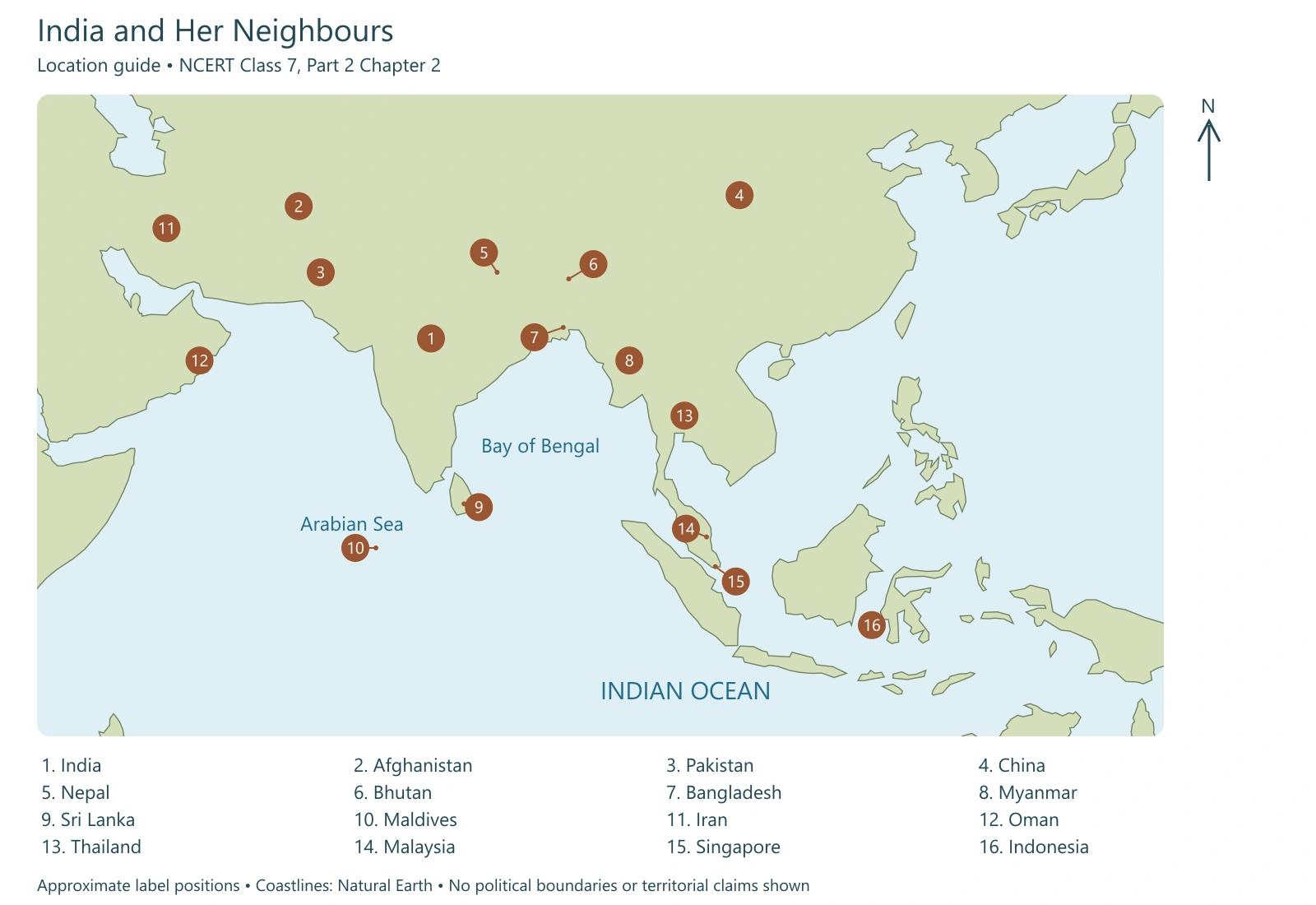
ANSWERUse a current official outline map, label north and the Arabian Sea, Bay of Bengal and Indian Ocean. Follow the textbook’s seven land-neighbour list: Afghanistan, Pakistan, China, Nepal, Bhutan, Bangladesh and Myanmar. Afghanistan’s listing follows India’s official territorial claim; the relevant territory is not under Indian administration.Label Sri Lanka and the Maldives as immediate maritime neighbours, then Iran, Oman, Thailand, Malaysia, Singapore and Indonesia in the chapter’s wider maritime neighbourhood. This broad term does not mean every listed country shares a legally delimited maritime boundary with India.Use arrows in both directions for exchanges in language, food, trade and pilgrimage. Distinguish goods, such as electronics, from cultural flows. Add dashed friendship connections without replacing political borders.Obtain flag images from official government or embassy sources. Preserve their proportions, colours and emblems. Record what is visibly present, then verify symbolism rather than guessing: India has a navy-blue wheel, Bhutan a white dragon, and Nepal a distinctive double-pennant flag.The location guide below uses coastline outlines and approximate country label positions. It is not a political boundary map and cannot replace the official outline map required for the exercise.
Country labels are positioned approximately. Coastline guide only; political boundaries and territorial claims are not depicted. Use an official outline map for the NCERT labelling exercise. Tap to view at full size.
The chapter also contains in-text Let’s explore prompts. Briefly: the three large water bodies surrounding India are the Arabian Sea (west), the Bay of Bengal (east) and the Indian Ocean (south). Bangkok’s ‘Suvarnabhumi’ Airport recalls Suvarṇabhūmi, the ancient Indian name for the ‘golden land’ of Southeast Asia. Tamil being an official language of Singapore shows the long, close ties between south India and Singapore through centuries of trade and migration.
Extra Practice Questions
These questions and MCQs are ClearStudy practice, separate from the NCERT exercise.
Short Answer Type Questions
Q1. How long is India’s land boundary, and which seas surround her?
ANSWERIndia’s land boundary stretches over 15,100 km, passing through deserts, plains, forests, mountains, marshes and river valleys. India is also a maritime nation surrounded on three sides by the sea — the Arabian Sea, the Bay of Bengal and the Indian Ocean — with a coastline of about 11,100 km.
Q2. What is the Kartarpur Corridor and why is it important?
ANSWERThe Kartarpur Corridor is a visa-free border crossing between India and Pakistan, opened in 2019, that lets Indian pilgrims visit Gurdwara Darbar Sahib in Kartarpur, Pakistan, on a permit (not a visa). It is important because the gurdwara is the final resting place of Guru Nānak Dev, founder of Sikhism, and the corridor is seen as a model for peace and dialogue.
Q3. What is SAARC and who are its members?
ANSWERSAARC, the South Asian Association for Regional Cooperation, was formed in 1985 to promote mutual interests and sociocultural and economic progress. Its members are Afghanistan, Bangladesh, Bhutan, India, the Maldives, Nepal, Pakistan and Sri Lanka. Political tensions among some members have, however, often disrupted its functioning.
Q4. Why is India and China’s relationship described as both close and complex?
ANSWERIndia and China share a long relationship shaped by history, geography, culture and trade — for instance, the spread of Buddhism and large two-way trade. Yet it is complex because their shared Himalayan border has seen tensions and conflicts, and the balance of trade is heavily in China’s favour. Both sides try to resolve disputes through dialogue and trade.
Q5. Why is the Maldives an important neighbour for India?
ANSWERThe Maldives, made up of over 1,100 islets, lies only about 130 km from Minicoy in India’s Lakshadweep, making it important for trade and security in the Indian Ocean. The two share centuries-old cultural ties (Dhivehi has Sanskrit and Tamil roots), and India was among the first to recognise the Maldives in 1965 and has given quick disaster relief during crises.
Long Answer Type Questions
Q1. Describe India’s maritime position and why it makes her important in the Indian Ocean region.
ANSWERIndia’s peninsula extends into the Indian Ocean, between the Arabian Sea and Bay of Bengal. Its ports and island territories connect it with sea routes towards Southeast Asia, West Asia and Africa.The textbook rounds the revised coastline measurement to about 11,100 km. Coastline figures depend on mapping scale and measurement method; this differs from the older figure used in some sources.Shipping supports trade, travel and cultural exchange. India also cooperates with neighbours on disaster warnings, relief and maritime safety. The textbook’s fractions for global container, bulk and oil traffic have no dated dataset here; avoid presenting them as verified current statistics.
Q2. Explain how culture and trade have linked India with her Southeast Asian neighbours.
ANSWERFrom a few centuries BCE, Indian traders sailed to Southeast Asia in search of gold, calling the region Suvarṇabhūmi, the ‘golden land’. Along with goods like spices and textiles, they carried religious and cultural ideas that deeply shaped the region. In Thailand, the Dvāravatī culture and the Ayutthayā kingdom were named after Dvārakā and Ayodhyā, and kings are still titled ‘Rama’. In Malaysia, the region adopted a script based on India’s Brāhmī and saw kingdoms like Srivijaya, while Indian workers later migrated to its rubber plantations. Singapore’s very name comes from ‘Singapuram’, the lion city, and Tamil is one of its official languages. In Indonesia, the Borobudur Stūpa, Garuḍa on its currency and Rāmāyaṇa performances show this legacy. Today these ties continue through trade, investment, tourism and modern projects like the India–Myanmar–Thailand Trilateral Highway.
Q3. “Geography and history together shape India’s relations with her neighbours.” Discuss with examples of both friendly and difficult relationships.
ANSWERIndia’s ties with her neighbours are shaped by both geography (mountains, rivers, seas, borders) and history (shared pasts, events, religions). Friendly relationships: the open-border arrangement and the 1950 treaty make India–Nepal ties close, with shared festivals and free movement; India and Bhutan share Himalayan geography and Buddhist heritage, cooperating on hydropower; India and Bangladesh share rivers, the Bangla language and the shared Sundarbans ecosystem. Difficult relationships: the 1947 Partition created one of South Asia’s most complex ties with Pakistan, marked by wars and terrorism, though pilgrimage links like the Kartarpur Corridor offer hope; the Himalayan border between India and China has seen serious tensions despite strong trade and cultural links. Thus the same forces — geography and history — can make a relationship warm or strained, but culture, trade and cooperation help keep the neighbourhood connected.
MCQs & Assertion–Reason
1. A maritime neighbour is a country connected to another by:
(a) a shared land border (b) a shared sea or ocean (c) a shared language only (d) a shared mountain range
2. India’s total land boundary stretches over about:
(a) 7,500 km (b) 11,100 km (c) 15,100 km (d) 32,000 km
3. The narrow stretch of sea separating India and Sri Lanka is the:
(a) Palk Strait (b) Bay of Bengal (c) Andaman Sea (d) Persian Gulf
4. The Kartarpur Corridor connects India with which country?
For each Assertion–Reason question, choose: (A) Both true and the Reason correctly explains the Assertion; (B) Both true but the Reason is not the correct explanation; (C) Assertion true, Reason false; (D) Assertion false, Reason true.
A-R 1. Assertion: Sri Lanka and the Maldives are India’s maritime neighbours.
Reason: They are connected to India across the sea, even without a direct land border.
A-R 2. Assertion: India and Nepal citizens need a visa and passport to cross their shared border.
Reason: India and Nepal share an open-border arrangement that facilitates movement of their citizens.
A-R 3. Assertion: Buddhism is a powerful cultural link between India and several of her neighbours.
Reason: Buddhism originated in India and spread to neighbours like China, Sri Lanka, Bhutan and Thailand through trade and pilgrimage.
A-R 4. Assertion: Bangladesh was born in 1971 after a war between India and Pakistan.
Reason: Bangladesh, earlier known as ‘East Pakistan’, shares the Bangla language with India’s state of West Bengal.
A-R 5. Assertion: Being good neighbours is only about sharing land borders.
Reason: Working together for the benefit of the whole region (regionalism) builds peace, stability and shared progress.
Answer key: 1-(A), 2-(D), 3-(A), 4-(B), 5-(D).
Important qualifications: the chapter describes projects and historical examples, not a live travel advisory. Check official sources before relying on current corridor access, transport-project completion or trade rankings. Bangladesh became independent through its 1971 Liberation War, supported by India; it was not merely a passive outcome of an India–Pakistan war. Maritime and land-neighbour categories can overlap.
In-text activities: Suvarnabhumi recalls the Sanskrit expression for “golden land”. Tamil’s official status in Singapore reflects the history and contribution of its Tamil-speaking community. Shared religious symbols should be understood in their local contexts.
Reviewed against NCERT Exploring Society: India and Beyond, Class 7, Part 2, Chapter 2, pp. 29–60 (first edition, November 2025), with the primary-source clarifications linked above. Review date: 10 October 2026.
Exam Tips & Common Mistakes
How to write a clear answer
Clearly separate land neighbours (Pakistan, Afghanistan, China, Nepal, Bhutan, Bangladesh, Myanmar) from maritime neighbours (Sri Lanka, Maldives, Iran, Oman, Thailand, Malaysia, Singapore, Indonesia) — examiners love this grouping. Learn the key numbers (land border ≈ 15,100 km; coastline ≈ 11,100 km; Palk Strait ≈ 32 km; Maldives ≈ 130 km from Minicoy). For ‘link’ questions, always give two or three concrete examples — the spread of Buddhism, the Kartarpur Corridor, the open border, Chabahar Port, the 2004 tsunami warning system and the Sundarban. Use the chapter’s own terms: maritime neighbour, regionalism, open border, SAARC.
Common mistakes to avoid
Saying a neighbour must share a land border — remember maritime neighbours like Sri Lanka and the Maldives.
Confusing land neighbours with maritime neighbours, or mixing up their borders/states.
Confusing visa-free movement for the two countries’ citizens with the absence of identity, customs and security rules.
Forgetting that Buddhism originated in India and then spread outward, not the other way round.
Mixing up Bangladesh (born 1971, earlier ‘East Pakistan’) with the 1947 Partition that created Pakistan.
Leaving the map/project question (Q8) and ‘imagination’ question (Q7) blank — attempt them with your own work.
Frequently Asked Questions
What is Part 2 Chapter 2 of Class 7 Social Science Exploring Society about?
Part 2 Chapter 2, India and Her Neighbours, explains who a neighbour is — both land-based and maritime — how geography and history shape India’s ties with countries like China, Pakistan, Bangladesh, Nepal, Bhutan, Myanmar, Sri Lanka, the Maldives, Iran, Oman and Southeast Asian nations, and how culture, religion, trade and cooperation keep them interconnected today.
Who are India’s land neighbours and maritime neighbours?
India’s land neighbours are Pakistan, Afghanistan, China (Tibet), Nepal, Bhutan, Bangladesh and Myanmar. Her maritime neighbours include Sri Lanka and the Maldives (nearest) and Iran, Oman, Thailand, Malaysia, Singapore and Indonesia in the wider neighbourhood.
What is the exercise heading for Part 2 Chapter 2 of Exploring Society Part 2?
The end-of-chapter exercise in Exploring Society: India and Beyond (Part 2) Part 2 Chapter 2 is headed Questions and activities and contains 8 numbered questions, all answered step by step on this page, along with the chapter’s ‘Big Questions’.