
NCERT Solutions for Class 7 Social Science (Exploring Society) Part 2 Chapter 3: Empires and Kingdoms: 6th to 10th Centuries (NCERT 2026–27)
These Class 7 Social Science Exploring Society Part 2 Chapter 3 solutions cover Empires and Kingdoms: 6th to 10th Centuries from Exploring Society: India and Beyond (Part 2), the NCERT textbook (first edition, November 2025), used here for the 2026–27 session. The chapter surveys India across the sixth to tenth centuries CE, with some earlier background and later developments — the reign of Harṣhavardhana, the long Tripartite Struggle over Kannauj between the Pālas, Gurjara-Pratīhāras and Rāṣhṭrakūṭas, the rise of southern powers like the Chālukyas, Pallavas, Pāṇḍyas and Cholas, and the impact of the Hūṇa and Arab invasions. Below you get step-by-step answers to all Questions and activities, clear notes on key terms, a timeline table, extra practice, MCQs, Assertion–Reason and FAQs.
This is NCERT Part 2 Chapter 3. ClearStudy previously called it Chapter 15 by continuing Part 1; the existing address is retained.
Class 7 Social Science Exploring Society Part 2 Chapter 3 – Overview
Part 2 Chapter 3, Empires and Kingdoms: 6th to 10th Centuries, picks up the story after the decline of the Gupta Empire. With no single power dominating the whole subcontinent, many strong regional kingdoms emerged. In the north, Harṣhavardhana ruled from Kannauj (606–647 CE), patronised scholars like Bāṇabhaṭṭa and hosted the Chinese pilgrim Xuanzang. After his death, the Pālas, Gurjara-Pratīhāras and Rāṣhṭrakūṭas fought the long, indecisive Tripartite Struggle for Kannauj. Meanwhile Kashmir, the Deccan and the far south flourished — the Chālukyas of Vātāpi, the Pallavas of Kānchī (builders of Māmallapuram), and the Pāṇḍyas, Cheras and rising Cholas. The chapter shows how rulers patronised Hindu, Buddhist and Jain traditions alike, how the Bhakti tradition, mathematics (Brahmagupta) and temple art blossomed, and how India absorbed the Hūṇas and resisted the Arab conquest of Sindh — a period of regional consolidation, cultural richness and resilience.
Key Terms & Concepts
Harṣhavardhana (Harṣha): ruler of the Puṣhyabhūti (Vardhana) dynasty who ascended the throne at Kannauj in 606 CE, expanded over much of north and east India, was a poet-dramatist and patron of scholars, and gave away his wealth every five years at the Prayāga assembly.
Xuanzang: a Chinese Buddhist pilgrim who travelled across India between 630 and 644 CE, carried back over 600 Sanskrit manuscripts to China, and left a detailed travelogue that is a major source for this period.
Tripartite Struggle: a long, indecisive contest during the 8th–9th centuries for control of Kannauj between three powers — the Pālas (east), the Gurjara-Pratīhāras (west) and the Rāṣhṭrakūṭas (Deccan). (‘Tripartite’ means involving three distinct parties.)
The Pālas: an eastern dynasty begun by Gopāla (chosen king in 750 CE); great patrons of Mahāyāna Buddhism who founded monastic universities such as Vikramaśhilā and Somapura and continued to support Nālandā.
The Gurjara-Pratīhāras: a western dynasty founded by Nāgabhaṭa I (mid-8th century) famous for pushing back Arab invasions; King Bhoja built a large empire across north India.
The Rāṣhṭrakūṭas: a Deccan power (capital Mānyakheṭa) begun when Dantidurga overthrew the Chālukyas; King Krishna I commissioned artisans to carve the rock-cut Kailaśhanātha temple at Ellora, and Amoghavarṣha I (Nṛipatunga) ruled for 64 years.
The Chālukyas: a Deccan dynasty (capital Vātāpi/Badami) whose ruler Pulakeśhin II checked Harṣha’s southward advance and was praised in the Aihole inscription by the poet Ravikīrti.
The Pallavas: a southern dynasty with capital at Kānchī, builders of the rock-cut and monolithic temples at Māmallapuram; their kings Mahendravarman I and Narasimhavarman I (‘Mamalla’) led them to their peak.
Sāmantas: subordinate rulers (tributaries or vassals) through whom emperors governed outlying regions; they led armies and managed local administration but their loyalty could be fragile.
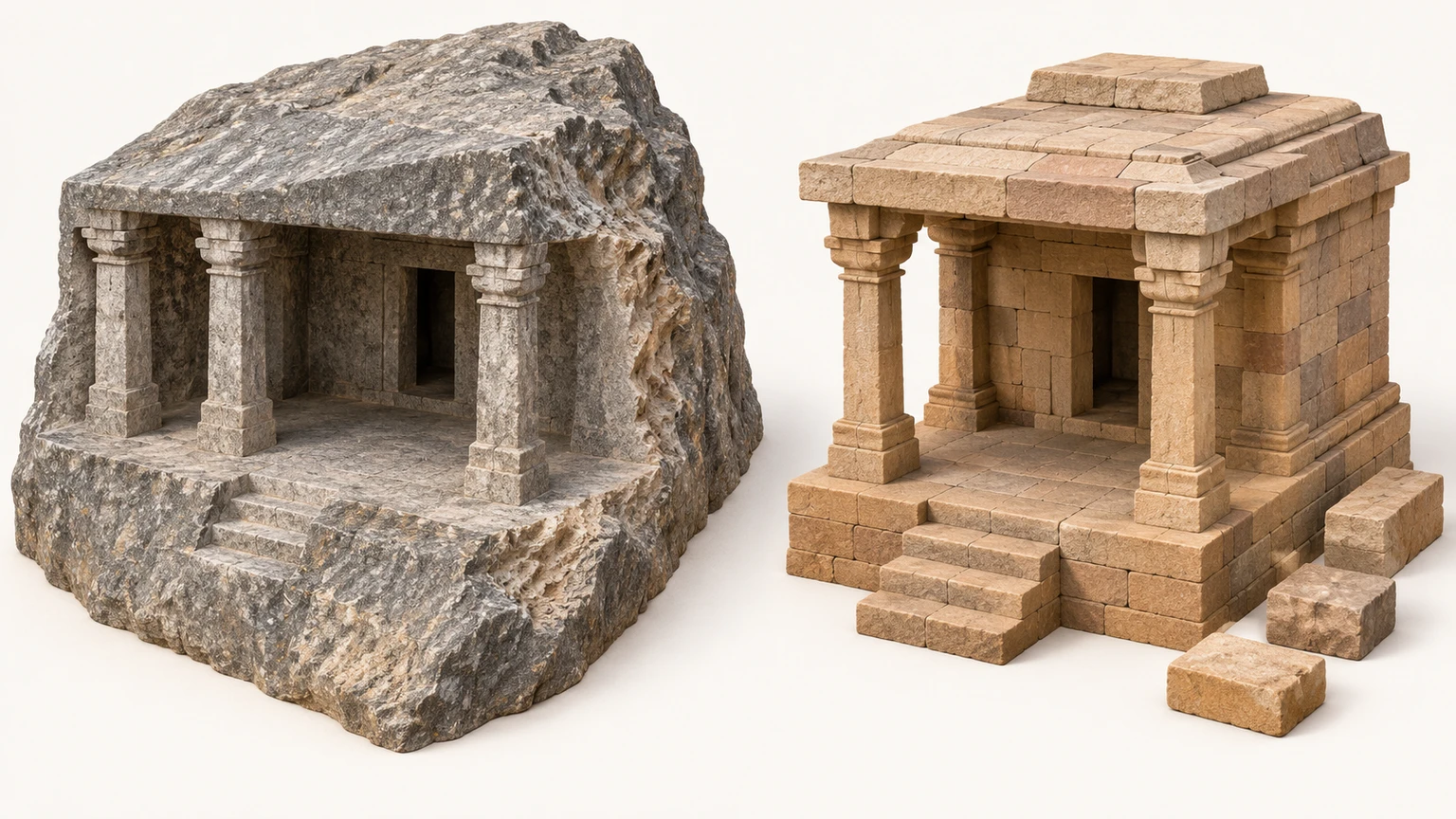
Monolithic: made of a single (‘mono’) stone or rock (‘lithic’) — as in the monolithic temples carved at Māmallapuram and the Kailaśhanātha temple at Ellora.
Other key names: Rājatarangiṇī (Kalhaṇa’s 12th-century Sanskrit history of Kashmir’s kings), Brahmagupta (mathematician-astronomer who set out rules for zero, negative numbers and fractions), the Bhakti tradition (personal devotion spread by the Ālvārs and Nāyanārs of the south), and the Mlechchha / infidel / idol terms explained in the chapter’s side-boxes.
Timeline of the Period (Fig. 3.2)
Adapted from NCERT Fig. 3.2. Dates are broad chronological guides; developments such as bhakti did not begin in a single year.
| Date | Event |
|---|---|
| 6th century | Rise of the Chālukya dynasty |
| 606 | Harṣhavardhana’s rule begins at Kannauj |
| 630–644 | Xuanzang’s travels in India |
| 637 | First Arab naval attack repulsed at Thana |
| From the 6th century; c. 650 in Fig. 3.2 | Expansion of Tamil bhakti poetry; devotional traditions have earlier roots |
| 6th to 8th century | Pallava–Chālukya struggle |
| 712 | Arabs conquer Sindh after several attempts |
| 750 | Rise of the Pāla dynasty |
| 8th–9th centuries | Tripartite Struggle over Kannauj |
| 9th century | The Cholas emerge as a dominant power |
The Big Questions — answered
1. What major changes characterised this period?
2. How did political, cultural and religious developments shape India?
3. What was the impact of foreign invasions and interactions?
“Questions and activities” — Full Solutions
All questions below are reproduced verbatim from the NCERT textbook’s end-of-chapter Questions and activities section. Answers are original, written in exam-ready style. Several questions are activity- or discussion-based; for these a model answer is given.
1. If you lived in Kannauj during the struggle between the Pālas, the Pratīhāras and the Rāṣhṭrakūṭas, how would it change your daily life and your estimate of the rulers? Write a letter on this to your friend living in Kanchipuram.
Dear friend in Kanchipuram,Our city attracts rulers from three powerful dynasties: the Palas, Gurjara-Pratiharas and Rashtrakutas. Its location in the fertile Ganga plain and its political importance make it a valuable prize.I fear that a new campaign could interrupt journeys, damage crops and bring extra demands for supplies. Traders may delay visits when roads are unsafe. Between campaigns, however, people still farm, make goods, worship and study. War does not mean every place is always in ruins.I would judge rulers by whether they protect residents, maintain fair administration and support useful public works, as well as by their generosity to scholars and religious institutions. Victories alone do not tell us whether ordinary people live well.Tell me about life in Kanchipuram and the temples near your home.
Your friendThe daily-life effects are reasonable possibilities for this creative task, not evidence of a documented event, coin change or price rise in a particular year.
2. Emperors and kings during this period controlled only core regions and governed other regions through subordinate vassals. What would be the advantages and the challenges of such a system?
3. In what ways were the invasions of the Hūṇas and the Arabs different in their aims, methods, and impact on the Indian subcontinent? Prepare a write-up, discuss and present it in the class.
4. Imagine you are a common citizen watching the Prayāga assembly. How would you react to Harṣha giving away most of his wealth?
5. Forming groups, let each group choose one Ālvār and one Nāyanār and prepare a biography poster or booklet. Include their life stories and a sample poem or two (in translation).
Sample project pair: Andal is remembered in the Tamil Vaishnava tradition at Srivilliputhur and is credited with the Tiruppavai and Nachiyar Tirumoli. Her adoption by Periyalvar and divine marriage belong to devotional biography; distinguish such traditions from securely dated evidence. Karaikkal Ammaiyar is a Shaiva poet from Karaikkal, commonly placed around the sixth century; her poetry addresses Shiva and his dance. Stories of her transformation express devotional beliefs.
Poem sources: choose a verse from Andal’s Tiruppavai, with text and translation links, and Karaikkal Ammaiyar’s Arputha Tiruvandhathi, verse 1. In the latter, the speaker recalls devotion since learning to speak and asks Shiva to relieve suffering (summary, not a quotation). Credit the translator and explain each poem in your own words; do not invent verses and attribute them to the saints.
6. You will notice that our maps show only ancient names for the kingdoms’ capitals and main cities. Using a pencil, mark the modern names next to their original names. Refer the current map of India and try to locate those cities on it.
This answer is based on the modern names supplied in the chapter text, since the textbook’s maps use only ancient names.
7. Match the ruler or the dynasty with the city.
| Ruler / Dynasty | City |
|---|---|
| (a) Rāṣhṭrakūṭas | (iii) Mānyakheṭa |
| (b) Gurjara-Pratīhāras | (iv) Ujjayinī |
| (c) Cholas | (ii) Tanjāvūr |
| (d) Harṣhavardhana | (v) Kānyakubja |
| (e) Pallavas | (i) Kānchī |
Extra Practice Questions
These questions and MCQs are ClearStudy practice, separate from the NCERT exercise.
Short Answer Type Questions
Q1. Who was Harṣhavardhana and from where did he rule?
Q2. Why was the city of Kannauj so important during this period?
Q3. What was Vikramaśhilā and why was it famous?
Q4. Who was Xuanzang and why is he important to historians?
Q5. What was the contribution of Brahmagupta to mathematics?
Long Answer Type Questions
Q1. Describe the Tripartite Struggle for Kannauj.
Q2. Discuss the cultural and religious developments of this period.
Q3. Write about the major southern kingdoms of this period and their achievements.
MCQs & Assertion–Reason
1. Harṣhavardhana ascended the throne at Kannauj in the year:
(a) 606 CE (b) 647 CE (c) 712 CE (d) 750 CE
2. The Chinese pilgrim who travelled in India between 630 and 644 CE was:
(a) Faxian (b) Xuanzang (c) Al-Balādhurī (d) Kalhaṇa
3. The three powers that fought the Tripartite Struggle for Kannauj were the Pālas, the Rāṣhṭrakūṭas and the:
(a) Cholas (b) Pallavas (c) Gurjara-Pratīhāras (d) Pāṇḍyas
4. The rock-cut Kailaśhanātha temple at Ellora was created under which Rāṣhṭrakūṭa king?
(a) Dantidurga (b) Krishna I (c) Amoghavarṣha I (d) Gopāla
5. The Pāla king who founded the university of Vikramaśhilā was:
(a) Gopāla (b) Bhoja (c) Dharmapāla (d) Nāgabhaṭa I
6. The capital of the Chālukyas under Pulakeśhin II was:
(a) Kānchī (b) Vātāpi (Badami) (c) Mānyakheṭa (d) Tanjāvūr
7. The Pallava king known as ‘Mamalla’, who defeated Pulakeśhin II, was:
(a) Mahendravarman I (b) Narasimhavarman I (c) Aditya I (d) Vijayālaya
8. Kalhaṇa’s Rājatarangiṇī is a history of the rulers of:
(a) Bengal (b) the Deccan (c) Kashmir (d) Tamil Nadu
9. The Arab commander who conquered Sindh and defeated King Dāhar was:
(a) Toramāṇa (b) Muhammad bin Qasim (c) Bakhtiyār Khiljī (d) Sulaiman
10. Brahmagupta is famous for setting out the rules of arithmetic with:
(a) only whole numbers (b) zero, negative numbers and fractions (c) Roman numerals (d) the calendar alone
For each Assertion–Reason question, choose: (A) Both true and the Reason correctly explains the Assertion; (B) Both true but the Reason is not the correct explanation; (C) Assertion true, Reason false; (D) Assertion false, Reason true.
A-R 1. Assertion: Many regional kingdoms emerged in India after about 600 CE.
Reason: The Gupta Empire had lost its dominance, and no single power could control the whole subcontinent.
A-R 2. Assertion: Powerful sāmantas could overthrow their overlords.
Reason: The Rāṣhṭrakūṭas, once sāmantas under the Chālukyas, grew strong enough to replace them.
A-R 3. Assertion: Evidence shows Hūṇa groups adopted elements of local culture.
Reason: Inscriptions and coins record local administrative roles, languages, titles and religious symbols.
A-R 4. Assertion: The Arab conquest of Sindh quickly led to control over most of India.
Reason: Indian rulers like the Gurjara-Pratīhāras repeatedly pushed back Arab advances, limiting their rule to small areas.
A-R 5. Assertion: Rulers of this period generally patronised Hindu, Buddhist and Jain traditions together.
Reason: In ancient India the idea of religion was more fluid, and rulers often took pride in supporting several schools of thought.
Further checks: Pataliputra was the earlier Maurya and Gupta centre; Kannauj’s rise shifted political attention within the Ganga plain. Xuanzang’s route crossed difficult Central Asian terrain; locate the Gobi, Taklamakan and Hindu Kush on Fig. 3.7 and identify Nalanda and Bodh Gaya. Do not invent pass names absent from the map.
Inscriptions: Ravikirti’s Aihole inscription praises his patron and needs comparison with other evidence. Bilingual grants could combine prestigious court language with practical local instructions. Gopala’s selection should not be equated with modern universal voting, nor Chola village assemblies with equal participation by everyone.
City exercise: add Ujjayini → Ujjain and Kashi → Varanasi to the listed pairs. The matching exercise uses the textbook’s associations; capitals could change over time. Vikramashila was a learning centre, not the answer to a Pala capital question.
Chronology: do not confuse the ninth-century Pratihara Mihira Bhoja with the later Paramara Bhoja. Royal patronage could cross religious affiliations, but it did not make all beliefs or social positions identical.
Reviewed against NCERT Exploring Society: India and Beyond, Class 7, Part 2, Chapter 3, pp. 61–96 (first edition, November 2025). Review date: 10 October 2026.
Exam Tips & Common Mistakes
How to write a clear answer
Memorise the three powers of the Tripartite Struggle and where each came from (Pālas–east, Gurjara-Pratīhāras–west, Rāṣhṭrakūṭas–Deccan). Link each dynasty to its capital and one achievement — Harṣha–Kannauj, Pālas–Vikramaśhilā, Rāṣhṭrakūṭas–Ellora’s Kailaśhanātha, Chālukyas–Vātāpi/Aihole, Pallavas–Māmallapuram, Cholas–Tanjāvūr. For the invasion question, compare aims, methods and impacts, distinguishing territorial expansion, integration and cultural exchange. Remember key sources — Xuanzang’s travelogue, Bāṇa’s Harṣhacharita, Kalhaṇa’s Rājatarangiṇī, the Aihole inscription — and the achievement of Brahmagupta in mathematics.
Common mistakes to avoid
- Confusing the two Chinese pilgrims — Faxian visited in the 5th century (Gupta era), Xuanzang in the 7th century (Harṣha’s time).
- Mixing up the capitals: Rāṣhṭrakūṭas–Mānyakheṭa, Chālukyas–Vātāpi, Pallavas–Kānchī, Cholas–Tanjāvūr.
- Thinking the Tripartite Struggle had a clear winner — it was long and indecisive.
- Assuming the Arabs conquered most of India — their control was limited to small parts of Sindh and Punjab.
- Confusing monolithic (carved from a single rock) temples with ordinary built temples.
- Leaving activity questions (1, 4, 5, 6) blank — write your own letter, reaction, project notes or map matches.
Frequently Asked Questions
What is Part 2 Chapter 3 of Class 7 Social Science Exploring Society about?
Part 2 Chapter 3, Empires and Kingdoms: 6th to 10th Centuries, surveys India after the Gupta Empire — the reign of Harṣhavardhana, the Tripartite Struggle for Kannauj between the Pālas, Gurjara-Pratīhāras and Rāṣhṭrakūṭas, the rise of southern powers like the Chālukyas, Pallavas, Pāṇḍyas and Cholas, the flowering of the Bhakti tradition and mathematics, and the Hūṇa and Arab invasions.
Who were the three powers in the Tripartite Struggle?
The Tripartite Struggle for Kannauj was fought during the 8th and 9th centuries between the Pālas from eastern India, the Gurjara-Pratīhāras from western India, and the Rāṣhṭrakūṭas from the Deccan. It was long and indecisive, with no lasting victor.
What is the exercise heading for Part 2 Chapter 3 of Exploring Society Part 2?
The end-of-chapter exercise in Exploring Society: India and Beyond (Part 2) Part 2 Chapter 3 is headed Questions and activities and contains 7 numbered questions, all answered step by step on this page.