
NCERT Solutions for Class 7 Social Science (Exploring Society) Part 2 Chapter 6: The State, the Government, and You
These Class 7 Social Science Exploring Society Part 2 Chapter 6 solutions cover The State, the Government, and You from Exploring Society: India and Beyond (Part 2), the NCERT textbook (first edition, November 2025), used here for the 2026–27 session. The chapter belongs to the theme Governance and Democracy and explains the difference between a state and a government, the four features of a state, why India is a democratic republic, the three organs (legislature, executive, judiciary) and three tiers of government, and the many ways in which ordinary citizens can engage with and hold the government accountable. Below you get step-by-step answers to all Questions and activities, clear notes on key terms, extra practice, MCQs, Assertion–Reason and FAQs.
This is NCERT Part 2 Chapter 6. ClearStudy previously called it Chapter 18 by continuing Part 1; the existing address is retained.
Class 7 Social Science Exploring Society Part 2 Chapter 6 – Overview
The State, the Government, and You distinguishes the enduring political state from the government that manages its affairs. A state has a population, territory, government and sovereignty. India combines representative democracy with a non-hereditary, elected head of state. The Constitution sets powers, limits and rights. The chapter explains three organs (legislature, executive, judiciary), three levels (Union, state, local), and citizen participation through elections, public discussion, information requests and complaints.
Key Concepts & Terms
State: a political organisation with a population, defined territory, government and sovereignty. Here it means the country as a political entity; a nation describes a shared identity and is not an exact synonym. A state such as Kerala is a constituent unit of India. Territory need not have permanently unchanged or entirely undisputed borders.
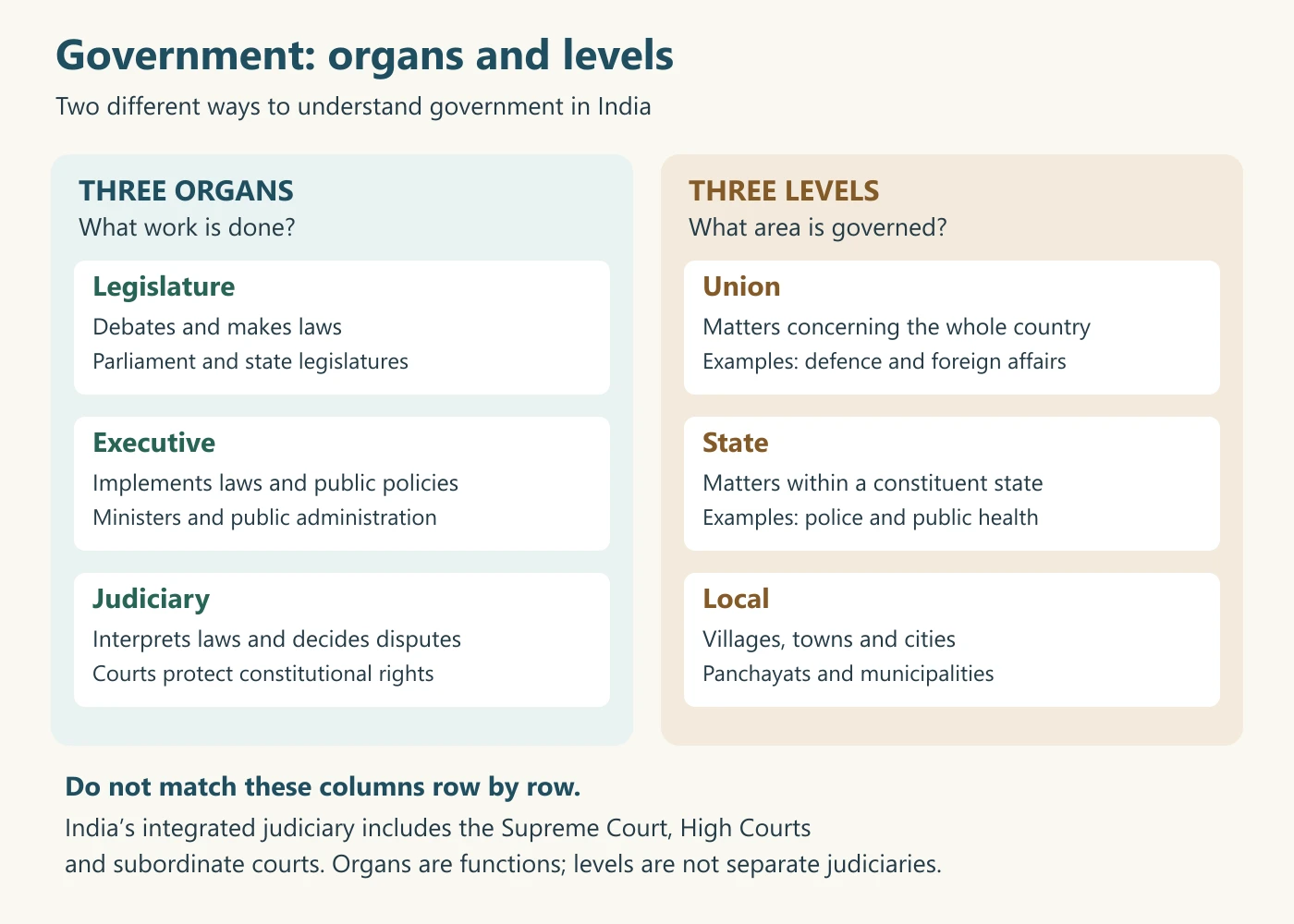
Government: institutions through which public affairs are managed: the legislature makes laws, the executive administers them, and the judiciary interprets them and decides disputes independently. Governments and office-holders can change while the state continues.
Sovereignty: the full power of a state to make and implement its own laws and take decisions without any outside control or interference; an essential feature of every state.
Democracy: ‘rule by the people’ (demos = people, kratos = rule). People have the power to choose their government through free and fair elections.
Republic: in this chapter, a country whose head of state is elected directly or indirectly rather than inheriting the office. Being a republic alone does not guarantee democracy or effective rights protection; constitutional monarchies can also be democracies with protected rights.
Three organs of government: the legislature (makes laws), the executive (implements laws and makes policy) and the judiciary (interprets laws, settles disputes, protects rights).
Political and permanent executive: ministers direct policy and are politically accountable; career civil servants administer policies and normally continue across elections. In India the President appoints the Prime Minister and the Governor appoints the Chief Minister; their ministries depend on legislative confidence. The President is indirectly elected; governors are appointed. A minister who is not a member of the relevant legislature must become one within six consecutive months or cease to be a minister.
Three tiers of government: the central (union) government for the whole country, the state governments for each state, and the local governments — panchayats and municipalities — made the ‘third tier’ by the 73rd and 74th Constitutional Amendments, enacted in 1992 and brought into force in 1993.
Decentralisation: spreading power and decision-making across levels rather than concentrating it in one place, so that local problems are solved locally and big issues by higher governments.
Dominance of the majority: a situation where only the interests of the majority are pursued, harming the rights of minorities; India’s Constitution guards against this through rights and the rule of law.
Other key terms: Transparency (open access to information about government policies and actions), accountability (those in power must answer for their actions), RTI (Right to Information Act), civil society (citizen groups/NGOs), and grām swarāj (Gandhi’s idea of self-sufficient village government).
The Big Questions — explained
1. State and government: the state includes people, territory, sovereignty and government. The government is one component and can change while the state continues.
2. Democracy and republic: democracy concerns rule through the people and accountable institutions; a republic has a non-hereditary head of state. India combines these with constitutional limits and rights.
3. How can citizens engage? vote when eligible, attend local meetings, write to representatives, use lawful public discussion and civil-society groups, seek records through RTI, and use the appropriate grievance mechanism. Students can identify a local issue and write a respectful, evidence-based representation.
“Questions and activities” — Full Solutions
All questions below are reproduced verbatim from the NCERT textbook’s end-of-chapter Questions and activities section. Answers are original, written in exam-ready style.
1. “Every democracy is a republic.” Is this statement true or false? Explain.
2. Give two reasons why decentralisation is important in India.
3. Imagine you are part of your school’s student council. The council works like a mini-parliament — it has members elected by students, debates issues and makes decisions. In this context, do you think it would be better if only the council president makes all the decisions or if power is to be shared among all members?
• Should the student council have the power to make rules about the food you eat, or the language you speak?
• What can go wrong if the student council is the most powerful body in your school and no one questions its decisions?
4. Think about these real-life situations in relation to India’s democracy:
• Should the Parliament be the most powerful institution in the country? Why or why not?
• Should the Parliament have the power to make any law it wants, even if it affects your rights?
• What could go wrong if lawmaking has no limits? Can it lead to unfair or unjust laws?
• Who is more powerful in India, the Parliament or the Supreme Court? Give your reasons.
5. Ask your parents / guardians how they engaged with the government over the past year. Make a list and classify the items based on the level of government they had to work with. What challenges did they face?
Reading the textbook’s organisation chart carefully
NCPCR means National Commission for Protection of Child Rights, and SCPCR means State Commission for Protection of Child Rights. These statutory child-rights bodies can investigate and recommend action; they are not courts or a tier of the judiciary. Read the names and placement in Fig. 6.19 with this correction. See the Commission’s official explanation.
Sources: NCERT Exploring Society: India and Beyond, Part 2, Chapter 6, pp. 143–167 (first edition, November 2025); Constitution of India; RTI Act. Related revision: the Constitution of India.
Extra Practice Questions
These questions and MCQs are ClearStudy practice, separate from the NCERT exercise.
Short Answer Type Questions
Q1. What are the four features of a state?
Q2. How is a state different from a government?
Q3. What is the difference between the political executive and the permanent executive?
Q4. What does the judiciary do, and why is it called the ‘watchdog’?
Q5. Name any three ways in which a citizen can engage with the government.
Long Answer Type Questions
Q1. Explain why India is described as a ‘democratic republic’.
Q2. Describe the three organs of the government and how the Constitution keeps a balance among them.
Q3. What is decentralisation? Explain the roles of the three tiers of government in India.
MCQs & Assertion–Reason
1. Which of the following is NOT one of the four features of a state?
(a) People (b) Land/territory (c) Sovereignty (d) A monarch
2. Sovereignty means that a state:
(a) has a large army (b) can make and implement its own laws without outside control (c) has many citizens (d) shares power with other states
3. The word ‘democracy’ comes from Greek words meaning:
(a) law and order (b) king and rule (c) people and rule (d) state and government
4. Which of these countries is a democracy but NOT a republic?
(a) India (b) the U.S.A. (c) the UK (d) France
5. The branch of government that makes laws is the:
(a) executive (b) legislature (c) judiciary (d) bureaucracy
6. Bureaucrats or civil servants selected through exams like the UPSC form the:
(a) political executive (b) permanent executive (c) legislature (d) judiciary
7. The judiciary is often called the:
(a) lawmaker (b) watchdog (c) provider (d) policymaker
8. The third tier of government in India consists of:
(a) the union government (b) the state governments (c) panchayats and municipalities (d) the Supreme Court
9. The Act through which citizens can ask the government for information about its actions is the:
(a) Right to Education Act (b) Right to Information Act (c) MGNREGS (d) Forest Rights Act
10. Chonira Belliappa Muthamma is remembered as the first Indian woman to:
(a) become Prime Minister (b) win an election (c) clear the public services exam and join the Indian Foreign Service (d) become a Supreme Court judge
For each Assertion–Reason question, choose: (A) Both true and the Reason correctly explains the Assertion; (B) Both true but the Reason is not the correct explanation; (C) Assertion true, Reason false; (D) Assertion false, Reason true.
A-R 1. Assertion: The state and the government are not the same thing.
Reason: The government is only one part of the state and can change after elections, while the state remains the same.
A-R 2. Assertion: Every democracy is also a republic.
Reason: In a republic the head of state is elected and not a hereditary king or queen.
A-R 3. Assertion: Decentralisation is important in a large and diverse country like India.
Reason: A single central government cannot meet the needs of all the people, so local matters are best handled locally.
A-R 4. Assertion: In India, Parliament can pass any law it wishes, even one that takes away fundamental rights.
Reason: The Constitution limits the powers of the government and protects fundamental rights; some belong to all persons and others specifically to citizens.
A-R 5. Assertion: The judiciary in India is independent.
Reason: An independent judiciary helps keep justice fair and protects the rule of law by checking unfair actions.
Exam Tips & Common Mistakes
How to write a clear answer
Memorise the four features of a state (people, land, government, sovereignty) and be able to state in one line how the state differs from the government (use the school-and-teachers comparison). Learn the clean definitions of democracy and republic, and remember the example that the UK, Canada and Sweden are democracies but not republics. For the three organs, link each to its job (legislature = makes laws, executive = implements, judiciary = interprets/protects) and mention ‘checks and balances’. Always connect ‘rights of all’ to the idea of guarding against the ‘dominance of the majority’, and name real examples from the chapter — RTI in Bagepalli, the Silent Valley movement, the Dongria Kondh hills, C.B. Muthamma, and grām swarāj — to show you have studied the text.
Common mistakes to avoid
- Treating state and government as the same — the government is only one part of the state.
- Saying “every democracy is a republic” — democracies with a monarch (UK, Canada, Sweden) are not republics.
- Confusing the political executive (politically accountable ministers) with the permanent executive (non-elected bureaucrats).
- Mixing up the three organs — legislature makes laws, executive implements them, judiciary interprets and protects.
- Thinking Parliament can make any law it wants — the Constitution limits it and protects fundamental rights.
- Leaving discussion/activity questions (Q3, Q5) blank — write a reasoned model answer with your own examples.
Frequently Asked Questions
What is Part 2 Chapter 6 of Class 7 Social Science Exploring Society about?
Part 2 Chapter 6, The State, the Government, and You, explains the difference between a state and a government, the four features of a state, why India is a democratic republic, the three organs (legislature, executive, judiciary) and three tiers of government, and the many ways citizens can engage with and hold the government accountable.
What is the difference between a state and a government?
A state is the larger concept — it includes the people, the territory, sovereignty and the government. The government is just one part of the state; it makes and runs the daily work of the country and can change after elections, while the state itself remains the same.
What is the exercise heading for Part 2 Chapter 6 of Exploring Society Part 2?
The end-of-chapter exercise in Exploring Society: India and Beyond (Part 2) Part 2 Chapter 6 is headed Questions and activities and contains 5 numbered questions, all answered step by step on this page.