
NCERT Solutions for Class 7 Social Science (Exploring Society) Part 2 Chapter 7: Infrastructure: Engine of India’s Development
These Class 7 Social Science Exploring Society Part 2 Chapter 7 solutions cover Infrastructure: Engine of India’s Development from Exploring Society: India and Beyond (Part 2), the NCERT textbook (first edition, November 2025), used here for the 2026–27 session. The chapter belongs to the theme Economic Life Around Us and explains what physical infrastructure is, how India’s transport, communication and energy networks have grown, how good infrastructure improves the quality of life, and why caring for public infrastructure is a collective responsibility. Below you get step-by-step answers to every question in the textbook’s Questions and activities, clear notes on key terms, extra practice, MCQs, Assertion–Reason and FAQs.
This is NCERT Part 2 Chapter 7. ClearStudy previously called it Chapter 19 by continuing Part 1; the existing address is retained.
Class 7 Social Science Exploring Society Part 2 Chapter 7 – Overview
Part 2 Chapter 7, Infrastructure: Engine of India’s Development, explains that physical infrastructure is the vast network of tangible structures — roads, bridges, railways, electricity, water pipelines, communication networks, energy projects and more — built to keep our cities and villages functioning. Through Rishabh’s journey from Delhi to Nashik and Satish the tomato farmer’s story, the chapter shows how transport, power, cold storage and the internet are connected “like pieces of a puzzle.” It surveys India’s transportation infrastructure (roads and highways, railways, metro systems, air transport, shipping and ports), its communications infrastructure (telegraph, telephone, internet, e-governance and e-commerce), and the contribution of Indian scientist J.C. Bose to wireless transmission. It closes with our collective responsibility to use and maintain public infrastructure, the need for safe and sustainable, eco-friendly design, and the rules for roads and waterworks described long ago in Kautilya’s Arthaśāstra.
Key Concepts & Terms
Physical infrastructure: the vast network of tangible (physical) structures built to keep cities and villages functioning — transportation systems, utilities, communication networks, energy infrastructure and so on.
Transportation infrastructure: the systems that enable the mobility of people and goods — roads and highways, railways, metro trains, air transport, and shipping and ports.
Types of roads: local roads serve neighbourhoods; state highways connect places within states; national highways serve wider national connections. National highways fall under Union responsibility, often executed through agencies and partners. Expressways can be developed by Union or state agencies; Uttar Pradesh’s UPEIDA is a state example. Not every national highway is access-controlled like an expressway.
Golden Quadrilateral: an important highway network connecting four of India’s major cities — Delhi, Mumbai, Chennai and Kolkata. NH44 is India’s longest national highway (4,112 km), running from Srinagar to Kanyakumari.
Communications infrastructure: cables, wireless devices, towers, satellites and data centres that enable transmitting messages, images and videos quickly across distances.
E-governance: the use of communication technologies by government to deliver services to citizens — for example, the DigiLocker app to store documents like the Aadhaar card and driving licence online.
E-commerce: buying or selling products and services conducted on online platforms or over the internet.
Patent: a legal right granted through the patent authority that allows the holder to stop others from using the patented invention without permission, subject to law. In India the term is normally 20 years from filing; it is not a general right awarded by any institution. Official patent explanation.
Social infrastructure: facilities such as schools, colleges, hospitals, health centres, police stations, fire stations, courts, parks, libraries and community centres that support the wellbeing and development of communities.
Sustainable infrastructure: infrastructure that uses cleaner energy and environment-friendly materials to minimise pollution and harm to biodiversity, and that considers the needs of children, the elderly and disabled persons.
The Big Questions — explained
1. What is physical infrastructure, and how has it changed? It is the built network supporting everyday life: transport, energy, water and communications. India’s networks have expanded and changed from older roads and steam trains to modern rail, digital communications and diverse energy systems.
2. How does it affect life? Reliable services improve access to schools, healthcare, work and markets. Poor access or damaged systems exclude people; inclusive design and maintenance are essential.
3. How does it support prosperity? Connected systems reduce delays and losses, support production and trade, and create jobs. Benefits depend on sound planning, environmental care and access for different communities.
Think about Satish’s tomato journey
Without irrigation or power, the crop may suffer; without suitable storage and transport, produce can spoil; without price information, the farmer may have fewer bargaining options. One broken link can reduce the value of the others. A new highway may improve market access but also needs safe crossings, fair land arrangements and pollution controls.
Source: NCERT Exploring Society: India and Beyond, Part 2 Chapter 7, pp. 169–192, first edition November 2025. Statistical statements retained from this edition are historical textbook figures. Read also The Story of Indian Farming and Understanding Markets.
“Questions and activities” — Full Solutions
All questions below are reproduced verbatim from the NCERT textbook’s end-of-chapter Questions and activities section. Answers are original, written in exam-ready style. Activity-based questions are answered with model responses that you can adapt to your own area.
1. Which form of physical infrastructure has been built in your area in the last decade? How do you think it has benefitted you or your family members? If you could build something for the community, what would it be?
2. How does infrastructure like ports, highways, and airports create jobs in different parts of the country? Can you think of indirect ways people benefit from it?
3. Why is it important to think about the environment when building new infrastructure like roads or airports? Can infrastructure development and environmental protection go hand in hand? If yes, how?
4. How can better infrastructure (like roads, airports, communication systems) help during natural disasters like floods or earthquakes?
5. Have you ever noticed people misusing public spaces, like scribbling on walls, breaking streetlights, or damaging benches? What are its consequences? Write your observations and suggest solutions to prevent it.
6. Prepare ‘scenario posters’ for the following situations:
• A new factory is planned in an area. What form of infrastructure is required for its smooth operation?
• Self-cleaning roads, underground highways, and high-speed bullet trains could be part of a futuristic city! Imagine the kind of infrastructure that would be required in the future that could help ease the lives of the people and communities in your city, town or village for various day-to-day functions.
• Think about upgrades to the infrastructure near you, considering the terrain of your area, such as coastal, mountainous, plains, etc., and the type of natural calamities your region is prone to.
• If you could design a new railway or metro station, what would it look like and what features would you add to make it more fun and comfortable for the passengers?
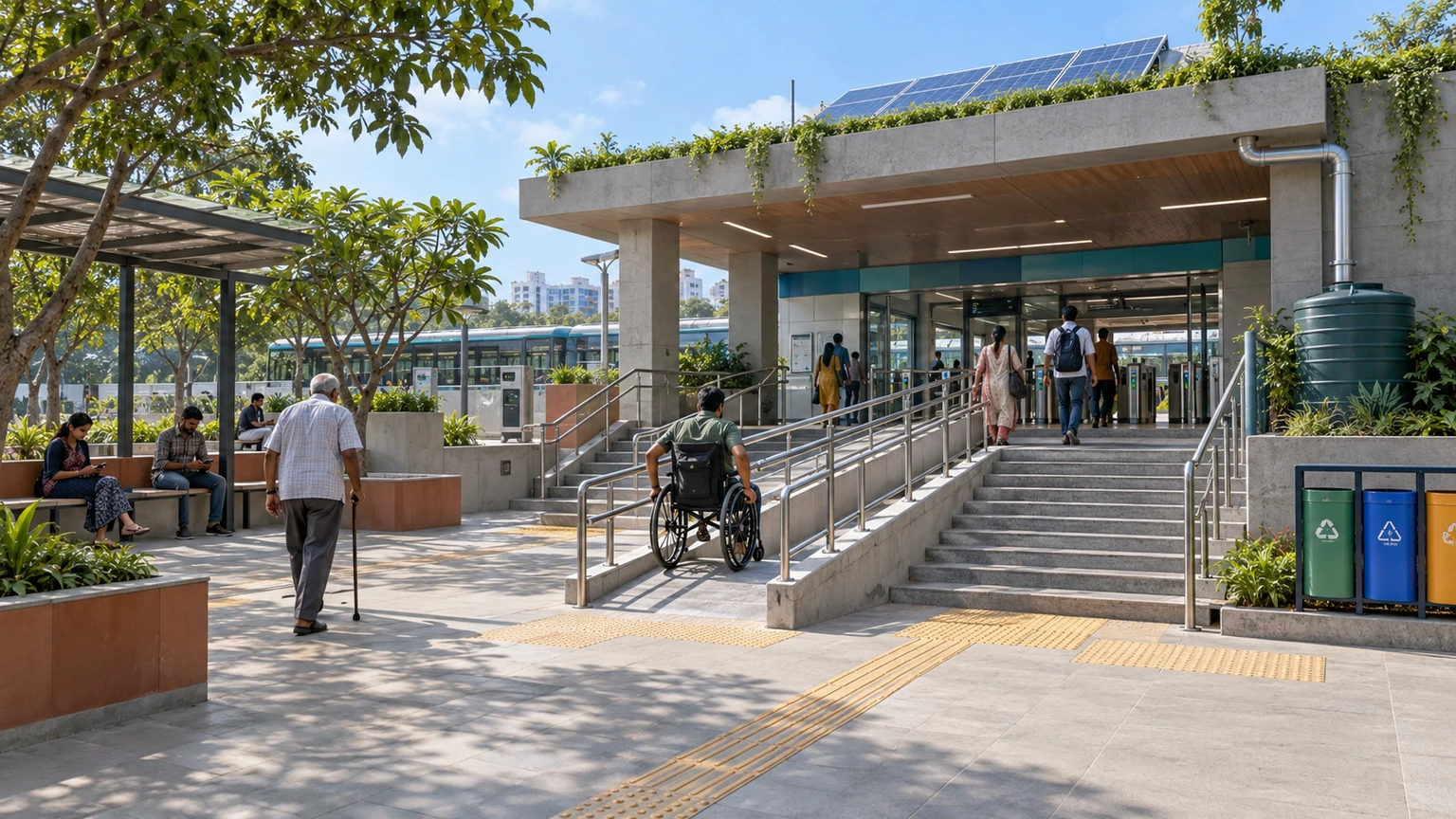
7. Today’s modern infrastructure requires consistent technological innovations. For instance, electric vehicles are increasingly being used by people as a cheaper alternative to polluting fuel like diesel or petrol. Find out about other innovations in infrastructure that can improve ease of living or mobility for communities.
Extra Practice Questions
These questions and MCQs are ClearStudy practice, separate from the NCERT exercise.
Short Answer Type Questions
Q1. What is physical infrastructure? Give two examples.
Q2. Who builds and maintains national highways and expressways in India?
Q3. What is the Golden Quadrilateral?
Q4. Why did the British introduce railways in India in 1853?
Q5. What is e-governance? Give one example.
Long Answer Type Questions
Q1. Describe the different modes of transportation infrastructure in India.
Q2. How has communication infrastructure improved the quality of life in India?
Q3. Why is taking care of public infrastructure a collective responsibility? What should citizens and the government do?
MCQs & Assertion–Reason
1. The vast network of tangible structures that keeps cities and villages functioning is called:
(a) social infrastructure (b) physical infrastructure (c) e-governance (d) e-commerce
2. In NCERT’s 2024 comparison, India has the second-largest road network, after:
(a) China (b) Russia (c) the United States of America (d) Canada
3. NH44, the longest national highway in India, runs from:
(a) Mumbai to Chennai (b) Srinagar to Kanyakumari (c) Delhi to Kolkata (d) Leh to Goa
4. The Golden Quadrilateral connects which four cities?
(a) Delhi, Mumbai, Chennai, Kolkata (b) Delhi, Jaipur, Lucknow, Patna (c) Mumbai, Pune, Surat, Nagpur (d) Bengaluru, Hyderabad, Chennai, Kochi
5. India’s first passenger train ran between Bombay and Thane in:
(a) 1757 (b) 1853 (c) 1882 (d) 1947
6. According to the November 2025 NCERT edition, metro trains operate in about:
(a) 5 cities (b) 12 cities (c) 23 cities (d) 40 cities
7. Which of the following is the fastest way to connect people and places and to deliver aid during disasters?
(a) Road transport (b) Railways (c) Shipping (d) Air transport
8. The DigiLocker app, used to store documents like the Aadhaar card online, is an example of:
(a) e-commerce (b) e-governance (c) a patent (d) social infrastructure
9. The Indian scientist who pioneered wireless transmission using microwaves was:
(a) Guglielmo Marconi (b) Alexander Graham Bell (c) Jagadish Chandra Bose (d) Samuel Morse
10. Schools, hospitals, police stations, parks and libraries are examples of:
(a) physical infrastructure (b) social infrastructure (c) energy infrastructure (d) communication infrastructure
For each Assertion–Reason question, choose: (A) Both true and the Reason correctly explains the Assertion; (B) Both true but the Reason is not the correct explanation; (C) Assertion true, Reason false; (D) Assertion false, Reason true.
A-R 1. Assertion: Good roads and bridges help during natural disasters like floods.
Reason: They allow rescue teams, ambulances and trucks carrying relief to reach affected areas quickly.
A-R 2. Assertion: The British built railways in India mainly to help Indian farmers and traders.
Reason: Railways were introduced in 1853 to transport raw materials to ports for export to Britain and to move troops and goods for British control.
A-R 3. Assertion: Metro trains help reduce pollution in cities.
Reason: Well-used metro systems can replace many individual motor trips and reduce energy use per passenger; electricity sources affect total emissions.
A-R 4. Assertion: Taking care of public infrastructure is a collective responsibility.
Reason: Damage to public infrastructure reduces ease of living and becomes a burden for every citizen.
A-R 5. Assertion: Cargo trains are more harmful to the environment than road transport.
Reason: NCERT cites freight rail using 75–90% less energy than road transport; actual results depend on loads, routes and power sources.
Exam Tips & Common Mistakes
How to write a clear answer
Explain how transport, water, energy and communications support one another. Use examples such as Satish’s tomatoes reaching a market, or an accessible station helping more passengers travel. Label numerical facts by source year and distinguish existing infrastructure from a proposed design. Discuss maintenance, inclusion and environmental costs as well as benefits.
Common mistakes to avoid
- Confusing physical infrastructure with social infrastructure — schools and hospitals are social infrastructure.
- Mixing up who builds roads — national highways are a Union responsibility, while expressways can be developed by Union or state agencies.
- Mixing up e-governance (government services online, e.g. DigiLocker) with e-commerce (buying and selling online).
- Forgetting that the British built railways for their own benefit, not for India’s.
- Saying trains pollute more than roads — NCERT’s freight comparison is not a guarantee for every train journey.
- Leaving activity questions (Q1, Q5, Q6, Q7) blank — give your own examples from your area.
Frequently Asked Questions
What is Part 2 Chapter 7 of Class 7 Social Science Exploring Society about?
Part 2 Chapter 7, Infrastructure: Engine of India’s Development, explains what physical infrastructure is, surveys India’s transport networks (roads, railways, metro, air, shipping and ports) and communications infrastructure, highlights scientist J.C. Bose, and stresses that maintaining public infrastructure through sustainable, eco-friendly design is a collective responsibility.
What is the difference between physical and social infrastructure?
Physical infrastructure is the network of tangible structures like roads, bridges, railways, electricity, water pipelines and communication networks. Social infrastructure includes facilities such as schools, colleges, hospitals, health centres, police stations, courts, parks and libraries that support the wellbeing and development of communities.
What is the exercise heading for Part 2 Chapter 7 of Exploring Society Part 2?
The end-of-chapter exercise in Exploring Society: India and Beyond (Part 2) Chapter 7 is headed Questions and activities and contains 7 questions, all answered step by step on this page.