
NCERT Solutions for Class 7 Social Science (Exploring Society) Chapter 4: New Beginnings: Cities and States (NCERT 2026–27)
These Class 7 Social Science Exploring Society Chapter 4 solutions cover New Beginnings: Cities and States from Exploring Society: India and Beyond (Part 1), the NCF-2023 textbook (2026–27 reprint). The chapter explains India’s Second Urbanisation, the rise of the janapadas and the sixteen mahājanapadas, their systems of governance (monarchies as well as early republics or gaṇas), the role of iron metallurgy and the first Indian coins, and the early varṇa–jāti system. Below you get step-by-step answers to all Questions and activities, the “Let’s explore” comparison table, clear notes on key terms, extra practice, MCQs, Assertion–Reason and FAQs.
Class 7 Social Science Exploring Society Chapter 4 – Overview
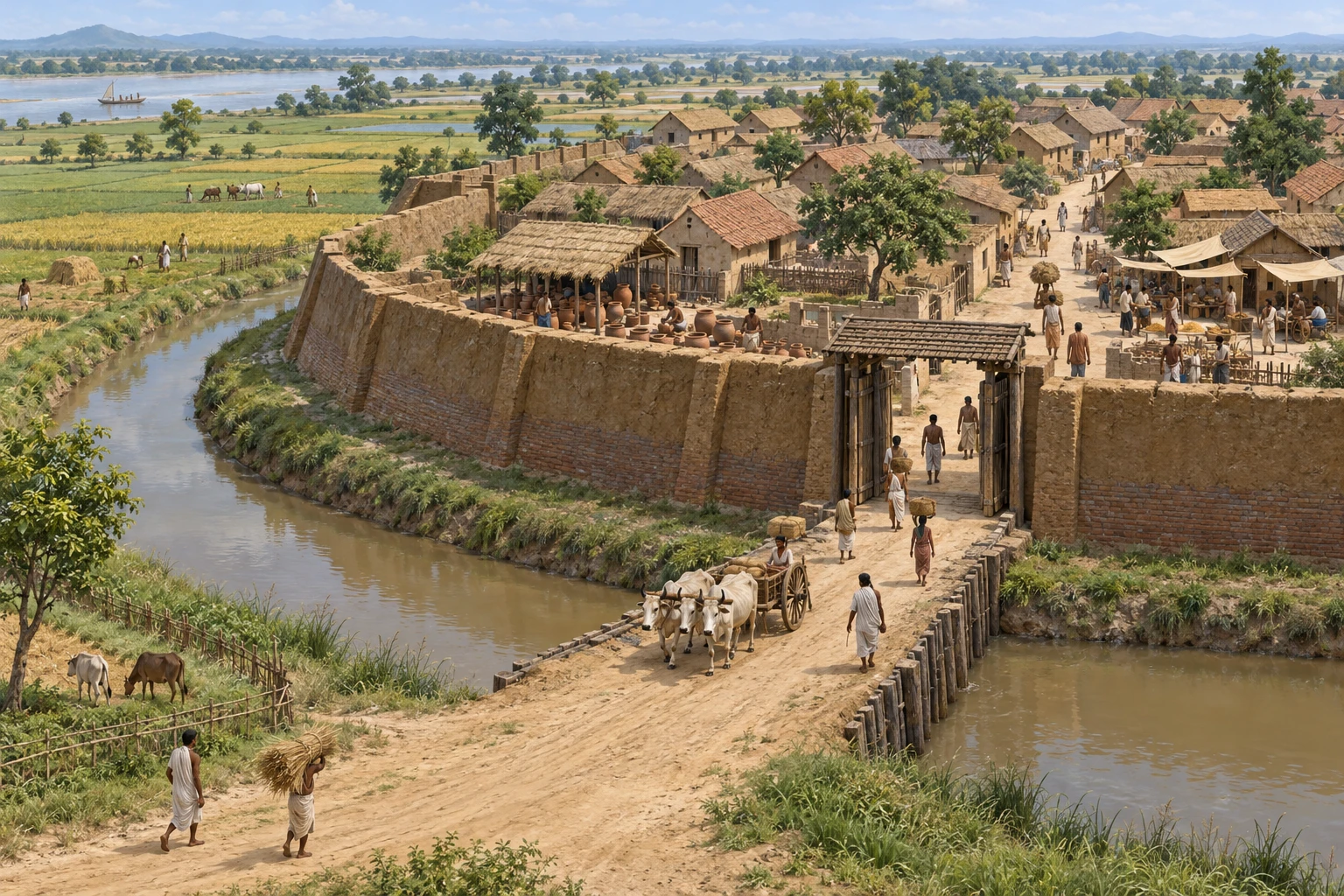
Chapter 4, New Beginnings: Cities and States, traces how urban life returned to India after the decline of the Harappan (Sindhu–Sarasvatī) civilisation — India’s ‘First Urbanisation’. For about a millennium urban life was largely absent, until a vibrant new phase, the Second Urbanisation, began in the 1st millennium BCE in the Ganga plains and the Indus basin. We know this from archaeological excavations and from ancient literature (late Vedic, Buddhist and Jain). As clans settled in territories called janapadas, ruled by a rājā with the help of assemblies (sabhā and samiti), some merged into sixteen large mahājanapadas such as Magadha, Kosala, Vatsa and Avanti. Some were monarchies; others, like Vajji (Vṛijji) and Malla, were gaṇas or sanghas — ‘early republics’. The age brought new technologies (especially iron metallurgy), the first punch-marked coins, new schools of thought, the varṇa–jāti system, and great trade routes (Uttarapatha and Dakṣhiṇapatha) that knit the Subcontinent together by about 300–200 BCE.
Key Terms & Concepts
First Urbanisation: the urban phase of the Harappan / Sindhu–Sarasvatī civilisation, which disintegrated in the early 2nd millennium BCE; cities were abandoned or reverted to a rural lifestyle.
Second Urbanisation: the new phase of urban life that began in the 1st millennium BCE in the Ganga plains and parts of the Indus basin, spreading across the Subcontinent — it has continued right up to today.
Janapada: a Sanskrit word meaning ‘where the people (jana) have set foot (pada)’, i.e. a territory where a clan has settled, led by a rājā or ruler.
Mahājanapada: a larger state formed when janapadas merged, around the 8th–7th centuries BCE; the commonest list names sixteen, from Gandhāra in the northwest to Anga in the east and Aśhmaka in central India.
Sabhā and samiti: assemblies or councils (first mentioned in the Vedas) where clan matters were discussed; a good rājā took their advice, and some texts say an incompetent ruler could even be removed by the assembly.
Gaṇa / sangha (early republic): mahājanapadas such as Vajji (Vṛijji) and Malla where the assembly held real power, took decisions by discussion or vote and even selected the rājā — not monarchies.
Moat: a deep, wide ditch surrounding a fort or fortified city and filled with water, used for defence; gateways were kept narrow to control movement.
Iron metallurgy: the technology of extracting and shaping iron; by the late 2nd millennium BCE iron tools were widespread, aiding large-scale agriculture and making tools and weapons for farming, crafts and armies.
Punch-marked coins: India’s first coins, made of silver, into which symbols were ‘punched’; later coins were of copper, gold and other metals, helping growing trade.
Varṇa: a four-fold concept from Vedic texts — Brahmins (knowledge and rituals), Kshatriyas (defence and warfare), Vaishyas (trade, business, agriculture) and Shudras (artisans, craftspeople, workers).
Jāti: a group or community with a specific occupation tied to livelihood, with skills passed from one generation to the next; often subdivided into sub-jātis with their own customs.
Uttarapatha and Dakṣhiṇapatha: the two great trade and pilgrimage routes — the first connecting the northwest to the Ganga plains and eastern India, the second running from Kauśhāmbī across the Vindhyas to the south.
“Questions and activities” — Full Solutions
The four end-of-chapter questions follow NCERT p. 81. These are ClearStudy model answers, not an official answer key. Historical interpretations should distinguish evidence, inference and uncertainty.
1. Consider the quotation at the start of the chapter and discuss in several groups. Compare your observations and conclusions on what Kauṭilya recommends for a kingdom. Is it very different today?
2. According to the text, how were rulers chosen in early Vedic society?
3. Imagine you are a historian studying ancient India. What types of sources (archaeological, literary, etc.) would you use to learn more about the mahājanapadas? Explain how each source might contribute to your understanding.
4. Why was the development of iron metallurgy so important for the growth of urbanism in the 1st millennium BCE? You may use points from the chapter but also from your knowledge or imagination.
“Let’s explore” Activities
The chapter also contains in-text “Let’s explore” activities, including a comparison table. These are reproduced and answered below.
Activity: The most powerful of these new states were Magadha, Kosala, Vatsa and Avanti. Looking at the map, can you identify their capitals? Also, how many can you match with Indian cities of today?
| Mahājanapada | Capital (ancient) | Matching modern city / region |
|---|---|---|
| Magadha | Rājagṛiha | Rajgir, in Bihar |
| Kosala | Śhrāvastī | Shravasti area, Uttar Pradesh |
| Vatsa | Kauśhāmbī | Kaushambi, near Prayagraj, Uttar Pradesh |
| Avanti | Ujjayinī | Ujjain, Madhya Pradesh |
Activity: Fill up the following table with a Yes (tick) or No (cross) in each square, comparing the two phases of Indian civilisation.
| Feature | First Urbanisation (Harappan) | Second Urbanisation |
|---|---|---|
| Ganga plains | No | Yes |
| Monasteries | No | Yes |
| Literature | No deciphered literary texts available* | Yes |
| Trade | Yes | Yes |
| Warfare | No clear evidence in this chapter* | Yes |
| Copper / bronze | Yes | Yes |
| Iron | No | Yes |
*For the textbook’s Yes/No comparison, “No” in these two cells means that the chapter does not provide clear evidence. The Harappans had writing, but it remains undeciphered; this is not proof that they had no stories or literature. Limited evidence of warfare does not prove that no conflict occurred.
Activity: Why should a complex society divide itself into such groups? List other professions you expect in a complex society of the 1st millennium BCE.
Occupational specialisation can help a society function, but it does not justify hereditary inequality, exclusion or discrimination. The chapter itself points out that groups may gain unequal wealth and power.
Extra Practice Questions
These questions and MCQs are ClearStudy practice, separate from the NCERT exercise.
Short Answer Type Questions
Q1. What is meant by the ‘Second Urbanisation of India’?
Q2. What does the word ‘janapada’ mean?
Q3. How were the mahājanapadas formed, and how many are usually listed?
Q4. What is a moat, and why were city gateways kept narrow?
Q5. Name the four varṇas and the work expected of each.
Long Answer Type Questions
Q1. Describe the system of governance that the janapadas and mahājanapadas evolved.
Q2. Explain the varṇa–jāti system and how it changed over time.
Q3. Describe the major innovations and trade routes of the age of the mahājanapadas.
MCQs & Assertion–Reason
1. India’s ‘First Urbanisation’ is associated with which civilisation?
(a) Vedic (b) Harappan / Sindhu–Sarasvatī (c) Mauryan (d) Gupta
2. The word ‘janapada’ literally means:
(a) a great king (b) a fortified city (c) where the people have set foot (settled) (d) a silver coin
3. According to the more frequent list, how many mahājanapadas were there?
(a) 8 (b) 12 (c) 16 (d) 22
4. Which of these mahājanapadas was a gaṇa or sangha (early republic)?
(a) Magadha (b) Avanti (c) Kosala (d) Vajji (Vṛijji)
5. The assemblies in which clan matters were discussed were called:
(a) sabhā and samiti (b) varṇa and jāti (c) Uttarapatha and Dakṣhiṇapatha (d) gaṇa and sangha
6. A deep, wide, water-filled ditch around a fortified city is called a:
(a) rampart (b) moat (c) gateway (d) janapada
7. India’s first coins were made mainly of which metal?
(a) Gold (b) Copper (c) Silver (d) Iron
8. Which technology was the major new shift of the Second Urbanisation?
(a) Bronze casting (b) Iron metallurgy (c) Glass-making (d) Paper-making
9. The capital of the Magadha mahājanapada was:
(a) Ujjayinī (b) Kauśhāmbī (c) Rājagṛiha (d) Śhrāvastī
10. The two great trade routes mentioned in the chapter were the:
(a) Uttarapatha and Dakṣhiṇapatha (b) sabhā and samiti (c) varṇa and jāti (d) Chola and Chera roads
For each Assertion–Reason question, choose: (A) Both true and the Reason correctly explains the Assertion; (B) Both true but the Reason is not the correct explanation; (C) Assertion true, Reason false; (D) Assertion false, Reason true.
A-R 1. Assertion: After the decline of the Harappan civilisation, urban life remained largely absent in India for about a thousand years.
Reason: Major Harappan urban institutions declined, while regional cultures and village life continued.
A-R 2. Assertion: Vajji (Vṛijji) and Malla were monarchies ruled by a hereditary king.
Reason: In these states the assembly took major decisions by discussion or vote and even selected the rājā.
A-R 3. Assertion: The development of iron metallurgy helped urbanism grow in the 1st millennium BCE.
Reason: Iron tools made large-scale agriculture possible and gave tools and weapons for farming, crafts and armies.
A-R 4. Assertion: Historians rely on both archaeological and literary sources to study the mahājanapadas.
Reason: Excavations confirm ancient urban centres while late Vedic, Buddhist and Jain texts describe them.
A-R 5. Assertion: The varṇa–jāti system was completely rigid right from the start.
Reason: There is evidence that in early periods individuals and communities changed their occupations when circumstances demanded.
Exam Tips & Common Mistakes
How to write a clear answer
Be ready to define First vs Second Urbanisation and to explain the difference between a janapada and a mahājanapada. Remember the number sixteen and a few names with capitals (Magadha–Rājagṛiha, Kosala–Śhrāvastī, Vatsa–Kauśhāmbī, Avanti–Ujjayinī). For governance questions, always contrast monarchies with the gaṇas/sanghas (early republics like Vajji and Malla). Link iron metallurgy to bigger agriculture, surplus, trade and stronger armies. Use the textbook’s own examples — sabhā/samiti, punch-marked coins, the moat and narrow gateways, the Uttarapatha and Dakṣhiṇapatha — to show you have studied the chapter.
Common mistakes to avoid
- Confusing the First Urbanisation (Harappan, Indus region, no iron) with the Second Urbanisation (Ganga plains, iron).
- Saying all mahājanapadas were monarchies — some, like Vajji and Malla, were gaṇas/sanghas (republics).
- Mixing up varṇa (the four-fold Vedic concept) with jāti (occupation-based community).
- Forgetting that India’s first coins were silver punch-marked coins, not gold.
- Treating the varṇa–jāti system as rigid from the beginning — it was more flexible in early periods.
- Giving only one type of source for Q3 — always mention both archaeological and literary sources.
Frequently Asked Questions
What is Chapter 4 of Class 7 Social Science Exploring Society about?
Chapter 4, New Beginnings: Cities and States, explains India’s Second Urbanisation — the rise of the janapadas and the sixteen mahājanapadas, their systems of governance (monarchies and early republics or gaṇas), the role of iron metallurgy and the first punch-marked coins, the varṇa–jāti system, and the great trade routes that connected the Subcontinent.
What is the difference between a janapada and a mahājanapada?
A janapada was a small early state — a territory where a clan had settled, led by a rājā. As trade expanded and janapadas merged by the 8th–7th centuries BCE, larger units called mahājanapadas were formed; the most frequent list names sixteen of them, with large fortified capital cities.
What is the exercise heading for Chapter 4 of Exploring Society?
The end-of-chapter exercise in Exploring Society: India and Beyond (Part 1) Chapter 4 is headed Questions and activities and contains 4 questions, all answered step by step on this page, along with the in-text “Let’s explore” activities and comparison table.
Reviewed 10 October 2026 against NCERT Exploring Society: India and Beyond, Grade 7 Part 1, Chapter 4, pp. 67–81 (2026–27 reprint). Use Fig. 4.3 for the approximate mahājanapada boundaries; ancient boundaries were not modern state borders. Further clarification: NCERT’s account of Vajji, hosted by IIT Kanpur SATHEE, explains that assembly participation was restricted; early republics did not have universal adult voting.