
NCERT Solutions for Class 7 Social Science (Exploring Society) Chapter 6: The Age of Reorganisation
These Class 7 Social Science Exploring Society Chapter 6 solutions cover The Age of Reorganisation from Exploring Society: India and Beyond (Part 1), the NCERT textbook (2026–27 reprint). The chapter belongs to the theme Tapestry of the Past and explores the period after the Maurya empire — roughly the 2nd century BCE to the 3rd century CE — when many kingdoms such as the Śhungas, Sātavāhanas, Chedis, Cholas, Cheras and Pānḍyas rose, and foreign powers like the Indo-Greeks, Śhakas and Kuṣhāṇas arrived and assimilated into Indian society. Below you get step-by-step answers to all Questions and activities, clear notes on key terms, extra practice, MCQs, Assertion–Reason and FAQs.
The Age of Reorganisation – Chapter Overview
Chapter 6, The Age of Reorganisation, traces what happened after the last Maurya emperor was assassinated around 185 BCE by his commander-in-chief Puṣhyamitra Śhunga. The empire broke up and many new kingdoms emerged, often from earlier tributary regions, which competed for control through matrimonial alliances and warfare. Scholars call this the ‘age of reorganisation’ because regions were being reshaped into new, rival kingdoms. The chapter covers the Śhungas (who revived Vedic rituals and built the Bharhut Stūpa railings), the Sātavāhanas of the Deccan (famous for sea trade and naming princes after their mothers), the Chedis of Kalinga under Khāravela, and the three southern ‘crowned kings’ — the Cholas, Cheras and Pānḍyas of the Sangam Age. It then turns north to the Indo-Greeks, Śhakas and Kuṣhāṇas, foreign invaders who assimilated Indian culture, creating the Gāndhāra and Mathurā schools of art. Despite conflicts, the era saw a rich confluence of cultures, flourishing Sanskrit literature and growing trade.
Key Terms & Concepts
Age of Reorganisation: the period after the Maurya empire (roughly 2nd century BCE to 3rd century CE), so called because existing regions were being reorganised into new kingdoms that constantly competed to become powerful.
Aśhvamedha yajña: a Vedic horse-sacrifice ritual performed by rulers (such as Puṣhyamitra Śhunga) to declare their supremacy; a horse with soldiers wandered freely and any unchallenged territory it crossed was claimed by the king.
Matrimonial alliance: an alliance arranged through marriage, generally between two royal families — a peaceful way of gaining or securing territorial control between neighbouring kingdoms.
Sangam literature / Sangam Age: the oldest literature of south India — anthologies of Tamil poems composed by an assembly (sangam, from Sanskrit sangha, ‘coming together’) of poets, expressing personal emotions and values like heroism and generosity.
The three ‘crowned kings’: the Cholas, Cheras and Pānḍyas — three powerful southern dynasties that competed for control while encouraging trade and Tamil culture.
Hāthīgumphā inscription: a Brahmi-script inscription at the Udayagiri caves near Bhubaneswar that records the achievements of the Chedi king Khāravela, the ‘monk-king’ (bhikṣhu-rāja).
Indo-Greeks: regional Greek rulers descended from Alexander’s satraps who established independent domains in the northwest and blended Greek and Indian elements in art, language and governance.
Śhaka Samvat: an era beginning in 78 CE. India’s National Calendar, adopted in 1957, uses this era. Its year number is generally 78 less than the Gregorian year, but before the Śhaka New Year in March it is 79 less. Do not subtract 78 blindly for a January date.
Gandhāra & Mathurā schools of art: two great schools of the Kuṣhāṇa period — the Gāndhāra style (grey-black schist, Greco-Roman + Indian features) and the Mathurā style (red sandstone, distinctly Indian) — celebrated for fusing Indian and Greek styles.
Silappadikāram: a famous Tamil epic composed soon after the Sangam collections, telling the story of Kaṇṇagi and centring on justice and the ruler’s dharma to protect it.
“Questions and activities” — Full Solutions
All questions below are reproduced verbatim from the NCERT textbook’s end-of-chapter Questions and activities section. Answers are original, written in exam-ready style.
1. Why was the post-Maurya era also known as the era of reorganisation?
2. Write a note on the Sangam literature in 150 words.
3. Which rulers mentioned in this chapter included their mother’s name in their title, and why did they do so?
4. Write a note of 250 words about one kingdom from this chapter that you find interesting. Explain why you chose it. After presenting your note in class, find out what kingdoms have been the most selected by your classmates.
5. Imagine you have the chance to create your own kingdom. What royal emblem would you choose, and why? What title would you take as the ruler? Write a note about your kingdom, including its values, rules and regulations, and some unique features.
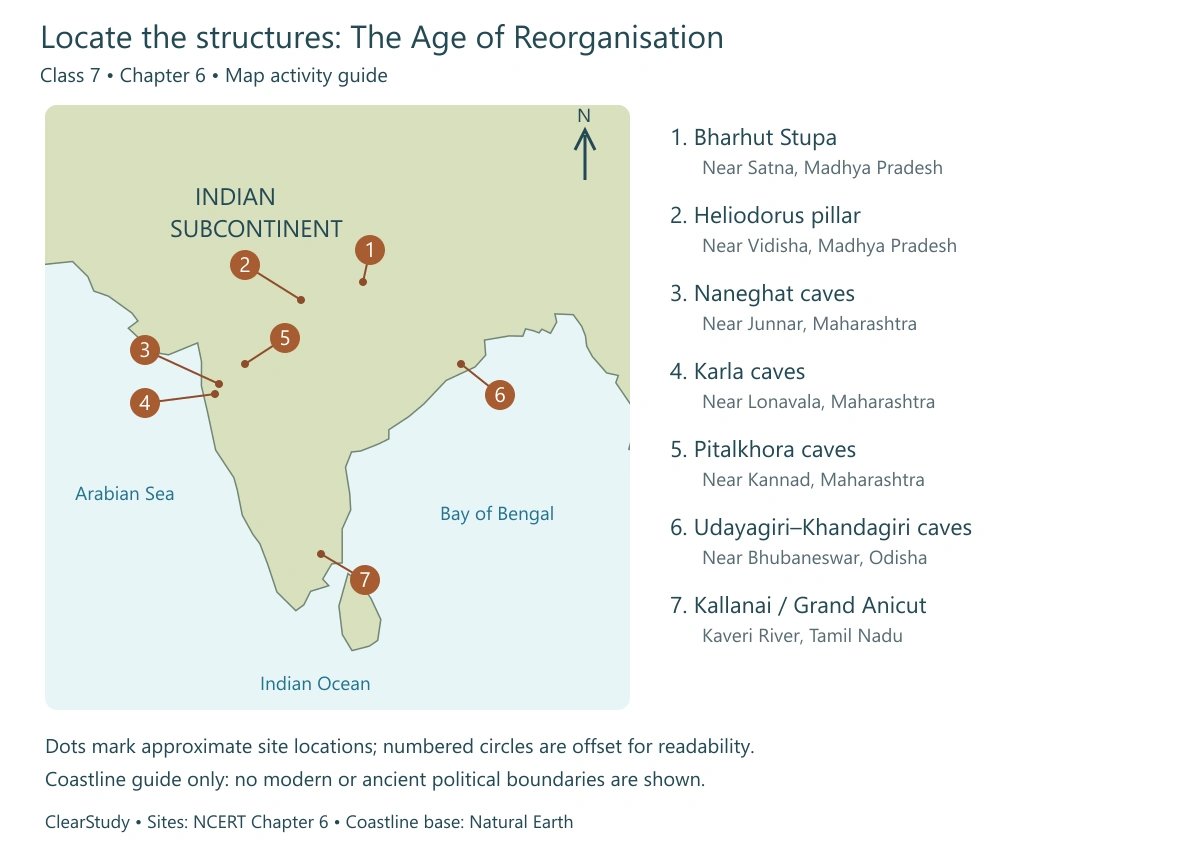
6. You have read about the architectural developments of the post-Maurya era. Take an outline of the Indian subcontinent and mark the approximate locations of some of the ancient structures mentioned in this chapter.
| Site | Present-day location | What to remember |
|---|---|---|
| Bharhut Stūpa | Near Satna, Madhya Pradesh | Carved railings associated with the Śhunga period; the stūpa had an earlier history. |
| Heliodorus pillar | Near Vidisha, Madhya Pradesh | Evidence of Indo-Greek connections and devotion to Vāsudeva. |
| Naneghat caves | Near Junnar, Maharashtra | Trade-route pass and inscriptions. |
| Karla caves | Near Lonavala, Maharashtra | Buddhist rock-cut architecture. |
| Pitalkhora caves | Near Kannad, Maharashtra | Rock-cut caves and sculpture. |
| Udayagiri–Khandagiri | Near Bhubaneswar, Odisha | Jain caves and the Hāthīgumphā inscription. |
| Kallaṇai / Grand Anicut | On the Kāveri, Tamil Nadu | Water-diversion work associated with Karikāla; restored over time. |
In-text activity guidance
Timeline: The 2nd century BCE runs from 200 to 101 BCE. The 3rd century CE ends in 300 CE. The complete span from the beginning of 200 BCE to the end of 300 CE covers 500 calendar years; there is no year zero. If comparing the same point within 200 BCE and 300 CE, the elapsed interval is 499 years. State which convention you are using.
Art identification, Fig. 6.27: Images 1, 2 and 6 show features consistent with Gāndhāra; 3, 4 and 5 with Mathurā. Compare drapery, modelling and stone colour, using the photographs and captions together. Colour alone is not a conclusive test.
Reading objects: A ship on a coin suggests maritime interests, while foreign coins, pottery, port remains and written accounts together strengthen an argument for long-distance trade. A ruler’s symbols may express religious patronage or political identity; they do not establish what every subject believed.
Craft skills: The goldsmith named on the Pitalkhora sculpture suggests that one artisan could work across materials. It does not prove that all occupations were interchangeable.
Link the periods: Revisit the Mauryas and the decline of empires before comparing the regional kingdoms.
Reviewed against NCERT Exploring Society: India and Beyond, Class 7, Part 1, Chapter 6, pp. 117–143 (2026–27 reprint), on 10 October 2026. Model activities are examples; use your own observations and classroom results.
Extra Practice Questions
These questions and MCQs are ClearStudy practice, separate from the NCERT exercise.
Short Answer Type Questions
Q1. Who founded the Śhunga dynasty, and what famous ritual did he perform?
Q2. What was special about the way Sātavāhana princes were named?
Q3. Who was Khāravela, and why is the Hāthīgumphā inscription important?
Q4. Name the three southern ‘crowned kings’ and one feature of each.
Q5. How did foreign invaders like the Indo-Greeks and Kuṣhāṇas influence Indian culture?
Long Answer Type Questions
Q1. Describe the contributions of the Sātavāhanas to trade, art and culture.
Q2. Explain how art and architecture flourished during the age of reorganisation despite political conflict.
Q3. How did foreign invaders enter India during this period and assimilate into Indian society?
MCQs & Assertion–Reason
1. Around which year was the last Maurya emperor assassinated by his commander-in-chief?
(a) 322 BCE (b) 261 BCE (c) 185 BCE (d) 78 CE
2. Who founded the Śhunga dynasty?
(a) Khāravela (b) Puṣhyamitra Śhunga (c) Karikāla (d) Kaṇiṣhka
3. The Sātavāhanas ruled large parts of which region?
(a) the Deccan (b) Kashmir (c) the Indus plains (d) Bengal
4. Gautamīputra Sātakarṇi was named after his:
(a) father (b) mother (c) capital city (d) royal emblem
5. The Hāthīgumphā inscription records the achievements of which king?
(a) Karikāla (b) Puṣhyamitra Śhunga (c) Khāravela (d) Kaṇiṣhka
6. Which three dynasties were the southern ‘crowned kings’?
(a) Śhungas, Chedis, Sātavāhanas (b) Cholas, Cheras, Pānḍyas (c) Indo-Greeks, Śhakas, Kuṣhāṇas (d) Mauryas, Guptas, Cholas
7. The Grand Anicut (Kallaṇai) on the Kāveri river was built by:
(a) the Chera king (b) the Chola king Karikāla (c) the Pānḍya king (d) Khāravela
8. After its New Year in March, the Śhaka year number is how many years less than the Gregorian year number?
(a) 57 years (b) 78 years (c) 100 years (d) 185 years
9. The Gandhāra and Mathurā schools of art developed mainly under which rulers?
(a) the Śhungas (b) the Sātavāhanas (c) the Kuṣhāṇas (d) the Chedis
10. The Tamil epic that tells the story of Kaṇṇagi and centres on justice is:
(a) Silappadikāram (b) Rāmāyaṇa (c) Mahābhārata (d) Yoga Sūtras
For each Assertion–Reason question, choose: (A) Both true and the Reason correctly explains the Assertion; (B) Both true but the Reason is not the correct explanation; (C) Assertion true, Reason false; (D) Assertion false, Reason true.
A-R 1. Assertion: The post-Maurya period is called the ‘age of reorganisation’.
Reason: Existing regions were being reorganised into new kingdoms that constantly competed to become powerful.
A-R 2. Assertion: Puṣhyamitra Śhunga performed the aśhvamedha yajña.
Reason: The aśhvamedha yajña was a Vedic ritual performed by rulers to declare their supremacy.
A-R 3. Assertion: The Sātavāhanas had no contact with distant foreign powers.
Reason: Sātavāhana trade networks reached as far as the Roman Empire and exchanged goods like spices and ivory.
A-R 4. Assertion: The Indo-Greeks, Śhakas and Kuṣhāṇas assimilated into Indian society.
Reason: Although they arrived as conquerors, they were much influenced by India’s rich local culture.
A-R 5. Assertion: Sangam literature is valuable to historians.
Reason: It is much consulted to understand the society and culture of the times in south India.
Exam Tips & Common Mistakes
How to write a clear answer
Remember the key date — the last Maurya emperor was assassinated around 185 BCE by Puṣhyamitra Śhunga. Learn the dynasties in two groups: from within the subcontinent (Śhungas, Chedis, Sātavāhanas, Cholas, Cheras, Pānḍyas) and from outside (Indo-Greeks, Śhakas, Kuṣhāṇas). Link each ruler to one memorable fact — Śhungas/Bharhut Stūpa, Sātavāhanas/ships and mother-names, Khāravela/Hāthīgumphā, Karikāla/Grand Anicut, Kaṇiṣhka/Gandhāra-Mathurā art. Always stress the chapter’s big theme: several inscriptions express respect for different schools of thought, and cultures interacted to create a shared heritage — the ‘Indian ethos’.
Common mistakes to avoid
- Confusing dynasties from within the subcontinent with those from outside (foreign invaders).
- Mixing up the two schools of art — Gandhāra (grey-black schist, Greco-Roman + Indian) and Mathurā (red sandstone, distinctly Indian).
- Forgetting that princes were named after their mothers by the Sātavāhanas, not the Śhungas.
- Writing that the Śhaka Samvat is ahead of the Gregorian calendar — its year number is normally 78 less, but 79 less before its New Year in March.
- Mixing up Khāravela (Chedi king of Kalinga) with Karikāla (Chola king of the South).
- Leaving activity/map questions (Q4, Q5, Q6) blank — give a model answer with real names and locations.
Frequently Asked Questions
What is Chapter 6 of Class 7 Social Science Exploring Society about?
Chapter 6, The Age of Reorganisation, covers the period after the Maurya empire (about the 2nd century BCE to the 3rd century CE), when many kingdoms such as the Śhungas, Sātavāhanas, Chedis, Cholas, Cheras and Pānḍyas rose, and foreign powers like the Indo-Greeks, Śhakas and Kuṣhāṇas arrived and assimilated, creating a rich confluence of cultures, art and trade.
Why is this period called the ‘age of reorganisation’?
After the Maurya empire broke up around 185 BCE, many new kingdoms (often former tributary regions) emerged and competed for control through matrimonial alliances and warfare. Because the political map of the subcontinent was being reshaped into new, rival kingdoms, scholars call this the ‘age of reorganisation’.
What is the exercise heading for Chapter 6 of Exploring Society?
The end-of-chapter exercise in Exploring Society: India and Beyond (Part 1) Chapter 6 is headed Questions and activities and contains 6 numbered questions, all answered step by step on this page.