
NCERT Solutions for Class 7 Social Science (Exploring Society) Chapter 7: The Gupta Era – An Age of Tireless Creativity (NCERT 2026–27)
These Class 7 Social Science Exploring Society Chapter 7 solutions cover The Gupta Era: An Age of Tireless Creativity from Exploring Society: India and Beyond (Part 1), the NCERT textbook (2026–27 reprint). The chapter follows Dhruv and Bhavisha’s time-machine journey into the Gupta Empire, which flourished from the 3rd to the 6th century CE with its capital at Pāṭaliputra. It explains who the Guptas were, why this period is called the ‘classical age’ of India, the great rulers Samudragupta and Chandragupta II (Vikramāditya), and remarkable figures like Āryabhaṭa, Varāhamihira and Kālidāsa. Below you get step-by-step answers to all Questions and activities, clear notes on key terms, extra practice, MCQs, Assertion–Reason and FAQs.
The Gupta Era – Chapter Overview
Chapter 7, The Gupta Era: An Age of Tireless Creativity, traces the rise of the Gupta dynasty after the decline of the Kuṣhāṇa Empire by the 3rd century CE. The Guptas ruled most of north and west India from their capital at Pāṭaliputra (present-day Patna). Two great rulers stand out: Samudragupta, the ‘warrior king’ praised in the prayāga praśhasti by his court poet Harisena, and his son Chandragupta II (Vikramāditya), in whose reign art, literature and science flourished. The chapter uses sources like the rust-resistant Iron Pillar of Delhi, Gupta coins, inscriptions and the travelogue of the Chinese pilgrim Faxian to picture Gupta society and governance. Relative stability and patronage contributed to what some historians call India’s ‘classical age’, with Āryabhaṭa, Varāhamihira and Kālidāsa, codified Āyurveda, and the art of Sārnāth, Ajanta and Udayagiri. It also notes the contemporary Vākāṭakas, Pallavas and the Kāmarūpa kingdom, before the Guptas declined under Hūṇa invasions by the 6th century CE.
Key Concepts & Terms
Gupta Empire: the most powerful empire of its time, flourishing from the 3rd to the 6th century CE with its capital at Pāṭaliputra (present-day Patna), covering most of present-day north and west India and parts of central and east India.
Chandragupta I: an early Gupta ruler remembered for his coins and strategic alliances, who helped consolidate power and lay the foundation of a strong empire; distinguished as Chandragupta I because his grandson also bore the name Chandragupta (II). The numbering is a historians’ convention.
Samudragupta: the ‘warrior king’, father of Chandragupta II, praised in the prayāga praśhasti for his ambition to be dharaṇi-bandha (‘unify the Earth’); shown as a veena player on his coins.
Chandragupta II (Vikramāditya): a renowned Gupta ruler and devotee of Viṣhṇu; the Iron Pillar inscription speaks of a king ‘Chandra’ identified with him. Art, literature and science especially flourished in his reign.
prayāga praśhasti: a pillar inscription in Prayagraj, composed by the court poet Harisena, that praises Samudragupta’s conquests and his support of art, learning and trade.
Iron Pillar of Delhi: a 6-tonne pillar over 1,600 years old at Mehrauli, erected in the reign of Chandragupta II and dedicated to Viṣhṇu; it has exceptional resistance to corrosion, illustrating ancient India’s metallurgical skill.
Faxian: a Chinese Buddhist pilgrim who visited India in the early 5th century CE; his travelogue A Record of Buddhistic Kingdoms describes a prosperous, charitable Gupta society (while also noting the harsh treatment of the chanḍālas).
Royal titles: Gupta rulers adopted grand titles like mahārājadhirāja, samrāṭ and chakravartin, claiming supreme authority over earlier rulers who used simpler titles like rājan and mahārāja.
Land grants: instead of ruling everything centrally, the Guptas divided the empire into provinces and granted land to local rulers, priests and chieftains, recording these grants on copper plates for accurate tax records.
Classical age: the term used by some historians for the Gupta period, when prolonged peace promoted great achievements in literature, art, mathematics, astronomy, medicine and metallurgy.
Other key terms: Regent ruler (one who temporarily governs for a monarch unable to do so), Outcastes (the chanḍālas, considered socially too low to be part of the varṇa system), aśhvamedha yajña (a horse sacrifice performed by ambitious kings to build mighty empires) and Hūṇas (a fierce central-Asian tribe whose attacks weakened the Guptas).
“Questions and activities” — Full Solutions
All questions below are reproduced verbatim from the NCERT textbook’s end-of-chapter Questions and activities section. Answers are original, written in exam-ready style.
1. Imagine you receive a letter from someone living in the Gupta Empire. The letter starts like this: “Greetings from Pāṭaliputra! Life here is vibrant and full of excitement. Just yesterday, I witnessed …” Complete the letter with a short paragraph (250–300 words) describing life in the Gupta Empire.
2. Which Gupta ruler was also known as the ‘Vikramāditya’?
3. “Periods of peace support the development of various aspects of sociocultural life, literature, and the development of science and technology.” Examine this statement in the light of the Gupta empire.
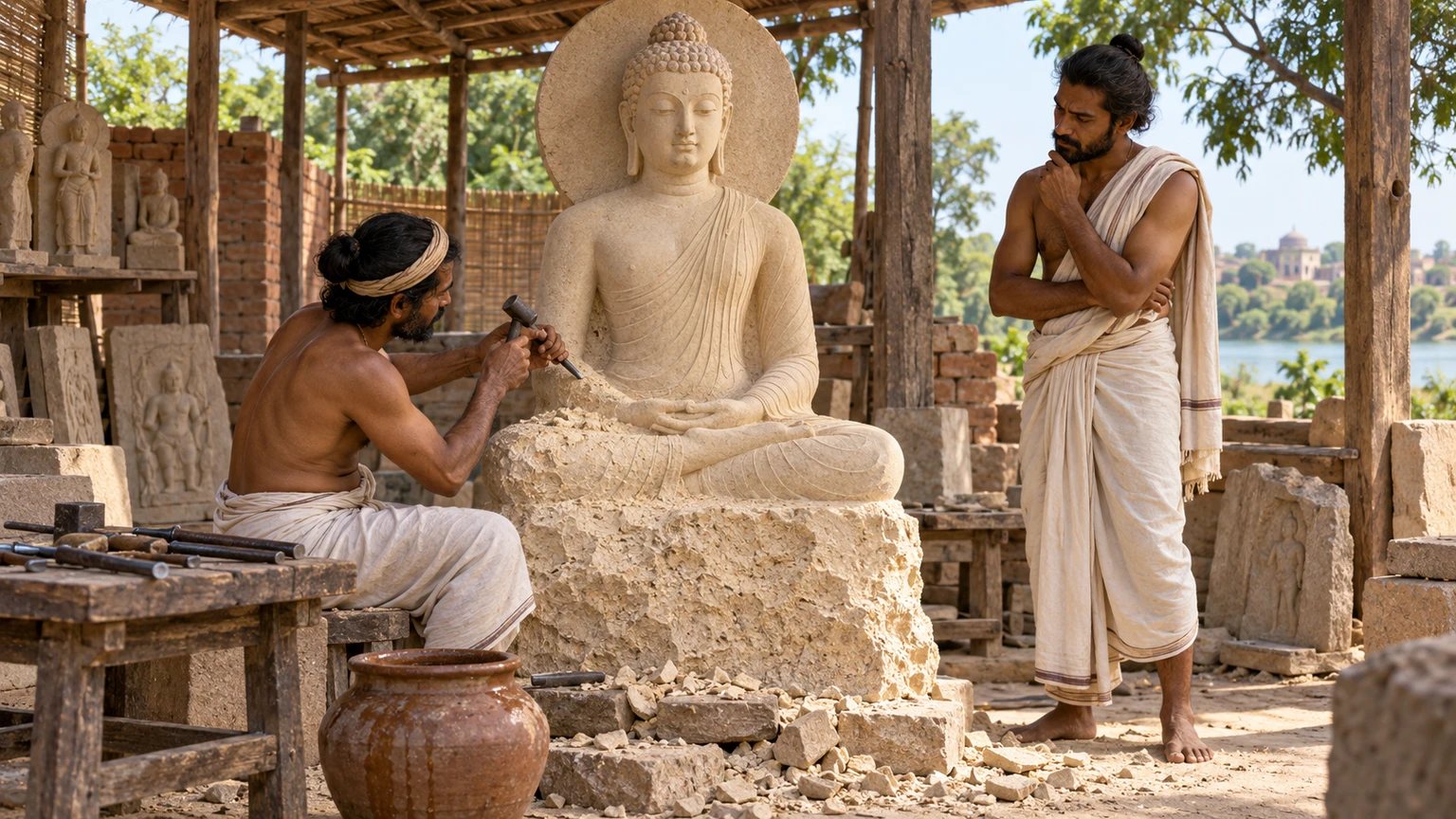
4. Recreate a scene from a Gupta ruler’s court. Write a short script, assign roles like the king, ministers, and scholars, and enact a role play to bring the Gupta era to life!
5. Match the two columns:
| Column A | Column B (correct match) |
|---|---|
| (1) Kānchipuram | (d) Known as ‘a city of a thousand temples’. |
| (2) Ujjayinī | (e) A prominent centre of learning in ancient India. |
| (3) Udayagiri | (b) Famous for rock-cut caves featuring intricate carvings of Hindu deities, especially Viṣhṇu. |
| (4) Ajanta | (a) Known for vibrant cave paintings that depict the Jātaka tales. |
| (5) Pāṭaliputra | (c) Capital of the Guptas. |
6. Who were the Pallavas and where did they rule?
7. Organise an exploration trip with your teachers to a nearby historical site, museum, or heritage building. After the trip, write a detailed report describing your experience. Include key observations about the site’s historical significance, the architecture, artefacts, and any interesting facts you learned during the visit. Reflect on how the trip enhanced your understanding of history.
Working with the chapter’s sources
Check the timeline: Chandragupta II belongs mainly to the late fourth and early fifth centuries CE; Āryabhaṭa and Varāhamihira belong to later generations. Do not assemble every famous figure at one court.
Inscriptions: A praśhasti praises a ruler. Harisena’s account tells us about Samudragupta’s claims and campaigns, but should be compared with coins, other inscriptions and archaeology.
Faxian: List the charity, trade and taxation described in the excerpt, then add his account of exclusion. One traveller cannot represent every place or social group.
Art and maps: Gupta-era Udayagiri is in Madhya Pradesh; the Udayagiri–Khandagiri caves of Chapter 6 are in Odisha. On the empire map distinguish directly ruled territory, allies and tributaries; ancient borders do not match modern states.
Interviews: Ask Āryabhaṭa how observations test an eclipse explanation and Varāhamihira how he gathered information. A classroom interview is imagined, not evidence of their exact words.
Reviewed against NCERT Exploring Society: India and Beyond, Class 7, Part 1, Chapter 7, pp. 145–166 (2026–27 reprint), on 10 October 2026. Additional context: UNESCO on Ajanta’s phases and patrons. Illustrations and classroom dialogue are labelled reconstructions.
Extra Practice Questions
These questions and MCQs are ClearStudy practice, separate from the NCERT exercise.
Short Answer Type Questions
Q1. When did the Gupta Empire flourish and where was its capital?
Q2. Why is the Iron Pillar of Delhi unusually rust-resistant?
Q3. What was the prayāga praśhasti, and who composed it?
Q4. Who was Faxian and why is his account important?
Q5. How did the Guptas administer their empire?
Long Answer Type Questions
Q1. Describe the contributions of Āryabhaṭa and Varāhamihira to science.
Q2. Why is the Gupta period called the ‘classical age’ of India? Give examples from art, literature and science.
Q3. Explain the strategies the Gupta rulers used to expand and consolidate their empire.
MCQs & Assertion–Reason
1. The capital of the Gupta Empire was at:
(a) Ujjayinī (b) Pāṭaliputra (c) Kānchipuram (d) Nandivardhana
2. The Gupta ruler also known as ‘Vikramāditya’ was:
(a) Samudragupta (b) Chandragupta I (c) Chandragupta II (d) Skandagupta
3. The prayāga praśhasti praises the achievements of:
(a) Chandragupta II (b) Samudragupta (c) Harisena (d) Prabhāvatī Gupta
4. The Iron Pillar of Delhi was dedicated to:
(a) Śhiva (b) the Buddha (c) Viṣhṇu (d) Garuḍa
5. The Chinese pilgrim who described Gupta society in his travelogue was:
(a) Xuanzang (b) Faxian (c) Kālidāsa (d) Harisena
6. Āryabhaṭa proposed that:
(a) the Sun moves around the Earth (b) the Earth is flat (c) the Earth spins on its axis (d) eclipses are caused by demons
7. The encyclopedic work Bṛihat Samhitā was written by:
(a) Āryabhaṭa (b) Kālidāsa (c) Varāhamihira (d) Harisena
8. Meghadūtam, the story of a yakṣha sending a message through a cloud, was composed by:
(a) Varāhamihira (b) Kālidāsa (c) Faxian (d) Samudragupta
9. Prabhāvatī Gupta, daughter of Chandragupta II, became the regent ruler of which kingdom?
(a) Pallava (b) Kāmarūpa (c) Vākāṭaka (d) Kuṣhāṇa
10. The decline of the Gupta Empire by the 6th century CE was hastened by repeated attacks of the:
(a) Sātavāhanas (b) Hūṇas (c) Pallavas (d) Romans
For each Assertion–Reason question, choose: (A) Both true and the Reason correctly explains the Assertion; (B) Both true but the Reason is not the correct explanation; (C) Assertion true, Reason false; (D) Assertion false, Reason true.
A-R 1. Assertion: The Gupta period is often called the ‘classical age’ of India.
Reason: A prolonged period of peace and stability promoted notable achievements in art, literature, science and mathematics.
A-R 2. Assertion: The Iron Pillar of Delhi has rusted badly over the centuries.
Reason: A unique thin protective layer formed on the iron protects it from corrosion.
A-R 3. Assertion: Gupta rulers adopted grand titles such as mahārājadhirāja, samrāṭ and chakravartin.
Reason: These titles reflected their claim to supreme authority and superiority over earlier rulers.
A-R 4. Assertion: The Guptas governed the whole empire directly from one central authority.
Reason: They divided the empire into provinces and granted land to local rulers, priests and chieftains.
A-R 5. Assertion: Faxian’s travelogue must be read carefully as one source among many.
Reason: A historical account reflects only the writer’s perspective at one point in time and for a limited portion of society.
Exam Tips & Common Mistakes
How to write a clear answer
Fix the timeline clearly in your mind: the Guptas flourished from the 3rd to the 6th century CE with capital at Pāṭaliputra. Remember the two key rulers — Samudragupta (warrior king of the prayāga praśhasti) and Chandragupta II / Vikramāditya (Iron Pillar, golden age of art). For ‘classical age’ questions, give one example each from literature (Kālidāsa), science (Āryabhaṭa, Varāhamihira), medicine (Āyurveda) and art (Ajanta, Sārnāth, Udayagiri). Use the textbook’s sources — coins, inscriptions, copper-plate land grants and Faxian’s travelogue — to show how historians reconstruct the past, and remember the contemporary Vākāṭakas, Pallavas and Kāmarūpa kingdom.
Common mistakes to avoid
- Confusing Chandragupta II (Gupta dynasty) with Chandragupta Maurya (Maurya dynasty) — they are different rulers from different times.
- Calling the Iron Pillar completely rust-proof: its protective surface layer greatly slows corrosion.
- Crediting the Bṛihat Samhitā to Āryabhaṭa — it was written by Varāhamihira; the Āryabhaṭīya is Āryabhaṭa’s.
- Forgetting that Faxian also recorded the harsh treatment of the chanḍālas, so his account is not the whole picture.
- Treating activity questions (Q1, Q4, Q7) as no-answer questions — write your own letter, script or report.
- Mixing up the Guptas’ allies the Vākāṭakas with their northern rivals; the Vākāṭakas ruled the central subcontinent.
Frequently Asked Questions
What is Chapter 7 of Class 7 Social Science Exploring Society about?
Chapter 7, The Gupta Era: An Age of Tireless Creativity, explains who the Guptas were, why their rule (3rd–6th century CE, capital Pāṭaliputra) is called the ‘classical age’ of India, the great rulers Samudragupta and Chandragupta II (Vikramāditya), the sources like the Iron Pillar and Faxian’s travelogue, and the achievements of Āryabhaṭa, Varāhamihira and Kālidāsa.
Which Gupta ruler was known as Vikramāditya?
Chandragupta II was known as Vikramāditya. He was a renowned Gupta ruler and a devotee of Viṣhṇu, and the Iron Pillar of Delhi was erected during his reign. Art, literature and science especially flourished in his time.
What is the exercise heading for Chapter 7 of Exploring Society?
The end-of-chapter exercise in Exploring Society: India and Beyond (Part 1) Chapter 7 is headed Questions and activities and contains 7 numbered questions, all answered step by step on this page.