
NCERT Solutions for Class 7 Social Science (Exploring Society) Chapter 8: How the Land Becomes Sacred
These Class 7 Social Science Exploring Society Chapter 8 solutions cover How the Land Becomes Sacred from Exploring Society: India and Beyond (Part 1), the NCERT textbook (2026–27 reprint). The chapter belongs to the theme Our Cultural Heritage and Knowledge Traditions and explains what sacredness means, how a piece of land comes to be regarded as holy, how pilgrimages (tīrthayātrās) and networks of sacred sites (tīrthas) crisscross India, and how this sacred geography helped knit the Indian Subcontinent into one cultural fabric. Below you get step-by-step answers to all Questions and activities, clear notes on key terms, extra practice, MCQs, Assertion–Reason and FAQs.
How the Land Becomes Sacred – Chapter Overview
Chapter 8, How the Land Becomes Sacred, explores the idea of sacredness — finding something of deep religious or spiritual significance, worthy of reverence. Almost every school of thought and religion in India has its own sacred places: shrines of Islam, Christianity, Judaism and Zoroastrianism; the Buddhist Great Stūpa at Sanchi and Mahabodhi Temple Complex at Bodh Gaya; the Sikh takhts; and the Jain tīrthas linked to the Tīrthankaras. In Hindu, folk and tribal traditions, elements of Nature — mountains, rivers, trees, forests and even stones — are revered, so that ultimately the whole Earth is seen as Bhūdevī (Mother Earth). Pilgrims undertaking tīrthayātrās travelled the length and breadth of the country, weaving networks such as the chār dhām, the 12 jyotirlingas and the 51 Shakti pīṭhas. These journeys created a sacred geography, encouraged trade along shared routes, protected Nature through sacred groves and ecology, and became a major force in the cultural integration of the Indian Subcontinent.
Key Concepts & Terms
Sacredness: finding something of deep religious or spiritual significance, worthy of respect and reverence — holy or divine. It can be a place, a shrine, a journey, the route taken, or even the very land covered.
Pilgrimage (tīrthayātrā): a journey to a sacred place that is significant within a religion or belief system. In India it is both a physical journey and an inner journey that requires a code of conduct.
Tīrtha: literally a place where one can cross a river or other body of water; symbolically, a place where one can cross from ordinary worldly life to a higher, spiritual life. Such places are held in high reverence and regarded as sacred.
Shrine: a place regarded as holy because of its associations with the divine, a sacred relic, or a spiritual figure.
Relic: a part of a saint’s or spiritual figure’s body, or one of their belongings, kept as an object of reverence.
Sacred sites across faiths: the Dargah Sharif of Ajmer and Velankanni Church (visited by people of many faiths); the Great Stūpa at Sanchi and the Mahabodhi Temple Complex at Bodh Gaya (Buddhism); the Sikh takhts — seats of spiritual authority — such as Takht Sri Patna Sahib, the Akal Takht and Takht Sri Keshgarh Sahib; and Jain tīrthas like Mount Abu, Girnar and the Śhatruñjaya hill.
Tīrthankara: in Jainism, one who “makes a tīrtha” — who guides the crossing from ordinary to higher life. The Tīrthankaras are the supreme preachers of dharma.
Sacred geography: the web of interconnected sacred sites — the chār dhām in the four corners of India, the 12 jyotirlingas (shrines of Śhiva), the 51 Shakti pīṭhas, and many regional networks — that crisscross India’s length and breadth, so that the land itself becomes sacred.
Puñyakṣhetra / kṣhetra: sacred space. Tīrthas usually lie on the banks of a river or lake, in a forest or on a mountain, so the natural landscape itself is perceived as sacred — geography, culture and spirituality fuse together.
Sacred groves: natural forests protected from harmful activity because they are seen as the abodes of deities (e.g., Ryngkew or Basa in Meghalaya). Known by many regional names — kāvu (Malayalam), devarāī (Marathi), sarnā (Jharkhand), oraṇ (Rajasthan) — they shelter great biodiversity and aid water conservation.
Cultural integration: the process by which pilgrims, traders, teachers and pilgrims’ routes converged, exchanging goods, ideas, tales and customs, knitting the diverse Indian Subcontinent into a shared culture.
“Questions and activities” — Full Solutions
All questions below are reproduced verbatim from the NCERT textbook’s end-of-chapter Questions and activities section. Answers are original, written in exam-ready style.
1. Read the following statement by a well-known environmental thinker, David Suzuki: “The way we see the world shapes the way we treat it. If a mountain is a deity, not a pile of ore; if a river is one of the veins of the land, not potential irrigation water; if a forest is a sacred grove, not timber; if other species are biological kin, not resources; or if the planet is our mother, not an opportunity—then we will treat each other with greater respect. Thus is the challenge, to look at the world from a different perspective.” Discuss in small groups. What do you think this statement means? What implication does it have for our actions with respect to the air, water, land, trees and mountains around us?
2. List the sacred sites in your region. Enquire into why they are considered sacred. Are there stories connected with these sacred places? Write a short essay of 150 words. (Hint: You could speak to elders in your family and community, discuss with your teacher, read books and articles, etc., to gather relevant information.)
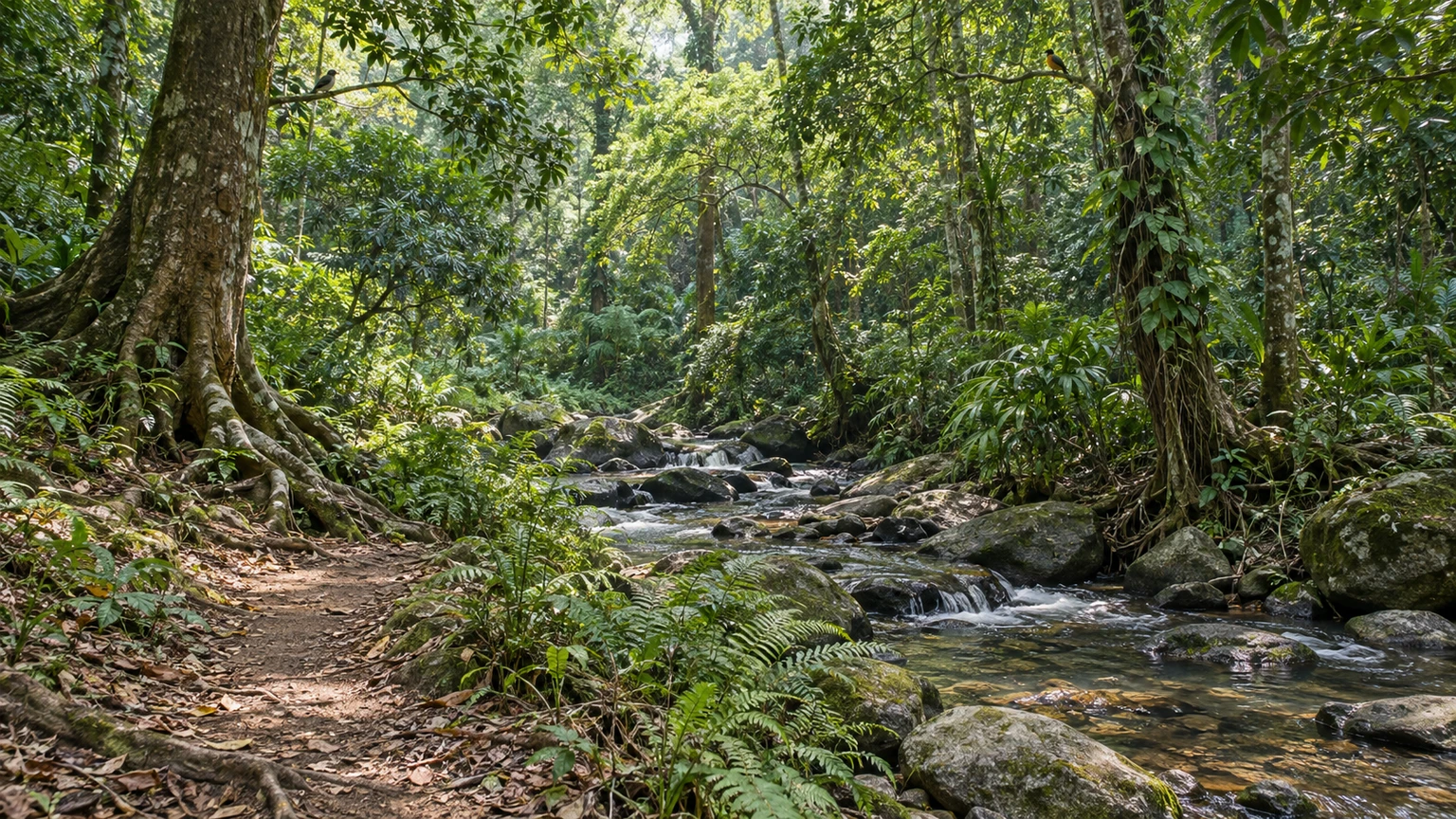
3. Why do you think natural elements like rivers, mountains and forests are considered sacred for the people? How do they contribute to our lives?
4. Why do people visit a tīrtha or other sacred sites?
5. How did the ancient pilgrimage routes help in fostering trade during those times? Do you think the sacred sites help in developing the economy of the region?
6. How do sacred places influence the culture and traditions of the people living near them?
7. From the various sacred sites of India, select two of your choice and create a project explaining their significance.
8. What is the two-fold significance of a tīrthayātrā or a pilgrimage?
In-text activities and key locations
The four Char Dham sites in this chapter: Badrinath in Uttarakhand (north), Dwarka in Gujarat (west), Puri in Odisha (east), and Rameswaram in Tamil Nadu (south). This all-India circuit differs from Uttarakhand’s smaller Char Dham circuit.
Reading Fig. 8.6: Use the legend to distinguish networks. Lines link sacred places schematically; they are not necessarily exact roads or documented itineraries. The chapter uses a tradition of 51 Shakti pīṭhas; other traditions may enumerate them differently.
Dharampal’s travellers: Their priority was to complete the pilgrimage and return home; Delhi was a change of train, not their chosen destination. The excerpt does not provide every intermediate stop, so label any proposed route as approximate.
Communication during journeys: Languages and dialects would vary with the route and period. Travellers could learn useful words, use gestures, or seek help from multilingual traders and hosts. Avoid projecting today’s language boundaries unchanged into ancient times.
Local-economy mind map: Sacred site → visitors → food, transport, lodging, guiding and crafts → jobs and income. Add a second branch for water, sanitation, waste and conservation costs.
Protecting the sacred: Believers and non-believers can cooperate on clean water, waste collection and habitat protection. A place’s sacred status does not make pollution disappear.
Reviewed against NCERT Exploring Society: India and Beyond, Class 7, Part 1, Chapter 8, pp. 167–184 (2026–27 reprint), on 10 October 2026. Beliefs, traditions and visitor estimates are identified as such.
Extra Practice Questions
These questions and MCQs are ClearStudy practice, separate from the NCERT exercise.
Short Answer Type Questions
Q1. What does ‘sacredness’ mean in the context of this chapter?
Q2. What is a tīrtha, literally and symbolically?
Q3. What are takhts in Sikhism? Give one example.
Q4. What is a sacred grove, and why is it important?
Q5. Name the four places where the Kumbh Mela is held and the legend behind it.
Long Answer Type Questions
Q1. Explain how a piece of land “becomes sacred” and how this creates a sacred geography of India.
Q2. Describe how pilgrimage and sacred geography contributed to the cultural integration of the Indian Subcontinent.
Q3. How is sacredness connected with the protection of Nature (sacred ecology), and why is this idea relevant today?
MCQs & Assertion–Reason
1. In this chapter, ‘sacredness’ means:
(a) something rare and expensive (b) something of deep religious or spiritual significance, worthy of reverence (c) something very old (d) something found only in temples
2. The word tīrtha literally refers to a place where one can:
(a) build a temple (b) hold a fair (c) cross a river or body of water (d) trade goods
3. The Mahabodhi Temple Complex at Bodh Gaya is associated with:
(a) Mahavira’s birth (b) the Buddha attaining enlightenment (c) Guru Nanak’s travels (d) Satī’s body parts
4. In Sikhism, the seats or centres of spiritual authority are called:
(a) tīrthas (b) jyotirlingas (c) takhts (d) pīṭhas
5. In Jain tradition, a Tīrthankara is one who:
(a) builds temples (b) makes a tīrtha and guides the crossing from ordinary to higher life (c) collects relics (d) rules a kingdom
6. The four sites of the chār dhām are located in:
(a) one region of India (b) the four corners (north, south, east, west) of India (c) only the Himalayas (d) only South India
7. The Kumbh Mela is held at Haridwar, Prayagraj, Nashik and:
(a) Varanasi (b) Mathura (c) Ujjain (d) Puri
8. The peepul or bodhi tree’s botanical name, meaning the ‘sacred fig’, is:
(a) Ficus religiosa (b) Mangifera indica (c) Azadirachta indica (d) Ficus benghalensis
9. The Niyam Dongar hill, sacred to the Dongria Khond tribe, is located in:
(a) Meghalaya (b) Odisha (c) Tamil Nadu (d) Sikkim
10. Pilgrimage routes and trade routes in ancient India often:
(a) avoided each other (b) overlapped, benefiting both pilgrims and traders (c) were forbidden to merchants (d) existed only in the south
For each Assertion–Reason question, choose: (A) Both true and the Reason correctly explains the Assertion; (B) Both true but the Reason is not the correct explanation; (C) Assertion true, Reason false; (D) Assertion false, Reason true.
A-R 1. Assertion: The entire geography of India came to be considered sacred.
Reason: For at least 3,000 years Indians have crisscrossed the Subcontinent on pilgrimages, linking sacred sites all over the land.
A-R 2. Assertion: Sacred groves help protect biodiversity.
Reason: Communities protect these forests as the abodes of deities, so they are saved from felling, hunting and mining.
A-R 3. Assertion: Only religions that originated in India have sacred places in the country.
Reason: Followers of Islam, Christianity, Judaism and Zoroastrianism also revere sacred sites such as the Dargah Sharif of Ajmer and the Velankanni Church.
A-R 4. Assertion: Pilgrimages contributed to the cultural integration of India.
Reason: Pilgrims travelling across the country exchanged goods, ideas and tales, and felt a sense of one country and one culture.
A-R 5. Assertion: A tīrthayātrā is only a physical journey.
Reason: A pilgrimage is also an inner journey that requires a specified code of conduct.
Exam Tips & Common Mistakes
How to write a clear answer
Learn the meaning of sacredness and the literal-plus-symbolic meaning of tīrtha — crossing from worldly life to a higher life. Be ready to name sacred sites across faiths (Sanchi’s Great Stūpa and Bodh Gaya’s Mahabodhi Temple Complex, Sikh takhts, Jain tīrthas, Ajmer Dargah, Velankanni Church). Remember the great networks — chār dhām, 12 jyotirlingas, 51 Shakti pīṭhas — that create India’s sacred geography. For the ‘two-fold significance’ question, clearly split the answer into a spiritual/personal part and a socio-economic/cultural-integration part. Use textbook examples — Kumbh Mela, Pandharpur wārī, Sabarimala, sacred groves and their regional names — to show you have studied the chapter.
Common mistakes to avoid
- Saying only Indian-origin religions have sacred places — faiths that began outside India (Islam, Christianity, Judaism, Zoroastrianism) also have revered shrines here.
- Confusing a tīrtha (sacred crossing place) with a takht (Sikh seat of authority) or a jyotirlinga (shrine of Śhiva).
- Treating a pilgrimage as only a physical trip — it is also an inner journey with a code of conduct.
- Ignoring the wording of the question: discuss spiritual, economic or cultural roles as requested, and explain both dimensions when asked for the two-fold significance.
- Leaving project/observation questions (Q2, Q7) blank — write your own region’s sites and stories, or choose two sites from the chapter.
- Mixing up the four Kumbh Mela cities — they are Haridwar, Prayagraj, Nashik and Ujjain.
Frequently Asked Questions
What is Chapter 8 of Class 7 Social Science Exploring Society about?
Chapter 8, How the Land Becomes Sacred, explains what sacredness means, how places, rivers, mountains, trees and forests come to be regarded as sacred, how pilgrimages (tīrthayātrās) and networks of sacred sites crisscross India to form a sacred geography, and how this fostered trade, protected Nature and helped the cultural integration of the Indian Subcontinent.
What is the two-fold significance of a pilgrimage according to this chapter?
A tīrthayātrā has a spiritual significance — it is an inner journey of self-development and growth, crossing from worldly life to a higher life — and a socio-economic significance — it promoted trade and the exchange of goods and ideas, and helped knit the diverse Indian Subcontinent into one shared culture.
What is the exercise heading for Chapter 8 of Exploring Society?
The end-of-chapter exercise in Exploring Society: India and Beyond (Part 1) Chapter 8 is headed Questions and activities and contains 8 numbered questions, all answered step by step on this page.