
NCERT Solutions for Class 7 Social Science (Exploring Society) Chapter 9: From the Rulers to the Ruled: Types of Governments (NCERT 2026–27)
These Class 7 Social Science Exploring Society Chapter 9 solutions cover From the Rulers to the Ruled: Types of Governments from Exploring Society: India and Beyond (Part 1), the NCERT textbook (2026–27 reprint). The chapter belongs to the theme Governance and Democracy and explains the functions of government (legislative, executive and judicial), what makes one government different from another, the principles and forms of democracy (direct, representative, parliamentary and presidential), and other forms such as monarchy, theocracy, dictatorship and oligarchy — and why democracy matters. Below you get step-by-step answers to all the Questions and activities, clear notes on key terms, extra practice, MCQs, Assertion–Reason and FAQs.
Types of Governments – Chapter Overview
Chapter 9, From the Rulers to the Ruled: Types of Governments, explores how countries are governed. It begins with the functions of government — making rules (the legislative function), implementing and administering them (the executive function) and interpreting laws and deciding legal disputes (the judicial function) — illustrated by a school’s Student Committee story. It explains democracy as the ‘rule of the people’ and its fundamental principles: equality, freedom, representative participation, universal adult franchise, fundamental rights and an independent judiciary. The chapter distinguishes direct and representative democracy, and the two forms of representative democracy — parliamentary (India) and presidential (USA). It then surveys other forms of government — monarchy (absolute and constitutional), theocracy, dictatorship and oligarchy — touches on early collective decision-making (Vajji) and village administration under the Cholas (Uttaramerur inscriptions), and closes with why democracy matters and what its challenges are.
Key Concepts & Terms
Government: the body that maintains law and order, ensures peace and security, manages defence and the economy, delivers essential goods and services (education, healthcare, infrastructure), and works for people’s welfare.
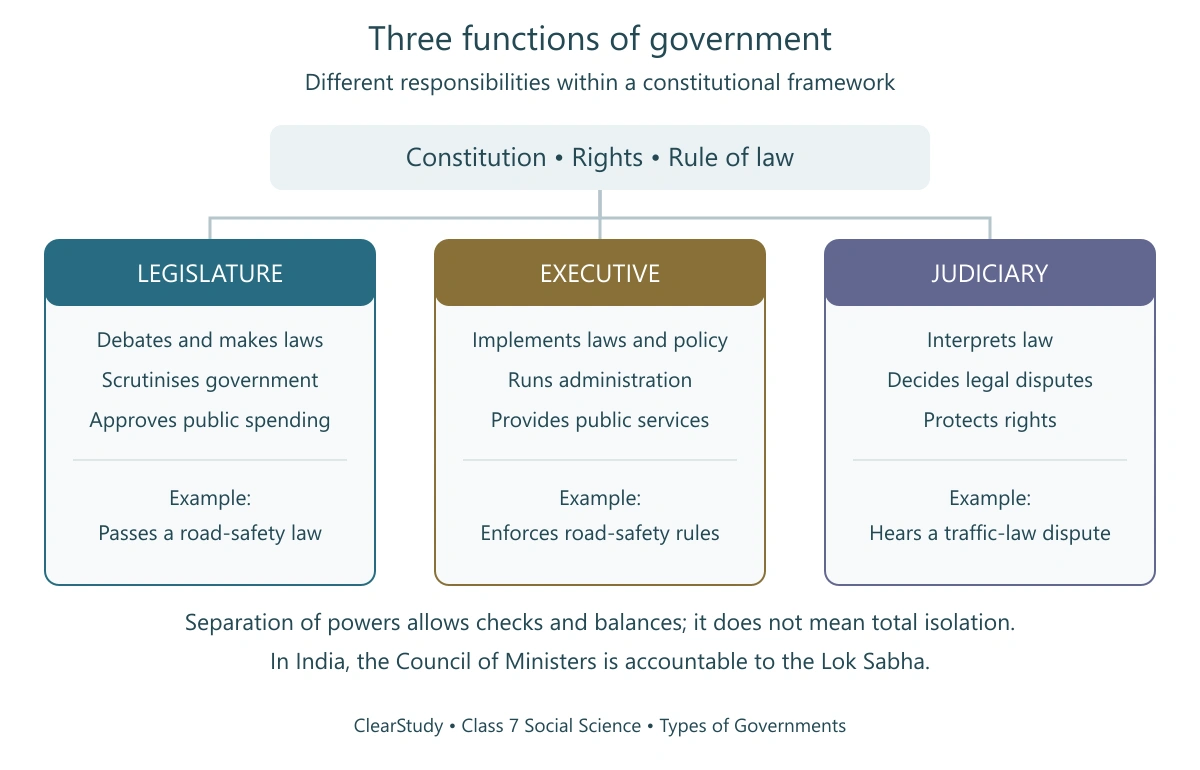
Three functions of government: the legislature makes laws and scrutinises government; the executive implements laws and administers services; the judiciary interprets laws, resolves legal disputes and protects rights. Police enforcement belongs to the executive, not the judiciary.
Democracy: ‘rule of the people’, where the source of power and authority is the people of the country. Abraham Lincoln called it ‘government of the people, by the people, for the people’.
Fundamental principles of democracy: equality, freedom, representative participation, universal adult franchise, fundamental rights of citizens, and an independent judiciary.
Direct democracy: all citizens are directly responsible for the rules and decisions and participate in them directly (some forms are seen in Switzerland). Hard to run in large countries.
Representative democracy: people elect their representatives through universal adult franchise (as in India); the people choose representatives to govern on their behalf, and the government remains accountable to the people through regular elections.
Parliamentary democracy: the political executive is drawn mainly from the legislature and depends on its confidence. In India the Council of Ministers is collectively responsible to the Lok Sabha. A person appointed minister without being an MP must become a member of either House within six months to continue.
Presidential democracy: the president has a separately established term and does not depend on ordinary legislative confidence to remain in office, but is subject to constitutional checks. Election methods vary: the US President is elected through the Electoral College, not a single direct nationwide popular vote. US National Archives.
Monarchy: a system with a monarch as head of state, usually hereditary. An absolute monarchy concentrates governing power in the monarch. A constitutional monarchy limits the monarch’s powers under constitutional rules; in the United Kingdom, elected institutions and a ministry accountable to Parliament govern.
Theocracy: a government ruled by the rules of religion and religious leaders (e.g., Iran, Afghanistan, Vatican City).
Dictatorship: a system in which a ruler or small group concentrates power and effective political accountability is severely limited. Laws, courts or a constitution may exist on paper without meaningfully restraining the ruler. Historical examples include Hitler’s Germany and Idi Amin’s Uganda.
Oligarchy: from Greek olígos (few) and árkhō (to rule) — a government where a small, powerful group (often wealthy families or influential people) makes the important decisions.
Republic: a state whose head is not a hereditary monarch; the head of state is normally chosen directly or indirectly. India is a republic. Ancient gaṇa-saṅghas such as Vajji involved collective rule by limited groups, unlike modern universal adult democracy. Uttaramerur records concern local village administration within the Chola monarchy, not a separate modern republic.
Other key terms: representative (a person chosen to act for others), accountability (the government is answerable to the people), sovereign (power independent of external influence), and separation of powers (government functions are divided, with constitutional checks and balances).
“Questions and activities” — Full Solutions
All questions below are reproduced verbatim from the NCERT textbook’s end-of-chapter Questions and activities section. Answers are original, written in exam-ready style.
1. Write names of the various types of government that you have learnt in the chapter.
2. Which type of Government does India have? And why is that called that type?
3. You read that an independent judiciary is present in all types of democracies. State any three reasons why you think it is important for the judiciary to be independent.
4. Do you think democratic government is better than other forms of government? Why?
5. These are some practices in a few different countries. Can you match the practice with the type of government?
| S. No | Practice in the country | Type of Government |
|---|---|---|
| I. | All citizens are treated equally before law | Democracy |
| II. | The government refers to the religious leader for each and every decision it takes. | Theocracy |
| III. | After the queen’s death, her son became the new king. | Monarchy |
| IV. | The ruler is not bound to follow any Constitution. He makes all the decisions as per his choice. | Dictatorship |
6. Below is a list of countries. Find out the types of government these countries have:
| Country | Classification | Key feature and source |
|---|---|---|
| Bhutan | Democratic constitutional monarchy | A monarch is head of state alongside elected institutions. Parliament of Bhutan. |
| Nepal | Federal parliamentary republic | A republican federal constitution and a parliamentary executive. Nepal Law Commission. |
| Bangladesh | Parliamentary republic | A Cabinet headed by the Prime Minister is responsible to Parliament. Constitution, Article 55. An elected government took office in February 2026, following the interim period. |
| South Africa | Republic with a parliamentary executive | The National Assembly elects the President, who is both head of state and head of the national executive. Constitution, Chapter 5. |
| Brazil | Federal presidential republic | The President is head of state and government in a federal system. Brazilian Constitution. |
This is a ‘find out’ activity; you should verify the latest position of each country from a reliable source, as a country’s form of government can change over time.
7. What are possible hurdles in a democracy in achieving its values and ideals? How can they be overcome?
8. Democracy is different from monarchy and dictatorship. Explain.
Extra Practice Questions
These questions and MCQs are ClearStudy practice, separate from the NCERT exercise.
Short Answer Type Questions
Q1. What are the three functions of government?
Q2. What is meant by ‘universal adult franchise’?
Q3. Differentiate between direct democracy and representative democracy.
Q4. What is a republic? Give one ancient Indian example.
Q5. How is an absolute monarchy different from a constitutional monarchy?
Long Answer Type Questions
Q1. Using the school Student Committee story, explain the three functions of government.
Q2. Describe the fundamental principles of a democracy.
Q3. Explain the four key aspects that make one form of government different from another.
MCQs & Assertion–Reason
1. The function of government that means making rules and laws is called the:
(a) executive function (b) judicial function (c) legislative function (d) electoral function
2. Democracy is best understood as:
(a) rule of the king (b) rule of the people (c) rule of religious leaders (d) rule of the army
3. Which country is given as an example of a presidential democracy?
(a) India (b) United Kingdom (c) USA (d) Saudi Arabia
4. In India’s parliamentary system, ministers normally are, or must within six months become:
(a) not part of the legislature (b) also members of the legislature (c) elected directly by the people (d) appointed for life
5. Saudi Arabia is given as an example of:
(a) a constitutional monarchy (b) an absolute monarchy (c) a republic (d) a direct democracy
6. A government ruled by the rules of religion and religious leaders is called a:
(a) monarchy (b) oligarchy (c) theocracy (d) democracy
7. The word ‘oligarchy’ comes from Greek words meaning:
(a) rule of one (b) rule of the few (c) rule of the people (d) rule of god
8. The Uttaramerur inscriptions, which describe the election of members to a village sabha, belong to which period?
(a) Mauryan (b) Gupta (c) Chola (d) Mughal
9. ‘Separation of powers’ means that the three organs of government:
(a) work under the king (b) have distinct functions with constitutional checks and balances (c) are controlled by the army (d) merge into one body
10. The normal term of the Lok Sabha, after which general elections are due, is:
(a) three years (b) four years (c) five years (d) six years
For each Assertion–Reason question, choose: (A) Both true and the Reason correctly explains the Assertion; (B) Both true but the Reason is not the correct explanation; (C) Assertion true, Reason false; (D) Assertion false, Reason true.
A-R 1. Assertion: In a democracy, the source of power and authority is the people of the country.
Reason: Democracy is best understood as the ‘rule of the people’.
A-R 2. Assertion: In a parliamentary democracy, the executive is independent of the legislature.
Reason: In India, the council of ministers continues to work only while it has the confidence of the Lok Sabha.
A-R 3. Assertion: The United Kingdom combines constitutional monarchy with parliamentary democracy.
Reason: In the UK, the monarch has a mainly ceremonial role while elected representatives and an accountable ministry govern.
A-R 4. Assertion: An independent judiciary is important in a democracy.
Reason: It protects citizens’ fundamental rights and ensures that laws are followed by everyone, including the government.
A-R 5. Assertion: In a dictatorship, legal institutions reliably prevent the ruler from exercising arbitrary power.
Reason: In a dictatorship, power is concentrated and effective checks on the ruler are severely limited.
Activity guidance
School election: Define duties, invite nominations fairly, let candidates explain their ideas, use a secret ballot, count transparently and arrange regular feedback. School representatives remain subject to school rules and teacher responsibility; they are not MPs.
Comparing institutions: A democracy may use representative institutions alongside referendums. Parliamentary and presidential systems are the two main forms highlighted here, but these are not an exhaustive list of every real-world combination.
Table 9.2: Mark democratic values as principles of democracy, not proof that every democracy achieves them fully. For the other idealised forms, explain that universal participation and enforceable accountability are not defining guarantees. Welfare outcomes require evidence, not a label alone.
Democratic practice: Citizens can ask questions, evaluate evidence, take part in peaceful public discussion and use lawful complaint and election processes. Respect for minority rights remains essential.
Next chapter: See how the Constitution of India establishes institutions, rights and limits.
Reviewed against NCERT Exploring Society: India and Beyond, Class 7, Part 1, Chapter 9, pp. 185–208 (2026–27 reprint), and official sources on 10 October 2026. Indian institutional details: Constitution of India.
Exam Tips & Common Mistakes
How to write a clear answer
Memorise the three functions of government (legislative, executive, judicial) and link them to the school Student Committee story for examples. Be able to name and classify every type of government — democracy (direct/representative; parliamentary/presidential), monarchy (absolute/constitutional), theocracy, dictatorship and oligarchy — with one country example each (India, USA, Saudi Arabia, UK, Iran, Germany under Hitler, Uganda under Idi Amin). For comparison questions, answer in a clear two- or three-sided structure (source of authority, how the government is formed, rights and accountability). Remember the fundamental principles of democracy and that India is a parliamentary democracy with general elections normally every five years.
Common mistakes to avoid
- Confusing parliamentary (executive is part of the legislature, e.g., India) with presidential (executive independent of the legislature, e.g., USA) democracy.
- Mixing up absolute monarchy (monarch holds all power, e.g., Saudi Arabia) with constitutional monarchy (monarch only nominal, e.g., UK).
- Thinking the UK is not a democracy because it has a king — it is a parliamentary democracy.
- Confusing the three functions: legislative (make rules), executive (implement), judicial (ensure they are followed).
- Forgetting that India gave universal adult franchise from the start (1950), while some countries gave it much later.
- Leaving ‘find out’ activity questions (like Q6) blank — write and verify the type of government for each country.
Frequently Asked Questions
What is Chapter 9 of Class 7 Social Science Exploring Society about?
Chapter 9, From the Rulers to the Ruled: Types of Governments, explains the three functions of government (legislative, executive and judicial), the principles and forms of democracy (direct, representative, parliamentary and presidential), and other forms of government such as monarchy, theocracy, dictatorship and oligarchy, along with why democracy matters and its challenges.
What type of government does India have?
India has a representative parliamentary democracy. Power lies with the people, who elect their representatives through universal adult franchise; the prime minister and council of ministers are members of Parliament and stay in office only while they have the confidence of the Lok Sabha.
What is the exercise heading for Chapter 9 of Exploring Society?
The end-of-chapter exercise in Exploring Society: India and Beyond (Part 1) Chapter 9 is headed Questions and activities and contains 8 numbered questions, all answered step by step on this page.