
CLASS 8 · Computational Thinking
Class 8 CT and AI: Proportional Reasoning Solutions
Work through Proportional Reasoning with explanations for the Class 8 CBSE Computational Thinking and Artificial Intelligence handbook.
Jump to a question or activity
Key ideas
Equivalent ratios scale all corresponding quantities by the same factor. Distinguish a count from a fraction of the whole, and check whether money or clock questions impose integer restrictions.
Short Concept Lessons
Learn a method, follow the example, then use it in the additional practice.
Scale both quantities
Equivalent ratios multiply or divide both terms by the same nonzero number.
12 : 18 = 2 : 3 after dividing both terms by 6.
Remember: Adding the same amount to both terms usually changes a ratio.
Divide a total into ratio parts
Add the ratio terms to find the number of equal parts.
₹70 in the ratio 2 : 5 gives seven parts of ₹10, so the shares are ₹20 and ₹50.
Remember: A ratio compares parts; a fraction of the whole uses their sum.
Track ingredients separately
Keep separate totals for each ingredient as you add to a mixture.
Adding 2 litres of water to 6 litres milk and 4 litres water gives 6 : 6 = 1 : 1.
Remember: Adding water changes the ratio but leaves the milk quantity unchanged.
Check cross-products
For nonzero denominators, a : b = c : d when ad = bc.
3 : 4 and 9 : 12 are proportional because 3 × 12 = 4 × 9.
Remember: Keep the order of corresponding quantities consistent.
Use integer restrictions
People, fruit counts and whole-rupee amounts require whole-number solutions.
A 2 : 3 fruit ratio gives counts 2k and 3k for a positive integer k.
Remember: Check the units and restrictions before rounding a result.
Count systematically
Organise cases so none are repeated or missed.
If minutes equal three times the hour, hour 7 gives 07:21.
Remember: A valid minute reading must lie between 00 and 59.
Questions and Solutions
Q1. A fruit basket has different fruits, Bananas, Apples, Cherries, and Strawberries.
– The bananas are 1/3 the number of cherries and twice that of apples
– The strawberries are 4 more than the number of apples
– The number of fruits of each variety are all even numbers less than 15
Based on the above statement, fill in the blank with the appropriate fruit name. For every 3 strawberries, there are proportionately 6 _________.
Solution
Option (c) Cherries. Let apples be a. Then bananas=2a, cherries=6a and strawberries=a+4. Positive even counts below 15 force a=2, giving 2 apples,4 bananas,12 cherries,6 strawberries. Halving the last two counts gives 3 strawberries to 6 cherries.
Q2. There are two unknown proportional ratios, A : B and C : D, where A, B, C, and D are DIFFERENT single-digit numbers.
– A is 2 less than C
– D is 3 times B
What is the HIGHEST difference between any two values among A, B, C, and D?
Solution
Option (d) 5. A/B = C/D, C=A+2 and D=3B imply 3A=C=A+2, so A=1 and C=3. Since B and D must be distinct single digits different from 1 and 3, B=2 and D=6. Largest minus smallest = 6−1 = 5.
Q3. A mixture contains milk and water.
When 15 litres of water is added to it, the total quantity of the mixture becomes 120 litres, where the quantity of milk and water have the LEAST POSSIBLE DIFFERENCE between them. Now, an additional 35 litres of mixture having the same milk-to-water ratio as the original mixture is added to this new mixture. What will be the ratio of milk to water in the final mixture?
Solution
Option (d) 16:15. Least difference at 120 litres means 60 litres of each. Before adding 15 litres of water, the original mixture contained 60 litres milk and 45 litres water, ratio 4:3. The extra 35 litres therefore adds 20 litres milk and 15 litres water. Final ratio = 80:75 = 16:15.
Q4. Six friends A, B, C, D, E, and F are standing in a straight line positioning from 1 to 6 (from left to right).
– The positions of A and C are in 1 : 2 ratio
– E is at an extreme end and F is at an odd numbered position
– B is next to D
– The positional ratios of D to E are in proportion to C to B
What is the position of F?
Solution
Option (c) 5. The valid orders from left to right are A C B D F E and A C D B F E. Both give A:C = 1:2, E at position 6, B next to D, and D/E = C/B (4/6=2/3 or 3/6=2/4). Checking A,C at (2,4) or (3,6) cannot satisfy all remaining conditions. F is therefore fifth in every valid arrangement.
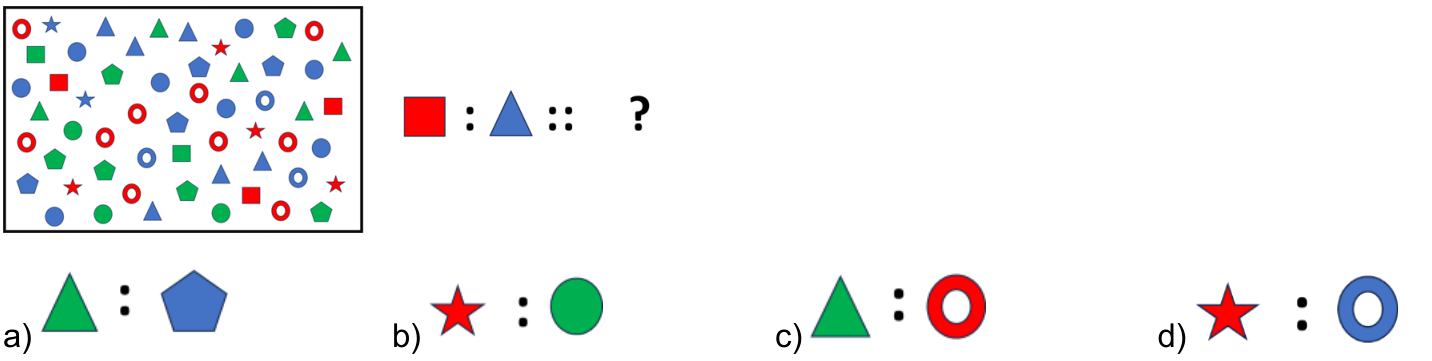
Q5. In the image given below, the ratio of blue stars to red stars is 1 : 2. Similarly, answer the following question based on the image.
What should replace the question mark so that the ratios are in proportion?
Solution
Option (c) Green triangles : red outlined circles. The reference counts are 3 red squares and 6 blue triangles, ratio 1:2. The matching counts are 5 green triangles and 10 red outlined circles, again 1:2. The other choices have ratios 5:4,4:3 and 4:3.
Q6. Find the ratio of unshaded (white) rectangles to ONLY PARTIALLY shaded (grey + white) rectangles in the figure given below.
Note: Please count all squares as rectangles for the purpose of this question

Solution
Option (c) 5 : 7. Include squares and larger rectangles made from adjacent parts. The left column has one all-white rectangle and three mixed rectangles. The right column has three all-white rectangles (two individual white cells and their union) and two mixed rectangles. Across both columns there is one all-white strip and two mixed rectangles. Thus white = 1+3+1 = 5 and mixed = 3+2+2 = 7. Entirely grey rectangles belong in neither count.
Q7. Three children have ages in the ratio 2 : 3 : 4. Each receives pocket money equal to Rs. 5 less than their age, and together they have Rs. 30.
How much minimum extra money should be added so that their final amounts are in the same ratio as their ages?
Solution
Option (b) Rs. 6 (with whole-rupee amounts). Ages 2k,3k,4k give total money 9k−15=30, so k=5. Existing amounts are ₹5,₹10,₹15. Whole-rupee amounts in ratio 2:3:4 first reach ₹8,₹12,₹16, requiring ₹3+₹2+₹1=₹6.
If paise are allowed, the mathematical minimum is ₹3.75. Amounts ₹7.50,₹11.25,₹15 already have ratio 2:3:4 and need additions ₹2.50,₹1.25,₹0. The question’s option (b) depends on the unstated whole-rupee assumption.
Q8. In a digital clock of HH : MM format, how many times the time will be as such the HH : MM ratio will be in proportion to 1 : y where y is a single digit number? (Here, the clock is in 12 hour format, where HH : MM will be 00-12 : 00-59)
Solution
Option (b) 89 (using hours 1–12 and y = 1–9). For hour h, minutes must equal hy and be at most 59. Counts per hour are 9,9,9,9,9,9,8,7,6,5,5,4. Their sum is 89 per 12-hour cycle. A standard 12-hour clock uses 12 rather than 00. If y=0 were allowed, the twelve exact-hour displays would add twelve, giving 101; the intended solution excludes zero.
Q9. A fruit seller sells apples and mangoes to 10 customers:
– The price per dozen of apples and mangoes is in the ratio 3 : 5
– Each customer buys a pack in which the number of apples and mangoes is in the ratio 1 : 3, and both quantities are multiples of 4
– The price of each fruit is a whole number greater than 10
If the total amount collected from all the customers is ₹8064, what is the MAXIMUM possible number of packs sold to a customer?
Solution
Option (d) 19. Per-fruit prices share ratio 3:5. With integer prices above ₹10 the smallest is ₹12 per apple and ₹20 per mango. The smallest pack contains 4 apples and 12 mangoes, costing 4×12 + 12×20 = ₹288. ₹8064 can therefore buy at most 28 such packs. Giving each of the other nine customers at least one leaves 28−9 = 19 for one customer. These minimum prices and packs achieve the bound.
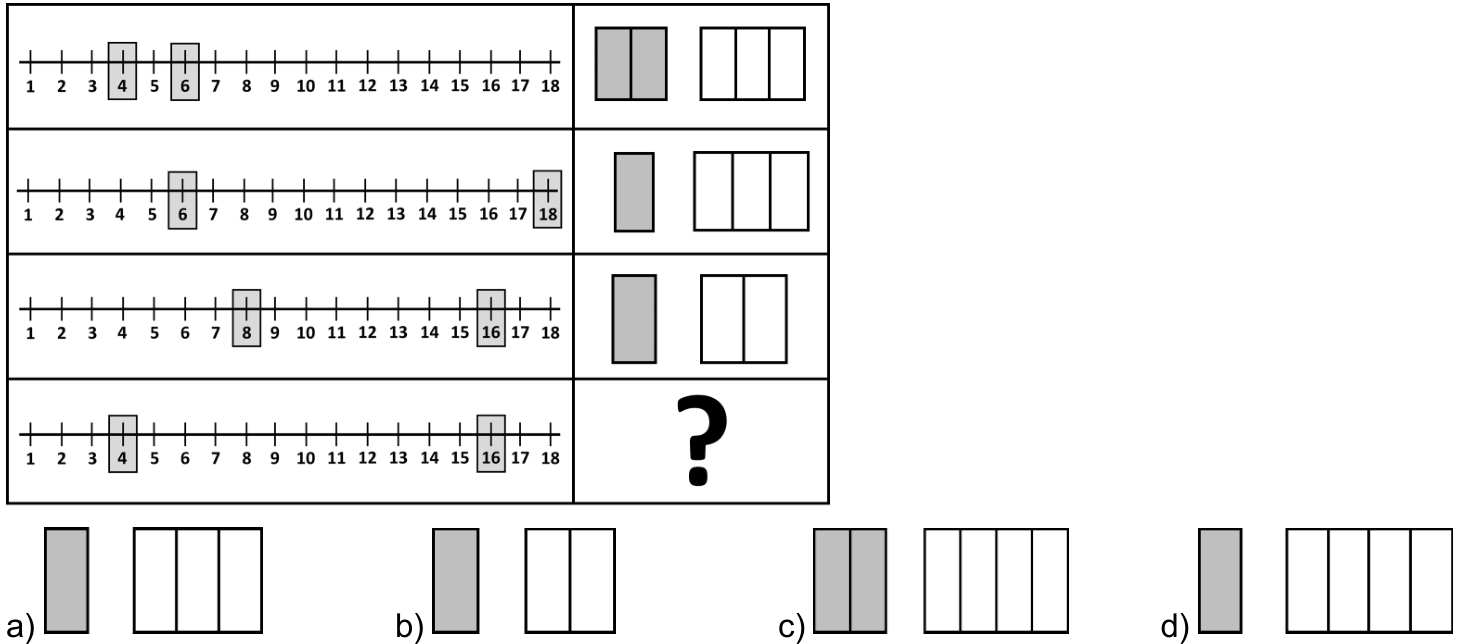
Q10. What will come in place of "?"
Solution
Option (d) One grey block and four white blocks. Simplify 4/16 to 1/4. In this code, the numerator counts grey blocks and the denominator counts white blocks, so choose one grey and four white. This is a grey:white ratio of 1:4, not a claim that one quarter of all five displayed blocks is grey.
The Thinking Spot
Sam arranged the following 4 blocks vertically, one on top of another, such that
• There are at least 2 blocks below the block having a circle
• The block with a triangle has at least 1 block above it
• The block having a rectangle is immediately above the block having a star
How many different arrangements satisfy all the above conditions?

Solution
Option (c) 2. From top to bottom the orders are Circle–Triangle–Rectangle–Star and Circle–Rectangle–Star–Triangle. If the circle were second, the rectangle–star adjacent pair could fit only in positions 3–4, forcing the triangle to the top, which is forbidden. Thus the circle must be first, leaving exactly the two orders above.
Additional Practice Questions with Solutions
Choose an answer, use a hint if needed, then open the worked solution to check your reasoning.
Solved 0 of 10 · Checked 0 of 10
Your practice progress lasts until you reset or reload this page.
Apply · Equivalent ratios
Practice Q1. Which ratio is equivalent to 3 : 5?
Show hint
Multiply both terms by the same factor.
Show worked solution
Option (b) 9 : 15.
3 × 3 : 5 × 3 = 9 : 15.
Common mistake: Both terms must use the same scale factor.
Apply · Sharing
Practice Q2. Divide 84 counters in the ratio 2 : 5. How many are in the smaller share?
Show hint
There are seven equal parts in total.
Show worked solution
Option (c) 24.
84 ÷ 7 = 12 counters per part. The smaller share is 2 × 12 = 24.
Common mistake: Use 2 + 5 parts for the whole.
Apply · Mixtures
Practice Q3. A mixture contains 8 litres of milk and 4 litres of water. Add 4 litres of water. What is the new milk-to-water ratio?
Show hint
Only the water quantity increases.
Show worked solution
Option (a) 1 : 1.
The final quantities are 8 litres milk and 8 litres water, giving 1 : 1.
Common mistake: Do not add the water to both ingredients.
Apply · Proportion
Practice Q4. If x : 15 = 2 : 3, what is x?
Show hint
The second term is multiplied by 5.
Show worked solution
Option (d) 10.
3 × 5 = 15, so x = 2 × 5 = 10.
Common mistake: Apply the same multiplier to both terms.
Apply · Whole-number counts
Practice Q5. Red and blue beads are in ratio 2 : 3. Which total is possible?
Show hint
The total must be a multiple of five.
Show worked solution
Option (b) 20.
A total of 20 gives 8 red and 12 blue beads. The other totals are not multiples of 5.
Common mistake: Bead counts must be whole numbers.
Apply · Ratios and fractions
Practice Q6. There are 3 grey blocks and 5 white blocks. What fraction of all blocks is grey?
Show hint
Count all blocks for the denominator.
Show worked solution
Option (c) 3/8.
There are 3 + 5 = 8 blocks in total, of which 3 are grey. The fraction is 3/8.
Common mistake: The grey:white ratio is not the grey fraction of the whole.
Apply · Mixture scaling
Practice Q7. A 21-litre mixture has milk-to-water ratio 4 : 3. How much milk does it contain?
Show hint
Divide the total into seven equal parts.
Show worked solution
Option (a) 12 litres.
Each part is 21 ÷ 7 = 3 litres. Milk occupies four parts: 4 × 3 = 12 litres.
Common mistake: Milk is four of the seven total parts.
Apply · Clock ratios
Practice Q8. At hour 08, minutes must be three times the hour value. Which time fits?
Show hint
Multiply 8 by 3.
Show worked solution
Option (d) 08:24.
The minute value is 8 × 3 = 24. Thus 08:24 gives ratio 8 : 24 = 1 : 3.
Common mistake: The ratio compares the numerical hour and minute readings.
Apply · Minimum additions
Practice Q9. Two children have ₹6 and ₹15. Add whole rupees, without taking any away, to make their amounts 1 : 2. What is the least total addition?
Show hint
Write the target amounts as k and 2k.
Show worked solution
Option (b) ₹3.
We need k ≥ 6 and 2k ≥ 15. The least integer k is 8, giving ₹8 and ₹16. Add ₹2 + ₹1 = ₹3.
Common mistake: The final amounts must be whole rupees and neither can decrease.
Apply · Unit price
Practice Q10. Apples and pears cost ₹12 and ₹18 each. What is their price ratio in simplest form?
Show hint
Divide both prices by their greatest common factor.
Show worked solution
Option (c) 2 : 3.
12 : 18 simplifies by dividing both terms by 6, giving 2 : 3.
Common mistake: An equivalent ratio is not necessarily in simplest form.