
CLASS 8 · Computational Thinking
Class 8 CT and AI: We Distribute Yet Things Multiply Solutions
Work through We Distribute Yet Things Multiply with explanations for the Class 8 CBSE Computational Thinking and Artificial Intelligence handbook.
Jump to a question or activity
Key ideas
The distributive law connects grouped arithmetic, area models and algebra. Track totals carefully when a problem describes several rounds of distribution or movement.
Short Concept Lessons
Learn a method, follow the example, then use it in the additional practice.
Multiply each part
The distributive law is a(b + c) = ab + ac.
7 × 13 = 7 × (10 + 3) = 70 + 21 = 91.
Remember: Multiply every term inside the bracket.
Read a split rectangle
Multiply the common height by each part of the width.
A 5 by 8 rectangle split into widths 3 and 5 has area 5 × 3 + 5 × 5 = 40.
Remember: Both pieces have the same height.
Expand a square
(a + b)² = a² + 2ab + b².
(10 + 2)² = 100 + 40 + 4 = 144.
Remember: Do not omit the middle term 2ab.
Subtract a whole expression
A minus sign before a bracket changes every sign inside it.
(x + 5) − (x − 3) = x + 5 − x + 3 = 8.
Remember: Keep brackets until you have distributed the negative sign.
Track changing totals
Work out the total after each stage before applying the next rule.
A bus with 40 passengers loses 12 and gains 8: 40 − 12 + 8 = 36.
Remember: Use the current number on each journey segment.
Check all conditions
A numerical solution must also satisfy restrictions such as distinct digits.
If A + B × C = 25, A = 5 and B × C = 20 would repeat digit 5 in the only allowed factor pair 4 and 5.
Remember: Multiplication comes before addition.
Questions and Solutions
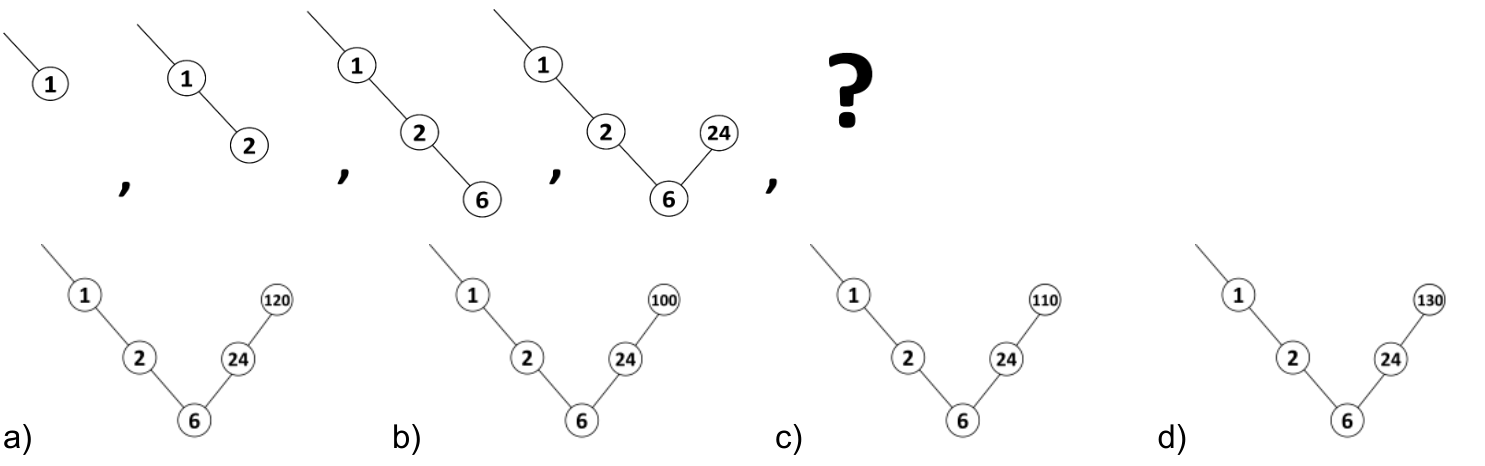
Q1. What will come in place of “?”
Solution
Option (a) 120. Values are 1,2,6,24, obtained successively by multiplying by 2,3,4. The next value is 24 × 5 = 120, added as the next circle.
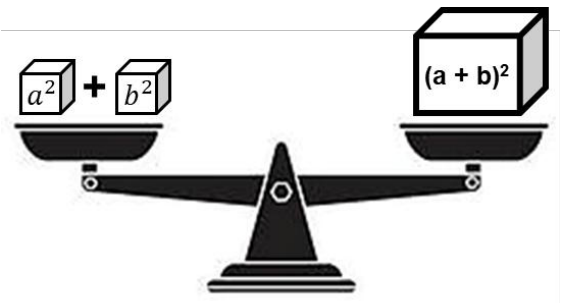
Q2. On a weighing scale, both a and b are whole numbers.
Which conclusion is logically correct?
Solution
Option (a) The scale can balance only when one of the numbers is 0. Expanding gives (a+b)² = a² + 2ab + b². Equality requires 2ab = 0. For whole numbers this means a=0 or b=0, including the case both are zero.
Q3. There are 49 sets of marbles, numbered from 1 to 49.
The set numbered k contains k marbles. The marbles in set 49 are sold at ₹1 per marble, those in set 48 at ₹2 per marble, those in set 47 at ₹3 per marble, and so on, with the price per marble increasing accordingly. What is the difference between the maximum and minimum total amount for which a set of marbles can be sold?
Solution
Option (b) 25² − 7². Set k costs k(50−k) = 625 − (k−25)². Its maximum is ₹625 at k=25. On 1≤k≤49 the minimum is ₹49, reached at k=1 or 49. Difference = 625−49 = 576.
Q4. A merchant has (19² − 1) coins. He must distribute the coins to some children.
The number of children is equal to the number of distinct prime factors of 30.
• First, each child receives 4 packs of 6 coins each
• Then, after this distribution, the merchant must give each child 3 more packs of 6 coins each, ONLY IF the remaining coins are more than half of the original count
Which of the following expressions represents the number of coins finally left with the merchant, after the distribution(s)?
Solution
Option (b) (19² − 1) − 3(6 × 4 + 3 × 6). There are 360 coins and three children (prime factors 2,3,5). The first round gives away 3 × 24 = 72, leaving 288. Since 288 > 180, the second round gives away 3 × 18 = 54. Final remainder = 360 − 72 − 54 = 234 coins. Keep both rounds inside the subtracted bracket.
Q5. A two-digit number XY is formed using two different digits. When the sum of its digits is added to the number, a new number is formed, which is divisible by 3.
Which of the following will be DEFINITELY true about the new number?
Solution
Option (c) X + Y is a multiple of 3. The new value is 10X+Y+X+Y = 11X+2Y = 9X+2(X+Y). The 9X term is divisible by 3. Since 2 has no factor 3, divisibility requires X+Y to be divisible by 3; X and Y need not individually be multiples of 3.
Q6. A, B, and C are three different digits among 1 – 9. How many digits CANNOT be assigned to "A" if the following condition is true?
A + B × C = 25
Solution
Option (c) 5. With distinct digits 1–9, possible A values are 1,4,7,9, witnessed by (A,B,C) = (1,3,8), (4,3,7), (7,2,9), (9,2,8). The excluded digits are 2,3,5,6,8. For A=5 the required product 20 needs 4×5 and repeats A. For the others the needed products 23,22,19,17 cannot be made from two single-digit factors.
Q7. What will come in place of “?”

Solution
Option (d) (6 x 2) + (6 x 3). The grid has six rows. The divider splits its five columns into two and three, giving 12 + 18 = 30 small cells.
Q8. A team of three painters – A, B, and C – must paint rooms and each painter paints 3 rooms per working day. They are scheduled to work for 50 days starting Monday.
● Painter A does not work on weekends (no Saturdays or Sundays)
● Painter B does not work on every 5th day (Day 5, Day 10, Day 15, and so on)
● Painter C works on all 50 days
Based on the above rules, determine an expression that represents the total number of rooms painted by all three painters combined.
Solution
Option (c) 3 × (36 + 40 + 50). A works five weekdays in each of seven full weeks plus the final Monday: 36 days. B misses ten multiples-of-five days and works 40. C works all 50. Multiply the combined 126 working days by three rooms per painter per day.
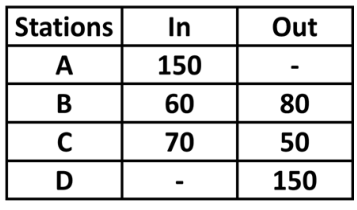
Q9. A train runs from A to D via B and C. The number of passengers entering and leaving at each station is given in the table. Each passenger buys a separate ticket for each segment travelled (A→B, B→C, C→D). Ticket prices are: A→B = Rs. 1, B→C = Rs. 2, C→D = Rs. 1
Which of the following is the total cost of all tickets purchased?
Solution
Option (a) Rs. [(150 x 1) + (70 x 3) + (60 x 2) + (80 x 1)]. A→B carries 150 people. B→C carries 150−80+60 = 130. C→D carries 130−50+70 = 150. Revenue is 150×1 + 130×2 + 150×1 = 560. The option’s regrouped expression, 150×1 + 70×3 + 60×2 + 80×1, has the same value; count passengers separately on each segment.
Q10. If 2(pq + rs) is coded as PQ_2_RS, 3(kl + mn) is coded as KL_3_MN and 4(gh + ij) is coded as GH_4_IJ, what will be the possible code of the SIMPLIFIED FORM of the following expression? (a +
Solution
Option (d) . Expanding (a+b)(c+d) − (a−b)(c−d) gives ac+ad+bc+bd − ac+ad+bc−bd = 2ad+2bc = 2(ad+bc). Following the supplied code rule yields AD_2_BC.
The Thinking Spot
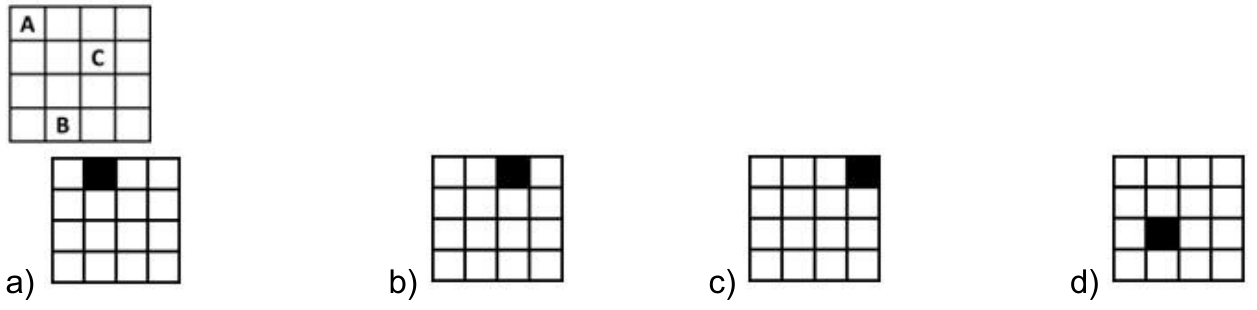
Two coins are hidden in the grid below in two different rows and columns.
• None of the coins is in A's column, but one is in its row
• None of the coins is in B's row, but one is in its column
• None of the coins is in C's row, but one is in its column
Which of the following blocks CANNOT have a coin?
Solution
Option (c) Top-right cell. Number rows and columns from the top-left. A excludes column 1; B excludes row 4 and requires column 2; C excludes row 2 and requires column 3. Since there are only two coins, one must occupy each of columns 2 and 3. The allowed paired placements are (row 1, column 2) with (row 3, column 3), or (row 1, column 3) with (row 3, column 2). Column 4 cannot contain either coin.
Additional Practice Questions with Solutions
Choose an answer, use a hint if needed, then open the worked solution to check your reasoning.
Solved 0 of 10 · Checked 0 of 10
Your practice progress lasts until you reset or reload this page.
Apply · Distributive law
Practice Q1. Which expression equals 8 × (20 + 3)?
Show hint
Multiply both terms by 8.
Show worked solution
Option (b) 8 × 20 + 8 × 3.
8 × (20 + 3) = 8 × 20 + 8 × 3 = 184.
Common mistake: The outside factor multiplies every term.
Apply · Area model
Practice Q2. A rectangle has 4 rows and columns split into groups of 3 and 5. How many unit squares are there?
Show hint
Add the areas of the two parts.
Show worked solution
Option (c) 32.
4 × 3 + 4 × 5 = 12 + 20 = 32.
Common mistake: Use four rows in both parts.
Apply · Square identity
Practice Q3. What is (a + b)² − a² − b²?
Show hint
Expand the square before subtracting.
Show worked solution
Option (a) 2ab.
a² + 2ab + b² − a² − b² = 2ab.
Common mistake: Squaring a sum creates a middle term.
Apply · Subtraction
Practice Q4. Simplify (x + 7) − (x − 2).
Show hint
Change both signs in the second bracket.
Show worked solution
Option (d) 9.
x + 7 − x + 2 = 9.
Common mistake: Subtracting negative 2 adds 2.
Apply · Distribution
Practice Q5. A teacher has 200 beads and gives each of 4 groups 3 bags of 10 beads. How many beads remain?
Show hint
Calculate the total handed out first.
Show worked solution
Option (b) 80 beads.
4 × 3 × 10 = 120 beads are handed out. 200 − 120 = 80 beads remain.
Common mistake: Subtract the total for all four groups.
Apply · Working days
Practice Q6. A painter starts on Monday and works weekdays only for 15 calendar days. How many days does the painter work?
Show hint
Fifteen days contain two full weeks and one Monday.
Show worked solution
Option (c) 11.
2 × 5 + 1 = 11 working days.
Common mistake: Separate calendar days from working days.
Apply · Passenger totals
Practice Q7. A bus carries 30 passengers on a ₹2 segment. Then 10 leave and 5 enter before a ₹3 segment. What is the total fare for both segments?
Show hint
Use 30 passengers first and 25 second.
Show worked solution
Option (a) ₹135.
30 × 2 + (30 − 10 + 5) × 3 = 60 + 75 = ₹135.
Common mistake: The passenger count changes between segments.
Apply · Factoring
Practice Q8. Which expression equals 6xy + 6xz?
Show hint
Find the factor common to both terms.
Show worked solution
Option (d) 6x(y + z).
Both terms contain 6x. Factoring gives 6x(y + z).
Common mistake: Every original term must be reproduced when you expand.
Apply · Digit constraints
Practice Q9. Which triple of distinct digits satisfies A + B × C = 19?
Show hint
Multiply before adding and check distinctness.
Show worked solution
Option (b) (1, 3, 6).
For (1, 3, 6), 1 + 3 × 6 = 19 and all digits differ.
Common mistake: An equation and its digit restrictions must both hold.
Apply · Difference of squares
Practice Q10. What is 21² − 19²?
Show hint
Use (u − v)(u + v).
Show worked solution
Option (c) 80.
(21 − 19)(21 + 19) = 2 × 40 = 80.
Common mistake: The difference of squares is not the square of the difference.