
CLASS 8 · Computational Thinking
Class 8 CT and AI: Number Play Solutions
Work through Number Play with explanations for the Class 8 CBSE Computational Thinking and Artificial Intelligence handbook.
Jump to a question or activity
Key ideas
Use divisibility tests, remainders and the exact wording of constraints. In digit puzzles, a letter stands for the same digit every time, and distinct-letter restrictions must hold throughout.
Short Concept Lessons
Learn a method, follow the example, then use it in the additional practice.
Test divisibility
A number is divisible by 9 when its digit sum is divisible by 9.
For 7,245, the digit sum is 18, so 7,245 is divisible by 9.
Remember: Rearranging digits preserves their sum.
Sort with overlapping rules
A number can belong to two groups at once.
Multiples of both 4 and 6 are multiples of their LCM, 12.
Remember: Count an overlapping number in each group it belongs to.
Find the remainder
Subtract the greatest multiple of the divisor that does not exceed the number.
47 = 4 × 10 + 7, so the remainder on division by 10 is 7.
Remember: The remainder is always smaller than the positive divisor.
Turn order clues into a list
Place the smallest and largest values first, then use the remaining comparisons.
Five numbers starting at 12 with a gap of 6 are 12, 18, 24, 30, 36.
Remember: Check every clue against the final order.
Check every digit constraint
The same letter keeps the same digit throughout a cryptarithm.
In 26 × 6 = 156, the units digit stays 6 and the other letters can represent distinct digits.
Remember: A leading digit cannot be zero. Check distinctness as well as arithmetic.
Prove a minimum
Find a working example, then explain why a smaller value cannot work.
The smallest distinct positive digits are 1 and 2, so their sum cannot be below 3.
Remember: A successful example alone does not prove it is the smallest.
Questions and Solutions
Q1. A, B, C, D, and E are five distinct whole numbers, with 16 as the smallest number. When arranged in ascending order, the difference between any two consecutive numbers is 8.
– It is given that D is the greatest number and A is the least
– Also, B is greater than E but less than C
Which of the following numbers is definitely divisible by 32?
Solution
Option (b) B. The five values are 16,24,32,40,48. Their order is A < E < B < C < D, so B = 32.
Q2. A control panel has three bulbs
– A, B, and C. Each bulb is associated with one fixed divisor (greater than 3). A bulb glows whenever the entered number is divisible by its own divisor. A technician tested the panel with several numbers and noted which bulbs glowed, as shown in the table below. Using this information, if 56 is entered, which bulb(s) will glow?

Solution
Option (c) B and C. A’s divisor is 6, the common divisor above 3 of 12,18,42. B’s is 4 from 12 and 16. C’s is 7 from 35 and 42. Since 56 is divisible by 4 and 7 but not 6, B and C glow.
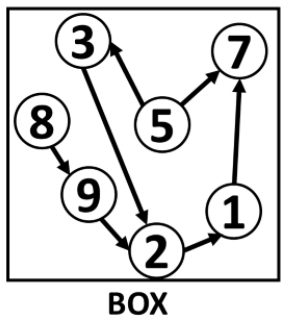
Q3. Using the digits shown in the Box, form the largest possible 6-digit number that is divisible by 9 (without repeating the digits).
In the number formed, which place values contain digits that point to a greater digit than themselves in the box?
Solution
Option (d) Ones and Thousands. The seven digits sum to 35. Removing 8 leaves sum 27, divisible by 9. Arranging the remaining digits in descending order gives 975321. Of its digits, 5 points to 7 and 1 points to 7. They occupy the thousands and ones places. The 8 → 9 arrow is irrelevant because 8 is not in the six-digit number.
Q4. Sam has two different two-digit numbers such that:
– Both numbers are divisible by 9
– None of the numbers is a multiple of 18 What is the LEAST possible sum of the two numbers?
Solution
Option (b) 72. Eligible values start 27,45,63,81,99. The smallest distinct pair is 27 and 45, whose sum is 72.
Q5. The numbers of the SET will be distributed to the Box 1 and Box 2, based on the conditions given below:
● If the number is a multiple of 4 it goes to Box 1
● If the number is a multiple of 6 it goes to Box 2
● If the number is a multiple of both 6 and 4 it goes in both the boxes
Find the ratio of the number of BLACK CIRCLES in Box 1 to the number of WHITE CIRCLES in Box 2, finally.

Solution
Option (c) 5:2. The black multiples of 4 are 16,36,32,28,96, giving five. The white multiples of 6 are 12 and 24, giving two. Multiples of both divisors belong in both boxes; do not remove them from either count.
Q6. Ashish and Devika together choose two different numbers from 2 to 24 (both inclusive). The chosen numbers are multiplied, and the product is divided by 25. The remainder decides the result:
● If the remainder is less than 10, Devika wins
● If the remainder is more than 14, Ashish wins
● In all other cases, the game is a draw
What is the minimum possible sum of the numbers chosen by Ashish and Devika such that Ashish wins the game?
Solution
Option (b) 8. Choose 3 and 5: 3 × 5 = 15, whose remainder modulo 25 is 15, greater than 14. With a sum below 8, the largest product of two distinct allowed integers is 3 × 4 = 12, so no smaller sum can win.
Q7. On the six faces of a die, even numbers from 2 to 12 are written.
● All multiples of 4 are written on adjacent faces such that no two of these faces are opposite to each other
● The sum of the numbers on any two opposite faces is always greater than 10
Which of these pairs are written on opposite faces?
Solution
Option (c) 2 and 12. Faces 4,8,12 are pairwise adjacent, so each must oppose one of 2,6,10. Face 2 cannot oppose 4 or 8 because the sums 6 and 10 are not greater than 10; it must oppose 12. Then 6 cannot oppose 4, so it opposes 8; the remaining opposite pair is 4 and 10.
Q8. In the year 2020, Simran’s age was a multiple of 6.
In the year 2024, her age was a multiple of 11. Which of the following could possibly be the age of Simran in the year 2024?
Solution
Option (b) 22 years. Four years earlier the age is 22 − 4 = 18, a multiple of 6, while 22 is a multiple of 11. The other choices give 2020 ages 7,29,40, none divisible by 6.
Q9. The middle number of 5 consecutive even numbers is 5p.
Exactly two numbers in the sequence are divisible by 4, and only one is divisible by 5. Among the following values, which could be the possible value of p.
Solution
Option (a) 2. The sequence is 5p − 4, 5p − 2, 5p, 5p + 2, 5p + 4. With p = 2 it becomes 6,8,10,12,14: exactly 8 and 12 are divisible by 4 and only 10 by 5. p = 3 or 5 makes the terms odd; p = 4 gives three multiples of 4.
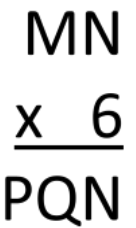
Q10. A cryptarithmetic multiplication is shown below.
Here, P, Q, M, and N are distinct single-digit natural numbers. MN represents a two-digit number, and PQN represents a three-digit number. What is the smallest possible value of P + M?
Solution
Option (a) 3. Since P and M are different positive digits, P + M is at least 1 + 2 = 3. This bound is attainable: 26 × 6 = 156 gives P=1, Q=5, M=2, N=6, all distinct. Also 28 × 6 = 168 works. Thus the minimum is 3.
The Thinking Spot
There are 9 switches in a row on a switchboard. 3 of them belong to lights and the remaining are of fans. Every two consecutive light switches have exactly two fan switches between them. The switch at the extreme right is NOT a light switch and the switch at the extreme left is NOT a fan switch.
Which of them is definitely a light switch?
Solution
Option (c) 6th switch from the right. The first switch must be a light. Two fans between consecutive lights force L F F L F F L F F. Light switches are positions 1,4,7 from the left; position 4 is sixth from the right.
Additional Practice Questions with Solutions
Choose an answer, use a hint if needed, then open the worked solution to check your reasoning.
Solved 0 of 10 · Checked 0 of 10
Your practice progress lasts until you reset or reload this page.
Apply · Divisibility
Practice Q1. Which number is divisible by 9?
Show hint
Add the digits.
Show worked solution
Option (b) 1,242.
1 + 2 + 4 + 2 = 9, so 1,242 is divisible by 9.
Common mistake: Testing only the last digit does not test divisibility by 9.
Apply · Overlapping sets
Practice Q2. From 12, 16, 18, 24 and 30, how many numbers are divisible by both 4 and 6?
Show hint
Look for multiples of 12.
Show worked solution
Option (c) 2.
Only 12 and 24 are divisible by both 4 and 6, giving 2 numbers.
Common mistake: Being divisible by one divisor is not enough.
Apply · Remainders
Practice Q3. What is the remainder when 7 × 8 is divided by 9?
Show hint
First find the product.
Show worked solution
Option (a) 2.
7 × 8 = 56 = 6 × 9 + 2. The remainder is 2.
Common mistake: The quotient and remainder are different.
Apply · Ordering
Practice Q4. Five numbers start at 10 and increase by 7 each time. What is the largest number?
Show hint
There are four gaps between five numbers.
Show worked solution
Option (d) 38.
The list is 10, 17, 24, 31, 38. The largest is 38.
Common mistake: Five numbers have four gaps, not five.
Apply · Divisibility
Practice Q5. What is the least sum of two different two-digit multiples of 5 that are not multiples of 10?
Show hint
List eligible numbers in increasing order.
Show worked solution
Option (b) 40.
The smallest eligible numbers are 15 and 25. Their sum is 40.
Common mistake: The two numbers must be different and must not be multiples of 10.
Apply · Place value
Practice Q6. What is the thousands digit in the largest number formed using 1, 2, 3, 4, 5 and 6 exactly once?
Show hint
Arrange the digits from largest to smallest.
Show worked solution
Option (c) 4.
The number is 654,321. Its thousands digit is 4.
Common mistake: Count place values from the right: ones, tens, hundreds, thousands.
Apply · Consecutive numbers
Practice Q7. Five consecutive even numbers have middle number 18. How many are divisible by 4?
Show hint
Write the complete list first.
Show worked solution
Option (a) 2.
The numbers are 14, 16, 18, 20 and 22. Only 16 and 20 are divisible by 4.
Common mistake: Consecutive even numbers differ by 2.
Apply · Digit puzzles
Practice Q8. In AB × 3 = 81, what is A + B?
Show hint
Divide 81 by 3 to find AB.
Show worked solution
Option (d) 9.
AB = 27, so A = 2 and B = 7. Their sum is 9.
Common mistake: AB represents a two-digit number, not A multiplied by B.
Apply · Position clues
Practice Q9. Nine switches follow L F F L F F L F F from left to right. Which switch is a light?
Show hint
Convert a position from the right to one from the left.
Show worked solution
Option (b) Sixth from the right.
Sixth from the right is position 9 − 6 + 1 = 4 from the left, which is L.
Common mistake: Include the switch itself when counting positions.
Apply · Minimum
Practice Q10. Choose two different integers from 2 to 10. Their product must exceed 20. What is the least possible sum?
Show hint
Try pairs with the smallest sums.
Show worked solution
Option (c) 10.
A sum of 9 gives a maximum product of 4 × 5 = 20, which is not enough. With sum 10, 4 × 6 = 24 works. Thus the minimum is 10.
Common mistake: Exceed 20 means strictly greater than 20, not equal to 20.