
CLASS 8 · Computational Thinking
Class 8 CT and AI: Quadrilaterals Solutions
Work through Quadrilaterals with explanations for the Class 8 CBSE Computational Thinking and Artificial Intelligence handbook.
Jump to a question or activity
Key ideas
A quadrilateral has four straight boundary sides. When counting composite shapes, include large shapes assembled from smaller parts, but do not count a boundary with extra corners as a quadrilateral. Squares are rectangles too.
Short Concept Lessons
Learn a method, follow the example, then use it in the additional practice.
Recognise inclusive shape families
Every square is a rectangle and a rhombus, and every rectangle or rhombus is a parallelogram.
A square satisfies the rectangle rule of four right angles.
Remember: A property of a special member need not hold for its whole family.
Practise this method →Distinguish diagonal properties
Parallelogram diagonals bisect each other; rectangle diagonals are also equal; rhombus diagonals are perpendicular.
A square has all these properties.
Remember: Equal and perpendicular mean different things.
Practise this method →Count complete outlines
A quadrilateral has four outside sides, even if lines divide its interior.
Two adjacent rectangles can form another larger rectangle.
Remember: Count tilted shapes too when their angles qualify.
Practise this method →Use angle relationships
A quadrilateral’s interior angles total 360°. A rectangle has four 90° angles.
If three angles are 80°,100°,70°, the fourth is 110°.
Remember: Do not assume a shape is a rectangle just from its appearance.
Practise this method →Trace the outside boundary
A shared edge becomes internal when two shapes join.
Two triangles joined along suitable sides can form a quadrilateral.
Remember: Merge collinear boundary edges when counting sides.
Practise this method →Reflect before comparing
A vertical mirror reverses left and right but preserves row positions.
In a four-column board, column 1 maps to 4 and 2 maps to 3.
Remember: Each mismatched circle needs one toggle.
Practise this method →Questions and Solutions
Q1. Raj colored the following shapes (Trapezium, Parallelogram, Square, Kite) in Red, Yellow, Green, and Blue, not necessarily in the same order.
● The shape colored in Red has no parallel sides
● The shape with each of its angles equal to 90°, is not Yellow
● The shape with two pairs of parallel sides is not Green
Which shape did he color in yellow?

Solution
Option (b) Parallelogram. The pictured kite has no parallel sides, so it is red. Neither the square nor parallelogram can be green, so the trapezium is green. The square cannot be yellow and must be blue. Yellow remains for the parallelogram.
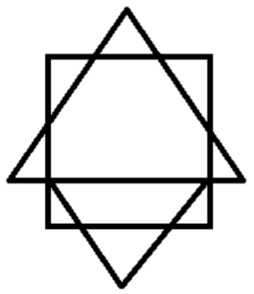
Q2. How many quadrilaterals are there in the given figure?
Solution
Option (d) 11. Count three rectangles formed by the two vertical sides and three horizontal levels: the upper rectangle, lower rectangle and their union. Then trace the eight nonrectangular four-sided outlines made using the sloping sides. Count each outline once, even when internal lines divide it into smaller regions. The total is 3 + 8 = 11.
Q3. How many rectangles are there in the given figure?
Note: For the purpose of this question, please count all squares also as rectangles

Solution
Option (c) 10. Group them by orientation. The diagonal strip at the upper left contains two small tilted rectangles and their combined rectangle: 3. The horizontal/vertical lines form 7 more: the outside square; the full-height right strip and its two stacked parts; the lower-left part of the small bottom-right block; that whole bottom-right block; and the large rectangle to the left of the full-height interior vertical line. Thus 3 + 7 = 10.
Q4. In the given tangram, how many quadrilaterals are made with exactly 3 colored tiles?

Solution
Option (b) 3. The valid three-tile groups are: peach + blue + dark grey at the upper left; light green + white + orange at the upper right; and light green + white + light grey in the middle-right. In each case trace only the outside boundary and merge collinear edges. Other three-tile unions either have more than four corners or do not form a single closed four-sided region.
Q5. Below are three families of shapes and a set of Property Cards.
– A property card should be placed into a family if the property applies to that family
– A single property may belong to more than one family
After placing all the property cards, which family will have the maximum number of properties?
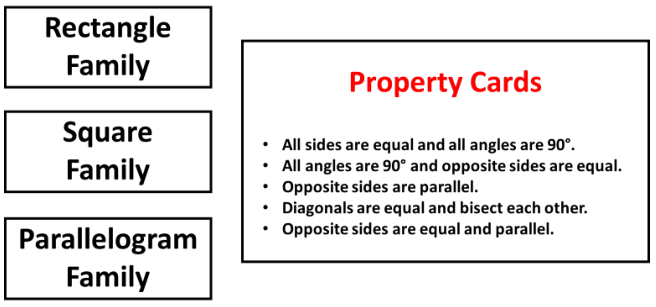
Property Cards:
- All sides are equal and all angles are 90°.
- All angles are 90° and opposite sides are equal.
- Opposite sides are parallel.
- Diagonals are equal and bisect each other.
- Opposite sides are equal and parallel.
Solution
Option (a) Square Family. A square satisfies all five cards. A rectangle satisfies every card except the one requiring all sides equal, so it receives four. A general parallelogram satisfies the two cards concerning equal/parallel opposite sides, so it receives two. Equal diagonals are not guaranteed for every parallelogram.
Q6. In the grid, each letter stands for the initial of a shape: Square, Rhombus, Kite, Trapezium, and Parallelogram.
How many pairs of adjacent letters represent two shapes in which the diagonals bisect each other?

Solution
Option (c) 5. Qualifying letters are S, R and P. In R K S P T R P S T P R S K the pairs are S–P at positions 3–4, R–P at 6–7, P–S at 7–8, P–R at 10–11 and R–S at 11–12. Count overlapping pairs separately.
Q7. Find the option that does NOT belong to the elements in the given set.
Set = (Angle between diagonals of a Rhombus, Each angle of a rectangle, Each angle of a square)
Solution
Option (c) Each angle of an Equilateral Triangle. It is 60°. The given set consists of 90° angles. An angle in a semicircle is 90°; half the 180° sum of opposite angles of a cyclic quadrilateral is 90°; and the angle opposite a right triangle’s hypotenuse is 90°.
Q8. Which shapes from the given options will NOT form a quadrilateral when any two identical shapes are joined along any one of their sides?
Note: You can rotate the shapes but they cannot overlap each other
Solution
Option (d) Pentagon. Joining two five-sided shapes along one complete side removes that shared side from the outside boundary. Eight boundary edges remain. At the two ends of the join, neighbouring edges can merge if they are collinear, reducing the count by at most two. At least six outside sides remain, so the result cannot be a quadrilateral. Suitable pairs of triangles, rhombi and trapeziums can form quadrilaterals.
Q9. Two transparent sheets are shown below.
Sheet A is a rectangle and Sheet B is a right-angled triangle. Rearrange the sheets so that the red points overlap exactly (without rotating or flipping the sheets). How many quadrilaterals are formed in the final figure?

Solution
Option (c) 5. Slide the triangle left, keeping its orientation. Its vertical side lies inside the rectangle. The three vertical lines produce three rectangles (left section, right section and the original rectangle). The triangle’s sloping side also forms two trapeziums: one across the whole lower outline and one within the overlap. Total = 3 + 2 = 5.
Q10. Paul and Sam are at different positions and start walking in opposite directions but along parallel paths.
After covering the same distance, each of them turns toward the starting point of the other person and walks straight (without taking any other turns) until they reach each other’s starting points. What can we say for certain about the shape formed by BOTH their paths together?
Solution
Option (c) Opposite sides are of same length. The first two paths are parallel, equal and oppositely directed. Joining their ends to the other starting points completes a parallelogram. A parallelogram has equal opposite sides, but without angle information we cannot conclude that it is a rectangle or that it has a particular number of symmetry axes.
The Thinking Spot
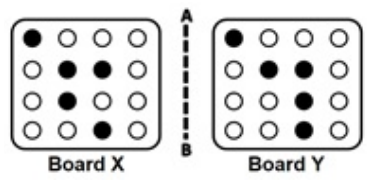
Given below are two boards, X and Y. Clicking any circle on Board Y changes its colour from black to white, or white to black.
What is the MINIMUM number of clicks required to transform Board Y into the MIRROR IMAGE of Board X?
Solution
Option (d) 4. Reflect X left-to-right, then compare corresponding cells. Counting rows from the top and columns from the left, change Y at (1,1), (1,4), (4,2) and (4,3). Each mismatched circle requires one click; already matching circles require none. Four mismatches prove both the lower bound and an achievable solution.
Additional Practice Questions with Solutions
Choose an answer, use a hint if needed, then open the worked solution to check your reasoning.
Solved 0 of 10 · Checked 0 of 10
Your practice progress lasts until you reset or reload this page.
Apply · families
Practice Q1. Which statement is always true?
Show hint
Use the defining properties.
Show worked solution
Option (b) Every square is a rectangle.
A square has four right angles, so it is a rectangle.
Common mistake: Special cases belong to broader families.
Apply · diagonals
Practice Q2. Which property holds for every parallelogram?
Show hint
Bisect means cut into two equal parts.
Show worked solution
Option (c) Its diagonals bisect each other.
Each diagonal cuts the other into equal halves in every parallelogram.
Common mistake: Do not transfer a square’s extra properties to all parallelograms.
Apply · count
Practice Q3. Two identical rectangles stand side by side with a full shared edge. With no other lines, how many rectangles can be counted?
Show hint
Count the two parts and their union.
Show worked solution
Option (a) 3.
There are two small rectangles and one larger outer rectangle.
Common mistake: Internal divisions do not stop the outside outline being counted.
Apply · angles
Practice Q4. Three interior angles of a quadrilateral are 80°,100° and 70°. What is the fourth?
Show hint
Subtract their sum from 360°.
Show worked solution
Option (d) 110°.
360−(80+100+70)=110°.
Common mistake: Use the quadrilateral total, not the triangle total.
Apply · join
Practice Q5. Two congruent right triangles can be joined along their hypotenuses to form which shape?
Show hint
Arrange the triangles as the two halves of a rectangle.
Show worked solution
Option (b) A rectangle.
The shared hypotenuse becomes the diagonal, leaving four right-angle corners.
Common mistake: Trace only the outside boundary.
Apply · mirror
Practice Q6. In a four-column board, where does row 2,column 1 move under reflection in a vertical mirror?
Show hint
Rows stay fixed and columns reverse.
Show worked solution
Option (c) Row 2,column 4.
Column 1 maps to 4 in the same row 2.
Common mistake: Vertical reflection does not swap rows with columns.
Apply · families
Practice Q7. Which property distinguishes a square from a rectangle that is not a square?
Show hint
Both shapes have right angles.
Show worked solution
Option (a) All four sides are equal.
A square has four equal sides; a non-square rectangle has unequal adjacent sides.
Common mistake: Shared properties do not distinguish the shapes.
Apply · diagonals
Practice Q8. The diagonals of a rhombus intersect at what angle?
Show hint
Rhombus diagonals are perpendicular.
Show worked solution
Option (d) 90°.
Perpendicular lines meet at 90°.
Common mistake: The side angles of a rhombus may differ from its diagonal intersection angle.
Apply · count
Practice Q9. In the row S R K P S, qualifying letters are S,R,P. How many adjacent qualifying pairs occur?
Show hint
Check each neighbouring pair.
Show worked solution
Option (b) 2.
S–R qualifies, R–K andK–P do not, andP–S qualifies:2 pairs.
Common mistake: Both letters must qualify.
Apply · mirror
Practice Q10. A target board differs from the current board in three circles. One click toggles one circle. What is the minimum number of clicks?
Show hint
Each mismatched circle must change.
Show worked solution
Option (c) 3.
Toggle each of the three mismatches once, for 3 clicks.
Common mistake: Do not click already matching circles.