
Class 8 Social Science Part II Chapter 5: Citizenship: Rights and Duties Solutions
These Class 8 Social Science Part 2 Chapter 5 solutions explain Citizenship: Rights and Duties. Connect constitutional ideas with everyday choices: welcoming classmates, questioning unfairness, listening respectfully and removing barriers to participation.
Use the chapter title and Part II numbering to match your school textbook. These are original ClearStudy explanations. Open-ended tasks have sample answers; your observations and local examples may differ. Question prompts are shortened for reference; read the complete tasks in your textbook.
- Chapter overview and revision
- The Big Questions
- In-text questions and activities
- Questions and activities: exercise solutions
- Frequently asked questions
Citizenship: Rights and Duties: chapter overview
Citizenship is legal membership of a country; residence is living in a place. A citizen can live abroad, and a resident need not be a citizen. Active citizenship also means taking responsibility for our shared community. Children can practise this through school and community participation even before they reach voting age.
| Concept | Meaning | Example |
|---|---|---|
| Rights | Protected claims and freedoms supporting dignity | Access to education without unfair exclusion |
| Duties | Responsibilities towards others and society | Protect public property and the environment |
| Equality | Equal dignity, protection and opportunity | A club uses fair participation rules |
| Equity | Appropriate support to address unequal barriers | Accessible materials and additional learning support |
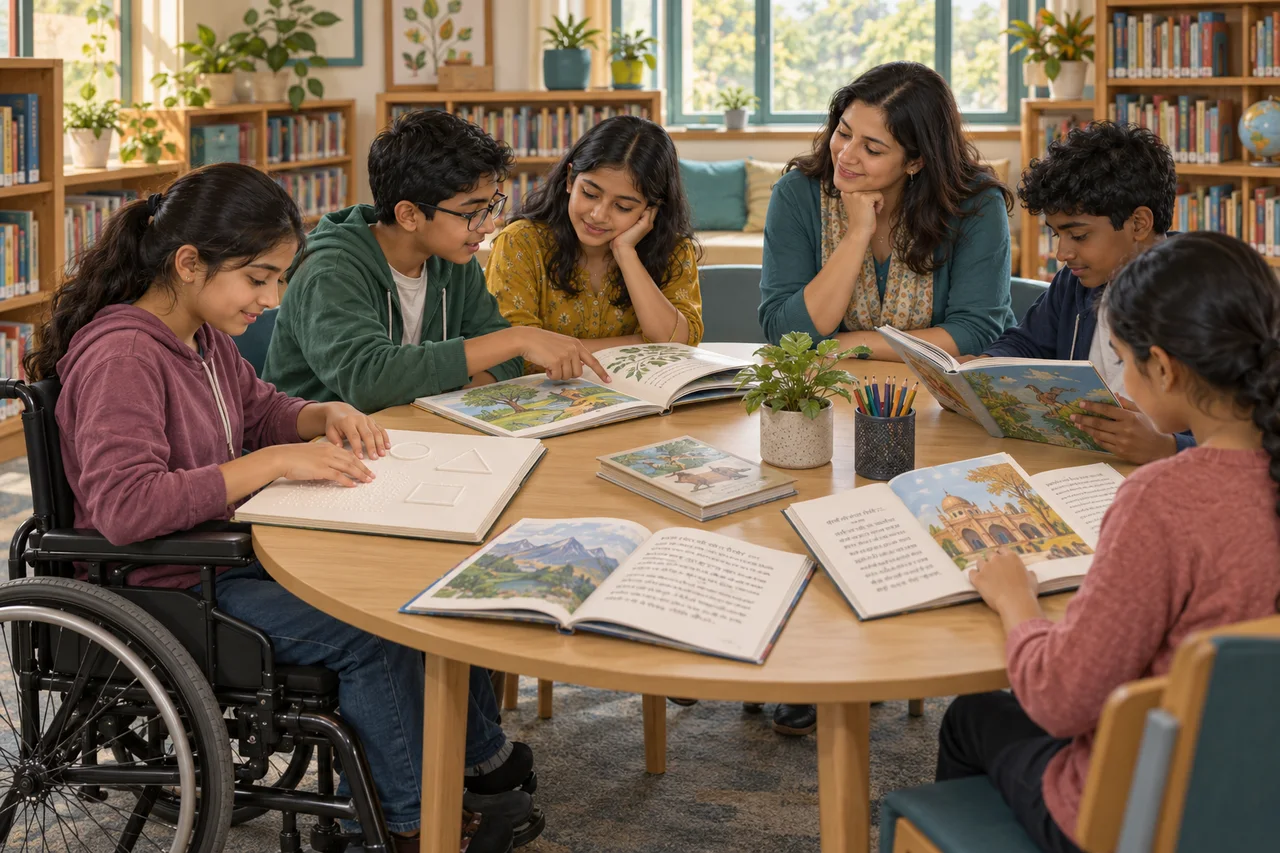
| Inclusion | Removing barriers so everyone can participate meaningfully | A reading club offers multiple languages and formats |
The six broad Fundamental Rights categories are equality, freedom, protection against exploitation, religious freedom, cultural and educational rights, and constitutional remedies. Article 21A provides free and compulsory education for children aged 6–14. Article 51A lists eleven Fundamental Duties; ten were added in 1976 and the education-related duty in 2002.
Important distinctions: some Fundamental Rights protect all persons, while others are specifically for citizens. Rights are not conditional rewards for good behaviour. Discrimination does not automatically cancel anyone’s legal citizenship. General responsibilities such as paying taxes as required by law should not all be described as separate Fundamental Duties in Article 51A. Restrictions on rights require a legal basis; inconvenience alone does not justify arbitrary restrictions.
Religious freedom is subject to constitutional limits, including public order, morality and health. Article 28 distinguishes educational institutions by funding and administration; the rules for wholly state-funded institutions and aided or recognised institutions are not identical.
The Big Questions
Big Question 1: What does being a citizen mean in law and everyday life?
In law, a citizen belongs to a country’s political community under its citizenship rules. In daily life, active citizenship involves respecting others’ dignity, following applicable laws, participating constructively and questioning unfair practices. Helping a teased classmate join an activity shows responsibility and inclusion; legal citizenship itself is not awarded or withdrawn by classmates’ opinions.
Big Question 2: Why are both rights and duties essential?
Rights protect dignity, liberty and opportunity. Duties encourage people to protect the conditions in which everyone can enjoy those rights. For example, a student’s opportunity to learn is helped when classmates avoid disrupting or excluding others. However, a person can still seek protection of their rights even if someone alleges that they failed in a duty.
Big Question 3: How can we build a fair, respectful and inclusive society?
Listen to people facing barriers, challenge stereotypes, use fair rules and provide suitable support. Inclusive spaces may need accessible entrances, different learning formats, language support and financial assistance. Participation should be meaningful rather than merely allowing someone to be present. Teachers, families, public institutions and students all have roles.
In-text questions and activities
Follow the textbook page references below. Suggested responses help you reason through discussion, observation and project tasks.
Pages 148–149 — equality and equity: Explain Fig. 5.3 and give another example of equity.
In the first picture, everyone receives the same support, but shorter viewers still cannot see over the barrier. In the second, support differs according to need, allowing everyone to see. Equal dignity does not require identical assistance in every circumstance. Examples include Braille or audio materials for a learner who needs them, scholarships addressing financial barriers and accessible transport. Support should respond to real needs without humiliating people.
Page 149 — Sports Day discussion: Was the student exercising free expression, and how should the school respond?
The student expressed a concern about comfort and safety during outdoor sport. A respectful request to the teacher or student council, explaining the heat and suggesting an affordable sports option, could make the concern clearer. The school should listen, consider safety and fairness, explain its rule and revise it where justified. Discipline need not mean silencing every disagreement. This discussion does not by itself establish a legal violation.
Page 150 — nature and rights: Why might people seek legal protection for nature?
Rivers, forests and wildlife cannot speak in court, yet damage to them harms ecosystems and communities. Legal protections can give responsible representatives a way to seek prevention, restoration or enforcement. Such arrangements need clear duties, representation and remedies; they do not mean that a river exercises every human right. Countries use different legal approaches, so do not assume that every example has the same status.
Page 152 — child protection: What could you do if a child is working instead of attending school?
I could tell a trusted teacher or principal and ask them to help contact the appropriate child-protection authority. India’s Child Helpline 1098 supports children in difficult circumstances. Share factual information with the responsible adult or service; do not confront an employer, enter a hazardous workplace or post the child’s identity online.
Page 153 — constitutional remedies: Why must there be a way to protect rights?
Written promises can be ignored if there is no remedy. Access to courts allows a violation to be examined and appropriate relief to be ordered. Article 32 guarantees the right to seek Supreme Court enforcement of Fundamental Rights; High Courts also have writ powers under Article 226. Remedies make government power accountable and help protect vulnerable people.
Page 159 — education and duty: Name a duty connected with the right to education.
Article 51A(k) places a duty on a parent or guardian to provide opportunities for education to their child or ward aged 6–14. Students can support learning by respecting classmates, caring for materials and cooperating in class. These student actions are practical responsibilities; they are not a condition that removes a child’s right to education.
Pages 159–160 — everyday situations: Identify rights and duties in the four situations.
- Ravi and the protest: respect his choice and opinion; classmates should not coerce him into agreeing.
- Rukmini’s traditional dress: respect cultural identity and avoid ridicule; discuss reasonable common school rules fairly.
- Chocolate wrappers: protect the environment and public spaces by disposing of waste responsibly.
- Online youth parliament: participation and expression can be widened through technology, provided accessibility and offline alternatives are considered.
Page 160 — rights and responsibilities: Can we demand rights without doing our duties?
Legally, a person’s Fundamental Rights do not depend on first proving perfect conduct. They can seek protection even when a duty is disputed. Ethically, ignoring responsibilities can damage others’ rights and community life, so we should exercise rights responsibly. This separates enforceable protections from the argument that good citizenship needs mutual care.
Page 162 — visible and less visible discrimination: Respond to the Rohan and Mina caselets.
Rohan faces open body-based ridicule and exclusion from a game. Mina faces economic exclusion and less visible social rejection because her family cannot afford a trip. I would refuse to join the teasing, include both students and tell a teacher when support is needed. The school could use fair game selection and confidential financial help or a lower-cost inclusive activity. A personal response may differ; nobody should have to reveal a painful experience to the class.
Page 163 — comparing illustrations: How does Fig. 5.14 differ from the equality and equity pictures?
Fig. 5.14 removes the fence that blocked the spectators’ view. Instead of only supplying boxes to overcome the barrier, the setting itself becomes accessible. This illustrates inclusion through changing a system that excludes people. In school, providing an accessible classroom or multiple book formats can remove barriers rather than repeatedly making exceptional arrangements.
Page 163 — different learning needs: How would you include a student who reads or writes more slowly?
Ask what support they prefer, allow time, explain instructions clearly and share tasks fairly. Make room for oral contributions, diagrams or accessible materials where suitable. Invite the student to speak without finishing their answers for them. The teacher can plan additional support. Patience should preserve the learner’s independence and dignity rather than treating them as incapable.
Questions and activities: exercise solutions
Answers follow the printed exercise order (pages 165–166).
Question 1: Why is respecting other religions important?
Respect protects people’s dignity and freedom of conscience and helps different communities live peacefully. It means not insulting, coercing or excluding people because of belief. Respecting a person does not require sharing every belief; disagreements can be discussed calmly within constitutional limits.
Question 2: How would you feel if you were left out?
I might feel hurt, lonely or doubtful about whether I belong. I would try to explain the exclusion to a trusted person and ask for a fair chance to participate. The experience would remind me to notice classmates who are left out and welcome them. Your feelings and response may be different.
Question 3: Why does discrimination continue despite guaranteed rights?
Prejudice, stereotypes, unequal resources, social habits and unequal power can persist even when the law promises equality. People may not know their rights, may fear complaining or may find enforcement difficult. Better awareness, fair procedures, accessible remedies and changes to exclusionary practices are needed to turn legal guarantees into everyday reality.
Question 4: Can rights and duties appear to conflict? Give an example.
Someone may claim freedom of expression while spreading false rumours that harm another person. Society must protect expression while also respecting others’ dignity and applying lawful restrictions where justified. Another example is a peaceful protest alongside the responsibility to avoid violence and damage. A duty cannot be used as a vague excuse to silence lawful criticism.
Question 5: How does respecting diversity strengthen democracy?
Democracy benefits when different languages, communities and viewpoints can participate without fear. Respect brings more experiences into public decisions, builds trust and prevents a powerful group from excluding others. Shared constitutional values allow people to cooperate while retaining different identities.
Question 6: Does technology make practising citizenship easier or harder?
Both. Online platforms can share public information, support petitions and discussion, and include people who live far away. But misinformation, harassment, privacy risks and unequal internet access can undermine participation. Verify information before sharing, discuss respectfully, protect personal details and retain accessible offline options. Technology helps when its use is responsible and inclusive.
Question 7: What if everyone claimed rights but ignored responsibilities?
Public spaces could be damaged, waste could accumulate, discussion could become abusive and people could exclude others while demanding respect for themselves. Rights would still need legal protection, but the shared conditions for enjoying them would weaken. Cooperation, fairness and care make freedom meaningful for all.
Question 8: How can students practise inclusion in school?
Invite classmates into groups, avoid jokes about identity or appearance, listen to quieter voices and share roles fairly. Use multiple languages or formats when helpful, keep accessible routes clear and tell a teacher about bullying or barriers. Ask people what they need instead of deciding for them. Inclusion is a continuing practice, not a single celebration.
Question 9: Respond to exclusion of girls from a club and a child forced to work in a welding shop.
(a) Ask the school to explain and remove the gender-based restriction. Clubs should use fair interest- and learning-related participation criteria. Students can raise the issue respectfully through a teacher, principal or student body.
(b) Inform a trusted teacher or responsible adult promptly and seek child-protection assistance, including Child Helpline 1098. Welding can be hazardous, and forced work also threatens education and safety. The response should support protection and return to education through competent authorities; students should not attempt a rescue themselves.
Question 10: Create a classroom charter of rights, duties and inclusion.
| Our classroom commitment | How we will practise it |
|---|---|
| Everyone is heard respectfully | Take turns, listen and disagree without insults |
| Everyone can learn and participate | Share roles and provide suitable formats and support |
| No identity-based exclusion | Challenge bullying and use fair criteria for activities |
| Privacy and safety | Ask before recording or sharing another person’s work or details |
| Care for shared resources | Protect books, furniture and the environment |
| Fair handling of complaints | Tell a trusted adult, hear all sides and review problems without retaliation |
Discuss, amend and agree on this charter as a class. Review it regularly with the teacher. A classroom charter supports constitutional values; it does not replace the Constitution or determine legal remedies.
Frequently asked questions
Are residence and citizenship the same?
No. Residence means living in a place; citizenship is formal legal membership of a country.
Is identical support always fair?
No. Equity may require different support to remove different barriers while respecting everyone’s equal dignity.
Do people lose Fundamental Rights if they neglect a duty?
No. Rights are not conditional rewards. Lawful consequences for a specific act are different from cancelling basic rights.
Textbook reference: NCERT, Exploring Society: India and Beyond, Grade 8, Part 2, first edition June 2026, Chapter 5, “Citizenship: Rights and Duties”. Compare with your school’s copy; official NCERT textbook portal. Constitutional clarifications: Constitution of India, including Articles 21A, 28, 32 and 51A. Child-protection contact: Ministry of Women and Child Development. ClearStudy is an independent study resource.