
Class 8 Social Science Part II Chapter 4: The Role of the Judiciary in Our Society Solutions
These Class 8 Social Science Part 2 Chapter 4 solutions cover The Role of the Judiciary in Our Society. Understand fair outcomes, fair hearings, India’s court structure and different ways of resolving disputes. Case responses below are classroom reasoning, not individual legal advice.
Use the chapter title and Part II numbering to match your school textbook. These are original ClearStudy explanations. Open-ended tasks have sample answers; your observations and local examples may differ. Question prompts are shortened for reference; read the complete tasks in your textbook.
- Chapter overview and revision
- The Big Questions
- In-text questions and activities
- Questions and activities: exercise solutions
- Frequently asked questions
The Role of the Judiciary in Our Society: chapter overview
Substantive justice concerns whether an outcome is fair. Procedural justice concerns a fair process: listening to parties, considering evidence and giving reasons. An independent judiciary interprets law, protects rights, resolves disputes and checks actions against the Constitution.
| Institution / method | Core role |
|---|---|
| Supreme Court | Apex constitutional court; specified original, appellate, writ and advisory powers |
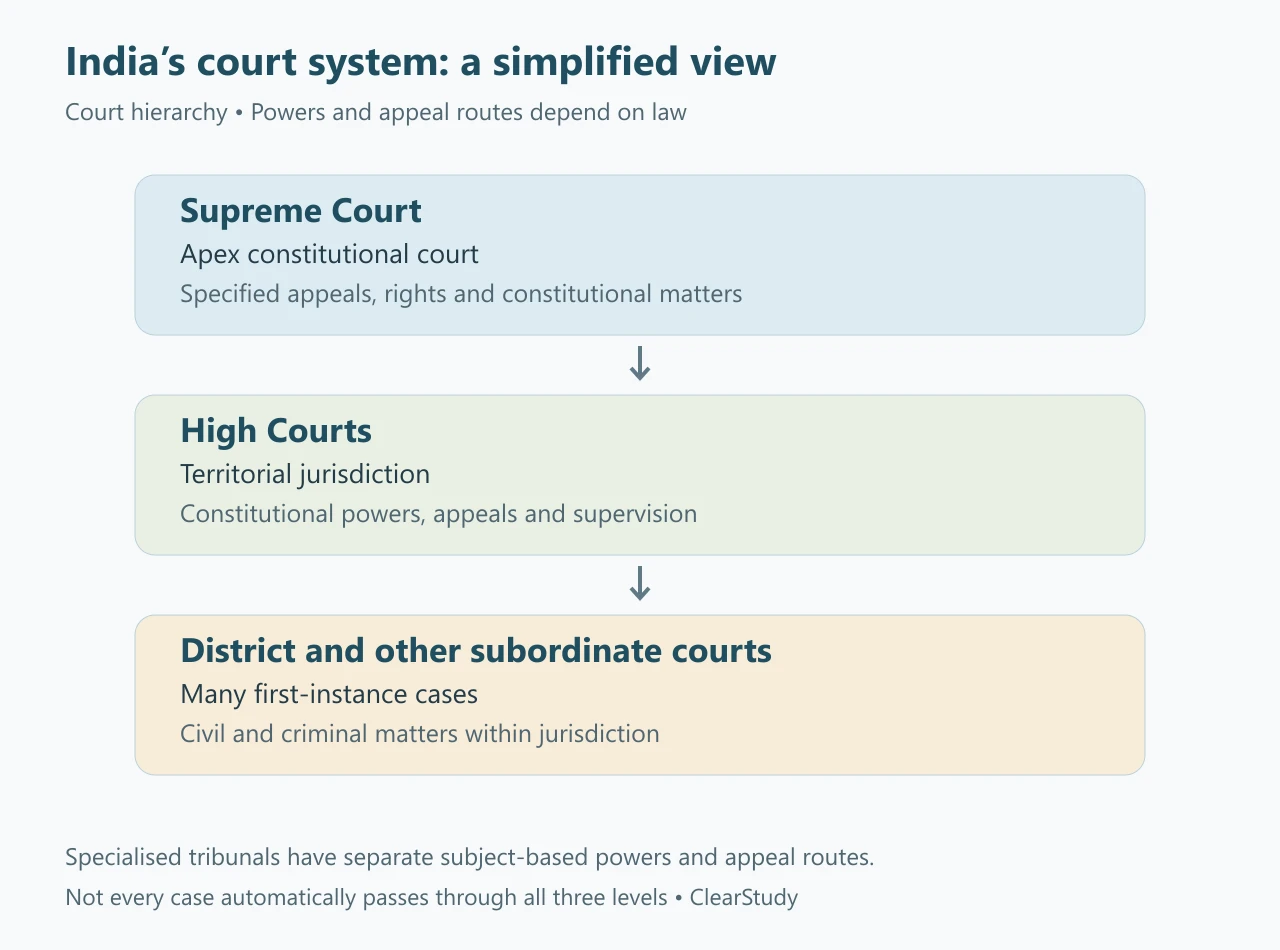
| High Courts | Constitutional courts with territorial jurisdiction; appeals and supervision of subordinate courts |
| Subordinate courts | Handle many civil and criminal cases close to the community |
| Specialised tribunals | Decide specified categories of disputes under their governing laws |
| Mediation | A neutral person helps parties reach agreement; does not impose a decision |
| Arbitration | An agreed arbitrator decides a dispute; the award is binding subject to legal review provisions |
| Ordinary Lok Adalat | Facilitates an agreed settlement; cannot impose a merits decision when compromise fails |
Accuracy notes: Article 32 protects the right to seek Supreme Court remedies for Fundamental Rights; it is not confined to issues with nationwide effects. High Court writ power under Article 226 also extends to other legal purposes, subject to jurisdiction. A PIL addresses public interest, not simply a private disagreement. The Supreme Court came into existence on 26 January 1950 and was inaugurated on 28 January. The textbook’s 34 judges describes sanctioned strength, including the Chief Justice, rather than a guarantee that every seat is occupied.
A Gram Nyayalaya is a statutory court with simplified procedures, not merely a private mediation forum. Appeals and access to each court depend on jurisdiction and law; a party cannot automatically move every case through all three levels. Some Fundamental Rights apply to all persons, while others are specifically for citizens.
The Big Questions
Big Question 1: What is justice?
Justice means fair treatment, protection of rights and a reasoned response to wrongdoing or disputes. It requires both a fair result and a fair method of reaching it. Treating people with dignity, considering relevant differences and giving each side a hearing are important parts of justice.
Big Question 2: Why is justice important for a harmonious society?
People are more likely to trust institutions when rules are fair and applied without arbitrary discrimination. Peaceful ways to resolve disputes reduce revenge and coercion. Justice protects vulnerable people and helps everyone participate with dignity, so harmony rests on fairness rather than on silencing complaints.
Big Question 3: What is the structure and role of India’s judiciary?
The integrated court system has the Supreme Court at its apex, High Courts with territorial jurisdiction and subordinate courts below them. Courts interpret and apply law, decide disputes, protect constitutional rights and review the legality of government action. Specialised tribunals handle particular subject areas. Judicial independence helps decisions rest on law and evidence rather than political pressure.
Big Question 4: What alternatives exist for dispute resolution?
Negotiation involves direct discussion; mediation and conciliation use a neutral facilitator; arbitration uses a decision-making arbitrator. Ordinary Lok Adalats support consensual settlements in eligible disputes. Different methods suit different matters, and participation, enforceability and review depend on law. Speed should never mean pressure to accept an unfair agreement.
In-text questions and activities
Follow the textbook page references below. Suggested responses help you reason through discussion, observation and project tasks.
Page 127 — fairness discussion: Describe an unfair experience and a fair response.
Example: a group project was marked without recognising my contribution. I would feel disappointed, then calmly explain the tasks I completed and ask the teacher to hear all group members before reviewing the evidence. The teacher could clarify the marking criteria and correct an error. A fair process should allow the others to explain too. Use a harmless example and avoid sharing anyone’s private details.
Page 130 — Supreme Court motto: What familiar elements and meaning can you identify in the court emblem?
The emblem connects the court with India’s national symbols and includes the Sanskrit motto Yato dharmastato jayah, meaning broadly ‘where there is dharma, there is victory’. In this context it points towards righteousness and justice. Compare the symbol directly with the textbook image rather than treating it as the court’s building plan.
Page 135 — High Court benches: Find High Courts that sit at more than one location.
A verified example is the High Court of Judicature at Allahabad and its Bench at Lucknow, listed on the official court website. A bench in another city is part of the same High Court, not an additional High Court. For a class table, record the principal seat, other bench locations and the official source/date. Check each court’s current website because arrangements may change; this is an example rather than an exhaustive list.
Page 136 — local court: Which subordinate court is closest to your home?
Find your district on the official district-court portal, then record the court name, town and approximate distance using public information. Identify whether it is a district, sessions or another subordinate court. Do not publish your home address. The geographically nearest court is not necessarily the court with jurisdiction over every dispute.
Page 137 — consumer dispute: What does the unfinished-flat example show about justice?
The family alleged that the builder had failed to honour an agreement despite receiving a large advance. The Commission heard both parties and ordered a refund with interest and litigation costs. Hearing both sides illustrates procedural justice; a reasoned remedy for a proved failure illustrates substantive justice. Preserve the example’s anonymity and do not assume that the same forum or remedy applies to every consumer complaint.
Questions and activities: exercise solutions
Answers follow the printed exercise order (pages 141–142).
Question 1: Write a model letter drawing a court’s attention to a social issue.
Classroom model — fictional example, not a filed petition
To the Registrar, [name of the relevant High Court]
Subject: Concern about polluted public water near a school
Respected Sir/Madam,
Our class wishes to draw attention to reports of waste entering a public water source used by nearby residents. We request appropriate consideration of the matter and action by the competent authorities to protect safe water and public health. A real submission should include verified observations, dates, relevant public records and details of representations already made to the authorities. We ask that affected people and the authorities have a fair opportunity to be heard.
Yours faithfully,
[name and date]
Replace the fictional issue with checked facts. Do not accuse a named person without evidence, fabricate complaints or disclose private information. A letter is not automatically a valid PIL; court rules and the correct jurisdiction matter.
Question 2: Suggest innovative ways to reduce the large number of pending cases.
Possible measures include filling vacancies through the proper process, improving court facilities and staff support, organising schedules efficiently, using accessible e-filing and digital case tracking, and reducing avoidable government litigation. Suitable disputes can use voluntary mediation or Lok Adalat settlements. Clear laws and timely administrative grievance handling can prevent some disputes. Legal aid, language support and offline access remain necessary so digital reforms do not exclude people. Evaluate success by fairness and access as well as speed.
Question 3: Enact the unequal-pay and river-pollution moot-court cases.
(i) Anita and Sameer: Anita should explain their qualifications, duties, work hours and pay difference, supported by relevant records. The employer must have a fair chance to explain any genuine differences in work, seniority or pay structure. The judge should test whether the work is the same or similar and whether the difference is unjustified discrimination. If the facts support Anita’s complaint, an appropriate remedy could correct the discriminatory pay and address dues as permitted by applicable law. The result cannot be assumed before evidence is heard.
(ii) River pollution: residents can document the change, report concerns to the pollution-control and local authorities and seek reliable water testing. The classroom case should hear residents, the factory and relevant experts. The judge or competent forum would consider evidence of discharge, causation, harm and compliance with environmental requirements. Possible directions, if justified, include stopping harmful discharge, treatment and monitoring, restoration and lawful compensation. A PIL or an environmental tribunal may be relevant depending on jurisdiction. Students should not enter industrial premises or collect hazardous samples themselves.
Assign roles for judge, parties, counsel and witnesses; distinguish observations from allegations. Give each side time to speak and end with a reasoned classroom decision.
Question 4: Write about a judge from your state or district and their contribution.
Example for Kerala: Justice M. Fathima Beevi. Born in Pathanamthitta in 1927, she entered legal practice in 1950 and served in Kerala’s subordinate judiciary before becoming a High Court judge in 1983. She was elevated to the Supreme Court in 1989. Her career is significant as that of the first woman judge of India’s Supreme Court, widening representation at the apex court and offering an example of professional advancement for women in law.
This short model uses the Supreme Court’s official biography and its official obituary. For another state, choose a relevant judge and use verified court records. Add a reliably researched judgment or contribution; do not invent rulings or quotations.
Question 5: Interview someone working in the judicial system and present what you learn.
Through your teacher, invite a willing judge, advocate, clerk, legal-aid worker or other professional. Ask about their role, a typical working day, common challenges, technology, fairness and what they find satisfying. Avoid questions about confidential or pending cases. Present the person’s role, three points you actually learned, one challenge and one suggestion for better access to justice. Obtain permission before recording or naming them. If an interview is not possible, identify the presentation as desk research rather than making up an interaction.
Frequently asked questions
Can a mediator impose a judgment?
No. A mediator assists discussion; the parties decide whether to reach a settlement.
Are tribunals simply another tier below the district courts?
No. They have specialised jurisdictions under their own laws; their appeal routes differ.
Must an Article 32 case affect the whole country?
No. Its purpose is enforcement of Fundamental Rights; a nationwide effect is not a general condition in Article 32.
Textbook reference: NCERT, Exploring Society: India and Beyond, Grade 8, Part 2, first edition June 2026, Chapter 4, “The Role of the Judiciary in Our Society”. Compare with your school’s copy; official NCERT textbook portal. Legal clarifications: Constitution of India, Articles 32 and 226; Supreme Court history; NALSA on Lok Adalats. ClearStudy is an independent study resource.