
Twin Melodies Questions and Answers | Class 9 Kaveri
Checked against NCERT Kaveri, first edition January 2026, pages 169–193; listening transcript 270. Personal, discussion and creative responses are samples: adapt them to your experience. This independent study guide is not an official NCERT answer key.
Chapter Overview
Twin Melodies is Mitra Phukan’s three-act play about Shruti Sharma, a young violinist who wants to perform with an Indo-Western fusion group. Her father, Guru Nabin Sharma, initially disapproves. Friends encourage her to speak, her mother helps Nabin reconsider, and the rehearsal shows him that a new musical setting can retain classical discipline. The play explores communication, trust and artistic freedom.
About the Author – Mitra Phukan
NCERT Kaveri credits Mitra Phukan as the author. In this play, dialogue, stage directions, humour and an aside reveal tensions that a prose narrator might otherwise explain. Support character interpretations with these dramatic details.
Summary in English
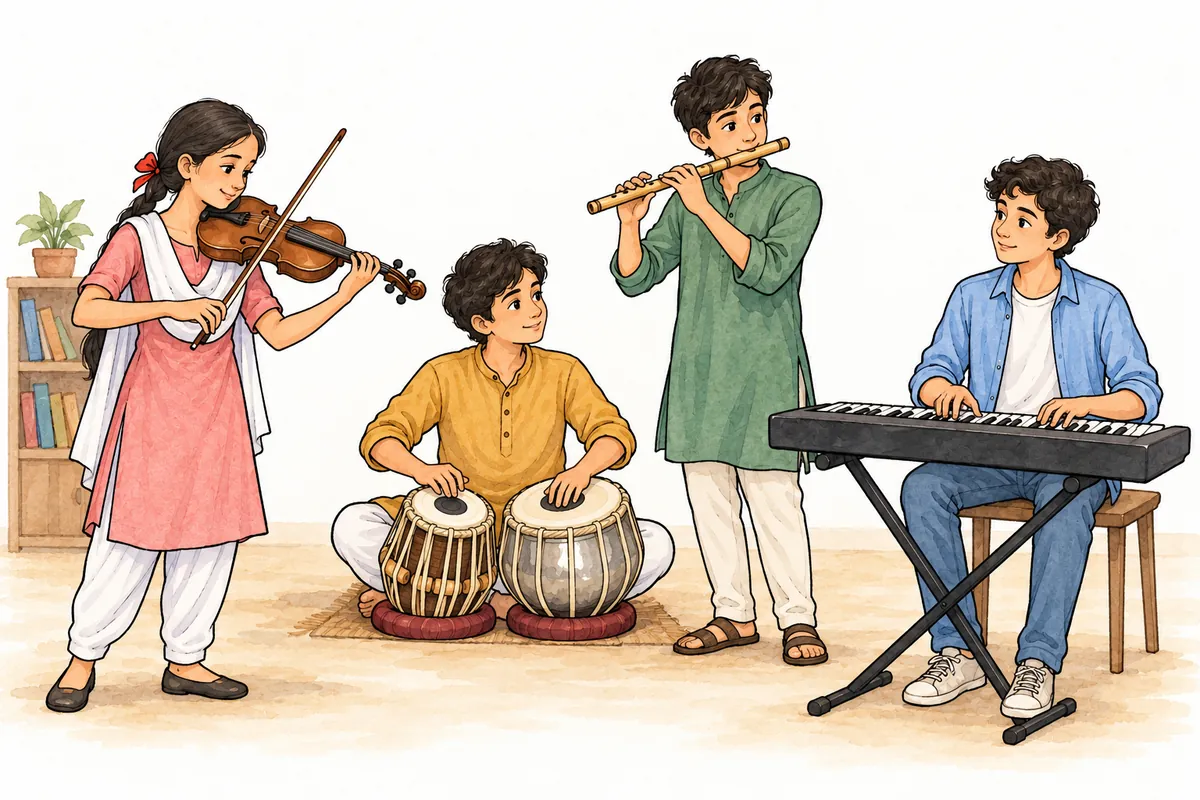
Act I: In Iqbal’s room — walls bearing posters of flute maestros Hariprasad Chaurasia and Shashank Subramanyam — four young musicians finish a fusion rehearsal in fine crescendo: Iqbal on flute, Avinash on tabla, Peter on keyboard and Shruti on violin. The newspaper has just praised Shruti’s classical performance with her father, but she sits distressed: she still hasn’t told her parents about the fusion group or its coming concert. Her father, she explains, would consider playing the violin to Western tunes a desecration; for him only classical Hindustani music, with its ragas and aalaaps, befits a true artist. Her friends urge honesty — Avinash reasons the worst is a scolding, Iqbal jokes that he has “a little bit of scolding for breakfast every day” — and Shruti resolves to bite the bullet and speak at dinner.
Act II: At dinner, Shruti haltingly tells her father about the concert. Nabin refuses at once — his rule is one performance in six months, for “familiarity breeds contempt” — and scorns the idea of drowning one’s individual style in the hubbub of an orchestra. When she admits it is an Indo-Western fusion concert, he is appalled, mocks it as “‘phoo’ music… when making noise starts needing practice”, and walks out. Leela scolds Shruti for hiding the truth, and Shruti, fearing the group’s practice will go down the drain, promises never to hide things again.
Act III: At the next rehearsal, Shruti plans to play one last time before quitting — when her parents quietly enter and listen. Slowly Nabin is engrossed, tapping his feet; at the end he claps furiously, glowing with pride: Shruti never lost sight of the raga’s notes even once. He offers the children his music room for regular practice. Privately, he credits Leela with opening his eyes: she had reminded him of his own past — born into a highly traditional family of vocalists, young Nabin had chosen the violin (a choice his own family had resisted), a choice his father saw as betrayal, and had worked his fingers to the bone to prove. “After all, each bay, its own wind,” he says — every artist must find their own path — and promises to root for the group at the concert. Shruti hugs her parents as the curtain falls.
Summary in Hindi (सारांश हिंदी में)
अंक 1: इकबाल के कमरे में चार युवा संगीतकार — बाँसुरी पर इकबाल, तबले पर अविनाश, की-बोर्ड पर पीटर और वायलिन पर श्रुति — इंडो-वेस्टर्न फ्यूज़न का अभ्यास समाप्त करते हैं। अखबार में श्रुति की अपने पिता के साथ शास्त्रीय प्रस्तुति की प्रशंसा छपी है, पर वह चिंतित है: उसने माता-पिता को फ्यूज़न समूह और आगामी संगीत-समारोह के बारे में बताया ही नहीं। उसके पिता, गुरु नबीन शर्मा, मानते हैं कि रागों और आलापों वाला हिंदुस्तानी शास्त्रीय संगीत ही सच्चे कलाकार का संगीत है; पश्चिमी धुनों पर वायलिन बजाना उन्हें वाद्य का अपमान लगेगा। मित्रों के प्रोत्साहन पर श्रुति रात के भोजन पर साहस करके बात करने का वचन देती है।
अंक 2: भोजन पर श्रुति हिचकते हुए समारोह की बात कहती है। पिता तुरंत मना कर देते हैं — उनका नियम है छह महीने में एक ही प्रस्तुति। जब पता चलता है कि यह फ्यूज़न समारोह है, तो वे उसे ‘फू-संगीत’ कहकर उपहास करते हैं और उठकर चले जाते हैं। माँ लीला छिपाने के लिए डाँटती है; श्रुति फिर कभी न छिपाने का वादा करती है।
अंक 3: अगले अभ्यास में श्रुति अंतिम बार बजाकर समूह छोड़ने की सोच रही है, तभी माता-पिता चुपचाप आकर सुनने लगते हैं। संगीत में डूबे नबीन पैर से ताल देते हैं और अंत में गर्व से तालियाँ बजाते हैं — श्रुति ने एक बार भी राग के स्वर नहीं छोड़े! वे बच्चों को नियमित अभ्यास के लिए अपना संगीत-कक्ष देने की पेशकश करते हैं। एकांत में वे स्वीकारते हैं कि लीला ने उनकी आँखें खोलीं — उन्हें उनका अपना अतीत याद दिलाया: गायकों के अत्यंत पारंपरिक परिवार में जन्मे नबीन ने स्वयं परिवार की इच्छा के विरुद्ध वायलिन चुना था और कठोर परिश्रम से उसे सिद्ध किया था। “हर खाड़ी की अपनी हवा होती है” — हर कलाकार की अपनी राह। वे समारोह में समूह का उत्साह बढ़ाने का वचन देते हैं। श्रुति माता-पिता के गले लग जाती है। संदेश: परंपरा और आधुनिकता विरोधी नहीं — दो जुड़वाँ धुनें हैं, जो संवाद और विश्वास से सुर में बज सकती हैं।
Story and history: Leela’s account explains Nabin’s family conflict. Her sweeping line about the violin not yet being incorporated into Indian classical music should not be treated as a reliable chronology. A Government of India address credits Baluswami Dikshithar as a pioneer of the violin in Carnatic music. The family story and the history of an entire musical tradition are different matters.
Word Meanings (शब्दार्थ)
| Word/Phrase | English Meaning | हिंदी अर्थ |
|---|---|---|
| crescendo | music that gets louder and louder | ध्वनि की तीव्रता में क्रमिक वृद्धि (सुर की ऊँचाई नहीं) |
| winding up | finishing, concluding | समाप्त करना |
| wearing a look of distress | appearing worried | चिंतित मुद्रा में |
| lost in his/her thoughts | deeply absorbed in thinking | विचारों में खोया |
| bring it up | to raise a topic | बात छेड़ना |
| bite the bullet | face a difficult situation with courage | हिम्मत करके सामना करना |
| come around (round) | eventually agree | मान जाना |
| throw a party | host a celebration | दावत देना |
| desecration | disrespect towards something sacred | अपवित्रीकरण, अपमान |
| ragas and aalaaps | elements of Hindustani classical music | राग और आलाप |
| familiarity breeds contempt | too much exposure reduces respect | अति-परिचय से आदर घटता है |
| contempt | strong dislike and disrespect | तिरस्कार |
| hubbub | a loud noise | शोरगुल |
| iterated | repeated | दोहराया गया |
| go down the drain | be wasted | व्यर्थ हो जाना |
| aside (drama) | words spoken to the audience, unheard by other characters | स्वगत कथन |
| painstakingly | with great care and effort | अत्यंत परिश्रम से |
| worked his fingers to the bone | worked very hard | हाड़-तोड़ मेहनत की |
| each bay, its own wind | every person/path is unique | हर राह की अपनी हवा |
| root for | show support for | समर्थन करना, हौसला बढ़ाना |
NCERT Exercise Solutions
Reflect and Respond
I. Identify the pictures on page 169, from left to right.
| Position | Instrument | Visual clue |
|---|---|---|
| Top 1 | Santoor | Trapezoidal box with many strings, struck with small beaters. |
| Top 2 | Sarangi | Short-necked bowed instrument. |
| Top 3 | Sarod | Fretless fingerboard and skin-covered resonator. |
| Top 4 | Sitar | Long fretted neck and rounded resonator. |
| Bottom 1 | Banjo | Round drum-like body and long neck. |
| Bottom 2 | Violin | Four-string bowed instrument with a waist. |
| Bottom 3 | Guitar | Waisted body, sound hole and long fretted neck. |
| Bottom 4 | Mandolin | Small pear-shaped body with paired strings. |
Printed-initial mismatch: the bottom row gives M under the banjo and B under the mandolin. Identify the pictures by their features; these two initials appear exchanged. The V picture is a violin, not a veena.
II. Which instrument would you choose? — sample
III. Do children and elders prefer different music? — sample
IV. Complete the paragraph and discuss meanings.
| Blank | Phrase | Meaning in this context |
|---|---|---|
| 1 | winding up | finishing |
| 2 | wearing a look of distress | looking worried |
| 3 | lost in his thoughts | deeply absorbed in thinking |
| 4 | bring it up | mention the disagreement |
| 5 | bite the bullet | face an uncomfortable conversation bravely |
| 6 | come around | become more accepting |
| 7 | found words | managed to express himself |
| 8 | throw a party | organise a celebration |
Unused: sweating on. These expressions use conventional, often figurative meanings: no bullet is literally bitten and a party is not physically thrown. “Found words” means overcoming hesitation, not discovering written words on the floor.
Check Your Understanding (Act I)
I. Complete the table based on Act I of the play.
| Setting | Where: Iqbal’s room. Description: a small rack and a wooden table stacked with books. On the wall: posters of famous Indian flute players Pandit Hariprasad Chaurasia and Shashank Subramanyam. |
|---|---|
| Children and instruments | 1. Iqbal: flute (given) 2. Avinash: tabla 3. Peter: keyboard 4. Shruti: violin |
| Speaker | Words of the Speaker | Reason |
|---|---|---|
| Avinash | “Oh ho! Wow Shruti! You are a sensation now! The least you can do is throw a party!” | He is thrilled and teases Shruti after the newspaper praises her performance with her father. |
| Shruti | “There is need to worry Iqbal! You don’t know papa.” | She fears her strict father will consider playing the violin to Western tunes a desecration, as he believes only classical music is worthy. |
| Peter | “That’s the spirit!” | He encourages Shruti when she finally resolves to tell her father about the concert at dinner. |
II. Do you think Shruti will gather the courage to speak to her father?
Yes. Her friends’ encouragement works on her: she admits it is time to “bite the bullet” and solemnly promises to bring up the matter at dinner that very night. Her genuine respect for her father — she does not want him to feel she ignores his opinions — also pushes her towards honesty rather than continued hiding.
III. What might be Shruti’s father’s reaction? Why?
He is likely to be angry and to refuse. Nabin firmly believes that classical Hindustani music, with its ragas and aalaaps, is the only music a worthy artist should play, and he would see the violin played to Western tunes as a desecration of the instrument.
Check Your Understanding (Act II)
I. Complete the summary of Act II by choosing the correct words from the box. There are two extra words.
Shruti seemed 1. absent-minded during dinner. She finally gathered the 2. courage to inform her father about the Indo-Western fusion concert. Nabin reacted negatively, expressing 3. disapproval of fusion music and dismissed the idea. Despite Shruti’s 4. plea to attend a practice before deciding, Nabin was 5. firm in his decision. Leela 6. scolded her for not seeking permission earlier. The tension highlights the 7. clash between traditional and contemporary musical preferences within the family. Despite the 8. setback, Shruti promises not to hide again. (Extra words: surprised, relief.)
II. Will Shruti’s father go for the rehearsal? Support your answer.
Quite possibly, yes. Though he mocked fusion as “‘phoo’ music”, he loves his daughter deeply and is a true musician at heart; Leela, who clearly sympathises with Shruti, may persuade him to at least listen once — and a single hearing could soften a man whose ears, after all, are trained to recognise good music.
III. Do you think Shruti and her parents would understand one another?
Yes. The family’s bonds are strong and affectionate beneath the conflict: Shruti respects her father’s opinions, Leela acts as a bridge between the two, and Nabin’s concern gives them a reason to keep communicating. At the end of Act II, understanding is possible but not guaranteed. A prediction should use evidence available so far, without relying on the later revelation about Nabin’s childhood.
Check Your Understanding (Act III)
I. Identify the true statements.
| 1. During the rehearsal, Shruti’s parents enter the room and are overjoyed at her performance. | True |
| 2. Shruti initially considers telling her friends that she can’t join them for the performance, after practising one last time. | True |
| 3. Shruti’s father expressed that she had sung a few notes incorrectly during her performance. | False — he praised her for not losing sight of the raga’s notes even once. |
| 4. Shruti’s father had followed the family’s tradition of being a violinist and worked very hard. | False — his was a family of vocalists; he broke tradition by choosing the violin. |
| 5. Shruti’s mother helped her husband realise why he should support their daughter. | True |
| 6. Shruti’s father accepts that he underrated the potential of classical music. | True — he admits, “I underestimated the power of our own music.” |
Critical Reflection
I. Read the extracts given below and answer the questions that follow. (Extract 1: Shruti’s fear and Iqbal’s reassurance — Act I)
(i) Select the option that correctly identifies Shruti’s situation.
D. in a dilemma
(ii) What does Shruti mean by ‘the right way’?
She means a manner of telling her father that would neither hurt him nor make him feel she disrespects his opinions — a gentle, honest framing that conveys both her love for his values and her wish to try something new.
(iii) The extract reflects the generational gap in understanding art and tradition because ______.
…the father holds that classical Hindustani music alone is worthy of a true artist, while the daughter, respecting that view, still wants to explore the contemporary world of Indo-Western fusion.
(iv) Explain how Iqbal’s words were meant as an assurance to Shruti.
By saying “All ways are right ways”, Iqbal frees Shruti from her anxiety over finding a perfect approach — what matters is telling the truth, not how. And by reminding her “He is your father, he will understand”, he assures her that a parent’s love will outweigh his anger.
(v) Fill in the blank with a phrase from the extract: The critics argued that only films which provoke thoughtful discussion are __________.
of any worth
(Extract 2: Nabin’s change of heart — Act III)
(i) Nabin’s breakthrough highlights a bridge between ______.
B. traditional values and modern expressions
(ii) The extract uses the word ‘lost’ both in the sense of losing ______ and physical separation.
…one’s musical roots/heritage (their own music) — Nabin feared Shruti would drift away from classical tradition as well as from the family.
(iii) Which word does not show what ‘Shruti hugs her parents’ conveys?
duty — the hug conveys reconciliation, harmony, acceptance and understanding, not mere obligation.
(iv) What can be inferred about Shruti’s future in music following her father’s expression of trust and support?
Her future looks bright and balanced: with her father’s blessing, his music room for practice and her own classical grounding, she has greater support and space to develop as a versatile artist; the play does not guarantee her future success — rooted in ragas yet free to innovate.
(v) Identify the phrase that refers to the uniqueness of each artist’s journey and style.
“each bay, its own wind“
II. Answer the following questions.
1. Justify the title ‘Twin Melodies’. How does the play explore the theme of tradition and modernity?
The title works on two levels. Musically, the ‘twin melodies’ are Indian classical and Western music, blended in the children’s fusion pieces where ragas flow over keyboards. Thematically, they are tradition and modernity — father and daughter — first clashing, then learning to play in harmony. The play argues that the two need not compete: Shruti keeps the raga’s notes intact within fusion, and Nabin, once a rebel himself, learns that new forms can honour old roots. Like twin melodies in a duet, the generations sound best together.
2. What are the different perspectives of Peter, Iqbal, and Avinash regarding confronting figures of authority?
Avinash is the pragmatist: hiding only worsens matters, the worst outcome is a scolding, and elders “eventually come round”. Iqbal is the cheerful optimist who normalises conflict — he has “a little bit of scolding for breakfast every day” — and trusts a father’s love: “All ways are right ways.” Peter is the practical encourager, urging her to state when and with whom she practises and later applauding Shruti’s resolve with “That’s the spirit!” Together they encourage communication. Their comments suggest different attitudes, but do not establish the full nature of each boy’s relationship with his own elders.
3. Analyse the character of Nabin Sharma. How does his attitude towards music evolve?
Nabin is a disciplined purist — a master violinist and principal of a music school who limits performances to one in six months and dismisses fusion as “‘phoo’ music”. Yet he is no tyrant: his words express devotion to his art and fear that his daughter may lose touch with their musical roots. Hearing the rehearsal, the musician in him conquers the conservative — he taps his feet, claps with pride and praises Shruti’s flawless ragas. Reminded by Leela of his own youthful rebellion, he humbly admits his fears were baseless, offers the children his music room and promises to cheer at the concert. He evolves from gatekeeper of tradition to its generous bridge-builder.
4. How does the play use Shruti’s internal conflict to explore the theme of duty towards family versus personal passion?
Shruti’s struggle is never rebellion — she genuinely cares for her father’s opinions while longing to try fusion. This double pull produces her secrecy, her distress, her honest confession in Act II, and later her aside about withdrawing after one last practice. The play resolves the conflict not by choosing one side but by dialogue: Shruti’s promise that she “will always take my art seriously no matter what I do” shows passion disciplined by duty, while her father’s blessing shows duty softened by love. Family and passion, the play suggests, are reconciled through truthfulness.
5. Evaluate the effectiveness of the play’s conclusion. Does it realistically address the conflicts presented?
The conclusion is satisfying and largely realistic. Nothing is resolved by magic: the parents come to see for themselves, the music must earn Nabin’s approval on his own terms (Shruti’s raga discipline), and the deciding argument is biographical truth — Leela’s reminder of Nabin’s own defiance of his vocalist family. The reconciliation therefore grows from established character, not convenience. One might say Nabin’s turnaround is swift, but for a genuine musician, one soulful hearing can indeed outweigh years of prejudice.
6. Assess how well the role of cultural diversity contributes to the storyline of the play.
Diversity is the play’s very fabric. The quartet — Iqbal, Avinash, Peter and Shruti — brings different individuals together, with flute, tabla, keyboard and violin combining different sounds and musical traditions — and their Indo-Western fusion is diversity made audible. The central conflict springs from cultural difference (classical vs Western), and its resolution proves that differences enrich rather than dilute: Shruti’s classical rigour shines brighter inside fusion. The rehearsal makes cooperation audible. The text names the characters but does not explicitly state their religions; do not assign faiths from names alone.
Vocabulary and Structures in Context
I. What is ‘aside’ used for?
(iv) (i), (ii), and (iii) — an aside lets a character talk about the story, reveals the character’s inner thoughts and feelings, and creates a direct link between character and audience.
II. Why are non-lexical fillers (Ahem ahem, I … er…) used? Match fillers to the emoticons.
Answer and emoticon order
Option 1: to fill gaps while speaking. In this picture exercise the choices also express reactions.
- arrgh — distress/frustration.
- ahem-ahem — the coughing or throat-clearing face.
- whew — relief, with a hand at the forehead.
- hmmm — thinking.
Unused: err. Follow the numbered pictures, not a generic list of emotions.
III. Match the music-related words with their meanings.
1. rhythm — (iii) the pattern of beats or time intervals in music | 2. tempo — (iv) the speed at which a piece is played | 3. bass — (i) the lowest tone or part in music | 4. baritone — (v) a male voice between the higher and lower ranges | 5. cacophony — (ii) a mixture of loud unpleasant sounds | 6. pitch — (vii) how high or low a sound is | 7. scale — (vi) a series of musical notes moving upwards or downwards
IV. Write the meanings of the underlined phrases.
1. drown your individual style — to lose one’s own unique identity or manner by blindly copying others.
2. sense of musicality — a natural feeling for and skill in music — tune, rhythm and expression.
3. go down the drain — to be completely wasted.
V. Identify the sentence type and convert the exclamatory sentences to declarative ones.
Sentences 1 and 2 are exclamatory. Plain declarative versions are “I enjoy performing this piece very much” and “It is very soulful; you have all done a wonderful job.” The textbook then asks for reporting verbs, so the following reported declaratives also answer its intended exercise:
1. Shruti exclaimed with joy that she enjoyed performing that piece very much.
2. Nabin exclaimed with admiration that it was very soulful and that they had all done a wonderful job.
VI. Write the sentences in reported speech.
2. Iqbal exclaimed that it was an incredible achievement and that he couldn’t believe they had pulled it off.
3. Shruti’s mother applauded that each note had been executed perfectly and that the performance had been flawless.
4. Iqbal said jokingly that he basically had a little bit of scolding for breakfast every day.
5. Shruti apologised to her mother and promised that she would not hide things from her again. Here ‘hide’ concerns concealing information, not physically hiding herself.
6. Avinash exclaimed that she was a sensation then and added that the least she could do was throw a party.
VII. Report the dialogue between Asma and Deepa in indirect speech.
Asma exclaimed excitedly that she 1. had had a unique experience at the art studio that day. Deepa urged her to tell her as she was eager to hear. Asma said that 2. she had accidentally spilled paint all over her canvas. Deepa pitied Asma. However, Asma replied to her not to worry as 3. the painting then looked better than her original plan. Deepa exclaimed that 4. that was incredible.
Listen and Respond
I–II. Identify a possible yazh in the four pictures.
Picture 3 is the fish-shaped decorated harp that fits the transcript’s matsya yazh variety. Picture 2 also has the curved neck and boat-shaped resonator of an arched harp. The transcript describes several yazh designs, so shape alone does not give an unambiguous geographical identification of every drawing. Discuss this overlap with your teacher; pictures 1 (lyre form) and 4 (long zither form) do not match the described curved, open-stringed harp as closely.
III. Notes — no more than three words per blank
| Blank | Answer |
|---|---|
| 1. Indian… | harp |
| 1(i). Used in | ancient Tamil music |
| 1(ii). Earlier version of | veena |
| 2(i). Stem tip | head |
| 2(ii) A. Resonator shape | boat |
| 2(ii) B. Material | skin-covered wood |
| 3(i). Two missing varieties | crocodile; fish |
The exact note answers come from the transcript on page 270. It describes gut strings and an ebony stem separately; do not put these into the resonator-material blank. The stem-tip animal is named Yali. The “ancestor of veena” wording is the transcript’s description.
Speaking Activity
I. Stress and intonation practice with lines from the play.
Follow the textbook models: stress the contrasting words (“I don’t want papa to feel that I don’t care… because I do” — rising at the end for sincerity); stress “promise” and “bring this up” with a decisive tone; keep Leela’s question gentle, rising on “lost”; and deliver “Each bay, its own wind” thoughtfully, with a gentle rise on “own”. These are expressive performance models, not fixed intonation rules for every speaker. Then pick other lines — try Nabin’s “(calmly but firmly) No is the answer” with flat, firm intonation, and Avinash’s “SHRUTI!” with stronger emphasis at a comfortable volume; do not strain your voice.
Writing Task
I. Opening scene based on Anuradha’s story — original model
Title: A Rhythm of Her Own
Characters: Anuradha; Father, a vocalist and school music teacher; Mother; Brother.
Setting: the family living room in the evening. A pair of tabla drums and an invitation lie beside Anuradha.
Anuradha: (aside) I have practised since primary school. This invitation means so much… but Father wants me to sing.
Brother: You have read that invitation three times. Are you going to perform?
Anuradha: Yes. I have decided to take part. I want to tell Father myself.
Mother: We support you. Explain why the tabla matters to you.
Father: (entering) What are you discussing?
Anuradha: I… er… have been invited to play tabla at an important event.
Father: You know my view. I would rather you concentrate on becoming a vocalist.
Anuradha: I respect your singing, Father. But the tabla is the instrument I have worked hard to learn. Will you hear what this opportunity means to me?
Brother: (quietly) Please let her finish.
Mother: We can listen before deciding what to say.
(Father sits. Anuradha places the invitation on the table. The opening scene ends with the conversation about to continue.)
This develops only the supplied beginning. It does not claim an ending given in NCERT. Four group members can take the four roles; brackets guide action and delivery and are not spoken aloud.
Learning Beyond the Text
I. Four observations about script format
- Quotation marks are unnecessary around every speech because the speaker’s name identifies it.
- A colon follows the speaker’s name to introduce the dialogue.
- Brackets contain directions for movement, emotion, tone or manner of speaking.
- They guide the actors’ delivery and actions. The bracketed instructions are not said aloud.
II. Recycled Orchestra of Cateura — check the date
The textbook gives 2012 as its formation year. The orchestra’s own history traces Favio Chávez’s work with the Cateura community to 2006 and says its story became widely known in late 2012 through the Landfill Harmonic trailer. Distinguish the project’s origins from that publicity milestone. The musicians use instruments made from discarded materials. Read the orchestra’s history.
III. Research a regional instrument — sample approach
Choose an instrument actually played in your region. Record its local name, material, how it produces sound, occasions when it is played and your source. For example, a bamboo flute is a wind instrument: air is directed across an opening, and covering finger holes changes the notes. Ask a local musician about the regional name and practice rather than assuming all flutes share one tradition.
IV. Five-person rhythm activity — sample
Count a steady four-beat cycle. Person 1 claps on beat 1; person 2 taps the desk lightly on beat 2; person 3 claps on beat 3; person 4 taps a closed empty container on beat 4. Person 5 keeps a gentle, steady pulse through all four beats. Repeat, then swap roles. Use safe classroom objects and agree a comfortable volume.
V. Reading extension
Read Rigmarole and Other Plays by Sai Paranjpye if available. Choose a short comic exchange and explain how dialogue, pauses or actions create humour. This is an independent reading activity; do not invent quotations or an ending without reading the selected play.
Extra Questions with Answers
Q1. Who are the members of the fusion group and what do they play? (30–40 words)
The group has four young musicians: Iqbal on the flute, Avinash on the tabla, Peter on the keyboard and Shruti Sharma on the violin. They rehearse Indo-Western fusion pieces in Iqbal’s room.
Q2. What is Nabin Sharma’s rule about performances, and why? (30–40 words)
His rule is one performance every six months, because “familiarity breeds contempt” — frequent public appearances, he believes, cheapen an artist; one should keep working on the art and let everything else follow.
Q3. How did the newspaper describe Shruti? (30–40 words)
The Parbatpuri Daily Clarion wrote that melody runs in the veins of Miss Shruti Sharma, daughter of the master violinist Nabin Sharma — high praise for her classical performance with her father.
Q4. What was Nabin’s own youthful rebellion? (30–40 words)
Born into a highly traditional family of vocalists, young Nabin chose the violin despite his family’s resistance. His father saw it as betrayal, but Nabin worked his fingers to the bone and triumphed.
Q5. Sketch the character of Shruti Sharma. (100–120 words)
Shruti is a gifted young violinist caught between two loves — her father’s classical tradition and her friends’ fusion music. She is respectful and sensitive: her secrecy is linked to fear of her father’s reaction and concern for opinions she values. She is honest at heart, confessing at dinner despite her dread, and responsible, promising her mother never to hide again. As an artist she is exceptional — even in fusion she never loses sight of the raga’s notes, earning her father’s proudest applause. Loyal to her group, she is ready to sacrifice the concert rather than defy her father, yet brave enough to plead her case. In her, talent, conscience and courage play in harmony.
Q6. What message does ‘Twin Melodies’ convey to young people and parents? (100–120 words)
To young people, the play says: pursue your passion, but with honesty and respect — hiding the truth, as Shruti learns, only multiplies trouble, while sincere dialogue can win over the sternest elder. To parents, it says: listen before judging. Nabin’s prejudice against fusion melts after he listens and Leela reminds him of his own past, and his own youth — when he defied a family of vocalists to take up the violin — reminds him that every generation must find its own music. The play’s wisdom is folded into one proverb: “each bay, its own wind.” Tradition and modernity are not rivals but twin melodies; played with trust and love, they make a richer music than either alone.
Additional MCQs
1. ‘Twin Melodies’ is a — (a) short story (b) interview (c) play (d) biography
2. Its author is — (a) Temsula Ao (b) Mitra Phukan (c) Asha Nehemiah (d) Irene Chua
3. The rehearsals take place in — (a) the music school (b) Iqbal’s room (c) Shruti’s house (d) the school hall
4. Shruti plays the — (a) flute (b) tabla (c) keyboard (d) violin
5. Nabin Sharma is the Principal of — (a) Parbatpuri College (b) Sangeetika Music School (c) the Daily Clarion (d) a fusion academy
6. The newspaper that praised Shruti was the — (a) Parbatpuri Daily Clarion (b) Music Times (c) Assam Tribune (d) Morning Melody
7. Nabin mockingly calls fusion — (a) noise music (b) ‘phoo’ music (c) street music (d) hybrid music
8. The posters in Iqbal’s room show famous players of the — (a) sitar (b) tabla (c) flute (d) veena
9. Nabin’s family had been a family of — (a) violinists (b) vocalists (c) dancers (d) poets
10. “After all each bay, its own ______.” — (a) wave (b) boat (c) wind (d) shore
Answer key: 1-c, 2-b, 3-b, 4-d, 5-b, 6-a, 7-b, 8-c, 9-b, 10-c
Assertion–Reason Questions
Options for each: (a) Both A and R are true and R explains A. (b) Both A and R are true but R does not explain A. (c) A is true, R is false. (d) A is false, R is true.
1. A: Shruti hesitated to tell her father about the fusion concert. R: Nabin believed classical Hindustani music was the only music worthy of a true artist. — (a)
2. A: Nabin clapped furiously after the rehearsal. R: Shruti had not lost sight of the raga’s notes even once. — (a)
3. A: Leela helped change Nabin’s mind. R: She reminded him that he himself had defied his family of vocalists to take up the violin. — (a)
4. A: Nabin offered the children his music room. R: He wanted them to stop practising fusion music. — (c)
5. A: An ‘aside’ is heard by all the characters on stage. R: It is a speech meant only for the audience. — (d)
FAQs
Who wrote Twin Melodies?
Mitra Phukan, the acclaimed Assamese author and trained classical vocalist who writes in English. The chapter is written as a three-act play.
What is the central conflict of Twin Melodies?
Young violinist Shruti’s wish to perform Indo-Western fusion clashes with her father Nabin’s belief that only classical Hindustani music is worthy — a clash of tradition and modernity resolved through honesty, a mother’s wisdom and the music itself.
What does the proverb “each bay, its own wind” mean?
Every person and every path is unique — what suits one need not suit another. Nabin uses it to accept that Shruti must find her own musical journey, as he once found his.
Also read: Chapter 5 – The World of Limitless Possibilities · Kaveri – All Chapters · NCERT Solutions Home. Official textbook PDF: ncert.nic.in