
The Winner — Class 6 English Poorvi Questions and Answers
The Winner questions and answers: explore Georgia Heard’s poem in Class 6 Poorvi with meanings, personification, visual layout, sport riddles and sample speaking and writing tasks.
Source: NCERT Poorvi, Grade 6, Unit 4, printed pages 115–121; supplied reprint 2026–27. Open-ended and personal responses are examples to adapt. These explanations are study support, not an official NCERT answer key.
- Poem Overview
- About the Poet
- Central Idea & Summary
- Word Meanings
- Poetic Devices
- NCERT textbook exercises
- Extra Questions
- MCQs & Answer Key
- Assertion–Reason Questions
- FAQs
Poem Overview
“The Winner” is a short, free-verse poem that captures the simple joy of children playing outdoors in the evening. A group of friends plays ball in a neighbour’s field, next to a creek, running so fast that the speaker can hardly catch her breath. As the sky changes colour — from blue to dark to black — and the cold grass begins to ache their feet, the trees seem to “creep close” in the gathering darkness. At last the game has to stop because it is too dark to play. With a clever twist, the poet declares that “Night wins!” — the real winner of the day’s games is not any child, but the night itself, which ends the play. The poem celebrates the freedom and fun of unstructured outdoor play and gently reminds us that nature decides when playtime is over.
About the Poet – Georgia Heard
Georgia Heard is credited as the poet in the textbook. The free-verse poem uses short lines, sensory images and a surprising final declaration to capture an evening of play.
Central Idea & Summary
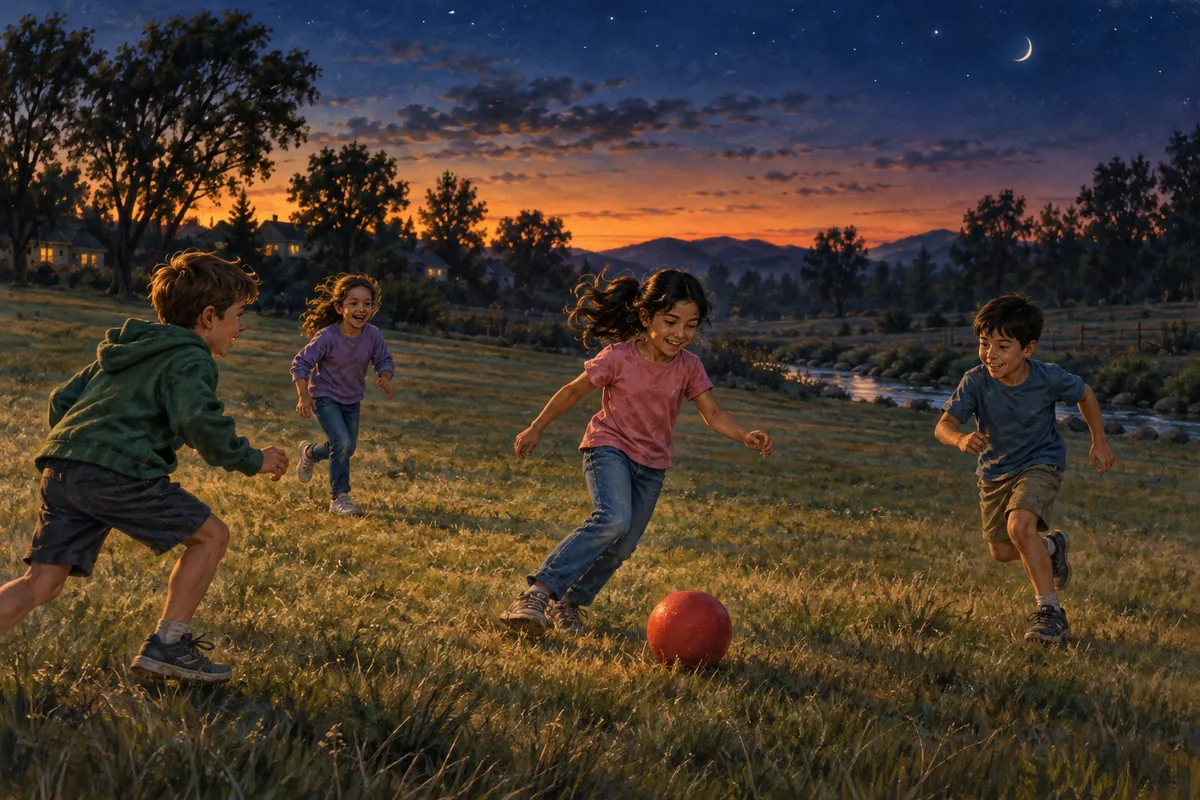
Children play ball in their neighbour’s field beside a creek. They run quickly, and the speaker becomes breathless. As deep blue light turns to darkness, the grass feels cold and trees seem to draw closer. The game ends, and the poet names Night as the winner because darkness has brought play to a stop.
The poem’s broken line pattern slows the breathless phrase into separate beats. The ending gives night the human role of winning. It does not identify a named ball sport, a final score, dew or whether the children wear shoes.
Word Meanings (शब्दार्थ)
| Word | English Meaning | हिंदी अर्थ |
|---|---|---|
| creek | a small stream or narrow body of water | छोटी नदी, धारा |
| field | an open piece of land, often grassy | मैदान, खेत |
| neighbour | a person who lives close by | पड़ोसी |
| catch my breath | to rest and breathe normally after effort | साँस लेना, दम लेना |
| breath | air taken into and let out of the lungs | साँस |
| blue dark | the deep blue colour of the early-night sky | गहरा नीला अँधेरा |
| aches | causes a dull, continuous pain | दर्द करता है |
| creep | to move slowly and quietly | धीरे-धीरे सरकना |
| game’s over | the game has ended | खेल समाप्त |
| wins | defeats others; comes first | जीतता है |
| evenings | the time of day after the afternoon | शाम का समय |
| cold grass | grass that feels cold as night approaches | ठंडी घास |
Poetic Devices in the Poem
| Feature | Effect |
|---|---|
| Free verse | No fixed end-rhyme pattern; short lines create a spoken rhythm. |
| Visual layout | The breathless statement appears word by word, suggesting pauses for air. |
| Personification | ‘Night wins!’ gives night the role of a competitor. Trees seeming to creep makes the landscape feel active. |
| Imagery | Changing blue-to-black light and cold grass appeal to sight and touch. |
| Alliteration | The repeated initial /k/ sound in ‘creep close’ gives a clear example. |
NCERT textbook exercises
Before we read — page 115
I. Picture observations: the children are playing outdoors, chasing or blowing bubbles. They appear to be on a grassy field or in a park. The long shadows and warm light suggest late afternoon or evening; this is a visual inference.
II. Personal responses — model: I go to play after finishing my homework. I play with neighbourhood friends in the park. I like badminton and hide-and-seek. I return at the time agreed with my family. Adapt these answers to your own routines.
Let us discuss I — line meanings
- Next to the creek: beside a small stream.
- Cannot catch her breath: running fast has left the speaker breathless.
- Blue dark becomes black: evening deepens into night.
- Trees creep close: in the dimming light trees seem nearer; they do not literally move.
Let us discuss II — summary blanks
ball; evenings; field; fast; black; aching; playing.
Let us think and reflect I.1
- C: running fast results in breathlessness.
- No. ‘We’ and ‘our’ show that the speaker plays with others.
- The words arranged below one another suggest breathless pauses and make the feeling visible on the page.
Let us think and reflect I.2
- Sample reason: the grass feels cool as evening becomes night.
- The children’s feet ache because the cold grass hurts them after running. Dew and bare feet are possible imaginings, but they are not stated in the poem.
- A: time for play has ended. Night’s arrival forces the game to stop.
Let us learn 1 — original examples
Visual layout sample:
tiptoe
slowly
past
the
door.
The short lines can make a reader slow down as though moving cautiously.
Personification sample: ‘The wind whispered a secret to the leaves.’ Wind receives the human action of whispering a secret.
Let us learn 2 — water-body word web
Possible entries: river, stream, lake, pond, sea, ocean, canal and reservoir. Give examples you know and discuss them with your teacher.
Let us listen — four printed riddles, pages 119–120
Answers in order: 1 football; 2 kabaddi; 3 swimming; 4 yoga/breathing exercises. The fourth describes an activity rather than a ball sport. Its breathing and daily-practice clues make yoga a suitable answer.
Original riddle: ‘Across a net I send a feather, / two rackets keep the rally together.’ Answer: badminton.
Let us speak — parent/child role-play samples
- Coming late: Child: ‘I am sorry I returned late. I lost track of time.’ Parent: ‘Please follow our agreed time and let me know if plans change.’
- Sharing play: Child: ‘We played badminton and practised passing.’ Parent: ‘What did you enjoy most?’ Child: ‘Learning together.’
- Introducing a friend: Child: ‘This is my friend Riya.’ Parent: ‘Welcome, Riya. It is nice to meet you.’
Let us write — personal model
Our Evening Playtime
I go to the park after my homework. My neighbours and I play badminton, catch and hide-and-seek. Badminton is my favourite because we can improve our rallies together. Playing gives us exercise and helps us practise cooperation and fair play. We include everyone and congratulate each other. I finish at the time agreed with my family and return home before it becomes too dark.
Let us explore — indigenous games
Research a game played in your region, such as kho-kho, kabaddi or a local form of hopscotch. Record its local name, equipment, team size, rules and source. Ask your teacher to supervise learning and playing it. Do not invent a single origin or set of rules for all regional versions.
Additional ClearStudy questions
This practice is separate from the printed textbook exercises.
Short Answer Questions (30–40 words)
The children play in the evenings, in their neighbour’s field, on a spot right next to a small creek (stream). It is an open, grassy place close to their homes where they gather after their day. Q2. What game do the children play?
The children play ball. They run about very fast while playing, chasing and passing the ball with their friends until they are completely out of breath. Q3. Why does the speaker say she cannot catch her breath?
The speaker says she cannot catch her breath because she has been running so fast during the ball game. The hard running tires her out and leaves her panting and breathless. Q4. What makes the children finally stop playing?
Darkness makes them stop. When the blue evening sky turns black, it becomes too dark to see and play, and the cold grass hurts their feet, so the game is over and they go home. Q5. Why does the poet say “Night wins”?
The poet says “Night wins” because it is the falling of night, not any child, that ends the game. Since night brings the play to a stop, the poet playfully treats night as the true winner.
Long Answer Questions (100–120 words)
The poet uses simple but vivid images to show evening turning into night. The line “When blue dark turns to black” tells us that the deep-blue evening sky is slowly becoming fully dark, marking the passing of time. The “cold grass aches our feet” appeals to our sense of touch and shows that the warm day is gone and the cool night has arrived. The personification “trees creep close” makes the trees seem to move nearer as the fading light blurs everything around the children. Together these images let us almost see and feel the gathering darkness, until at last it is too dark to play and the “game’s over.” Q2. Explain the title ‘The Winner’. Why is it a surprising and clever title?
The title ‘The Winner’ makes us expect that one child, or one team, will win the ball game. But the poem never names any human winner; instead the children simply play happily until the light fails. The clever twist comes in the very last line — “Night wins!” The real “winner” is not a player at all but Night, because it is darkness that finally stops the game. The title is surprising because it gives a human quality (winning) to a part of nature, and it is clever because it gently teaches us that the joy of play is in the playing itself, while it is nature, not competition, that decides when play must end. Q3. What message about play and nature does the poem give to young readers?
The poem gives a warm, simple message about the pure joy of outdoor play. The children are not worried about scores, trophies or beating one another; they are happy just to run, play ball and spend the evening together with friends. Their fun continues for as long as the light allows. By making “Night” the winner, the poet reminds us that nature controls our time outdoors — daylight and darkness, warmth and cold all shape when we can play. The poem encourages children to enjoy active, carefree play in the open air and to notice and respect the changing world of nature around them, instead of focusing only on who wins or loses.
ClearStudy MCQ practice
1. Who is the poet of ‘The Winner’?
(a) Sudha Murty (b) Georgia Heard (c) Jean de La Fontaine (d) Jill Wolf
2. When do the children play in the poem?
(a) mornings (b) afternoons (c) evenings (d) nights
3. Where do the children play?
(a) in a park (b) in their neighbour’s field (c) on a playground (d) in the school ground
4. The children play next to a —
(a) river (b) lake (c) creek (d) pond
5. The word ‘creek’ means a —
(a) large ocean (b) small stream of water (c) tall tree (d) deep well
6. Why can the speaker not catch her breath?
(a) she is ill (b) she has been running fast (c) she is afraid (d) she is cold
7. ‘When blue dark turns to black’ shows that —
(a) it is early morning (b) evening is turning into night (c) it is raining (d) the sky is clear
8. ‘trees creep close’ is an example of —
(a) simile (b) personification (c) hyperbole (d) metaphor
9. Why does the cold grass ache the children’s feet?
(a) the grass is thorny (b) it is night and the grass is cold (c) the field is rocky (d) they wear no shoes for fun
10. According to the poem, who is the real ‘winner’?
(a) the speaker (b) the friends (c) Night (d) the neighbour
ClearStudy assertion–reason practice
For each, choose: (a) Both A and R are true and R is the correct explanation of A. (b) Both A and R are true but R is NOT the correct explanation of A. (c) A is true but R is false. (d) A is false but R is true.
1. Assertion (A): The poem says “Night wins!”
Reason (R): The fall of night makes it too dark to play, so darkness ends the game.
Answer: (a) — R correctly explains why night is called the winner.
2. Assertion (A): The speaker is playing alone.
Reason (R): The poem uses words like “we” and “our feet”.
Answer: (d) — A is false (she plays with friends); R is true and actually proves she is not alone.
3. Assertion (A): “trees creep close” is an example of personification.
Reason (R): The trees are given the human action of creeping, though they do not really move.
Answer: (a) — R correctly explains the device.
4. Assertion (A): The children stop playing because it begins to rain.
Reason (R): The poem says “cold grass aches our feet”.
Answer: (d) — A is false (they stop because of darkness, not rain); R is true.
5. Assertion (A): The line “I can’t even catch my breath” is printed word by word down the page.
Reason (R): The broken pattern helps show that the speaker is panting and out of breath.
Answer: (a) — R correctly explains the purpose of the unusual layout.
📌 Exam Tips
• Remember the key images in order: evening play → running breathless → blue dark turns to black → cold grass aches feet → trees creep close → game’s over → Night wins.
• Be ready to explain the twist in the title: the “winner” is Night, not a child.
• Learn two devices to quote — personification (“trees creep close”, “Night wins!”) and the special word-by-word layout of “I can’t even catch my breath”.
• Use short quotations from the poem to support your answers and earn extra marks.
⚠ Common Mistakes to Avoid
• Do not write that one of the children wins the game — the poem says “Night wins!”
• Do not say the children stop playing because they are bored or it rains; they stop because it becomes too dark.
• A “creek” is a small stream, not a large sea or ocean.
• “trees creep close” does not mean the trees really move; it only seems so in the dim light — and it is personification, not a simile.
• Spell the poet’s name correctly: Georgia Heard.
Frequently Asked Questions (FAQs)
Who wrote The Winner?
NCERT Poorvi credits Georgia Heard as the poet.
Why does night win?
Nightfall ends the outdoor game. The poet playfully treats night as the winner rather than naming a child or team.
What do the separate words show?
The word-by-word layout suggests pauses for breath after running fast and makes the speaker’s breathlessness visible.
What are the sports-riddle answers?
The four answers are football, kabaddi, swimming and yoga or breathing exercises.