
NCERT Solutions for Class 6 Science (Curiosity) Chapter 2: Diversity in the Living World (NCERT 2026–27)
These Class 6 Science Curiosity Chapter 2 solutions cover Diversity in the Living World from the new NCF textbook (2026–27). The chapter takes you on a nature walk to discover the huge variety of plants and animals around us — what we call biodiversity — and teaches you how to group them based on their features such as stems, leaves, roots, seeds, movement and habitat. Every question of the “Let us enhance our learning” exercise is solved below in simple, exam-ready language.
Class 6 Science Curiosity Chapter 2 Solutions – Overview
Chapter 2 of Curiosity, Diversity in the Living World, begins with a nature walk led by Dr Raghu and Maniram chacha. The students observe many kinds of grasses, bushes, trees, birds, butterflies and monkeys, and realise that nature is full of variety — the biodiversity of a region. The chapter then explains how scientists make sense of this variety by grouping living things using common features. Plants are grouped as herbs, shrubs and trees (height and nature of stem), by leaf venation (reticulate or parallel), by root type (taproot or fibrous) and by seed type (dicot or monocot). Animals are grouped by their movement, body parts and habitat (land, water, or both). Finally, it describes how plants and animals have special features called adaptations to survive in their habitat, and why we must protect biodiversity.
Key Concepts & Definitions
Biodiversity: the variety of plants and animals found in a particular region. Each member has a role to play, and they depend on one another.
Grouping: arranging living things into groups based on common features so they are easier to study and understand.
Herbs, shrubs and trees: herbs are small with soft, green stems; shrubs are medium-sized with many hard, woody stems branching near the ground; trees are tall with a single hard, thick, woody stem branching higher up.
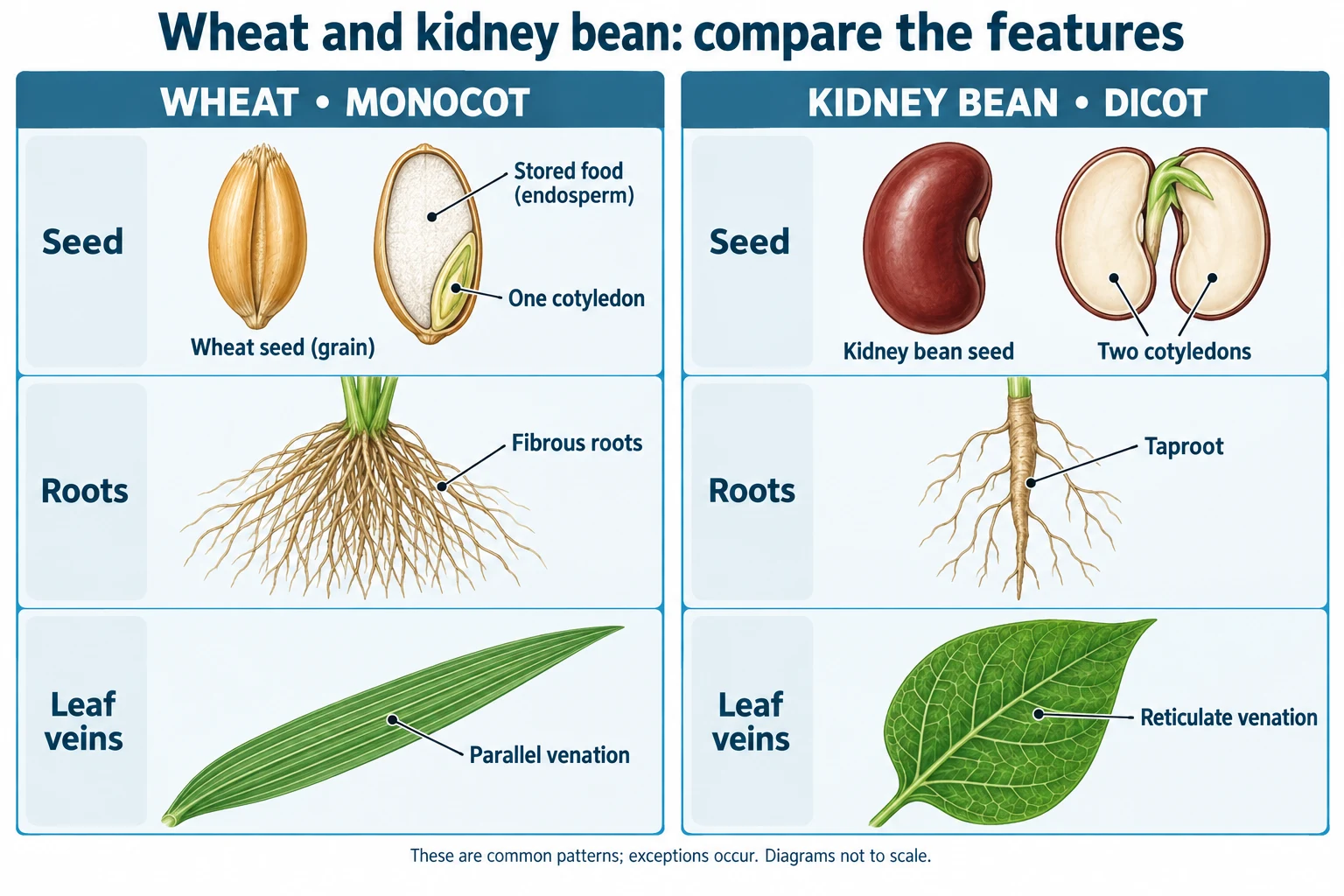
Venation: the pattern of veins in a leaf. Reticulate venation is a net-like pattern (e.g. hibiscus); parallel venation has veins running side by side (e.g. banana, grass).
Taproot and fibrous root: a taproot has one main root with small side roots (e.g. mustard); fibrous roots are a bunch of thin, similar-sized roots from the stem base (e.g. grass).
Dicots and monocots: dicots have seeds with two cotyledons (e.g. chickpea) and generally show reticulate venation and taproots; monocots have one cotyledon (e.g. maize) and generally show parallel venation and fibrous roots. Cotyledon number defines these seed groups; the root and vein patterns have exceptions.
Adaptation: the special features that enable a plant or animal to survive in a particular region (e.g. the cactus’s fleshy stem, the camel’s hump).
Habitat: the place where a plant or animal lives, providing food, water, air and shelter. Habitats may be terrestrial (land) or aquatic (water); animals like frogs that live in both are amphibians.
“Let us enhance our learning” — Full Solutions
Questions 1–10 follow the NCERT Curiosity exercise on pages 31–33 (reprint 2026–27). Figures and some layouts are adapted for this page. The worked explanations and teaching illustrations are ClearStudy additions.
1. Here are two types of seeds. What differences do you find among the roots and leaf venation of their plants? (a) Wheat (b) Kidney beans
2. Names of some animals are given below. Group them based on their habitats. Write the names of aquatic animals in the area marked ‘A’ and terrestrial animals in the area marked ‘B’. Enter the names of animals living in both habitats in part ‘C’.Horse, Dolphin, Frog, Sheep, Crocodile, Squirrel, Whale, Earthworm, Pigeon, Tortoise
| A – Aquatic (water) | C – Both habitats | B – Terrestrial (land) |
|---|---|---|
| Dolphin, Whale | Frog, Crocodile | Horse, Sheep, Squirrel, Earthworm, Pigeon, Tortoise |
3. Manu’s mother maintains a kitchen garden. One day, she was digging out radish from the soil. She told Manu that radish is a kind of root. Examine a radish and write what type of root it is. What type of venation would you observe in the leaves of radish plant?
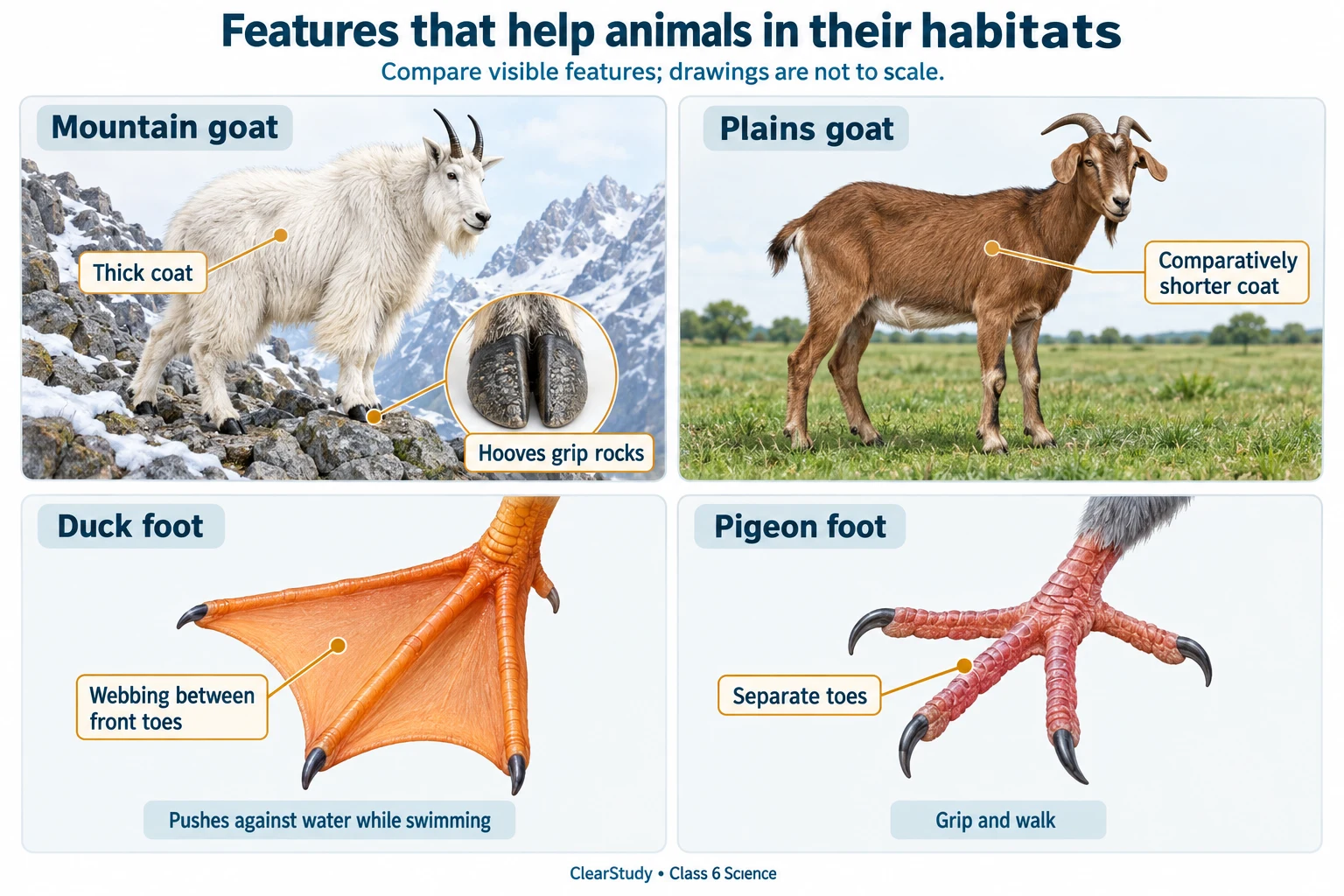
4. Look at the image of a mountain goat and a goat found in the plains. Point out the similarities and differences between them. What are the reasons for these differences?
5. Group the following animals into two groups based on any feature other than those discussed in the chapter—cow, cockroach, pigeon, bat, tortoise, whale, fish, grasshopper, lizard.
| Young are fed milk | Young are not fed milk |
|---|---|
| Cow, bat, whale | Cockroach, pigeon, tortoise, fish, grasshopper, lizard |
6. As the population grows and people want more comfortable lives, forests are being cut down to meet various needs. How can this affect our surroundings? How do you think we can address this challenge?
7. Analyse the flowchart. What can be examples of ‘A’ and ‘B’?Plant → Does it have leaves? (Yes) → Does it have reticulate venation? — Yes → A | No → B
↓
Does the leaf have reticulate venation?Yes → A
Hibiscus / kidney bean
No → B
Wheat / grass
(parallel venation)
8. Raj argues with his friend Sanjay that “Gudhal (hibiscus) plant is a shrub.” What questions can Sanjay ask for clarification?
9. Based on the information in the table, find out examples of these plants for each group.Group A: Dicot, Taproot — Examples? | Group B: Monocot, Fibrous roots — Examples? (a) What other similarities do plants of group A have? (b) What other similarities do plants of group B have?
| Group | Type of seed | Type of root | Examples |
|---|---|---|---|
| A | Dicot | Taproot | Chickpea (chana), kidney bean, mustard, hibiscus, mango |
| B | Monocot | Fibrous roots | Wheat, maize, grass, lemongrass, rice |
10. Observe the labelled part of a duck in the picture given below. What differences do you observe in the feet of the duck compared to the other birds? Which activity would the duck be able to perform using this part?
Extra Practice Questions
These supplementary questions and the MCQs below are ClearStudy practice, separate from the NCERT exercise.
Short Answer Type Questions
Q1. What is meant by biodiversity?
Q2. Why do we group plants and animals?
Q3. Give one difference between a herb and a tree.
Q4. What is an adaptation? Give one example.
Q5. Name the two main types of leaf venation and give an example of each.
Long Answer Type Questions
Q1. Explain how plants can be grouped as herbs, shrubs and trees.
Q2. Describe the relationship between seed type, root type and leaf venation in plants.
Q3. Why does the biodiversity of one region differ from another? Explain with examples.
MCQs & Assertion–Reason
1. The variety of plants and animals found in a particular region is called:
(a) habitat (b) biodiversity (c) adaptation (d) venation
2. A tomato plant with a small, soft, green stem is an example of a:
(a) tree (b) shrub (c) herb (d) climber
3. The net-like pattern of veins seen in a hibiscus leaf is called:
(a) parallel venation (b) reticulate venation (c) fibrous venation (d) taproot
4. A plant with one main root and small side roots arising from it has a:
(a) fibrous root (b) taproot (c) web root (d) cotyledon
5. Maize seed has a single cotyledon, so maize is a:
(a) dicot (b) monocot (c) shrub (d) tree
6. Dicot plants generally have:
(a) parallel venation and fibrous roots (b) reticulate venation and taproots (c) parallel venation and taproots (d) reticulate venation and fibrous roots
7. An animal like a frog that can live both on land and in water is called:
(a) aquatic (b) terrestrial (c) amphibian (d) monocot
8. The special features that help a plant or animal survive in its surroundings are called:
(a) habitats (b) adaptations (c) cotyledons (d) groves
9. The webbed feet of a duck help it to:
(a) fly faster (b) swim in water (c) climb trees (d) dig soil
10. Forests, deserts, grasslands and mountains are examples of:
(a) aquatic habitats (b) terrestrial habitats (c) sacred groves (d) cotyledons
For each Assertion–Reason question, choose: (A) Both true and the Reason correctly explains the Assertion; (B) Both true but the Reason is not the correct explanation; (C) Assertion true, Reason false; (D) Assertion false, Reason true.
A-R 1. Assertion: Grass has fibrous roots and parallel venation.
Reason: Grass is a monocot plant.
A-R 2. Assertion: A rose plant is a tree.
Reason: A rose plant has medium height with hard, woody stems that branch near the ground.
A-R 3. Assertion: The cactus has thick, fleshy stems.
Reason: Fleshy stems store water and help the cactus survive in the hot desert.
A-R 4. Assertion: Cutting down forests can lead to a loss of biodiversity.
Reason: Destroying forests removes the habitat, food and shelter of many plants and animals.
A-R 5. Assertion: A chickpea seed splits into two parts.
Reason: Chickpea is a monocot plant with a single cotyledon.
Quick Revision Summary
- The variety of plants and animals in a region is its biodiversity; each member has a role and they depend on each other.
- Living things are grouped by common features so they are easier to study.
- Plants are grouped as herbs, shrubs and trees by height and stem; weak-stemmed plants are climbers or creepers.
- Leaves show reticulate (net-like) or parallel venation; roots are taproots or fibrous roots.
- Dicots have two cotyledons; monocots have one. Reticulate veins with taproots and parallel veins with fibrous roots are their respective common patterns, with exceptions.
- Animals may be grouped by movement, body parts and use of land, water or both. Amphibians are an animal group, not a habitat.
- Special survival features are adaptations; the place where an organism lives is its habitat.
- Damaging habitats causes loss of biodiversity, so we must protect it (e.g. Project Tiger, sacred groves).
Common Mistakes to Avoid
Watch out for these
- Mixing up reticulate (net-like) and parallel venation — remember hibiscus = reticulate, banana/grass = parallel.
- Confusing taproot (one main root) with fibrous roots (a bunch of thin roots).
- Swapping dicot and monocot features — dicot = 2 cotyledons; reticulate veins and taproots are usual, with exceptions.
- Thinking a radish is a stem — it is a swollen taproot that stores food.
- Calling every tall plant a tree — check the stem: a shrub has many hard stems branching near the ground.
- Forgetting that some animals (like frogs) live in both water and land — they are amphibians.
How to write a clear answer
Learn the three linked features of plants together — seed type, root type and leaf venation — because one question often tests all of them. For grouping questions (like herbs/shrubs/trees or aquatic/terrestrial), always state the feature you used to group. In “reason for differences” questions, use the word adaptation and connect the feature to the animal’s or plant’s habitat. Use the textbook’s own examples — hibiscus, mango, grass, mustard, camel, cactus, deodar — to show you have read the chapter.
Frequently Asked Questions
What is Class 6 Science Curiosity Chapter 2 about?
Chapter 2, Diversity in the Living World, is about the variety of plants and animals around us (biodiversity) and how we group them using features such as stems, leaves, roots, seeds, movement and habitat. It also explains adaptations and why we must protect biodiversity.
What is the difference between a dicot and a monocot plant?
A dicot seed splits into two cotyledons and the plant generally has reticulate (net-like) leaf venation and a taproot (e.g. chickpea, kidney bean). A monocot seed has a single cotyledon and the plant generally has parallel leaf venation and fibrous roots (e.g. maize, wheat).
What type of root and venation does a radish have?
A radish is a swollen taproot that stores food, so the radish plant is a dicot. Its leaves therefore show reticulate (net-like) venation.
Are these Class 6 Science Curiosity Chapter 2 solutions free?
Yes. All solutions are free and follow the official NCERT Curiosity textbook for 2026–27.
Reference: NCERT Curiosity Chapter 2, official PDF, exercise pages 31–33. See also San Diego Zoo’s turtle and tortoise guide and the Wildlife Institute of India’s bustard habitat description.