
NCERT Solutions for Class 6 Science (Curiosity) Chapter 4: Exploring Magnets (NCERT 2026–27)
These Class 6 Science Curiosity Chapter 4 solutions cover Exploring Magnets from the new NCF textbook (2026–27). The chapter introduces magnets and their shapes, magnetic and non-magnetic materials, the two poles of a magnet, how a freely suspended magnet finds direction, the magnetic compass, and attraction and repulsion between magnets. All 11 questions from “Let us enhance our learning” are answered below, with labelled diagrams for the clip positions, ring magnets and three-magnet arrangement.
Class 6 Science Curiosity Chapter 4 Solutions – Overview
Chapter 4 of Curiosity, Exploring Magnets, begins with a story about Reshma, who learns that sailors in the olden days used a magnetic compass to find directions when stars were not visible. The chapter explains that magnets occur naturally as lodestones and can also be made artificially in many shapes — bar, U-shaped, ring, disc, cylindrical and spherical. You discover which materials are magnetic (iron, nickel, cobalt) and which are non-magnetic, that every magnet has two poles (North and South) which always occur in pairs, and that a freely suspended magnet always rests in the north–south direction because the Earth itself behaves like a giant magnet. Finally, it shows that like poles repel and unlike poles attract, and that magnetic force can act even through non-magnetic materials.
Key Concepts & Definitions
Magnet: a material that attracts objects made of iron, nickel and cobalt. Magnets may be natural (lodestone) or artificial (man-made).
Magnetic materials: materials that are attracted towards a magnet, such as iron, nickel and cobalt.
Non-magnetic materials: materials that are not attracted towards a magnet, such as wood, plastic, glass, rubber and paper.
Poles of a magnet: the two ends where the magnetic force is strongest — the North pole and the South pole. Iron filings stick mostly at the poles. Poles always exist in pairs; a single pole cannot exist.
North (north-seeking) pole & South (south-seeking) pole: when a magnet hangs freely, the end pointing north is the North pole and the end pointing south is the South pole.
Magnetic compass: a small device with a freely rotating magnetised needle that always comes to rest along the north–south direction, used to find directions.
Attraction and repulsion: unlike poles (N–S) attract each other, while like poles (N–N or S–S) repel each other. Repulsion is the sure test of a magnet.
Compass accuracy: “North–south” is the Class 6 description. More precisely, a compass aligns with the local magnetic field, which may differ from true geographic north. Keep nearby magnets and iron objects away when finding direction.
“Let us enhance our learning” — NCERT Solutions
Questions 1–11 follow NCERT Curiosity Chapter 4, pages 74–76. Answers and diagrams are original ClearStudy teaching aids.
1. Fill in the blanks (i) Unlike poles of two magnets __________ each other, whereas like poles __________ each other. (ii) The materials that are attracted towards a magnet are called __________. (iii) The needle of a magnetic compass rests along the __________ direction. (iv) A magnet always has __________ poles.
2. State whether the following statements are True (T) or False (F). (i) A magnet can be broken into pieces to obtain a single pole. [ ] (ii) Similar poles of a magnet repel each other. [ ] (iii) Iron filings mostly stick in the middle of a bar magnet when it is brought near them. [ ] (iv) A freely suspended bar magnet always aligns with the north-south direction. [ ]
3. Column I shows different positions in which one pole of a magnet is placed near that of the other. Column II indicates the resulting interaction between them for different situations. Fill in the blanks.
| Column I (poles facing) | Column II (interaction) |
|---|---|
| N–N | Repulsion |
| N–S | Attraction |
| S–N | Attraction |
| S–S | Repulsion |
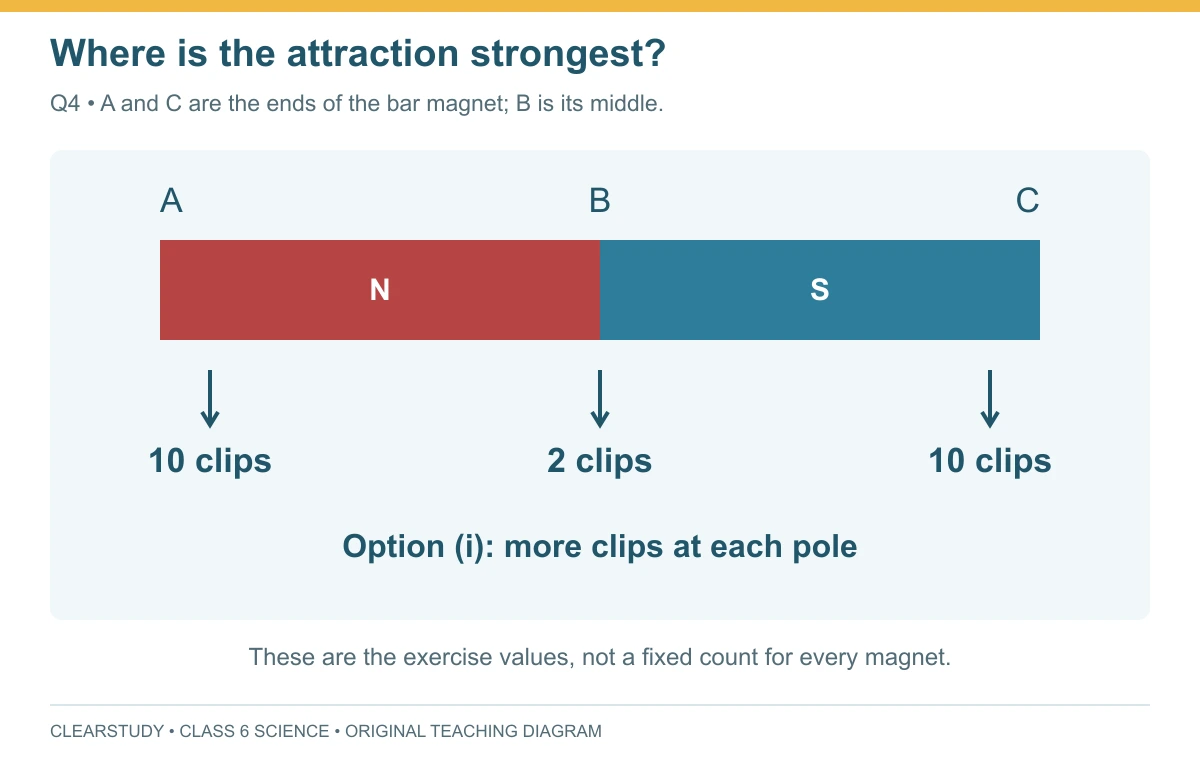
4. Atharv performed an experiment in which he took a bar magnet and rolled it over a heap of steel U-clips (Fig. 4.15). According to you, which of the options given in Table 4.3 is likely to be his observation? (i) Position A = 10, Position B = 2, Position C = 10 (ii) Position A = 10, Position B = 10, Position C = 2 (iii) Position A = 2, Position B = 10, Position C = 10 (iv) Position A = 10, Position B = 10, Position C = 10
5. Reshma bought three identical metal bars from the market. Out of these bars, two were magnets and one was just a piece of iron. How will she identify which two amongst the three could be magnets (without using any other material)?
6. You are given a magnet which does not have the poles marked. How can you find its poles with the help of another magnet which has its poles marked?
7. A bar magnet has no markings to indicate its poles. How would you find out near which end its North pole is located without using another magnet?
8. If the earth is itself a magnet, can you guess the poles of earth’s magnet by looking at the direction of the magnetic compass?
9. While a mechanic was repairing a gadget using a screw driver, the steel screws kept falling down. Suggest a way to solve the problem of the mechanic on the basis of what you have learnt in this chapter.
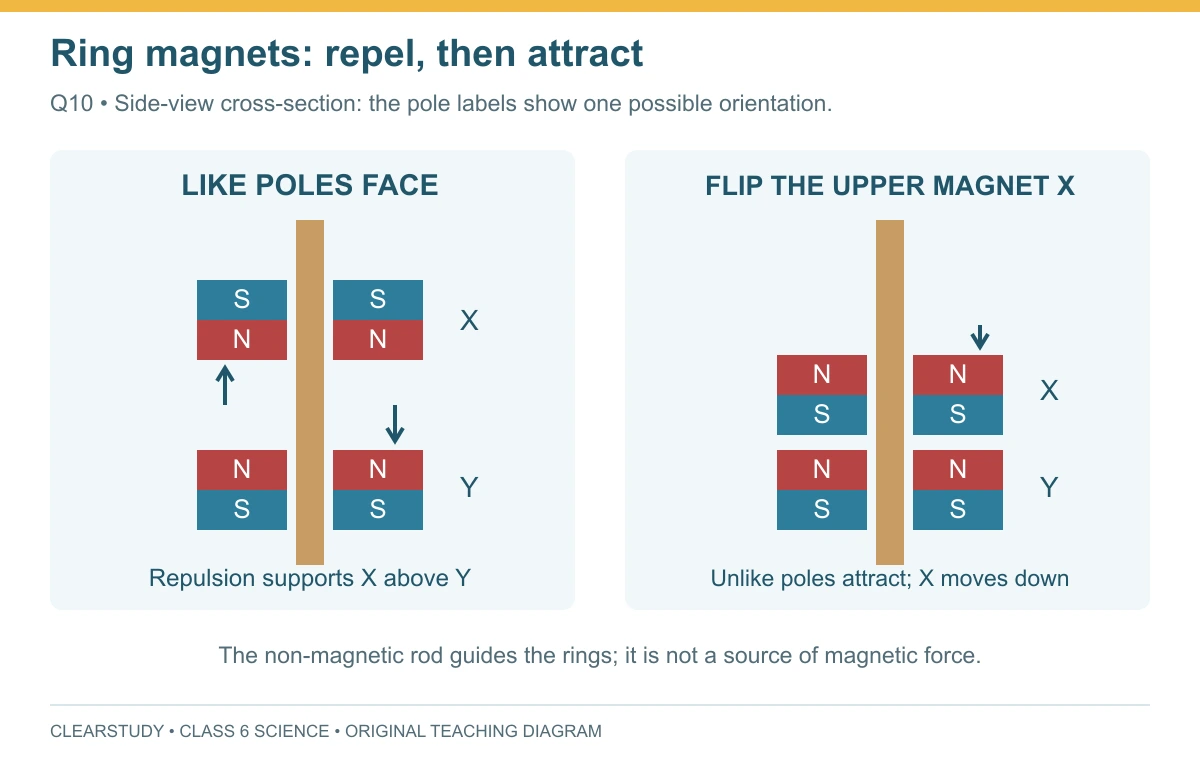
10. Two ring magnets X and Y are arranged as shown in Fig. 4.16. It is observed that the magnet X does not move down further. What could be the possible reason? Suggest a way to bring the magnet X in contact with magnet Y, without pushing either of the magnets.
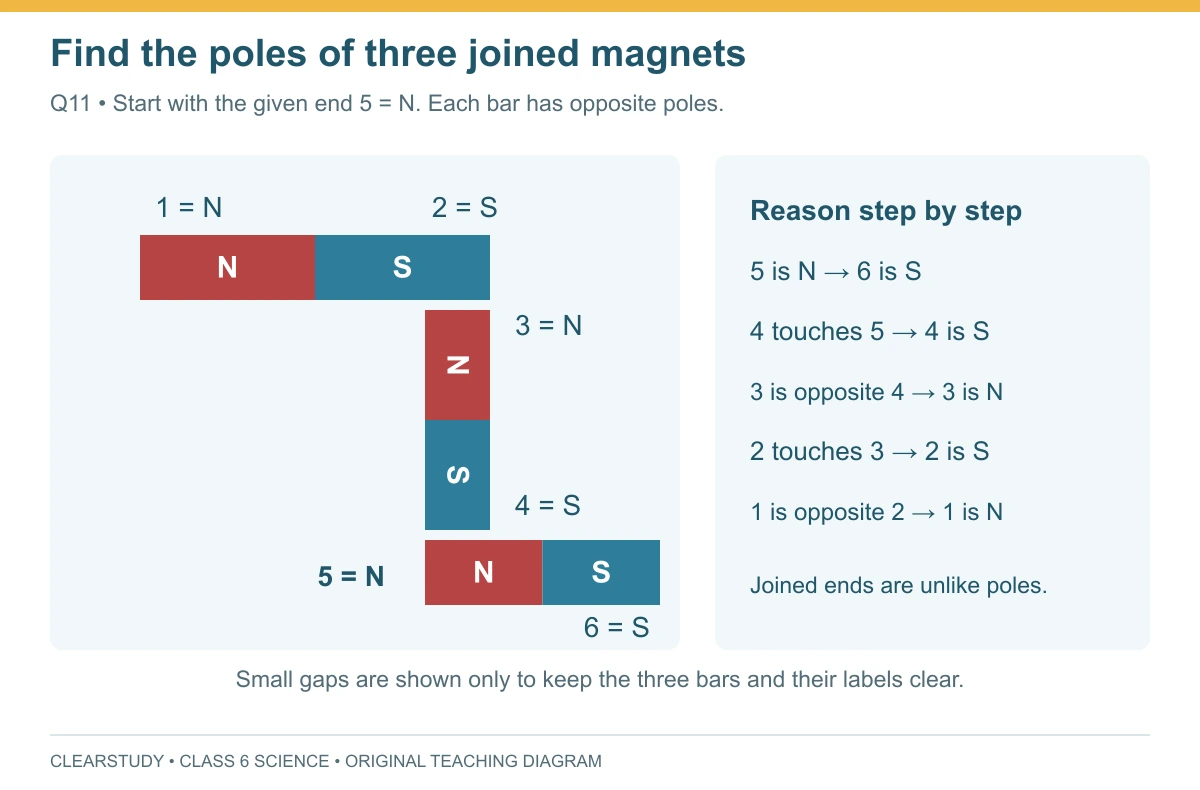
11. Three magnets are arranged on a table in the form of the shape shown in Fig. 4.17. What is the polarity, N or S, at the ends 1, 2, 3, 4 and 6 of the magnets? Polarity of one end (5) is given for you. (End 5 = N)
| End | Polarity |
|---|---|
| 1 | N |
| 2 | S |
| 3 | N |
| 4 | S |
| 5 (given) | N |
| 6 | S |
Common Mistakes to Avoid
Watch out for these
- Thinking a magnet can have a single pole — even the smallest broken piece always has both a North and a South pole.
- Believing iron filings stick most in the middle of a bar magnet — they actually cluster at the two ends (poles).
- Confusing attraction and repulsion — only repulsion is the sure test of a magnet, since a magnet and an iron bar can only attract.
- Forgetting that magnetic force passes through non-magnetic materials like wood, plastic, glass and cardboard.
- Mixing up the Earth’s poles — the Earth’s magnetic South pole lies near the geographic North.
- Calling materials like aluminium or copper “magnetic” — iron, nickel and cobalt are familiar examples, not a complete list. Aluminium and copper show no noticeable attraction in this classroom test.
Extra Practice Questions
These questions and MCQs are ClearStudy practice, separate from the NCERT exercise.
Short Answer Type Questions
Q1. What are magnetic and non-magnetic materials? Give one example of each.
Q2. Name any three shapes in which magnets are commonly made.
Q3. Why is it not possible to have a magnet with only one pole?
Q4. What is a lodestone?
Q5. Why does a freely suspended magnet always come to rest in the north–south direction?
Long Answer Type Questions
Q1. Describe an activity to show that a magnet has two poles and that the poles are the strongest parts.
Q2. Explain how you can make your own magnetic compass at home using a sewing needle and a magnet.
Q3. Explain attraction and repulsion between magnets, and state why repulsion is the surest test of a magnet.
MCQs & Assertion–Reason
1. Which of the following is a magnetic material?
(a) Plastic (b) Wood (c) Iron (d) Glass
2. A naturally occurring magnet is called a:
(a) bar magnet (b) lodestone (c) compass (d) ring magnet
3. The number of poles a magnet always has is:
(a) one (b) two (c) three (d) four
4. Iron filings sprinkled on a bar magnet stick mostly:
(a) in the middle (b) all over equally (c) near the two ends (d) nowhere
5. When the North pole of one magnet is brought near the North pole of another, they:
(a) attract (b) repel (c) do nothing (d) join and break
6. A freely suspended bar magnet comes to rest along the:
(a) east–west direction (b) north–south direction (c) up–down direction (d) any random direction
7. The device used to find directions is the:
(a) thermometer (b) barometer (c) magnetic compass (d) telescope
8. The surest test to identify a magnet is:
(a) attraction (b) repulsion (c) its colour (d) its weight
9. Which of these will a magnet not attract?
(a) an iron nail (b) a steel pin (c) a cobalt piece (d) a plastic eraser
10. The magnetic effect of a magnet on a compass needle, when a sheet of wood is placed in between, is:
(a) completely blocked (b) almost unchanged (c) doubled (d) reversed
For each Assertion–Reason question, choose: (A) Both true and the Reason correctly explains the Assertion; (B) Both true but the Reason is not the correct explanation; (C) Assertion true, Reason false; (D) Assertion false, Reason true.
A-R 1. Assertion: A single magnetic pole cannot exist on its own.
Reason: When a magnet is broken, each piece still has both a North and a South pole.
A-R 2. Assertion: Two magnets can repel each other.
Reason: Like poles of two magnets repel each other.
A-R 3. Assertion: A freely suspended magnet rests along the east–west direction.
Reason: The Earth behaves like a giant magnet.
A-R 4. Assertion: Repulsion is the sure test of a magnet.
Reason: A magnet attracts every metal placed near it.
A-R 5. Assertion: A magnetic compass needle is itself a small magnet.
Reason: The needle comes to rest in the north–south direction.
Quick Revision Summary
- Magnets may be natural (lodestone) or artificial, and come in many shapes: bar, U-shaped, ring, disc, cylindrical and spherical.
- Magnetic materials (iron, nickel, cobalt) are attracted to a magnet; non-magnetic materials (wood, plastic, glass, rubber) are not.
- Every magnet has two poles — North and South. Poles always occur in pairs; a single pole cannot exist.
- Iron filings stick mostly at the poles, which are the strongest parts of a magnet.
- A freely suspended magnet rests along the north–south direction because the Earth behaves like a giant magnet; this is used in the magnetic compass.
- Like poles repel, unlike poles attract; repulsion is the sure test of a magnet, and magnetic force can pass through non-magnetic materials.
Real-life Applications
Magnets are everywhere in daily life. They keep pencil boxes, purses and refrigerator doors closed, hold paper on writing boards through magnetic dusters, and stick decorative fridge magnets in place. A magnetised screwdriver tip grips steel screws so they do not fall. Magnetic compasses still guide hikers, sailors and explorers, and the same idea once powered the Indian matsya-yantra used at sea. Bigger applications include electric bells, loudspeakers, electric motors, and high-speed Maglev trains, which use magnetic forces for levitation. Magnets are also used in the field of medicine, for example in MRI machines. Understanding attraction, repulsion and poles in this chapter is the first step towards all of these uses.
How to write a clear answer
Remember the two golden rules: like poles repel, unlike poles attract, and a magnet always has two poles that occur in pairs. When a question asks you to identify a magnet, always answer using repulsion, not attraction. For “find the poles” questions, mention either a known marked magnet or a freely suspended magnet resting north–south. State clearly that iron filings stick at the ends, and that magnetic force acts even through non-magnetic materials. A neat labelled diagram can make your explanation easier to follow when relevant to the question.
Frequently Asked Questions
What is Class 6 Science Curiosity Chapter 4 about?
Chapter 4, Exploring Magnets, teaches what magnets are, their shapes, magnetic and non-magnetic materials, the two poles of a magnet, how a freely suspended magnet and a magnetic compass find direction, and the rule that like poles repel while unlike poles attract.
What is the rule of attraction and repulsion between magnets?
Unlike poles (North–South) attract each other, while like poles (North–North or South–South) repel each other. Repulsion is the surest test of a magnet because only two magnets can repel.
Why does a freely suspended magnet point north–south?
Because the Earth itself behaves like a giant magnet. Its magnetism aligns a freely suspended magnet so that one end points north (the North pole) and the other points south (the South pole). This is the principle of the magnetic compass.
Are these Class 6 Science Curiosity Chapter 4 solutions free?
Yes. All solutions are free and follow the official NCERT Curiosity textbook for session 2026–27.
Sources: NCERT Curiosity Chapter 4 (official PDF); NOAA explanation of compass direction and magnetic declination.