
NCERT Solutions for Class 6 Social Science (Exploring Society) Chapter 10: Grassroots Democracy – Part 1: Governance (NCERT 2026–27)
These Class 6 Social Science Exploring Society Chapter 10 solutions cover Grassroots Democracy – Part 1: Governance from Exploring Society: India and Beyond, the NCERT textbook (2026–27 reprint). The chapter explains why a society needs rules, governance and a government, introduces the three organs of government (legislature, executive and judiciary) and the idea of separation of powers with checks and balances, describes the three levels or tiers of government in India, and explains what democracy, direct and representative democracy, and grassroots democracy mean. Below you get step-by-step answers to all Questions, activities and projects, clear notes on key terms, extra practice, MCQs, Assertion–Reason questions and FAQs.
Class 6 Social Science Exploring Society Chapter 10 – Overview
Chapter 10, Grassroots Democracy – Part 1: Governance, begins with a simple idea: whenever many people live together, rules are needed to maintain order and harmony. The process of taking decisions, organising society with rules and ensuring they are followed is called governance; the system or group that makes and enforces the rules is the government, and the most important rules are called laws. A modern government works through three organs — the legislature (makes laws), the executive (implements laws) and the judiciary (interprets laws and settles disputes). To prevent misuse of power, these organs are kept separate — the separation of powers — which provides a system of checks and balances. In India, government functions at three levels: local, State and Central (Union). The chapter then explains democracy (‘rule of the people’), the difference between direct and representative democracy, and ends with grassroots democracy, which encourages ordinary citizens to take part in decisions that affect them.
Key Concepts & Terms
Governance: the process of taking decisions, organising society’s life with different sets of rules, and ensuring that those rules are followed.
Government: the group of individuals or the system that makes the rules and ensures that they are followed.
Laws: some of the more important rules of a society are called laws.
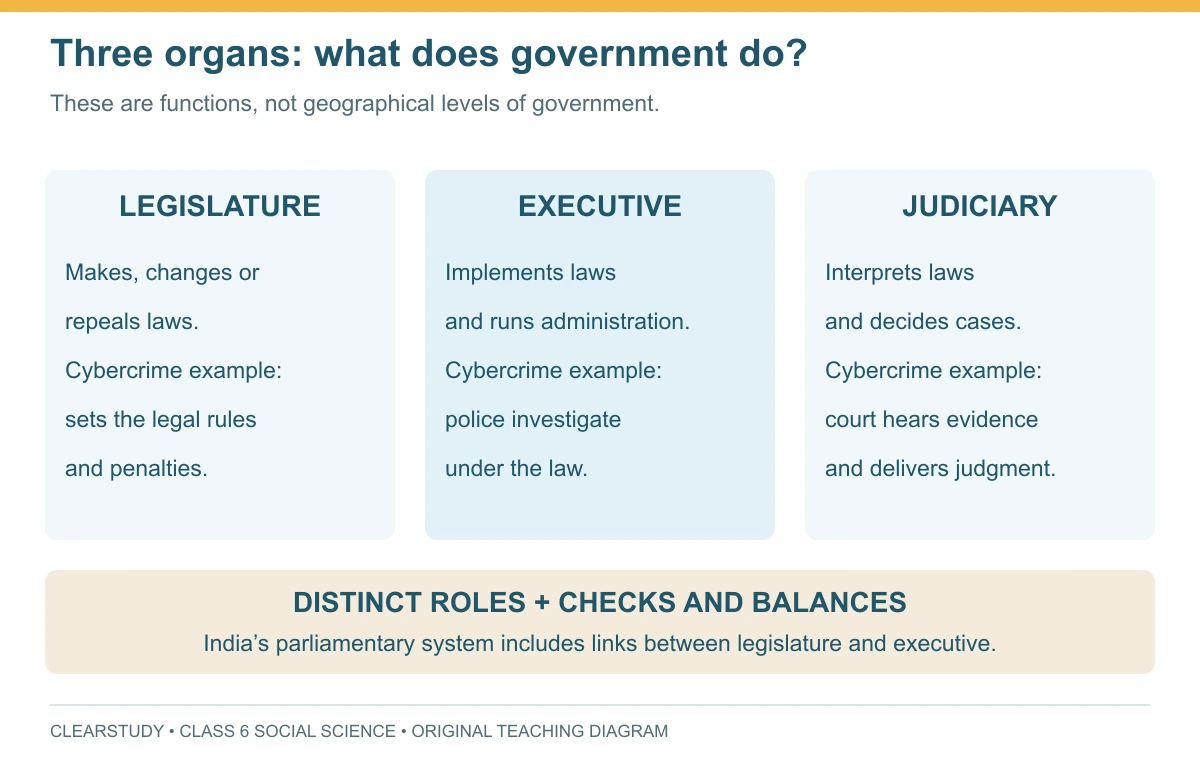
Legislature: the organ of government that makes new laws (legislates) and sometimes updates or removes existing laws, through an assembly of representatives of the people.
Executive: the organ that implements (executes) the laws — including constitutional heads, heads of government, ministers, and agencies responsible for enforcing law and order (such as the police).
Judiciary: the system of courts that decides whether someone has broken the law and what action should be taken, interprets laws, settles disputes and reviews government action against the Constitution and law.
Separation of powers: keeping the three organs of government separate, even though they interact and work together, so that no single group holds all power.
Checks and balances: a system in which each organ of government can check what the others are doing and restore balance if one organ acts beyond its expected role.
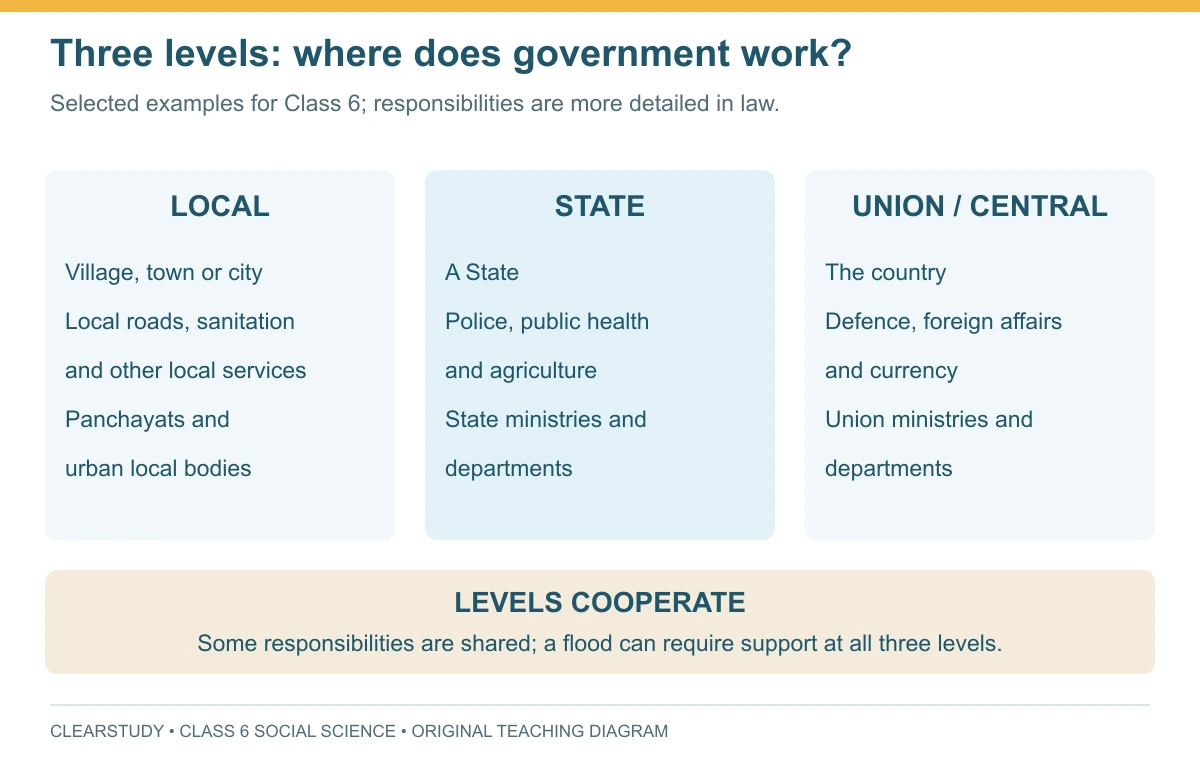
Three levels (tiers) of government: in India, government works at the local (town/village), State (regional) and Central or Union (national) levels, each dealing with different matters.
Democracy: from the Greek dēmos (‘people’) and kratos (‘rule’ or ‘power’), so it literally means the ‘rule of the people’.
Direct democracy: a system in which every person’s opinion is taken directly to make a decision (as when a class votes by raising hands to choose a picnic spot).
Representative democracy: a system in which people elect representatives (such as MLAs at the State level and MPs at the national level) who take decisions on their behalf; India is a representative democracy and the world’s largest.
Grassroots democracy: a system that enables and encourages the participation of ordinary citizens — the base of the pyramid — so that they can have a say in decisions which affect them.
Other key terms: MLA (Member of Legislative Assembly, at the State level), MP (Member of Parliament, at the national level), and cybercrime (criminal activity carried out through digital means).
“Questions, activities and projects” — Full Solutions
These solutions follow NCERT’s end-of-chapter questions. Answers and teaching illustrations are ClearStudy explanations; personal and group activities use model responses to adapt.
1. Test yourself — What is the meaning of democracy? What is the difference between direct democracy and representative democracy?
2. Recall the three organs of government. What are their different roles?
India has a parliamentary system: the executive and legislature have links, and ministers are normally legislators. Separation of powers means distinct constitutional roles and checks, not complete isolation. Judicial independence is essential.
3. Why do we need three tiers of government?
4. Project: Many of you will remember the lockdown that took place during the COVID-19 pandemic. Make a list of all the actions that were taken at that time? Which tiers of government were involved in managing the situation? What was the role of each of the organs of government?
Extra Practice Questions
These questions and MCQs are ClearStudy practice, separate from the NCERT exercise.
Short Answer Type Questions
Q1. What is meant by ‘governance’?
Q2. What is the difference between a rule and a law?
Q3. What does the term ‘separation of powers’ mean?
Q4. From which words is the term ‘democracy’ derived, and what does it mean?
Q5. What is grassroots democracy?
Long Answer Type Questions
Q1. Why do societies need rules, governance and a government? Explain.
Q2. Explain the three organs of government and how the separation of powers helps in good governance.
Q3. Describe the three levels of government in India with an example of how they work together.
MCQs & Assertion–Reason
1. The process of taking decisions, organising society with rules and ensuring that they are followed is called:
(a) governance (b) democracy (c) election (d) legislation
2. The more important rules of a society are called:
(a) customs (b) laws (c) habits (d) traditions
3. Which organ of government makes new laws?
(a) the executive (b) the judiciary (c) the legislature (d) the police
4. The organ of government that implements or ‘executes’ the laws is the:
(a) legislature (b) executive (c) judiciary (d) assembly
5. The system of courts that decides whether someone has broken the law is the:
(a) legislature (b) executive (c) judiciary (d) cabinet
6. Keeping the three organs of government separate is called the:
(a) checks and balances (b) separation of powers (c) rule of law (d) division of labour
7. In India, government functions at how many levels or tiers?
(a) one (b) two (c) three (d) four
8. The word ‘democracy’ comes from two Greek words meaning:
(a) law and order (b) people and rule (c) state and nation (d) city and citizen
9. Elected representatives at the national level are called:
(a) MLAs (b) MPs (c) ministers (d) governors
10. A system that enables and encourages the participation of ordinary citizens in decisions affecting them is called:
(a) direct democracy (b) representative democracy (c) grassroots democracy (d) separation of powers
For each Assertion–Reason question, choose: (A) Both true and the Reason correctly explains the Assertion; (B) Both true but the Reason is not the correct explanation; (C) Assertion true, Reason false; (D) Assertion false, Reason true.
A-R 1. Assertion: Rules are necessary when a large number of people live together.
Reason: Without rules there can be disagreements and disorder, and society would not be able to function.
A-R 2. Assertion: The legislature is the organ that tries individual criminal cases and sentences convicted offenders.
Reason: The legislature makes new laws and updates or removes existing ones.
A-R 3. Assertion: The three organs of government are kept separate.
Reason: The separation of powers provides a system of checks and balances so that no organ becomes too powerful.
A-R 4. Assertion: India is a representative democracy.
Reason: People elect representatives such as MLAs and MPs who take decisions on their behalf in the assemblies.
A-R 5. Assertion: In direct democracy, people elect representatives to take decisions for them.
Reason: In a direct democracy every person’s opinion is taken directly to make a decision.
Exam Tips & Common Mistakes
How to write a clear answer
Learn the clear definitions of governance, government and laws in one line each. Memorise the three organs with their action words — legislature makes laws, executive implements laws, judiciary interprets laws — and always mention separation of powers and checks and balances together. For the three tiers, name them in order (local → State → Central) and use the textbook’s flood example to show how they work together. For democracy questions, give the Greek meaning (dēmos + kratos = rule of the people) and contrast direct versus representative democracy with the picnic and election examples. Finish stewardship-style answers by mentioning grassroots democracy.
Common mistakes to avoid
- Confusing governance (the process) with government (the system or group that does it).
- Mixing up the roles of the three organs — remember the executive (not the legislature) implements laws, and the judiciary (not the executive) decides punishment.
- Writing only two tiers of government — India has three: local, State and Central.
- Swapping direct and representative democracy in answers.
- Forgetting that ‘separation of powers’ works through checks and balances.
- Leaving the project question (Q4) blank — write your own list of actions and the tiers/organs involved.
Frequently Asked Questions
What is Chapter 10 of Class 6 Social Science Exploring Society about?
Chapter 10, Grassroots Democracy – Part 1: Governance, explains why society needs rules, governance and a government, describes the three organs of government (legislature, executive and judiciary) and the separation of powers, the three levels (local, State and Central) of government in India, and the meaning of democracy, direct and representative democracy, and grassroots democracy.
What are the three organs of government?
The three organs of government are the legislature, which makes laws; the executive, which implements the laws (including the head of state, ministers and the police); and the judiciary, which is the system of courts that decides whether the law has been broken and what action should be taken.
What is the exercise heading for Chapter 10 of Exploring Society Class 6?
The end-of-chapter exercise in Exploring Society: India and Beyond Chapter 10 is headed Questions, activities and projects and contains 4 numbered items, all answered step by step on this page.
Reviewed against NCERT, Exploring Society: India and Beyond, Chapter 10 (2026–27 reprint). Content reviewed 9 October 2026.
Further checks: President’s Secretariat: head of state; Supreme Court: Constitution and government; 24 March 2020 lockdown order.