
NCERT Solutions for Class 6 Social Science (Exploring Society) Chapter 13: The Value of Work
These Class 6 Social Science Exploring Society Chapter 13 solutions cover The Value of Work from Exploring Society: India and Beyond, the NCERT textbook (2026–27 reprint). The chapter belongs to the theme Economic Life Around Us and explains the different types of work people do, how activities are grouped into economic and non-economic activities, how people are paid (salary, fee, wage, payment in kind), the idea of value addition, and the deep importance of non-economic activities like sevā and community participation. Below you get step-by-step answers to all the Questions, activities and projects, clear notes on key terms, extra practice, MCQs, Assertion–Reason and FAQs.
Class 6 Social Science Exploring Society Chapter 13 – Overview
Chapter 13, The Value of Work, opens with the story of Anu and Kabir, who notice the many kinds of work people around them do — an Air Force pilot, a shopkeeper, a software engineer, a teacher, and volunteers. From these examples the chapter divides all activities into two groups. Economic activities are done in exchange for money or money’s worth (a farmer selling produce, a lawyer charging a fee, a driver transporting goods). Non-economic activities do not earn income but are done out of love, care, gratitude and respect (parents cooking food, youth caring for grandparents, free teaching). The chapter then shows the different types of payment — salary, fee, wage and payment in kind — and explains value addition using Rajesh the carpenter, who turns ₹600 of wood into a ₹1,000 chair. It ends by celebrating the value of non-economic work through sevā, langars, the Swachh Bharat Abhiyan and Van Mahotsav, showing how such service builds social welfare and personal wellbeing.
Key Concepts & Terms
Economic activities: activities that involve money or are performed in exchange for money or money’s worth for the parties involved — for example, a business person selling school bags, a farmer selling produce, a lawyer arguing a case for a fee, a truck driver transporting goods, or workers in a car factory.
Non-economic activities: activities that do not generate income or wealth but are done out of feelings like gratitude, love, care and respect — for example, parents cooking food or helping with schoolwork, youth taking care of grandparents, or family members helping renovate the house.
Money’s worth: the monetary value that a person places on an object based on the benefit they derive from it.
Market: a place where people engage in the exchange of goods and services. People may exchange goods for other goods, but in most markets these are exchanged for money.
Salary: a fixed regular payment, generally paid monthly by an employer to an employee (for example, Geeta Aunty the pilot, or Anu’s brother Rohan).
Fee: a payment made to a person or organisation in exchange for professional advice or services — for example, a fee paid to a doctor or a lawyer.
Wage: a payment made by the employer to the worker for a specific period of time — for example, the daily wage earned by Sahil, the farm labourer.
Payment in kind: a non-cash payment that is received for the work performed — for example, the mangoes Sahil receives as part of his payment.
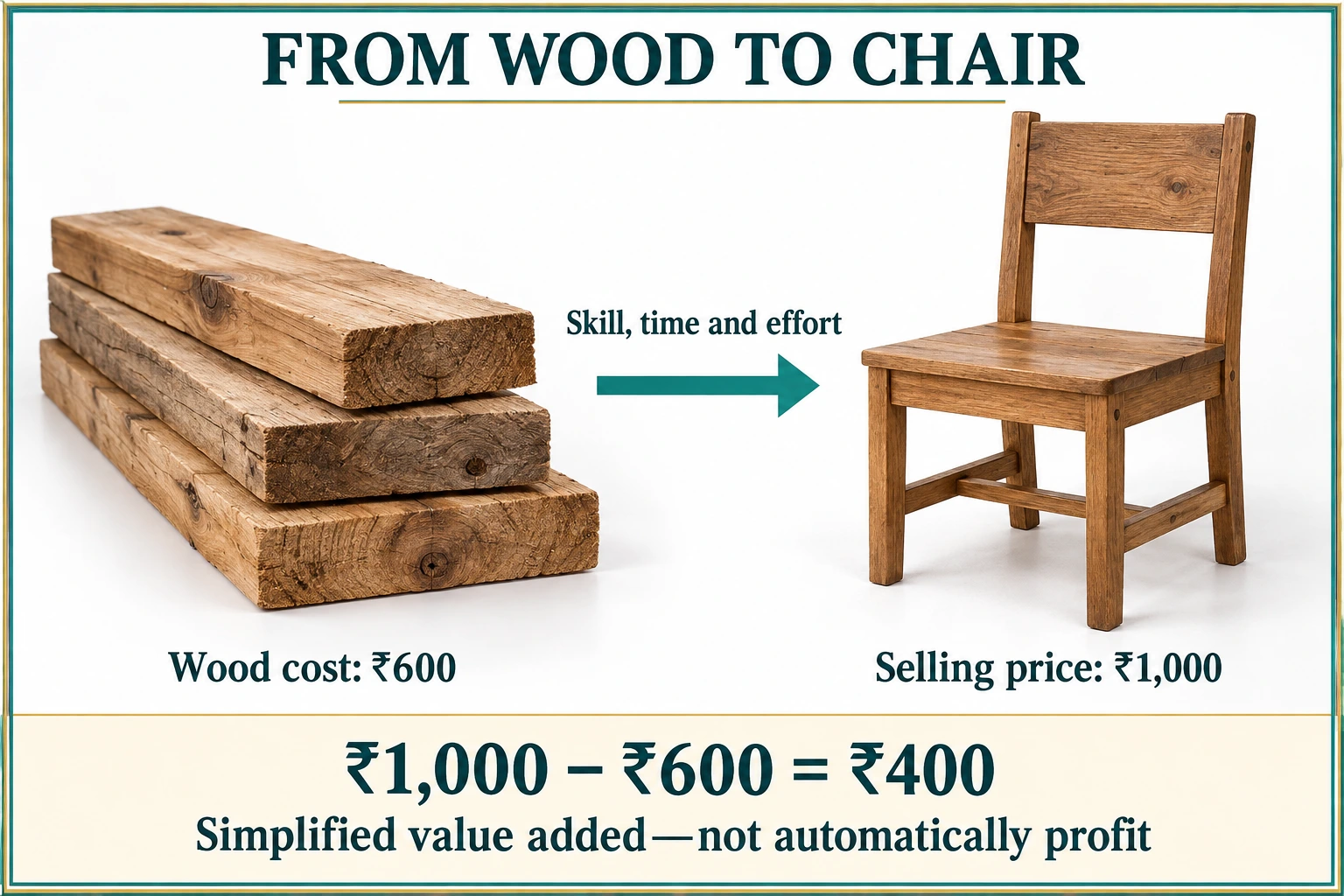
Value addition: the value added at each stage of transforming something into another form. Rajesh buys wood for ₹600 and sells a chair for ₹1,000; the extra ₹400 is the monetary value of his skill, time and effort.
Sevā: selfless service done without expecting anything in return — seen in temples, gurudwaras, mosques and churches, such as the langars (community kitchens) that serve free food to every visitor.
Community participation: collective effort by people for a common good — for example, the Swachh Bharat Abhiyan to keep surroundings clean, and Van Mahotsav (the festival of forests) for tree plantation drives.
“Questions, activities and projects” — Full Solutions
These solutions follow NCERT’s end-of-chapter questions. Answers and teaching illustrations are ClearStudy explanations; personal and group activities use model responses to adapt.
1. How are economic activities different from non-economic activities?
2. What kind of economic activities do people engage in? Illustrate with examples.
3. There is great value attached to people who are engaged in community service activities. Comment on this statement.
4. What are the various ways in which people are compensated for various economic activities? Give some examples.
“Let’s Explore” in-text activities
Let’s Explore (page 185): What activities did the people in Anu’s and Kabir’s story engage in? Then label the third column ‘economic / non-economic activity’ and classify them.
| Character in the story | Activities they are engaged in | Economic / Non-economic activity |
|---|---|---|
| Geeta Aunty | Works as a pilot in the Indian Air Force (receives a salary) | Economic |
| Kabir’s grandfather | Provides free Geography classes to neighbourhood kids; tends the vegetable garden; runs errands for the home | Non-economic |
| Anu’s parents (Appa and Maa) | Run a shop selling uniforms and ready-made garments | Economic |
| Anu’s mother (Maa) | Volunteers in a group that teaches knitting to women in the community | Non-economic |
| Rohan (Anu’s brother) | Works as a software engineer in a company (receives a salary) | Economic |
| Rohan (Anu’s brother) | Volunteers on weekends to teach computer skills for free | Non-economic |
Let’s Explore (page 191): Put a tick against those activities/professions that you think create monetary value, and add two more activities with examples of money-related value creation.
| Activity / Profession | Creates monetary value? | Example of money-related value creation |
|---|---|---|
| 1. Baker | Yes ✓ | Bakes and sells bread and cakes for money |
| 2. Tailor | Yes ✓ | Stitches clothes and charges a fee |
| 3. Farmers repairing their tractor | Yes ✓, in the farming context | Restores productive equipment, avoids a repair-service expense and supports farming; a separate cash payment is not necessary |
| 4. Doctor | Yes ✓ | Treats patients and charges a fee |
| 5. Parents cooking dinner for their family | No | Done out of love and care, not for money |
| 6. Scientist | Yes ✓ | Does research for a salary in an institution |
| 7. Person taking care of a sick grandparent | No | Done out of love and respect, not for money |
| 8. Carpenter (added) | Yes ✓ | Makes furniture and sells it, adding value to wood |
| 9. Bus driver (added) | Yes ✓ | Drives passengers and earns a salary or fare |
These are sample answers. You may tick the professions and add your own two examples of money-related value creation.
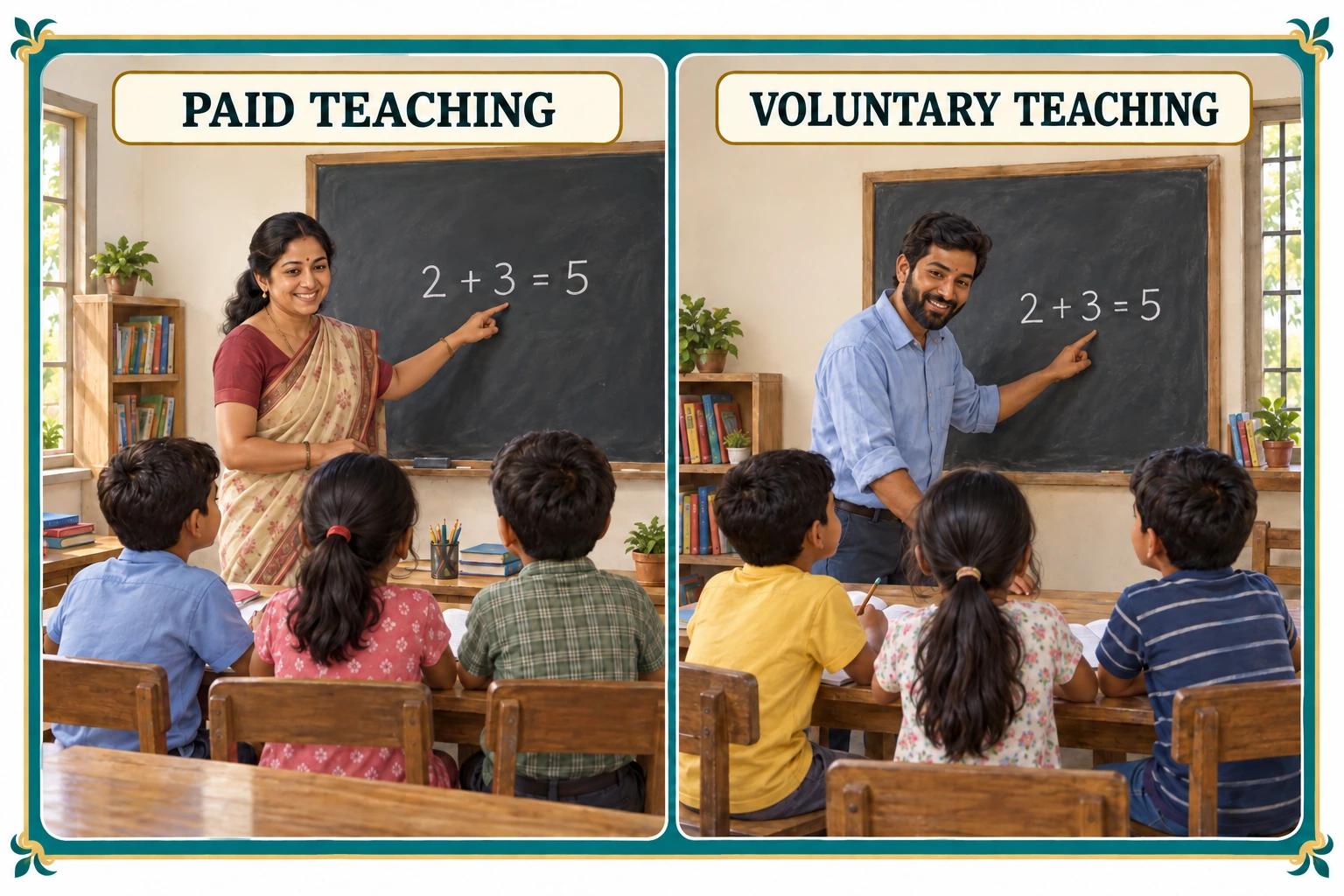
Think About It (page 187): When Kabir’s grandfather voluntarily teaches the neighbourhood kids for free, is that an economic or a non-economic activity? How is it different from your teachers teaching you at school? Also, what are some non-economic activities important to you and your family, and why are they valuable?
Extra Practice Questions
These questions and MCQs are ClearStudy practice, separate from the NCERT exercise.
Short Answer Type Questions
Q1. What are economic activities?
Q2. What is meant by ‘money’s worth’?
Q3. What is value addition? Explain with the example of Rajesh.
Q4. What is the difference between a salary and a wage?
Q5. What is sevā? Give one example.
Long Answer Type Questions
Q1. Explain the four ways in which people are paid for economic activities, with examples.
Q2. Why are non-economic activities important even though they do not earn money?
Q3. Describe the different types of work people do, using examples from the chapter.
MCQs & Assertion–Reason
1. Economic activities are those that:
(a) are done only at home (b) involve money or are performed in exchange for money or money’s worth (c) are done out of love (d) never earn any income
2. Which of the following is a non-economic activity?
(a) A farmer selling produce (b) A lawyer charging a fee (c) Parents cooking food for the family (d) A worker in a car factory
3. A fixed regular payment, generally made monthly by an employer, is called a:
(a) fee (b) wage (c) salary (d) payment in kind
4. The mangoes that Sahil receives instead of cash are an example of:
(a) a salary (b) payment in kind (c) a fee (d) money’s worth
5. Rajesh buys wood for ₹600 and sells a chair for ₹1,000. The extra ₹400 represents:
(a) the cost of the wood (b) the value of his skill, time and effort (c) a fee (d) a loss
6. A payment made to a person or organisation for professional advice or services is called a:
(a) wage (b) salary (c) fee (d) prasād
7. The langar at a gurudwara that serves free food to every visitor is an example of:
(a) an economic activity (b) sevā (selfless service) (c) value addition (d) payment in kind
8. A place where people engage in the exchange of goods and services is called a:
(a) factory (b) market (c) garden (d) post office
9. Which national programme is based on the collective efforts of citizens to keep surroundings clean?
(a) Van Mahotsav (b) Green Revolution (c) Swachh Bharat Abhiyan (d) International Solar Alliance
10. Van Mahotsav, the festival of forests, brings communities together for:
(a) selling timber (b) tree plantation drives (c) building highways (d) running shops
For each Assertion–Reason question, choose: (A) Both true and the Reason correctly explains the Assertion; (B) Both true but the Reason is not the correct explanation; (C) Assertion true, Reason false; (D) Assertion false, Reason true.
A-R 1. Assertion: A software engineer working in a company performs an economic activity.
Reason: The engineer is paid a salary in exchange for the work done.
A-R 2. Assertion: A grandfather teaching neighbourhood children for free is performing an economic activity.
Reason: He teaches voluntarily without receiving payment for those lessons.
A-R 3. Assertion: Rajesh adds value to the wood when he turns it into furniture.
Reason: Value addition is the value added at each stage of transforming something into another form through skill, time and effort.
A-R 4. Assertion: Non-economic activities have no value for society.
Reason: Non-economic activities are done out of love, care and gratitude and improve social welfare and wellbeing.
A-R 5. Assertion: A worker’s payment must always be entirely in cash.
Reason: Payment in kind is non-cash compensation, such as the mangoes Sahil receives for part of his work.
Exam Tips & Common Mistakes
How to write a clear answer
Learn the clear difference between economic and non-economic activities — economic activities are done for money or money’s worth, non-economic ones out of love, care, gratitude and respect. Memorise the four ways people are paid (salary, fee, wage, payment in kind) with the textbook’s own characters: Geeta Aunty/Rohan (salary), the doctor/lawyer (fee), Sahil (wage and payment in kind). For value addition, always use the Rajesh example (₹600 wood → ₹1,000 chair = ₹400 added value). For the importance of non-economic work, mention sevā, langars, the Swachh Bharat Abhiyan and Van Mahotsav to show you studied the chapter.
Common mistakes to avoid
- Judging only by whether cash changes hands: payment in kind and productive work such as repairing farm equipment can have monetary value. Unpaid care and voluntary service remain valuable too.
- Confusing a salary (fixed, monthly) with a wage (paid for a specific period, often daily).
- Mixing up a fee (for professional services) with payment in kind (non-cash payment).
- Forgetting that a teacher in a school earns a salary, so school teaching is an economic activity.
- Saying non-economic activities are “useless” — they have great social and personal value.
- Calling value addition “profit”: in NCERT’s simplified chair example, ₹1,000 − ₹600 = ₹400. Profit requires accounting for all relevant costs.
Frequently Asked Questions
What is Chapter 13 of Class 6 Social Science Exploring Society about?
Chapter 13, The Value of Work, explains the different types of work people do, divides activities into economic and non-economic activities, describes the ways people are paid (salary, fee, wage and payment in kind), introduces value addition with the example of Rajesh the carpenter, and shows the importance of non-economic activities like sevā and community participation.
What is the difference between economic and non-economic activities?
Economic activities are done in exchange for money or money’s worth and generate income, such as a farmer selling produce or a lawyer earning a fee. Non-economic activities do not earn money and are done out of love, care, gratitude and respect, such as parents cooking food or someone teaching children for free.
What is the exercise heading for Chapter 13 of Exploring Society?
The end-of-chapter exercise in Exploring Society: India and Beyond Chapter 13 is headed Questions, activities and projects and contains 4 numbered questions, all answered step by step on this page along with the in-text “Let’s Explore” and “Think About It” activities.
Reviewed against NCERT, Exploring Society: India and Beyond, Chapter 13 (2026–27 reprint). Content reviewed 9 October 2026.