
A Homage to Our Brave Soldiers — Class 7 English Poorvi Questions and Answers
A Homage to Our Brave Soldiers questions and answers for Class 7 Poorvi explain Soumya and Ananda’s letters, the National War Memorial, vocabulary and clauses. Find textbook-based listening answers and sample speaking, letter-writing and research activities.
Source: NCERT Poorvi, Grade 7, Unit 5, printed pages 179–198 (listening transcript 223); supplied reprint 2026–27. Open-ended and personal responses are examples to adapt. These explanations are study support, not an official NCERT answer key.
About the chapter
“A Homage to Our Brave Soldiers” is the opening prose piece of Unit 5, ‘Bravehearts’. It is written as an exchange of two letters between two friends, Soumya (from Bengaluru) and Ananda (from Chandigarh). Soumya writes to share her experience of an educational trip to the National War Memorial in New Delhi, describing the Amar Jawan Jyoti, the four Chakras and the citations of war heroes such as Lance Naik Albert Ekka and Major Padmapani Acharya. Ananda replies with her own reflections, recalling a war memorial in Chandigarh and the poem ‘Pushp ki Abhilasha’. Through their letters the chapter pays tribute to the courage and sacrifice of Indian soldiers.
About the text
The supplied chapter gives no individual author byline. Its two-letter format presents Soumya’s visit and Ananda’s response alongside information about memorials and gallantry citations. The Hindi poem referred to in the reply, Pushp ki Abhilasha, is by Makhanlal Chaturvedi. Distinguish the student-letter framework from independently checkable historical facts.
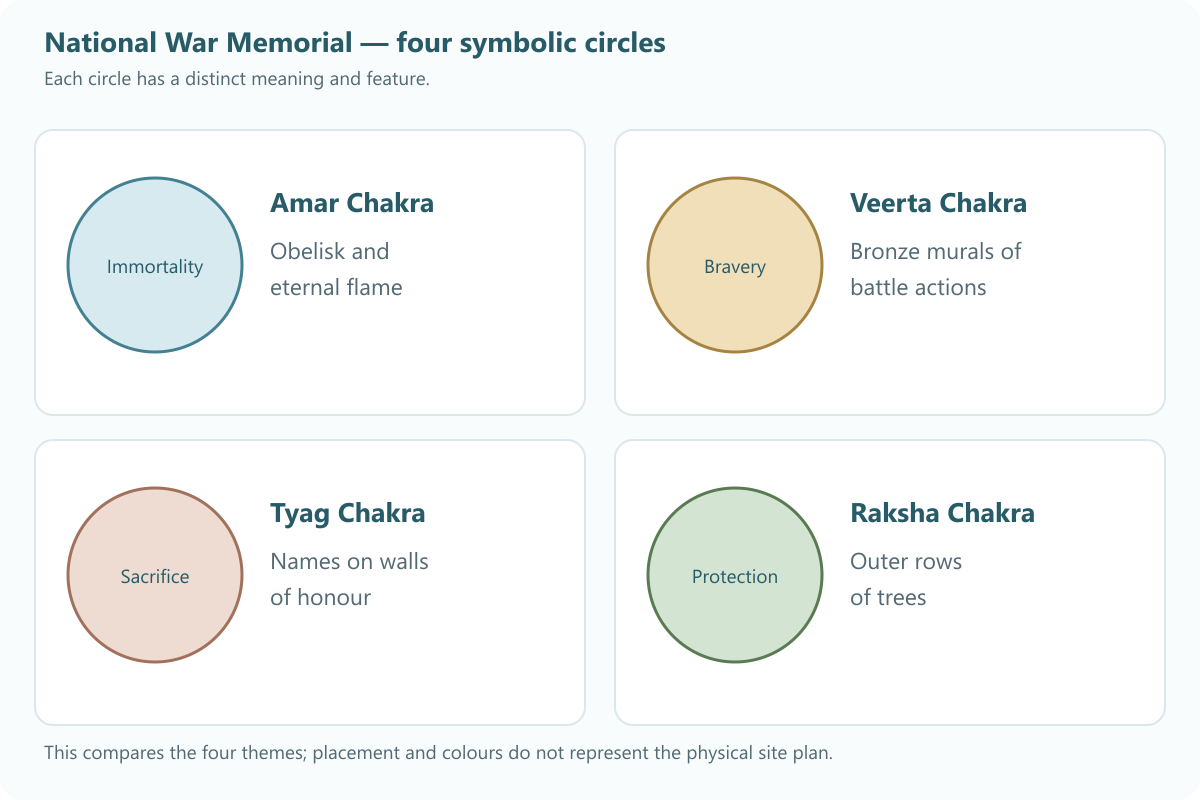
Open the four-circle comparison at full size. Amar means immortality (obelisk and flame); Veerta means bravery (bronze murals); Tyag means sacrifice (names on walls); Raksha means protection (outer trees).
Historical checks: The memorial was inaugurated on 25 February 2019. The flame established at India Gate in January 1972 was merged with the National War Memorial flame on 21 January 2022. Tablet and name counts in the textbook are historical figures and can change. See the official memorial description.
The book’s p. 181 wording groups Major Hoshiar Singh with posthumous 1971 PVC recipients. His award was not posthumous; he survived the battle. See his official citation. The official Param Vir Chakra account also explains the 1950 institution date and retrospective effect.
Summary
In her letter, Soumya tells Ananda about a school trip to New Delhi. She describes the National War Memorial, spread over forty acres near India Gate, which was envisioned and inaugurated by Prime Minister Shri Narendra Modi in February 2019. She explains that even after Independence in 1947 India had to fight several wars to protect her borders, and that the memorial honours soldiers who made the supreme sacrifice in conflicts such as the 1962 Indo-China war, the 1965 and 1971 Indo-Pak wars and the 1999 Kargil war. Each ‘tablet’ bears a fallen soldier’s name; the textbook reports 29,000 tablets carrying more than 26,000 names.
Soumya writes about the gallantry awards – the Param Vir Chakra (PVC), Maha Vir Chakra, Kirti Chakra, Vir Chakra and Shaurya Chakra – and shares the citation of Lance Naik Albert Ekka (PVC), who silenced enemy machine guns at Gangasagar in 1971 and made the supreme sacrifice. She describes the Amar Jawan Jyoti, the eternal flame in the obelisk, and the four concentric circles – Amar Chakra (Immortality), Veerta Chakra (Bravery), Tyag Chakra (Sacrifice) and Raksha Chakra (Protection). She also mentions her class presentation on Major Padmapani Acharya (MVC) of the Kargil war, who quoted the Bhagavad Gita before battle.
In her reply, Ananda says she was moved by Soumya’s letter. She agrees that a war memorial is an expression of deep gratitude for soldiers’ supreme sacrifice and admits she is thinking of joining the Armed Forces. She recalls visiting a war memorial in a Chandigarh garden and the poem ‘Pushp ki Abhilasha’, mentions the ‘National War Memorial and Museum’ mobile app and a memoir on Captain Anuj Nayyar (MVC), and shares her hobby of philately (stamp-collecting). The two letters together honour India’s bravehearts.
Theme & message
The central theme is gratitude, patriotism and remembrance – honouring the courage and supreme sacrifice of Indian soldiers who protect the nation’s freedom. Through the National War Memorial, the citations and the heroes’ stories, the text reminds us of “the cost of freedom”. Its message is that the peace and liberty we enjoy are gifts of the bravehearts, and that it is our duty to remember, respect and pay homage to them – and perhaps even to serve the nation ourselves.
Word meanings
| Word | English meaning | Hindi meaning |
|---|---|---|
| homage | respect shown publicly for someone | श्रद्धांजलि |
| territorial integrity | safeguarding a nation’s borders | अखंडता (सीमाओं की रक्षा) |
| envisioned | visualised; imagined as a plan | कल्पना / दूरदर्शिता |
| iconic | celebrated; widely admired | प्रतीकात्मक / प्रसिद्ध |
| tribute | showing respect and gratitude | श्रद्धांजलि / आभार |
| etched | engraved; cut into a surface | उत्कीर्ण / खुदा हुआ |
| gallantry | exceptional courage, especially in battle | शौर्य / वीरता |
| posthumously | after a person’s death | मृत्यु के बाद |
| citation | official record of meritorious service | प्रशस्ति-पत्र |
| awestruck | filled with wonder and amazement | अभिभूत / स्तब्ध |
| commemorates | remembers officially and shows respect | स्मृति में सम्मानित करना |
| obelisk | a tall, tapering stone pillar | स्तम्भ / स्मारक स्तंभ |
| wreaths | circular arrangements of flowers placed in remembrance | पुष्प चक्र / माला |
| interminable | everlasting; never-ending | अनंत / सतत |
| murals | large paintings made on a wall | भित्तिचित्र |
| discourses | serious discussions on different topics | गंभीर चर्चा / प्रवचन |
| edifice | a large, impressive building | भव्य / विशाल इमारत |
| valiant | very brave | वीर / साहसी |
| memoir | an account of one’s personal life and experiences | संस्मरण / आत्मकथा |
| philately | the hobby of collecting postage stamps | डाक-टिकट संग्रह |
Let us discuss (after Letter I)
I. Complete the table of war heroes
I. Complete the table given below. An example has been done for you. (Columns: Name of the War Hero | Contribution and Achievement | Award Given)
| Name of the War Hero | Contribution and Achievement | Award Given |
|---|---|---|
| Major Somnath Sharma | Battle of Badgam in 1947 (given) | First Param Vir Chakra awarded posthumously (given) |
| Captain Mahendra Nath Mulla | Navy personnel who showed exemplary courage and leadership during the 1971 war. | Maha Vir Chakra (MVC) |
| Lance Naik Albert Ekka | In the 1971 war he charged an enemy bunker at Gangasagar, silenced the machine guns and made the supreme sacrifice. | Param Vir Chakra (PVC), posthumously |
| Major Padmapani Acharya | Fought for India in the 1999 Kargil War (Operation Vijay), captured a heavily fortified enemy position and succumbed to his injuries. | Maha Vir Chakra (MVC), posthumously |
II. Find the paragraph(s) and sentences in the text that evoke the feelings given below. 1. feeling of wonder 2. heartening 3. sense of motivation 4. pride 5. visually inspiring 6. sadness 7. gratitude 8. inspiration
III. Which is India’s highest gallantry award?
IV. How would Ananda feel after reading this letter?
V. Do you think Soumya enjoyed writing this letter? Why or why not?
Let us discuss (after Letter II)
I. Why was Ananda reminded of the poem ‘Pushp ki Abhilasha’?
II. How does Soumya’s letter help Ananda in pursuing her hobby?
III. Ananda is inspired to act after reading the letter from Soumya. What actions does she intend to take up? Fill in the table citing the sentences from the text. (1. visit 2. mobile app 3. sharing ideas 4. creating a collage 5. joining the army 6. website)
| Action | Sentence / intention from the text |
|---|---|
| 1. visit | “We all wish to visit the National War Memorial, Delhi.” |
| 2. mobile app | “We have found out a mobile app ‘National War Memorial and Museum’… provides answers to our queries in 21 languages.” |
| 3. sharing ideas | “Next week, I am going to share this idea with my classmates and my teacher.” |
| 4. creating a collage | “I think it would be great to create a collage capturing the lives and stories of people that can inspire us each day.” |
| 5. joining the army | “I feel motivated and I am seriously thinking of joining the Armed Forces to serve my motherland.” |
| 6. website | Soumya shares a website link in Letter I. Ananda does not explicitly state a website action in Letter II. Reading the link is a reasonable inference, but it is not a sentence that can be quoted from her reply. |
Let us think and reflect
I.1. Extract – “You can see the obelisk surrounded by wreaths that have been placed as a mark of respect. The lighting design is planned in such a way that it transforms the monument’s landscape as sunlight changes from dawn to dusk. It truly is a majestic site that filled me with pride for our nation. I was also overwhelmed by the interminable flame as a metaphor for eternal stories of courage and valour.”
I.2. Extract – “I was happy to hear that you got an opportunity to visit the National War Memorial. I have heard a lot about it. Some people might see a war memorial as just a monument, statue, an edifice to celebrate a war or victory and commemorate those who sacrificed their lives or got injured in the war. In my view, it is also an expression of deep gratitude for the supreme sacrifice made by our brave soldiers defending the sovereignty and integrity of the country.”
II. Answer the following questions.
Let us learn
I. Prefixes – match and complete
I. Match the prefixes with their meanings and the root words to create a new word. (Prefixes: re-, mal-, un-, anti-, extra-, ex-, de-; an example: extra- + ordinary = Extraordinary)
Now complete the paragraph using the new words. “Soldiers undergo (i) extraordinary training… They learn to (ii) ___ explosives and handle (iii) ___ equipment… They stand as a powerful force against (iv) ___ elements, displaying (v) ___ bravery. (vi) ___ members often share their experiences… Their service can continually (vii) ___ the essence of commitment and sacrifice.”
II. Words associated with ‘brave’ (fill in the missing vowels)
II. Find words associated with ‘brave’ by filling in the missing vowels.
III. Opposites of ‘brave’
III. Fill in the blanks with the correct opposite words of ‘brave’ from the box (fear, cowardly, timid, afraid).
IV. Main and subordinate clauses
1. Main: “I aspire to be courageous like him”; subordinate: “when I join the army”.
2. Main framework: “They exchange letters and share their feelings of gratitude for the freedom”; relative subordinate clause modifying freedom: “(that) they enjoy”. The remaining “because of the sacrifices made by the bravehearts of the country” is a prepositional phrase. It has no finite verb and is not a finite subordinate clause. To express that reason as a clause, rewrite it as “because the bravehearts of the country made sacrifices”.
3. Main: “he continued to fight alongside his comrades”; reduced subordinate part: “Though seriously wounded in this encounter”. Expand it to “Though he was seriously wounded in this encounter” to see the omitted subject and verb.
4. Main: “The sacrifices of the soldiers make monuments like the National War Memorial extremely important”; subordinate: “so that we should never forget the cost of freedom”.
The textbook’s simplified explanation treats a reason phrase like a clause. A finite clause needs a subject and finite verb; the distinction above prevents learning an incorrect grammar rule.
V. Combine using subordinating conjunctions
V. Combine the pairs using suitable subordinating conjunctions (because, unless, when, where, though).
VI. Complete the sentences with a suitable clause
VI. Complete the following sentences with a suitable main clause or subordinate clause. (Sample answers given.)
Let us listen / speak / write / explore
Before reading — p. 179
I. Sample discussion: We remember people whose courage and service helped others. We may show respect through remembrance, flowers, letters or community service. II. Sample sentences: “The class paid homage to those who served the country.” “Our team celebrated its victory respectfully.” Use your own examples in the word table.
Let us listen — p. 197; transcript p. 223
- most honourable job
- wearing the uniform
- body active
- new experiences (or new challenges)
- loyalty, duty (also service, honesty)
For item 3, the full idea is that discipline keeps the mind and body active. “Body active” is an exact two-word fragment that fits the requested length; a full explanation can mention both mind and body.
Let us speak — p. 197
Professions in the picture: carpenter, teacher, cricketer/sportsperson, pilot, farmer, doctor, painter/artist, chef and dancer. The children in the centre are thinking about careers.
Sample: “I would like to become a teacher because I enjoy explaining ideas. I would study my subjects carefully, practise communicating clearly and learn how to support different learners.” Choose your own profession. Possible preparation includes practical craft skills for a carpenter, subject knowledge for a teacher, coached practice for a sportsperson, science and supervised training for a pilot or doctor, crop knowledge for a farmer, art practice for a painter, food preparation for a chef, and regular rehearsal for a dancer. Actual entry requirements need separate current research.
Let us write — pp. 197–198
Sample friendly letter about service during peace:
24, Sample Road
Sample City
10 August 20XX
Dear Friend,
Our English lesson made me think about how the Armed Forces help people during peacetime. During floods and earthquakes, personnel may rescue stranded people, bring supplies and help restore essential services. Military engineering teams can also support bridges and roads when needed. Medical and welfare activities provide another way to serve communities. Such work requires organisation, technical skills and cooperation with civilian authorities. It shows that service includes helping people recover from hardship as well as defending the country. I would like to learn about a verified local example and share it with our class. What examples have you read about?
Yours affectionately,
Sample Student
This is an original model letter, not a claim that the writer witnessed a rescue or visited a camp.
Let us explore — p. 198
Mottos in the textbook: Army — Service Before Self; Air Force — Touch the Sky with Glory; Navy — Be Auspicious Unto Us, O Varuna. For other forces, record the exact motto, its meaning and the official source you consulted.
Collage: Choose inspiring people, verify each name and achievement, write a short original caption and use a permitted photograph. Women in the Armed Forces: prepare a brief researched profile with service/role, training and an achievement supported by an official biography. Share it with classmates and explain what you learned; this research task has many possible answers.
Additional ClearStudy questions
This practice is separate from the printed textbook exercises.
Short answer (30–40 words)
1. When was the National War Memorial built and inaugurated, and by whom?
2. What is the Amar Jawan Jyoti and what does it symbolise?
3. Name the four Chakras of the National War Memorial and what each represents.
4. What did Major Padmapani Acharya write before going into battle?
5. What is ‘philately’, and how is it connected to Ananda?
Long answer (100–120 words)
6. Describe the structure and significance of the National War Memorial as explained in the chapter.
7. How do the two letters in this chapter pay homage to India’s brave soldiers?
ClearStudy MCQs and assertion–reason practice
1. Where is the National War Memorial located?
(a) near the Red Fort (b) near India Gate (c) in Chandigarh (d) in Bengaluru
2. Who inaugurated the National War Memorial in February 2019?
(a) the President (b) the Defence Minister (c) Prime Minister Shri Narendra Modi (d) the Army Chief
3. What is India’s highest wartime gallantry award?
(a) Maha Vir Chakra (b) Kirti Chakra (c) Param Vir Chakra (d) Shaurya Chakra
4. Who was awarded India’s first Param Vir Chakra (posthumously)?
(a) Lance Naik Albert Ekka (b) Major Somnath Sharma (c) Major Hoshiar Singh (d) Captain Mahendra Nath Mulla
5. In which war did Lance Naik Albert Ekka win the Param Vir Chakra?
(a) 1962 Indo-China (b) 1965 Indo-Pak (c) 1971 Indo-Pak (d) 1999 Kargil
6. What is the eternal flame at the memorial called?
(a) Veer Jyoti (b) Amar Jawan Jyoti (c) Raksha Jyoti (d) Shanti Jyoti
7. The innermost circle of the memorial, the Amar Chakra, is also known as the –
(a) Circle of Bravery (b) Circle of Sacrifice (c) Circle of Immortality (d) Circle of Protection
8. Major Padmapani Acharya was awarded the Maha Vir Chakra for his role in –
(a) the 1962 war (b) the 1965 war (c) the 1971 war (d) the 1999 Kargil War
9. Which hobby of Ananda’s is mentioned in her letter?
(a) painting (b) philately (stamp-collecting) (c) photography (d) coin-collecting
10. The poem ‘Pushp ki Abhilasha’, quoted by Ananda, was written by –
(a) Rabindranath Tagore (b) A.P.J. Abdul Kalam (c) Makhanlal Chaturvedi (d) Subhadra Kumari Chauhan
Assertion–Reason – choose: (a) A and R true, R explains A; (b) A and R true, R does not explain A; (c) A true, R false; (d) A false, R true.
1. Assertion (A): The National War Memorial is extremely important to us.
Reason (R): It reminds the nation never to forget the cost of freedom and the sacrifices of its soldiers.
2. Assertion (A): Lance Naik Albert Ekka was awarded the Param Vir Chakra posthumously.
Reason (R): He silenced enemy machine guns at Gangasagar but succumbed to his injuries after the objective was captured.
3. Assertion (A): Soumya felt sad during parts of her visit to the memorial.
Reason (R): The discourses made her think about the massive devastation and loss of life caused by wars.
4. Assertion (A): Ananda is uninterested in serving the nation.
Reason (R): She writes that she is seriously thinking of joining the Armed Forces to serve her motherland.
5. Assertion (A): The Amar Jawan Jyoti is kept burning all the time.
Reason (R): The everlasting flame symbolises the immortality of the spirit of the fallen soldiers.
Exam tips & common mistakes
Exam tips
• Remember key facts: memorial built 2018–2019, near India Gate, 40 acres, 29,000 tablets / 26,000+ names. These are textbook figures, not a current memorial count.
• Learn the four Chakras in order: Amar (Immortality) → Veerta (Bravery) → Tyag (Sacrifice) → Raksha (Protection).
• Match heroes to awards and wars: Somnath Sharma (first PVC, 1947), Albert Ekka (PVC, 1971), Padmapani Acharya (MVC, Kargil 1999).
• For value questions, stress gratitude, patriotism, sacrifice and the duty to pay homage.
Common mistakes
• Do not confuse the awards: the Param Vir Chakra (PVC) is the highest, the Maha Vir Chakra (MVC) the second highest.
• Major Somnath Sharma won the first PVC for actions in 1947, not in the Kargil War.
• ‘It truly is a majestic site’ is an opinion, not a fact – do not mix the two in fact/opinion questions.
• The two friends are Soumya (Bengaluru) and Ananda (Chandigarh) – do not swap their cities or letters.
FAQs
Who are the two friends writing letters in ‘A Homage to Our Brave Soldiers’?
The two friends are Soumya, who lives in Bengaluru, and Ananda, who lives in Chandigarh. Soumya writes about her visit to the National War Memorial, and Ananda replies with her own reflections.
What is the main message of this chapter?
The chapter pays homage to India’s brave soldiers, teaching gratitude, patriotism and remembrance for the courage and supreme sacrifice of those who protect the nation’s freedom.
What is the National War Memorial?
It is a memorial near India Gate, built in 2018–2019, honouring soldiers who made the supreme sacrifice since 1947. It has the Amar Jawan Jyoti and four Chakras, with tablets bearing the names of fallen heroes.
Which is India’s highest gallantry award mentioned in the chapter?
India’s highest wartime gallantry award is the Param Vir Chakra (PVC). Major Somnath Sharma received the first PVC posthumously for his actions at Badgam in 1947. The award itself was instituted on 26 January 1950 with retrospective effect from 15 August 1947.
Textbook-based exercises and additional ClearStudy practice are identified separately. Use your textbook alongside these explanations.