Class 7 Maths Ganita Prakash Chapter 12 Solutions (NCERT 2026–27) – Another Peek Beyond the Point
These Class 7 Maths Ganita Prakash Chapter 12 solutions cover Another Peek Beyond the Point — Chapter 4 of Ganita Prakash Part II (continuous chapter 12 on ClearStudy). The worked exercises and in-text explanations include decimal multiplication, decimal division, long division, recurring-decimal patterns and the leap-year calculation, so you can master the chapter and revise it quickly.
Class: 7Subject: MathematicsBook: Ganita Prakash (Part II)Chapter: 12 (Part II, Chapter 4)Exercises: Figure it Out (pp. 73–74), (p. 83), (pp. 86–87), (p. 93–95)Session: 2026–27
Chapter 12 of Ganita Prakash, Another Peek Beyond the Point (Part II, Chapter 4), continues the story of decimals begun in A Peek Beyond the Point. It shows that multiplying and dividing decimals are natural extensions of the same operations on counting numbers. You learn to multiply decimals (multiply as whole numbers, then place the point so that the number of decimal places in the product equals the sum of decimal places in the factors), to divide decimals by powers of ten and by other decimals using the division-by-place-value (long division) method, to spot when a quotient never ends (recurring decimals like 10 ÷ 3 and the “magic number” 142857 from 1 ÷ 7), and finally to apply decimals to the real-life design of the leap-year calendar. The Class 7 Maths Ganita Prakash Chapter 12 solutions below work through the Figure it Out exercises and in-text decimal activities with worked explanations.
Key Concepts & Definitions
Product and quotient size comparisons below assume positive numbers. A divisor must be non-zero. In decimal multiplication, count places before removing any optional trailing zeros: 2.5 × 0.4 = 1.00 = 1.
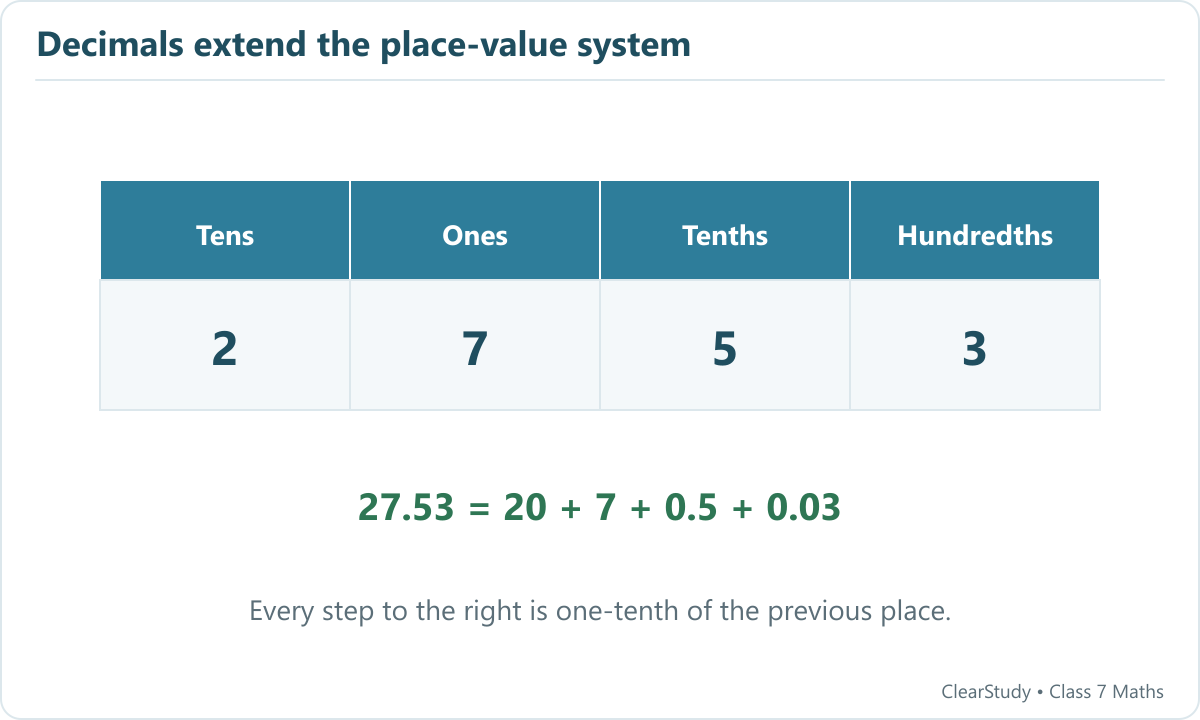
The number 27.53 has 2 tens, 7 ones, 5 tenths and 3 hundredths:20+7+0.5+0.03.
Decimal: an extension of the place-value system to show tenths, hundredths, thousandths, … e.g. 27.53 = 2 Tens + 7 Ones + 5 Tenths + 3 Hundredths.
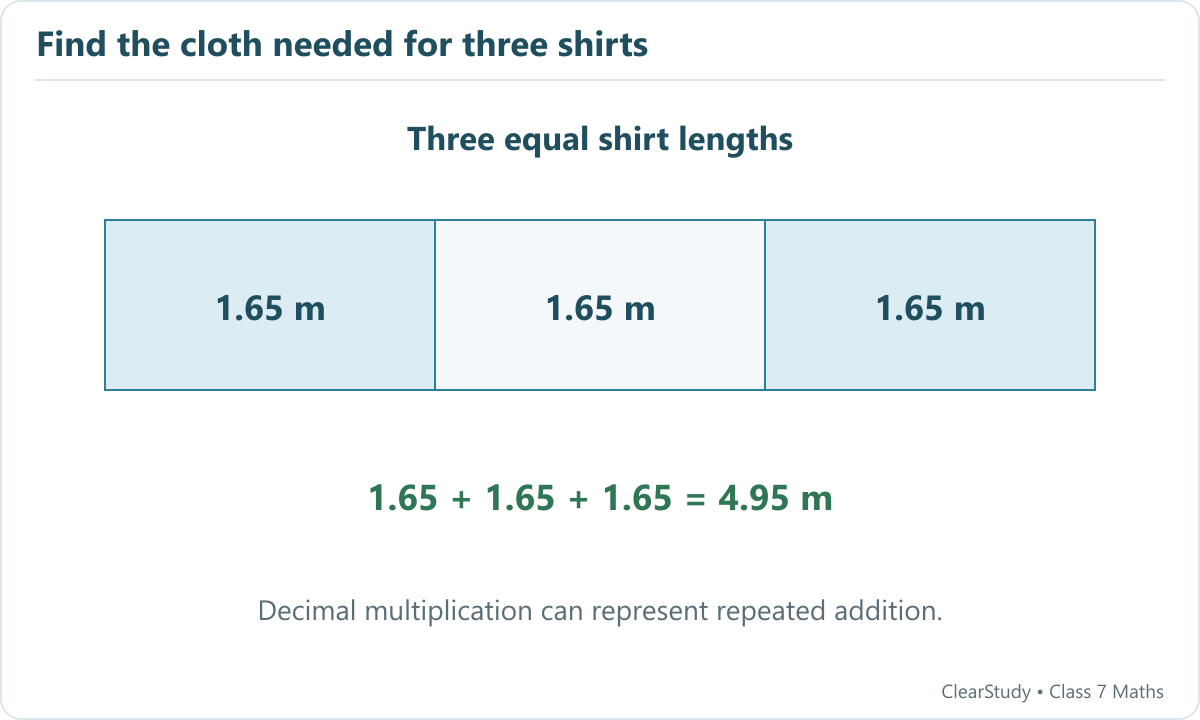
Multiplying decimals: remove the points, multiply as counting numbers, then put the point back so the product has as many decimal places as the two factors put together.
Dividing by 10, 100, 1000: shift the decimal point to the left by as many places as there are zeros in the divisor (e.g. 18.7 ÷ 100 = 0.187).
Multiplying by 10, 100, 1000: shift the decimal point to the right by as many places as there are zeros (e.g. 5.7 × 100 = 570).
Division by place value (long division): share Thousands, Hundreds, Tens and Ones; when Ones are regrouped into Tenths, put a decimal point in the quotient and carry on into Tenths, Hundredths, …
Decimal divisor: multiply both the dividend and the divisor by 10, 100, 1000… until the divisor becomes a whole number, then divide normally — the quotient is unchanged.
Recurring (non-terminating) decimal: a quotient whose digits never end and repeat in a cycle, e.g. 10 ÷ 3 = 3.333… and 1 ÷ 7 = 0.142857142857…
Important Formulas & Patterns (Chapter 12)
Decimal-place rule for products: (places in product) = (places in multiplier) + (places in multiplicand). Example: 5.96 (2 places) × 24.8 (1 place) → 147.808 (3 places).
Same-digits shortcut: if a × b = N, then shifting any point only moves the point in the answer, e.g. 18 × 12 = 216 ⇒ 1.8 × 1.2 = 2.16.
Division by powers of 10: N ÷ 10k moves the point k places left; multiplication by 10k moves it k places right.
Decimal-divisor trick: a ÷ b = (a × 10k) ÷ (b × 10k), e.g. 4.68 ÷ 0.13 = 468 ÷ 13.
Relationship product vs factors: two factors > 1 → product > both; two factors between 0 and 1 → product < both; one of each → product lies in between.
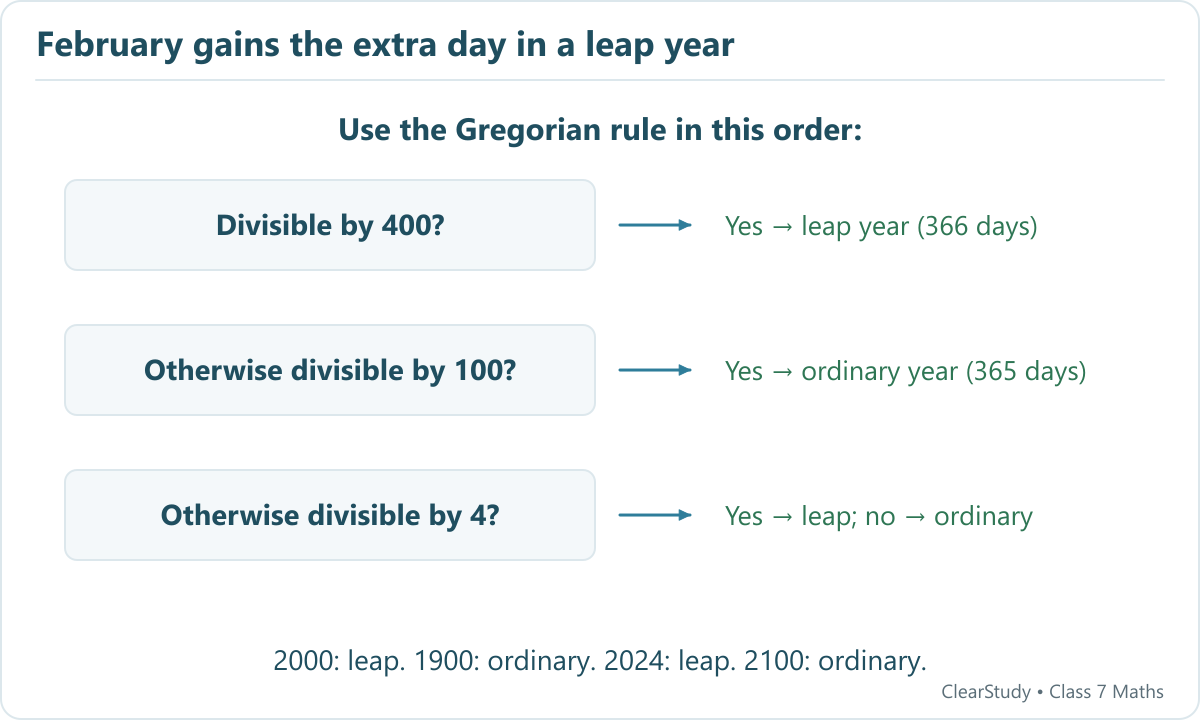
Leap-year rule: a year is a leap year (366 days) if it is divisible by 4, except century years, which are leap only if divisible by 400.
Figure it Out — Decimal Multiplication (Pages 73–74)
1. Recall that a tenth is 0.1, a hundredth is 0.01, and so on. Find the following products in tenths, hundredths and so on:
(a) 6 × 4 tenths = 24 tenths(b) 7 × 0.3(c) 9 × 5 hundredths
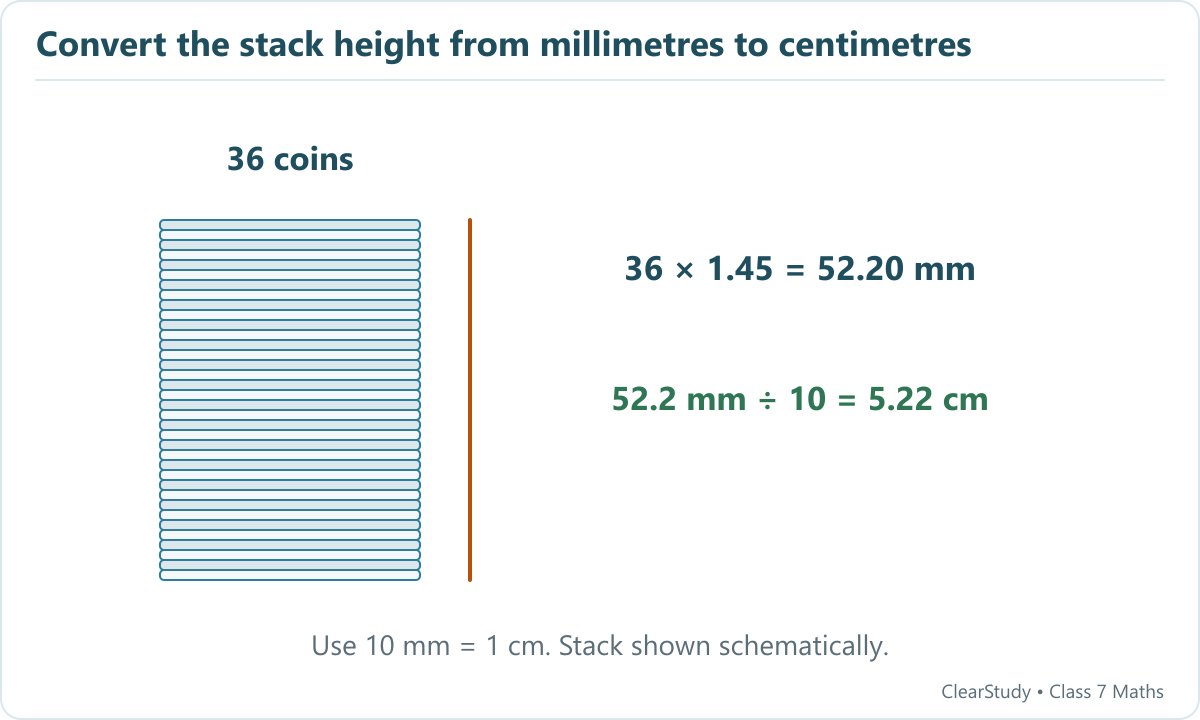
5. The thickness of a rupee coin is 1.45 mm. What is the total height of the cylinder formed by placing 36 rupee coins one over the other? Write the answer in centimeters.
SOLUTIONHeight = 1.45 × 36 mm. 145 × 36 = 5220; 1.45 has 2 places, so 1.45 × 36 = 52.20 mm.52.2 mm = 52.2 ÷ 10 = 5.22 cm.
A stack of 36 coins at 1.45 mm per coin is 52.20 mm tall, which equals 5.22 cm.
6. The price of 1 kg of oranges is ₹56.50. What is the price of 2.250 kg of oranges? Can we write 56.50 as 56.5 and 2.250 as 2.25 and multiply? Will we get the same product? Why?
SOLUTIONPrice = 56.50 × 2.250. Multiplying as whole numbers: 5650 × 2250 = 12712500; total places = 2 + 3 = 5, so the price = ₹127.125 (about ₹127.13).Yes, we may drop the trailing zeros and use 56.5 × 2.25. A trailing zero after the decimal point does not change the value: 56.50 = 56.5 and 2.250 = 2.25.565 × 225 = 127125; places = 1 + 2 = 3, so 56.5 × 2.25 = 127.125 — the same product, because the numbers are equal.
7. Dwarakanath purchases notebooks at a wholesale price of ₹23.6 per piece and sells each notebook at ₹30/-. How much profit does he make if he sells 50 books in a week?
SOLUTIONProfit per notebook = 30 − 23.6 = ₹6.4.Profit on 50 notebooks = 6.4 × 50 = ₹320.
8. Given that 18 × 12 = 216, find the products:
(a) 18 × 1.2 (b) 18 × 0.12(c) 1.8 × 1.2 (d) 0.18 × 0.12(e) 0.018 × 0.012 (f) 1.8 × 12In which of the cases above is the product less than 1?
SOLUTIONUse 18 × 12 = 216 and just place the point so that the product has as many decimals as the two factors together.(a) 1 place → 21.6; (b) 2 places → 2.16; (c) 1 + 1 = 2 places → 2.16.(d) 2 + 2 = 4 places → 0.0216; (e) 3 + 3 = 6 places → 0.000216; (f) 1 place → 21.6.Products less than 1: (d) 0.0216 and (e) 0.000216.
9. In which of the following multiplications is the product less than 1? Can you find the answer without actually doing the multiplications?
(a) 7 × 0.6 (b) 0.7 × 0.6(c) 0.7 × 6 (d) 0.07 × 0.06
SOLUTION(b) and (d). Both factors in 0.7 × 0.6 and 0.07 × 0.06 lie strictly between 0 and 1, so each product is smaller than either factor and therefore below 1.For (a), 7 × 0.6 > 2 × 0.6 = 1.2. For (c), 0.7 × 6 > 0.7 × 2 = 1.4. Both exceed 1. We have compared them without finding their full products.
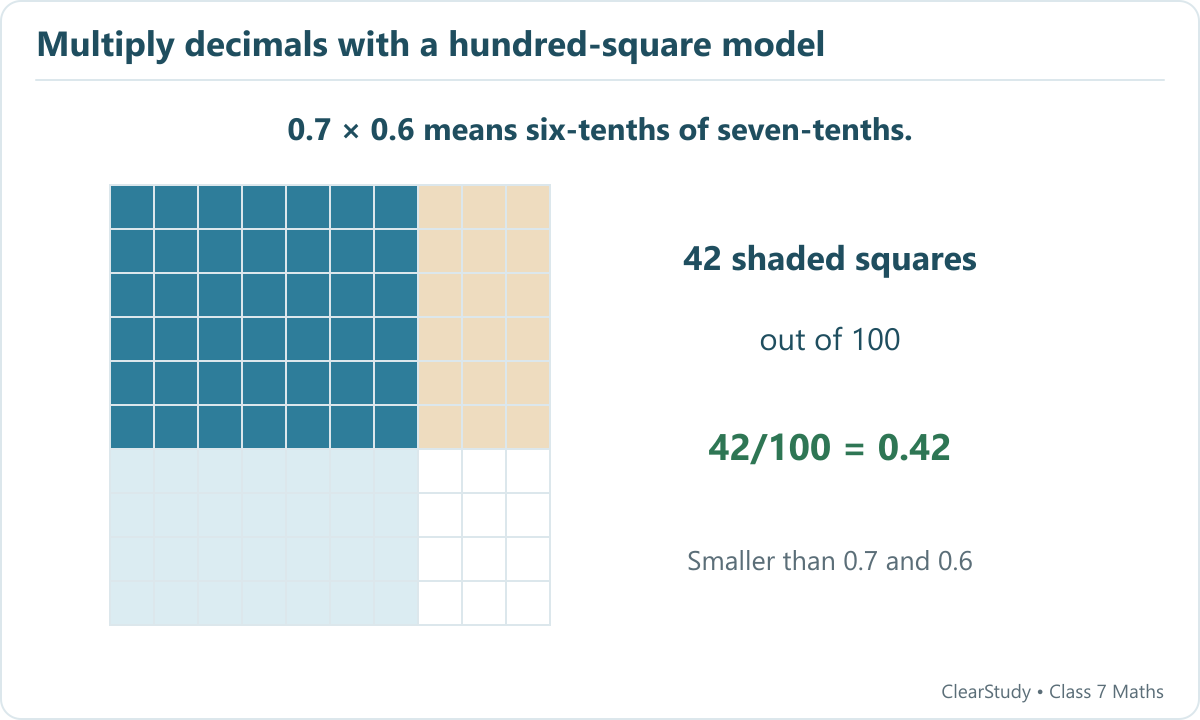
On a 10 by 10 unit square, seven columns and six rows overlap in 42 hundredths. Therefore 0.7×0.6=0.42, less than either factor.
10. Multiplying the following numbers by 10, 100 and 1000 to complete the table.
SOLUTIONTo multiply by 10, 100, 1000 move the decimal point 1, 2, 3 places to the right (adding zeros where needed).
Number
× 10
× 100
× 1000
5.7
57
570
5700
23.02
230.2
2302
23020
0.92
9.2
92
920
0.306
3.06
30.6
306
24.67
246.7
2467
24670
Figure it Out — Division by Place Value (Page 83)
1. Find the quotient by converting the denominator into 1, 10, 100 or 1000 and verify the solution by the long division method (division by place value).
(a) 18/5 (b) 415/4(c) 1217/2 (d) 4827/8
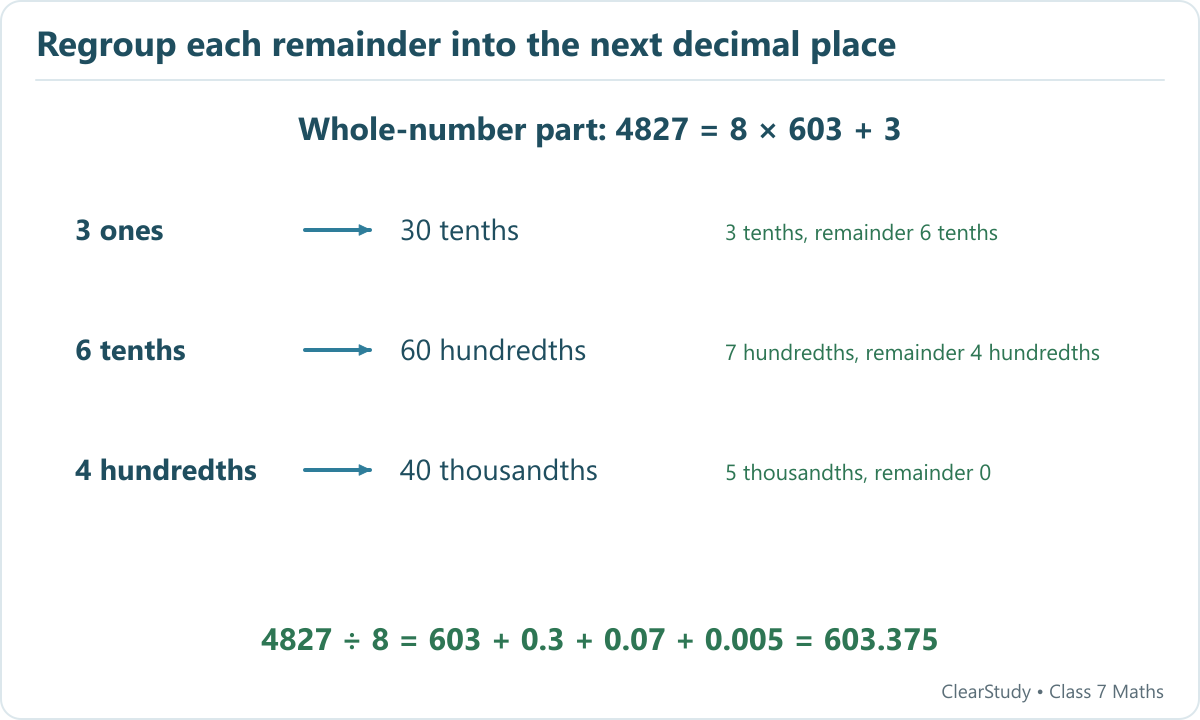
After 4827÷8 gives 603 remainder 3, regroup 3 ones as 30 tenths, 6 tenths as 60 hundredths and 4 hundredths as 40 thousandths. The decimal digits are 3, 7, 5, giving 603.375.
2. Choose the correct answer:
(a) 1526/4 = (i) 38.15 (ii) 380.15 (iii) 381.5 (iv) 381.05(b) 3567/8 = (i) 4458.75 (ii) 44.5875 (iii) 445.875 (iv) 4458.75
3. What is the quotient?
(a) 132 ÷ 4 = (b) 13.2 ÷ 4 =(c) 1.32 ÷ 4 = (d) 0.132 ÷ 4 =
SOLUTIONDivide 132 by 4 once (= 33), then move the point to match the dividend.(a) 132 ÷ 4 = 33; (b) 13.2 ÷ 4 = 3.3; (c) 1.32 ÷ 4 = 0.33; (d) 0.132 ÷ 4 = 0.033.
4. What is the quotient?
(a) 126 ÷ 8 = (b) 12.6 ÷ 8 =(c) 1.26 ÷ 8 = (d) 0.126 ÷ 8 =(e) 0.0126 ÷ 8 =
SOLUTION126 ÷ 8 = 15.75; now shift the point for each part.(a) 15.75; (b) 1.575; (c) 0.1575; (d) 0.01575; (e) 0.001575.
Figure it Out — Decimal Division (Pages 86–87)
1. Express the following fractions in decimal form:
(a) 2/5 (b) 13/4(c) 4/50 (d) 5/8
SOLUTION(a) 25 ÷ 1000 = 0.025; (b) 25 ÷ 0.1 = 250; (c) 25 ÷ 10 = 2.5.(d) 25 ÷ 10 = 25 × 0.1 (dividing by 10 is the same as multiplying by one-tenth).(e) 25 ÷ 0.10 = 25 × 10; (f) 25 ÷ 0.01 = 25 × 100 (dividing by a decimal less than 1 is the same as multiplying by its reciprocal).
5. Find the quotient:
(a) 2.46 ÷ 1.5 = (b) 2.46 ÷ 0.15 =(c) 2.46 ÷ 0.015 =Is the quotient obtained in 24.6 ÷ 1.5 the same as the quotient obtained in 2.46 ÷ 0.15?
SOLUTION(a) 2.46 ÷ 1.5 = 24.6 ÷ 15 = 1.64.(b) 2.46 ÷ 0.15 = 246 ÷ 15 = 16.4.(c) 2.46 ÷ 0.015 = 2460 ÷ 15 = 164.24.6 ÷ 1.5 = 246 ÷ 15 = 16.4, and 2.46 ÷ 0.15 = 246 ÷ 15 = 16.4. Yes, both equal 16.4 — multiplying dividend and divisor by the same power of 10 keeps the quotient unchanged.
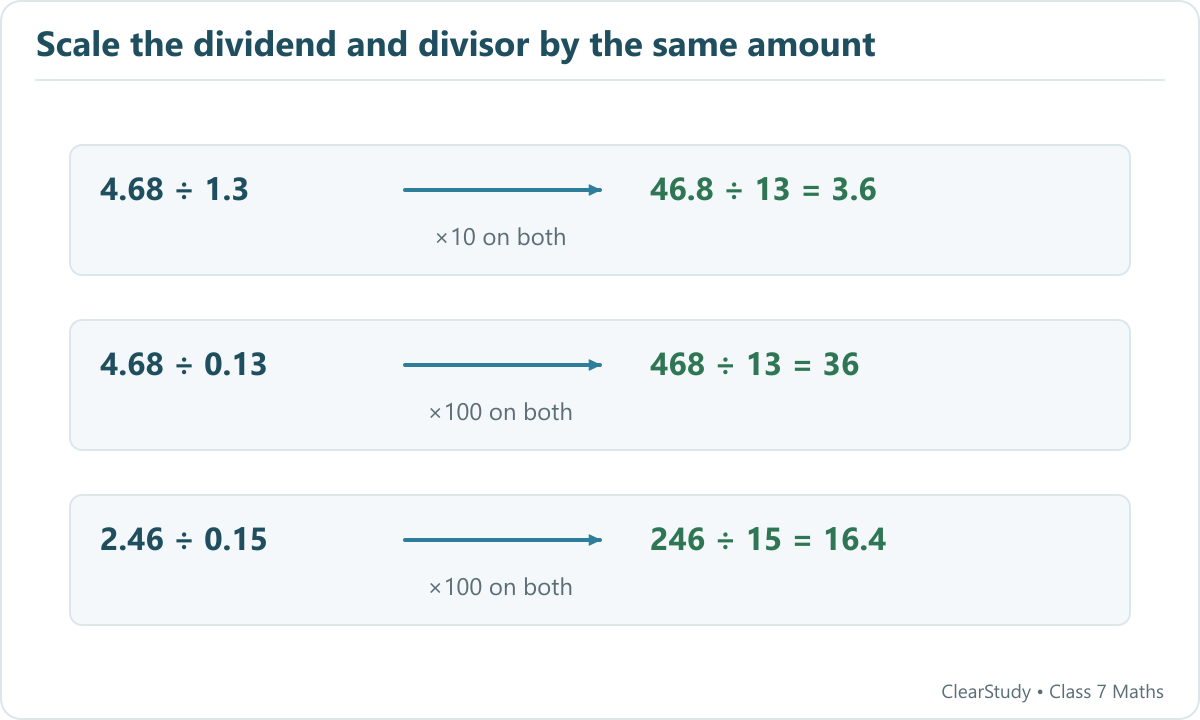
Multiplying both parts of a division by the same non-zero power of ten keeps the quotient unchanged. Examples:4.68÷1.3=3.6; 4.68÷0.13=36; 2.46÷0.15=16.4.
6. A 4 m long wooden block has to be cut into 5 pieces of equal length. What is the length of each piece?
SOLUTIONLength of each piece = 4 ÷ 5 = 40 tenths ÷ 5 = 8 tenths = 0.8 m.
7. If the perimeter of a regular polygon with 12 sides is 208.8 cm, what is the length of its side?
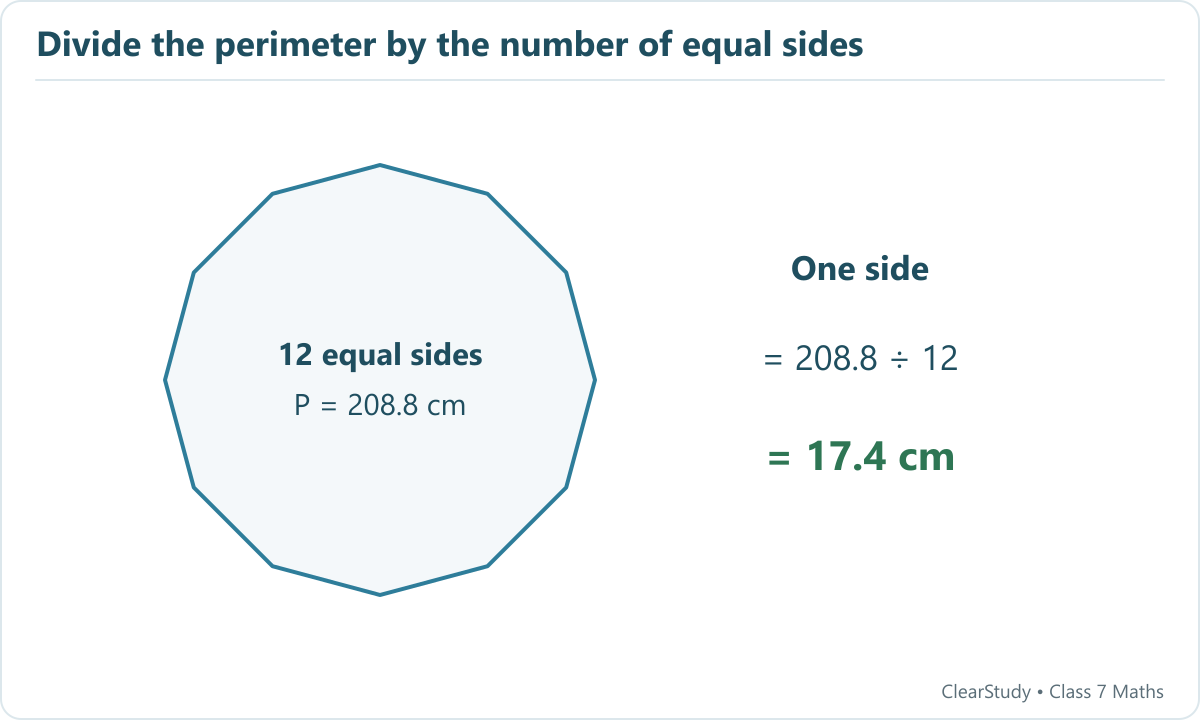
SOLUTIONAll sides of a regular polygon are equal, so side = perimeter ÷ number of sides = 208.8 ÷ 12.2088 ÷ 12 = 174, so 208.8 ÷ 12 = 17.4 cm.
A regular twelve-sided polygon with perimeter 208.8 cm has side length 208.8÷12=17.4 cm.
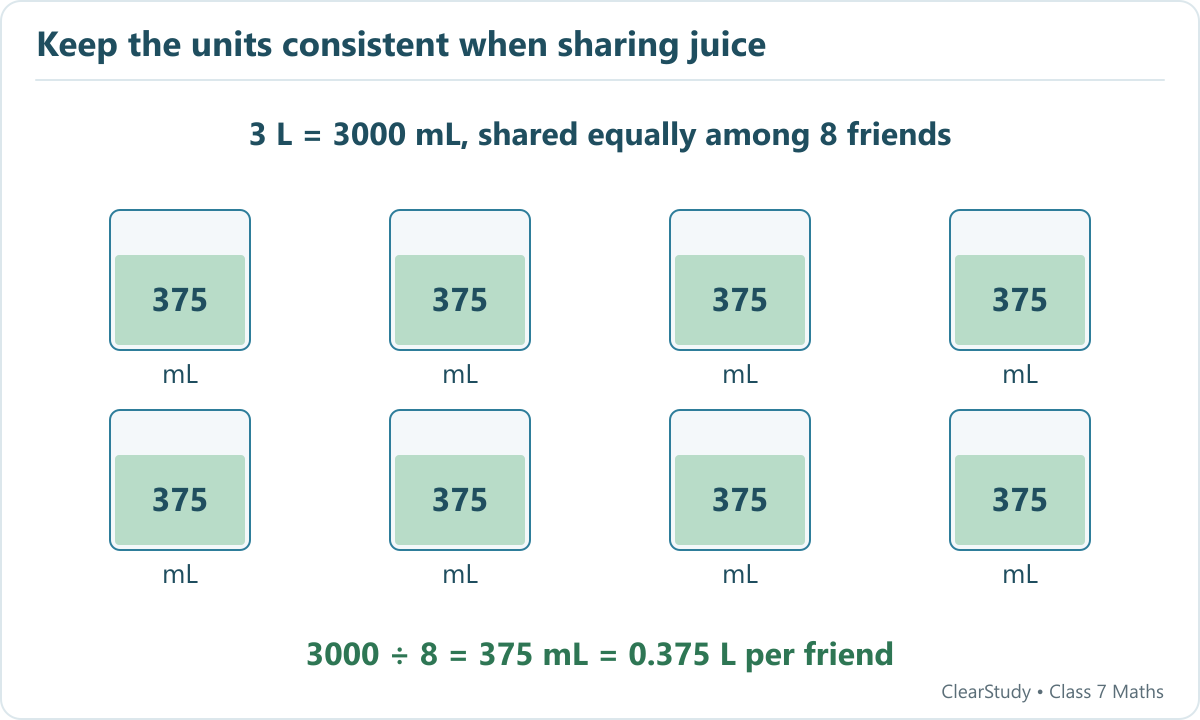
8. 3 litres of watermelon juice is shared among 8 friends equally. How much watermelon juice will each get? Express the quantity of juice in millilitres.
SOLUTIONEach friend gets 3 ÷ 8 = 0.375 litre.0.375 L = 0.375 × 1000 mL = 375 mL.
Eight equal shares of 3 litres each contain 375 mL, because 3000÷8=375. Each share is 0.375 litre.
9. A car covers 234.45 km using 12.6 litres of petrol. What is the distance travelled per litre?
SOLUTIONDistance per litre = 234.45 ÷ 12.6 = 2344.5 ÷ 126 (multiply both by 10).This does not divide evenly: 234.45 ÷ 12.6 = 18.607… ≈ 18.61 km per litre (a non-terminating decimal; rounded to two places).
10. 13.5 kg of flour (aata) was distributed equally among 15 students. How much flour did each student receive?
1. A 210 gram packet of peanut chikki costs ₹70.5, while a 110 gram packet of potato chips costs ₹33.25. Which is cheaper?
SOLUTIONCompare the cost per gram. Chikki: 70.5 ÷ 210 ≈ ₹0.336 per gram (about 33.6 paisa).Chips: 33.25 ÷ 110 ≈ ₹0.302 per gram (about 30.2 paisa).Since 0.302 < 0.336, the potato chips are cheaper per gram.
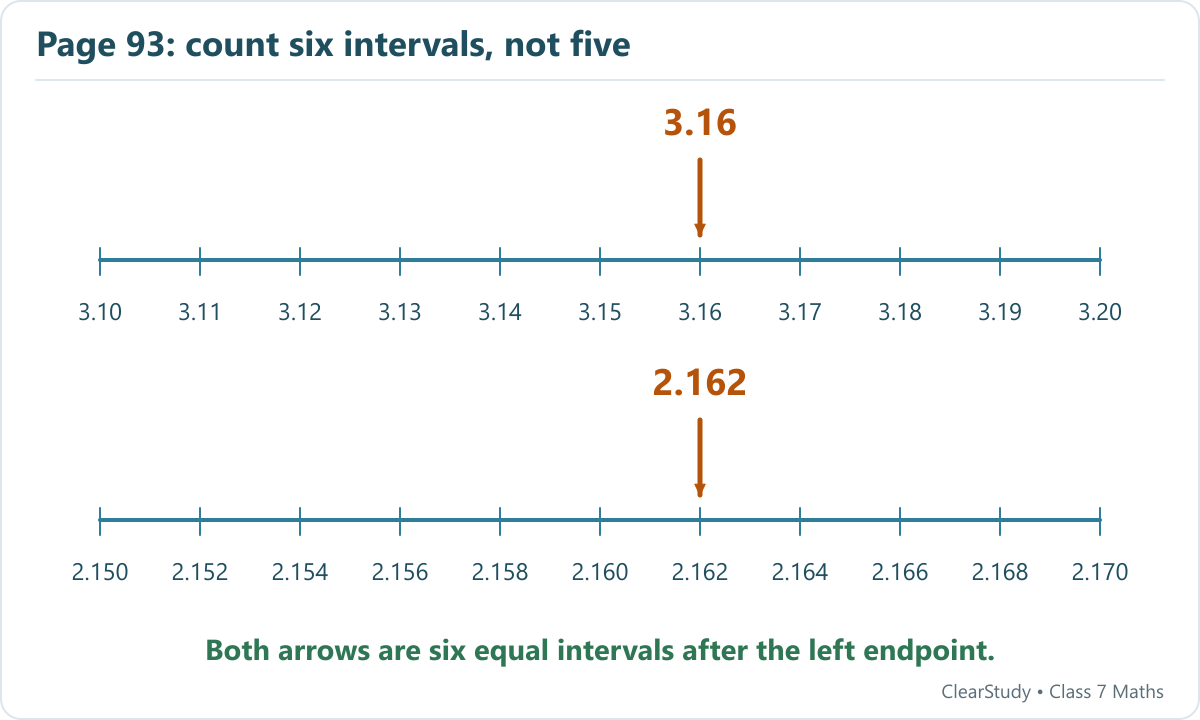
2. Write the decimal number at the arrow mark:
(i) a number line marked from 3.1 to 3.2(ii) a number line marked from 2.15 to 2.17
SOLUTION(i) 3.16. The interval from 3.1 to 3.2 is split into 10 equal parts, so each step is 0.01. The arrow is six steps after 3.1: 3.1 + 6 × 0.01 = 3.16.(ii) 2.162. The interval from 2.15 to 2.17 is split into 10 equal parts, so each step is 0.02 ÷ 10 = 0.002. The arrow is six steps after 2.15: 2.15 + 6 × 0.002 = 2.162.
First line:3.1+6×0.01=3.16. Second line:2.15+6×0.002=2.162. Both arrows point to the sixth subdivision after the left endpoint.
3. Shyamala bought 3 kg bananas at ₹30/- per kg. She counted 35 bananas in all. She sells each banana for ₹5/-. How much profit does she make selling all the bananas?
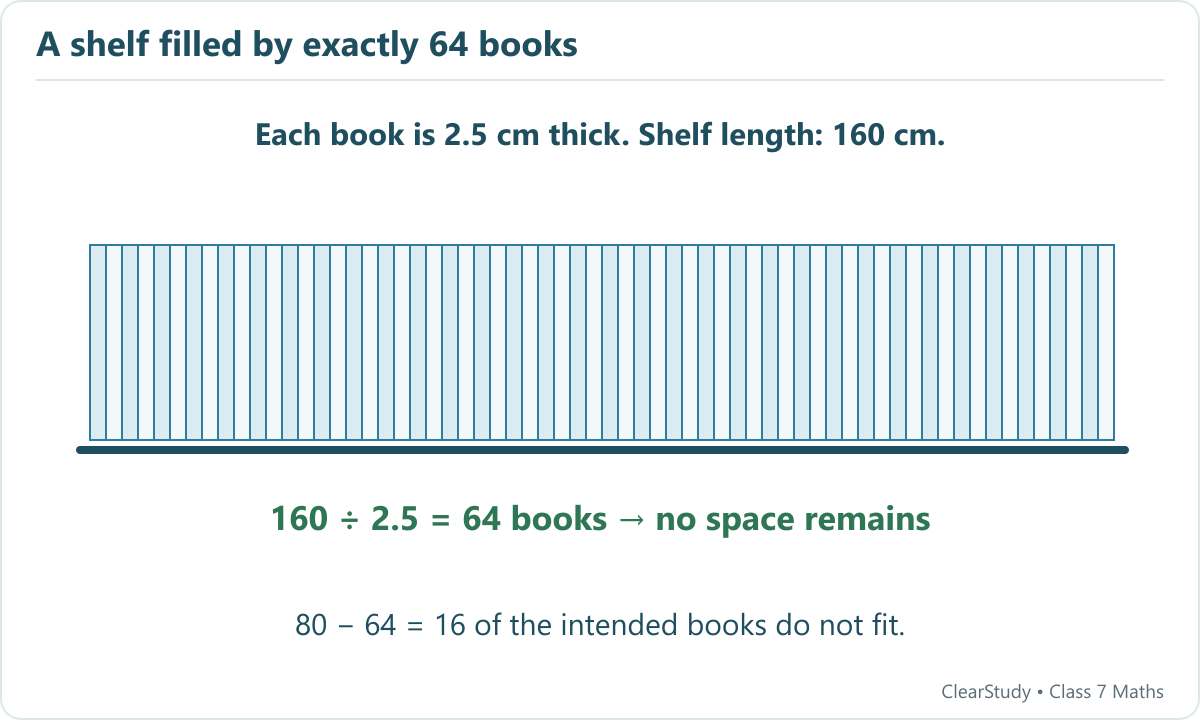
4. A teacher placed textbooks that are 2.5 cm thick on a bookshelf. The teacher wanted to place 80 textbooks on the shelf. The bookshelf is 160 cm long. How many books could be placed on the shelf? Was there any space left? If yes, how much?
SOLUTIONNumber of books that fit = 160 ÷ 2.5 = 1600 ÷ 25 = 64 books.64 books take 64 × 2.5 = 160 cm, which is exactly the shelf length, so no space is left (0 cm).The teacher wanted 80 books but only 64 can be placed; 80 − 64 = 16 books will not fit.
Sixty-four books of thickness 2.5 cm occupy 160 cm exactly. No space remains, and 16 of the 80 intended books do not fit.
5. Fill in the following blanks appropriately (1 cm = 10 mm, 1 m = 100 cm, 1 km = 1000 m, 1 kg = 1000 g, 1 g = 1000 mg, 1 l = 1000 ml):
5.5 km = _________ m 35 cm = ________ m 14.5 cm = _______ mm68 g = ________ kg 9.02 m = ________ mm 125.5 ml = _______ l
SOLUTION5.5 km = 5.5 × 1000 = 5500 m.35 cm = 35 ÷ 100 = 0.35 m.14.5 cm = 14.5 × 10 = 145 mm.68 g = 68 ÷ 1000 = 0.068 kg.9.02 m = 9.02 × 100 × 10 = 9.02 × 1000 = 9020 mm.125.5 ml = 125.5 ÷ 1000 = 0.1255 l.
6. The following problem was set by Sridharacharya in his book, Patiganita. “6¼ is divided by 2½, and 60¼ is divided by 3½. Tell the quotients separately.” Can you try to solve it by converting the fractions into decimals?
SOLUTIONConvert the mixed numbers to decimals: 6¼ = 6.25, 2½ = 2.5, 60¼ = 60.25, 3½ = 3.5.First quotient: 6.25 ÷ 2.5 = 62.5 ÷ 25 = 2.5.Second quotient: 60.25 ÷ 3.5 = 602.5 ÷ 35 = 17.214… ≈ 17.21 (a non-terminating decimal; equal to the fraction 241/14). The first quotient is exact, the second is recurring.
7. Fill the boxes in at least 2 different ways:
(a) □ × □ = 2.4 (b) □ × □ = 14.5
SOLUTIONAny pair of decimals whose product is the target works.(a) Two ways: 0.6 × 4 = 2.4 and 1.2 × 2 = 2.4 (also 0.8 × 3, 2.4 × 1, 0.4 × 6).(b) Two ways: 2.9 × 5 = 14.5 and 1.45 × 10 = 14.5 (also 29 × 0.5, 5.8 × 2.5).
8. Find the following quotients given that 756 ÷ 36 = 21:
(a) 75.6 ÷ 3.6 (b) 7.56 ÷ 0.36(c) 756 ÷ 0.36 (d) 75.6 ÷ 360(e) 7560 ÷ 3.6 (f) 7.56 ÷ 0.36
SOLUTIONIn each part rewrite the division so it becomes 756 ÷ 36 = 21 with the point shifted.(a) 75.6 ÷ 3.6 = 756 ÷ 36 = 21.(b) 7.56 ÷ 0.36 = 756 ÷ 36 = 21.(c) 756 ÷ 0.36 = 75600 ÷ 36 = 2100.(d) 75.6 ÷ 360 = 7.56 ÷ 36 = 0.21.(e) 7560 ÷ 3.6 = 75600 ÷ 36 = 2100.(f) 7.56 ÷ 0.36 = 756 ÷ 36 = 21 (same as part b).
9. Find the missing cells if each cell represents a÷b (column heads are values of a: 1517, 151.7, 15.17, 1.517, 15170; row heads are values of b: 37, 3.7, 0.37, 0.037, 370).
SOLUTIONEvery entry is a ÷ b. Since 1517 ÷ 37 = 41, all other cells are found by shifting the decimal point of 41 according to the points in a and b. The completed table is shown below.
b ↓ \ a →
1517
151.7
15.17
1.517
15170
37
41
4.1
0.41
0.041
410
3.7
410
41
4.1
0.41
4100
0.37
4100
410
41
4.1
41000
0.037
41000
4100
410
41
410000
370
4.1
0.41
0.041
0.0041
41
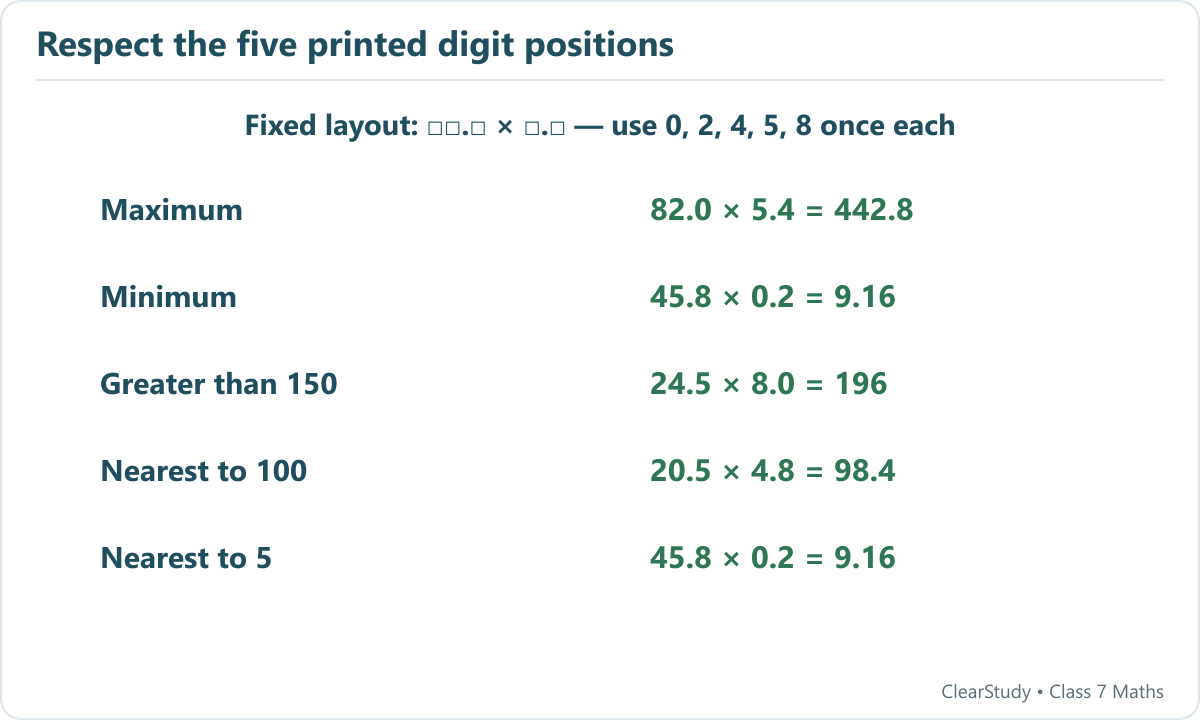
10. Using the digits 2, 4, 5, 8, and 0 fill the boxes □□.□ × □.□ to get the:
(a) maximum product (b) minimum product(c) product greater than 150 (d) product nearest to 100(e) product nearest to 5
SOLUTIONUse each digit exactly once in the fixed layout □□.□ × □.□. The first factor has two whole-number positions and one decimal position; the second has one of each.(a) Maximum: 82.0 × 5.4 = 442.8. Another maximum is 54.0 × 8.2 = 442.8.(b) Minimum: 45.8 × 0.2 = 9.16. To make the second factor smallest, use 0.2; the remaining digits form the smallest first factor, 45.8. Other permitted second factors produce larger products.(c) Greater than 150: 24.5 × 8.0 = 196.(d) Nearest to 100: 20.5 × 4.8 = 98.4, a distance of 1.6 from 100. Compare 40.8 × 2.5 = 102, a distance of 2.(e) Nearest to 5: 45.8 × 0.2 = 9.16, a distance of 4.16. This is the minimum permitted product and all products exceed 5. The layout does not permit 0.2 × 4.58 or 5.4 × 0.82.The maximum, minimum and nearest values were checked across all arrangements of the five digits in the printed positions.
Using each digit once in the layout two-digit decimal times one-digit decimal gives maximum 442.8, min 9.16, an example above 150 of 196, nearest 100 of 98.4, and nearest 5 of 9.16.
11. Sort the following expressions in increasing order:
(a) 245.05 × 0.942368 (b) 245.05 × 7.9682(c) 245.05 ÷ 7.9682 (d) 245.05 ÷ 0.942368(e) 245.05 (f) 7.9682
SOLUTIONReason without exact multiplication. Multiplying 245.05 by a number < 1 (a) makes it smaller; by a number > 1 (b) makes it much larger. Dividing by a number > 1 (c) makes it smaller; dividing by a number < 1 (d) makes it larger. (f) is just 7.9682.Approximate values: (f) ≈ 7.97, (c) ≈ 30.8, (a) ≈ 230.9, (e) = 245.05, (d) ≈ 260.0, (b) ≈ 1952.6.Increasing order: (f) < (c) < (a) < (e) < (d) < (b).
Math Talk & Try This — Answered
These are the in-text reflective tasks in the chapter; the determinate ones are answered, the open-ended ones are guided.
Math Talk — Dividing by 1 followed by zerosCan you give a simple rule to divide any number by a number of the form 1 followed by zeroes — 10, 100, 1000, etc.? For example, 123/10, 24/100 or 678/1000?Answer. Write the number with a decimal point and move the point to the left by as many places as there are zeros in the divisor. So 123 ÷ 10 = 12.3, 24 ÷ 100 = 0.24, 678 ÷ 1000 = 0.678 (and 12345 ÷ 1000 = 12.345).
Math Talk — Can the product be a natural number?Can the product of two decimals be a natural number? Can the product of a decimal and a natural number be a natural number?Answer.Yes to both. For example 2.5 × 0.4 = 1 (two decimals giving a whole number), and 2.5 × 8 = 20 (a decimal times a natural number giving a whole number). For example, (25/10) × (4/10) = 100/100 = 1; cancellation of the fraction factors leaves a whole number.
Math Talk — Using 596 × 248 = 147808Suppose we know that 596 × 248 = 147808, can you immediately write down the product of 5.96 × 24.8?Answer.Yes. 5.96 has 2 decimal places and 24.8 has 1, so the product has 2 + 1 = 3 decimal places: 5.96 × 24.8 = 147.808.
Math Talk — When is the product bigger or smaller?When is the product of two decimals greater than both the numbers? When is it less than both the numbers?Answer. The product is greater than both numbers when both factors are greater than 1 (e.g. 3.4 × 6.5 = 22.1). It is less than both when both factors lie between 0 and 1 (e.g. 0.75 × 0.4 = 0.3). If one factor is between 0 and 1 and the other is greater than 1, the product lies in between.
Math Talk — Q6 (price & trailing zeros)Can we write 56.50 as 56.5 and 2.250 as 2.25 and multiply? Will we get the same product? Why?Answer.Yes. A zero written after the last non-zero digit beyond the point does not change a number’s value, so 56.50 = 56.5 and 2.250 = 2.25. Both ways give the same product, ₹127.125. (Full working in Figure it Out p. 73, Q6.)
Math Talk — Quotient vs dividend with a decimal divisorWill the quotient be always greater than the dividend when the divisor is a decimal? Describe the relationship between the dividend, divisor and quotient.Answer. For a positive dividend, division by a number strictly between 0 and 1 increases the value; division by 1 preserves it; division by a number greater than 1 decreases it. For example, 128 ÷ 0.4 = 320, 128 ÷ 1 = 128, and 128 ÷ 4 = 32. If the dividend is zero and the divisor non-zero, the quotient is zero. Division by zero is undefined.
Math Talk — Q7 fill the boxesFill the boxes in at least 2 different ways: (a) □ × □ = 2.4; (b) □ × □ = 14.5.Answer. (a) 0.6 × 4 = 2.4 and 1.2 × 2 = 2.4. (b) 2.9 × 5 = 14.5 and 1.45 × 10 = 14.5. (Full list in Figure it Out p. 94, Q7.)
Math Talk — Powers of 2 and 5 patternWhat pattern do you observe in 1/2 = 0.5, 1/(2×2) = 0.25, … and 1/5 = 0.2, 1/(5×5) = 0.04, …? Why are 2 and 5 related in this way? What are 1/25 and 1/55?Answer. Each extra factor of 2 (or of 5) adds one more decimal place. The two columns are linked because 2 × 5 = 10, the base of our place-value system, so 1/2n and 1/5n both terminate after n places. Continuing: 1/25 = 1/32 = 0.03125 and 1/55 = 1/3125 = 0.00032.
Math Talk — Days in 100 calendar yearsWith the scheme of adding one extra day every 4th year, what is the number of days in 100 calendar years? Can you write different expressions for the same question?Answer. There are 25 years divisible by 4 in 100 years, so days = 100 × 365 + 25 = 36,525 days. Different expressions: (100 × 365) + (100 ÷ 4) × 1, or (75 × 365) + (25 × 366), both give 36,525. (Using the textbook approximation gives 100 × 365.2422 = 36,524.22 days, so this scheme over-counts.)
Math Talk — Days in 100 years with the “no leap in century” ruleCan you write an expression for the number of days in 100 calendar years with the adjustment that century years are not leap years?Answer. Now only 24 of the 100 years are leap years (the year 100 is excluded). Days = (24 × 366) + (76 × 365) = 8784 + 27,740 = 36,524 days — closer to the actual 36,524.22 days.
Try This — A second cyclic number from 1 ÷ 17To find another “cyclic” number like 142857, find 1 ÷ 17 in decimal and use the repeating block of digits.Answer. 1 ÷ 17 = 0.0588235294117647…, which repeats with the 16-digit block 0588235294117647. Like 142857, multiplying this block by 1, 2, 3, … up to 16 gives cyclic rearrangements of the same digits — so it is another cyclic number.
Try This — The final leap-year scheme over 10,000 yearsWith the final scheme of leap years (every 4th year, except centuries, except multiples of 400), calculate the number of calendar days in 10,000 years and the actual number of days the Earth takes for 10,000 revolutions. What is the difference? Can you suggest a fix?Answer. Apply the Gregorian rule to years 1 through 10,000. Leap years = 2500 − 100 + 25 = 2425. Calendar days = 10,000 × 365 + 2425 = 3,652,425. Using the textbook approximation of 365.2422 days per year gives 3,652,422 days, a difference of 3 days. A classroom proposal could omit three otherwise scheduled leap days, for example in years 3200, 6400 and 9600. That corrects this 10,000-year arithmetic model; it is not an adopted Gregorian rule. Omitting years divisible by 4000 would remove only two days in this interval, not three. Also, 365.2422 is an approximate tropical-year value, not an exact unchanging orbital period. See the U.S. Naval Observatory explanation of leap years.
Gregorian years divisible by 400 are leap years; other century years are ordinary; remaining years are leap if divisible by 4. This gives 97 leap years per 400 years.
Try This — Traditional Indian calendarsInvestigate how traditional calendars in India managed to consistently align the days in the calendar with astronomical events like the Earth going around the Sun or the positions of the stars.Answer (project guidance). India has solar and lunisolar calendar traditions. Solar calendars follow the Sun’s annual cycle; lunisolar calendars combine lunar months with a solar-year framework, using an intercalary month (adhika masa) when needed. For your project, compare one regional solar calendar with one lunisolar calendar, recording how each defines a month and keeps track of the year. Consult M. S. Sriram’s IIT Gandhinagar teacher-workshop notes for the astronomical background. Avoid treating all Indian calendars as one identical system.
Divide by powers of ten (Pages 74–75)A 3.9 m ribbon cut into 10 equal pieces gives 0.39 m each; cut into 100 pieces, it gives 0.039 m = 3.9 cm = 39 mm each.
Number
÷10
÷100
÷1000
÷10000
18.7
1.87
0.187
0.0187
0.00187
21.1
2.11
0.211
0.0211
0.00211
0.13
0.013
0.0013
0.00013
0.000013
2.146
0.2146
0.02146
0.002146
0.0002146
0.0058
0.00058
0.000058
0.0000058
0.00000058
Further worked examples (Pages 69–84)Multiplication: five pens at ₹9.5 cost ₹47.5; 12.5 km/L × 7.5 L = 93.75 km; Ajay walks 0.827 × 2 × 6 = 9.924 km each week. A 5.7 cm by 13.3 cm rectangle has area 75.81 cm2; using 13.35 cm instead gives 76.095 cm2.Division: 29 ÷ 2 = 14.5; 29 ÷ 4 = 7.25; 1324 ÷ 4 = 331; 1325 ÷ 4 = 331.25; 237 ÷ 8 = 29.625; 0.06 ÷ 5 = 0.012. Ravi’s average speed is 126 ÷ 2.5 = 50.4 km/h.Fraction verification: 5.8 × 1.24 = (58 × 124)/1000 = 7192/1000 = 7.192.
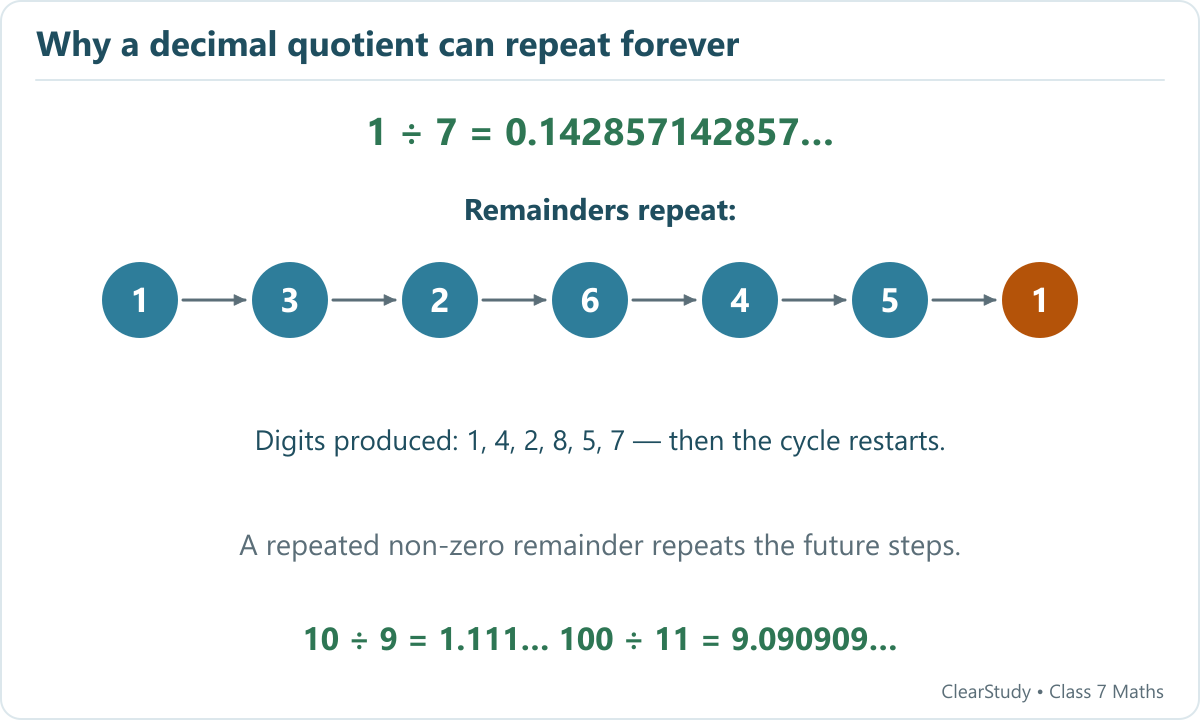
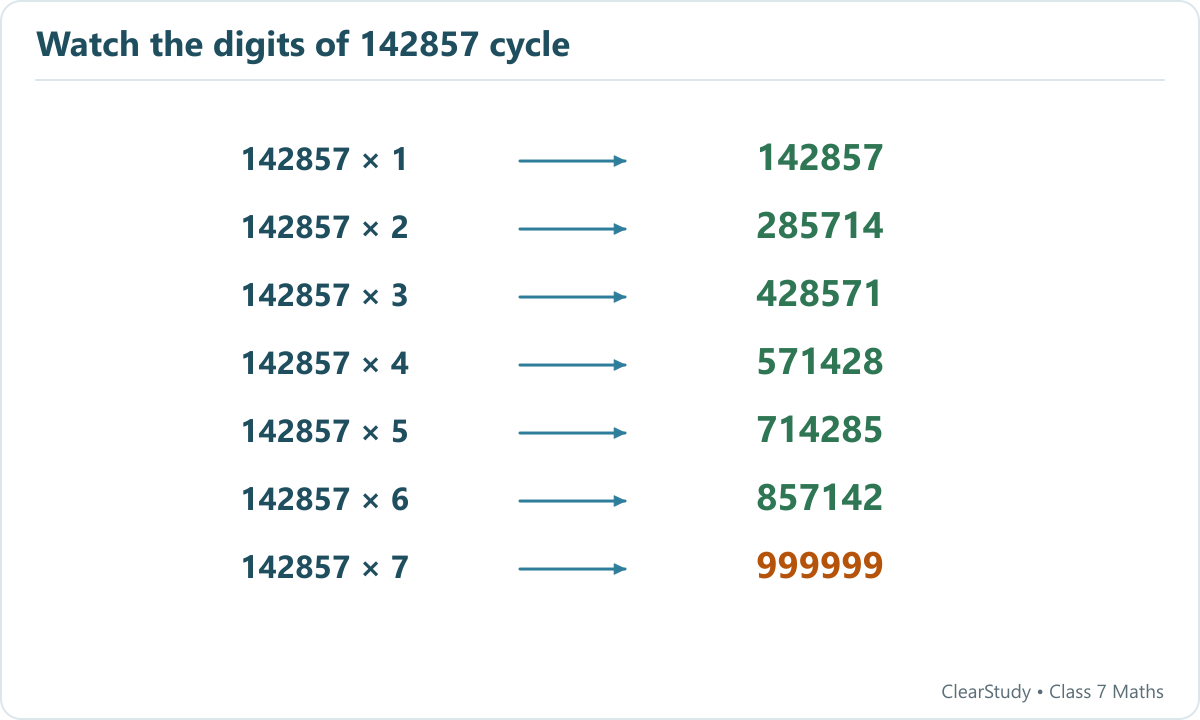
Recurring decimals and the cyclic number (Pages 85–86)10 ÷ 9 = 1.111… and 100 ÷ 11 = 9.090909…. A repeated non-zero remainder makes the future long-division steps repeat. For 1 ÷ 7, the remainders cycle through 1, 3, 2, 6, 4, 5 and back to 1; the repeating digits are 142857.Multiplying 142857 by 1 through 6 cycles its six digits. Multiplying by 7 gives 999999. In the separate 1/17 activity, retain a leading zero to display each cyclic block at the full width of 16 digits.
For 1÷7, the successive remainders 1, 3, 2, 6, 4, 5 return to 1. The quotient block 142857 then repeats. Similarly 10÷9=1.111… and 100÷11=9.090909….Multiplying 142857 by 1 through 6 gives 142857, 285714, 428571, 571428, 714285, 857142. Multiplying by 7 gives 999999.
Calendar calculation notes (Pages 88–93)The extra leap day is 29 February. Using the textbook model, four seasonal years take 4 × 365.2422 = 1460.9688 days, while three ordinary years and one leap year contain 1461 days.For years 1 through 1000, the Gregorian rule gives 250 − 10 + 2 = 242 leap years, hence 365,242 calendar days. This is 0.2 day below 365,242.2 in the stated model. The count for an arbitrary 1000-year interval can differ depending on its start year.The value 364.2422 in the page 93 prompt is a printing error relative to the chapter’s 365.2422-day approximation. The tropical year tracks the seasonal cycle and is approximate; it should not be described as an exact fixed period.
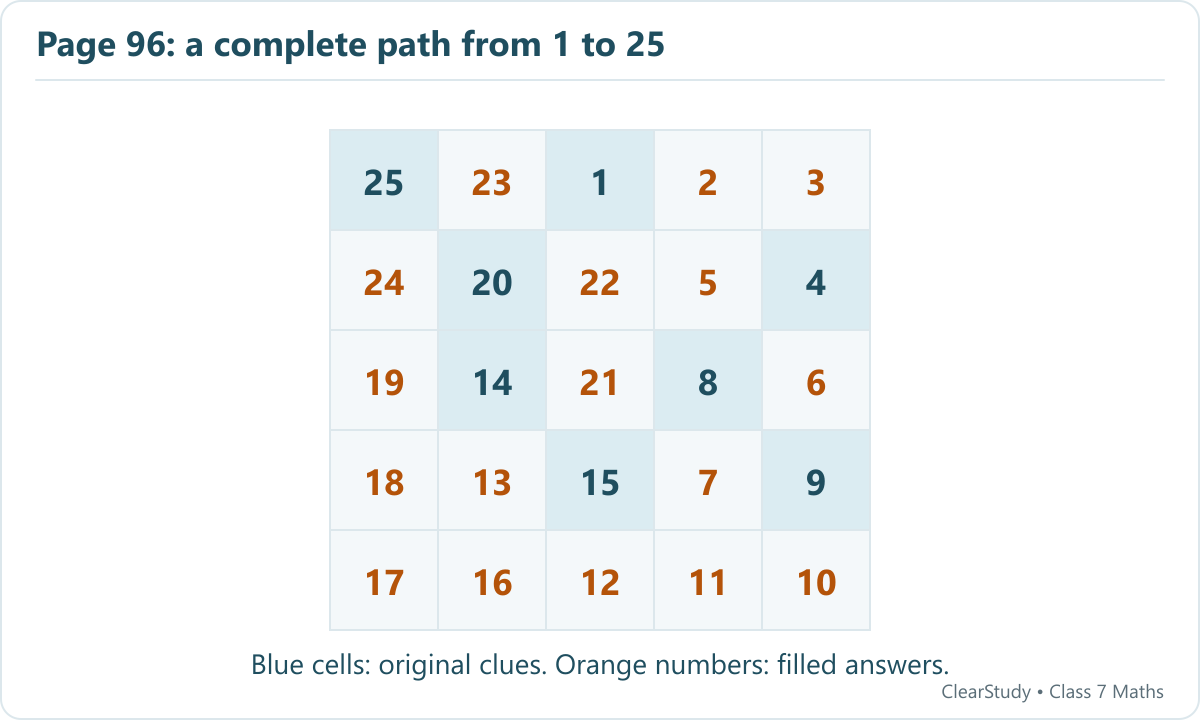
Hidato: the 5 × 5 puzzle (Page 96)The diagram below completes the first, square puzzle. Read a continuous path from 1 to 25; each consecutive number touches the next horizontally, vertically or diagonally. Every clue is preserved and every cell is used once. This is a worked example of the puzzle method.
Solution rows:25, 23, 1, 2, 3; 24, 20, 22, 5, 4; 19, 14, 21, 8, 6; 18, 13, 15, 7, 9; 17, 16, 12, 11, 10. Every consecutive pair is horizontally, vertically or diagonally adjacent, and all printed clues are preserved.
Common Mistakes to Avoid
Watch out for these
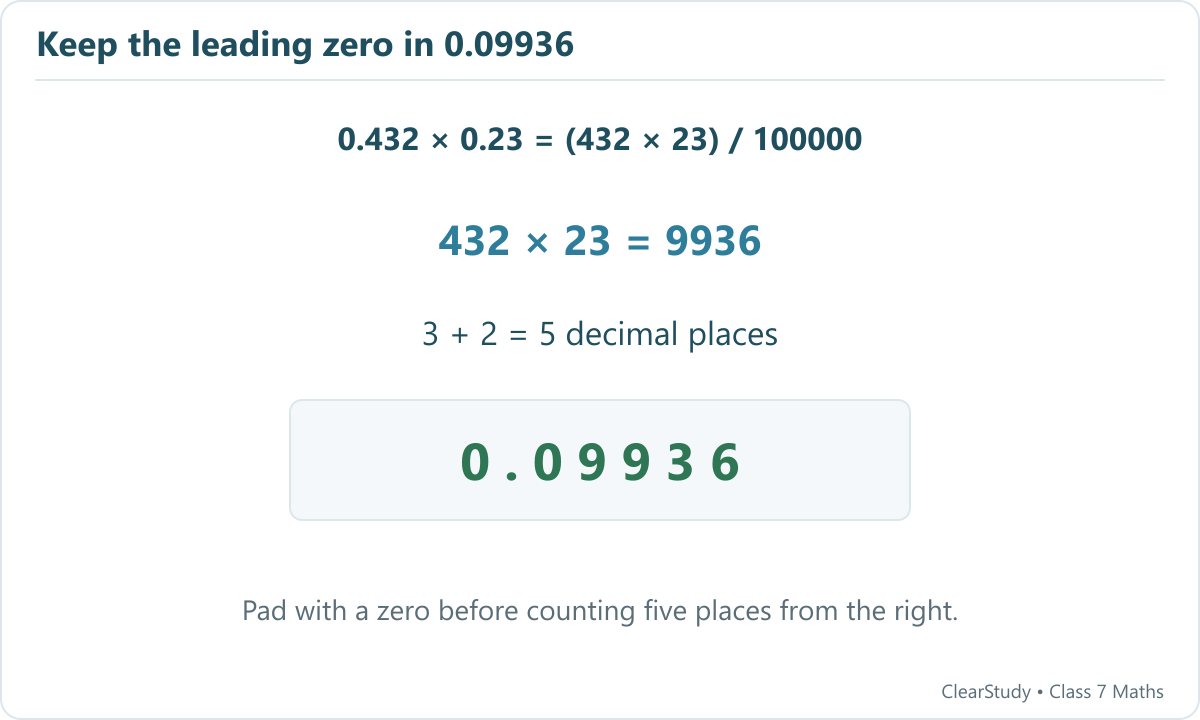
Forgetting to count all the decimal places — the product’s places equal the sum of the places in both factors (e.g. 0.432 × 0.23 has 5 places).
Moving the point the wrong way: ÷ 10 moves it left, × 10 moves it right.
When dividing by a decimal, multiplying only the divisor by 10/100… — you must multiply the dividend by the same number too.
Placing the decimal point in the quotient too early or too late — in long division put it in the quotient exactly when you regroup Ones into Tenths.
Assuming every division ends — some quotients (10 ÷ 3, 1 ÷ 7, 234.45 ÷ 12.6) are recurring and must be rounded or written with the repeating block.
Thinking the quotient is always smaller than the dividend — for a positive dividend and a divisor strictly between 0 and 1, the quotient is larger (128 ÷ 0.4 = 320).
Practice MCQs & Assertion–Reason
1. The product 4.23 × 3.7 is:
(a) 1.5651 (b) 15.651 (c) 156.51 (d) 1565.1
2. 0.306 × 1000 equals:
(a) 3.06 (b) 30.6 (c) 306 (d) 3060
3. 18.7 ÷ 100 equals:
(a) 1.87 (b) 0.187 (c) 0.0187 (d) 1870
4. Given 18 × 12 = 216, the value of 0.18 × 0.12 is:
(a) 2.16 (b) 0.216 (c) 0.0216 (d) 0.00216
5. The quotient 1526 ÷ 4 is:
(a) 38.15 (b) 380.15 (c) 381.5 (d) 381.05
6. Which fraction, written as a decimal, is 0.625?
For each Assertion–Reason question, choose: (A) Both Assertion and Reason are true and the Reason is the correct explanation of the Assertion; (B) Both are true but the Reason is not the correct explanation; (C) Assertion is true but Reason is false; (D) Assertion is false but Reason is true.
A-R 1. Assertion: 0.432 × 0.23 = 0.09936.
Reason: Before removing optional trailing zeros, place the decimal point using the sum of decimal places in the two factors.
A-R 2. Assertion: 24.86 ÷ 1.2 is a terminating decimal.
Reason: 24.86 ÷ 1.2 = 1243/60, and the simplified denominator contains the prime factor 3, so the decimal recurs.
A-R 3. Assertion: 128 ÷ 0.4 = 320, which is greater than 128.
Reason: For a positive dividend and a divisor strictly between 0 and 1, the quotient is greater than the dividend.
A-R 4. Assertion: 2.46 ÷ 0.15 and 24.6 ÷ 1.5 give the same quotient.
Reason: Multiplying the dividend and a non-zero divisor by the same non-zero number does not change the quotient.
A-R 5. Assertion: The year 2000 was a leap year but 1900 was not.
Reason: A century year is a leap year only when it is divisible by 400.
Answer key: 1-(A), 2-(D), 3-(A), 4-(A), 5-(A).
Quick Revision Summary
To multiply decimals: multiply as whole numbers, then give the product as many decimal places as the two factors together.
To multiply by 10, 100, 1000 move the point right; to divide by them move the point left, one place per zero.
Division by place value (long division) extends past the Ones into Tenths, Hundredths, …; place the point in the quotient when you regroup Ones into Tenths.
For a decimal divisor, multiply dividend and divisor by the same power of 10 to make the divisor a whole number; the quotient is unchanged.
Some quotients never end and repeat in a cycle (10 ÷ 3 = 3.333…, 1 ÷ 7 = 0.142857…); these are recurring decimals.
A product is greater than both factors only when both are > 1; for a positive dividend, a quotient exceeds it when the divisor is strictly between 0 and 1.
The leap-year rule (every 4th year, not centuries, but yes every 400th year) keeps the calendar close to the Earth’s 365.2422-day year.
How to score full marks in this chapter
Whenever you multiply or divide decimals, first do the sum with whole numbers and only then fix the decimal point — count the places carefully. For a decimal divisor, write the “clean” division (e.g. 4.68 ÷ 0.13 = 468 ÷ 13) before dividing. Show the place-value steps in long division and put the point in the quotient as soon as you reach the Tenths. If a quotient does not end, round it sensibly (say, to two decimal places) and say so. Check answers by reversing the operation or by estimating.
Frequently Asked Questions
What is Class 7 Maths Ganita Prakash Chapter 12 about?
Chapter 12, Another Peek Beyond the Point (Ganita Prakash Part II, Chapter 4), teaches how to multiply and divide decimals as natural extensions of whole-number operations, how to divide using place value (long division), how to recognise recurring decimals such as 10 ÷ 3 and 1 ÷ 7, and how decimals are used to design the leap-year calendar.
How do you place the decimal point when multiplying two decimals?
Ignore the points and multiply the numbers as whole numbers. Then put the point back so that the product has as many decimal places as the two factors have together. For example 5.96 (2 places) × 24.8 (1 place) = 147.808 (3 places).
Why do some decimal divisions never end?
When the denominator (after simplifying) has a prime factor other than 2 or 5, the long division leaves the same remainder again and again, so the digits repeat forever — for example 10 ÷ 3 = 3.333… and 1 ÷ 7 = 0.142857142857… These are called recurring or non-terminating decimals.
Are these Class 7 Maths Ganita Prakash Chapter 12 solutions free?
Yes. All solutions are free and follow the official NCERT Ganita Prakash (Part II) textbook for the 2026–27 session, with worked exercises, in-text explanations and original teaching diagrams.