Class 7 Maths Ganita Prakash Chapter 14 Solutions (NCERT 2026–27) – Constructions and Tilings
These Class 7 Maths Ganita Prakash Chapter 14 solutions cover Constructions and Tilings, which is Chapter 6 of Ganita Prakash Part II (the site lists it as Chapter 14 in continuous numbering). The worked examples explain ruler-and-compass constructions, geometric patterns and tiling proofs with original diagrams. A complete arrangement is shown for the first tangram silhouette; the other silhouettes are practice challenges.
Class: 7Subject: MathematicsBook: Ganita Prakash (Part II)Chapter: 14 (Part II, Ch. 6)Exercises: Six “Figure it Out” sets + Math Talk & Try ThisSession: 2026–27
Chapter 14 of Ganita Prakash, Constructions and Tilings (Part II, Chapter 6), teaches accurate geometric constructions using only an unmarked ruler and a compass, then explores how shapes cover a region or the whole plane. Starting from the playful ‘Eyes’ design, it derives the perpendicular bisector and proves it works using triangle congruence, then extends the idea to build a 90° angle, bisect any angle (giving 45°, 30°, 15°), copy an angle, draw parallel lines, and construct a 60° angle and a regular hexagon. It also visits the ancient Śulba-Sūtras rope methods, arch and star designs, tangrams, and finally tiling — deciding when an m × n grid can be covered by 2 × 1 tiles using a clever black-and-white colouring argument. The solutions below explain the core constructions, give worked geometric designs and tilings, and include a complete example for the first tangram silhouette.
Key Concepts & Definitions
Bisection: dividing a line segment (or any geometrical object) into two identical parts.
Perpendicular bisector: a line that bisects a given segment and is perpendicular to it. Key property — any point equidistant from the two endpoints of a segment lies on its perpendicular bisector.
Angle bisector: a ray that divides an angle into two equal angles. It can be drawn by building two congruent triangles (SSS) on the two arms.
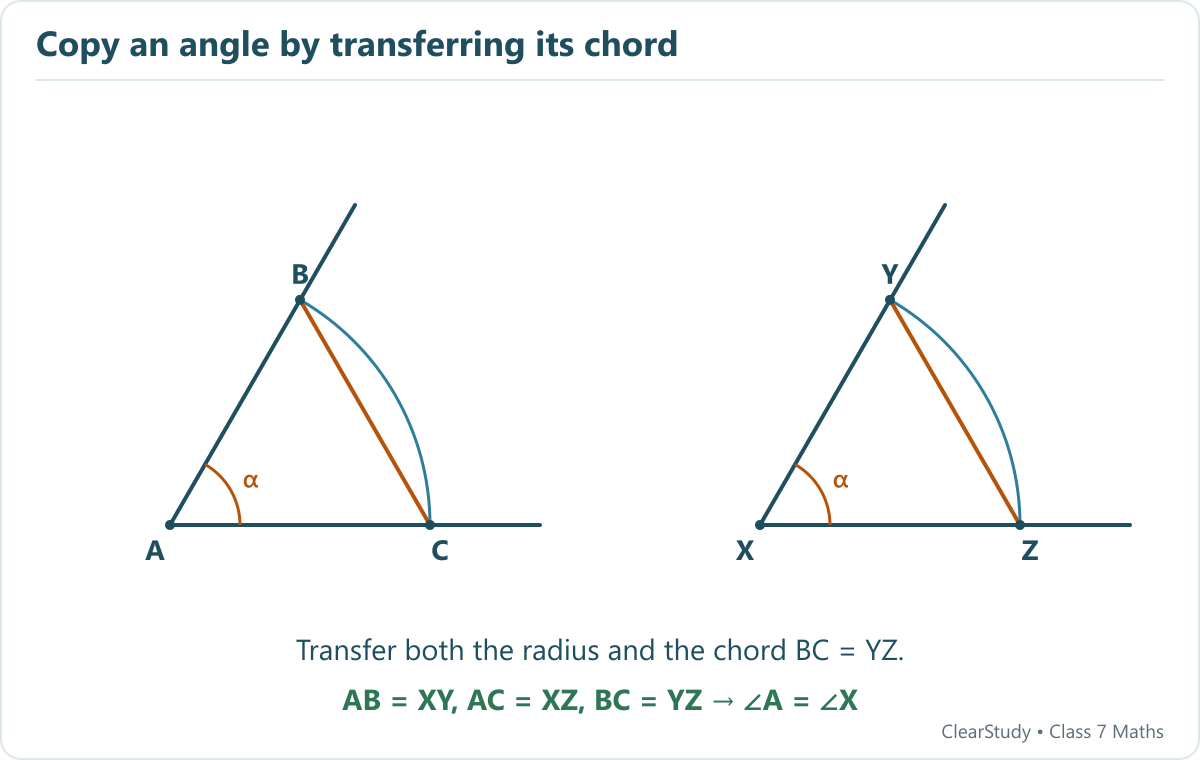
Copying an angle: reproducing the exact measure of a given angle elsewhere by transferring an isosceles triangle of arcs (SSS congruence makes ∠A = ∠X).
Congruence conditions used:SSS (three sides equal) and SAS (two sides and the included angle equal) — the proofs in this chapter rely on these.
Regular polygon: a polygon with all sides equal and all angles equal; a regular hexagon splits into 6 congruent equilateral triangles.
Tiling: covering a region using a set of shapes without gaps or overlaps.
Śulba-Sūtras: ancient Indian geometric texts (Vedāṅga) that give rope-and-peg methods to construct perpendiculars and perpendicular bisectors.
Important Constructions & Facts (Chapter 14)
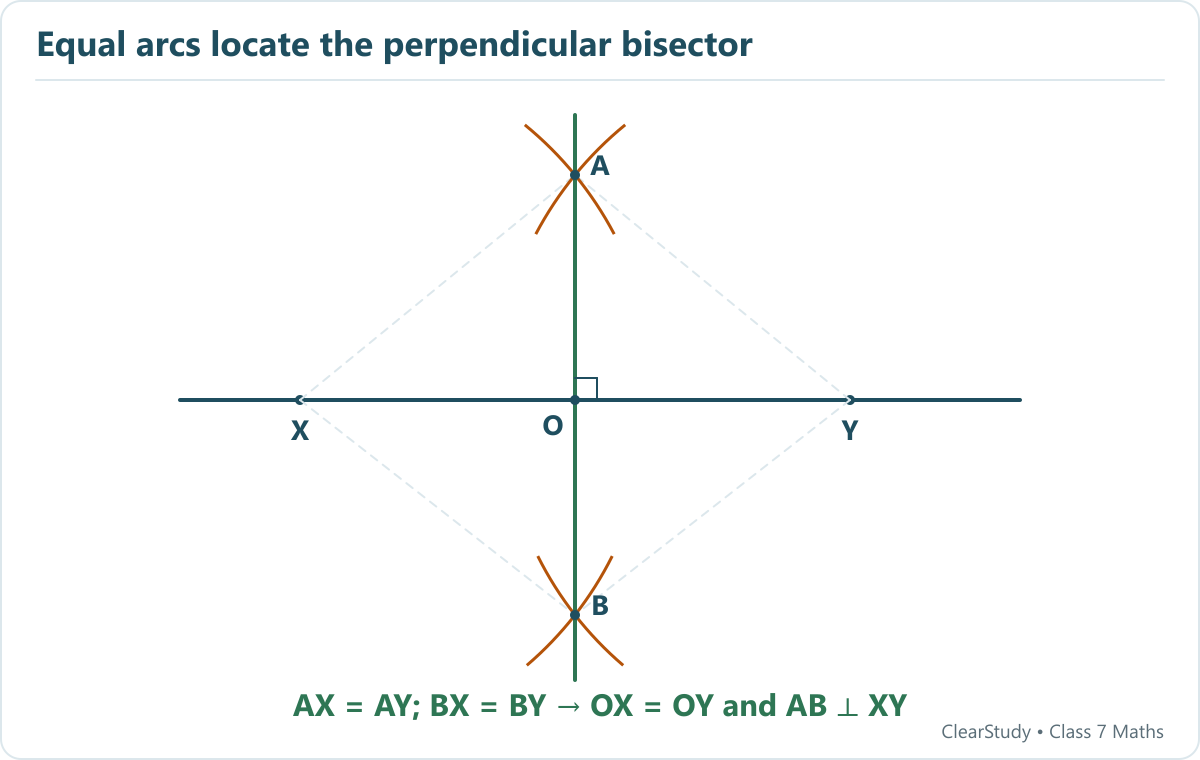
Perpendicular bisector of XY: with a fixed radius greater than half of XY, draw arcs from X and from Y above XY (meeting at A) and below XY (meeting at B); the line AB is the perpendicular bisector.
90° at a point O on a line: mark X and Y equidistant from O, then draw the perpendicular bisector of XY — it passes through O at 90° (only one extra arc point is needed since O is already on it).
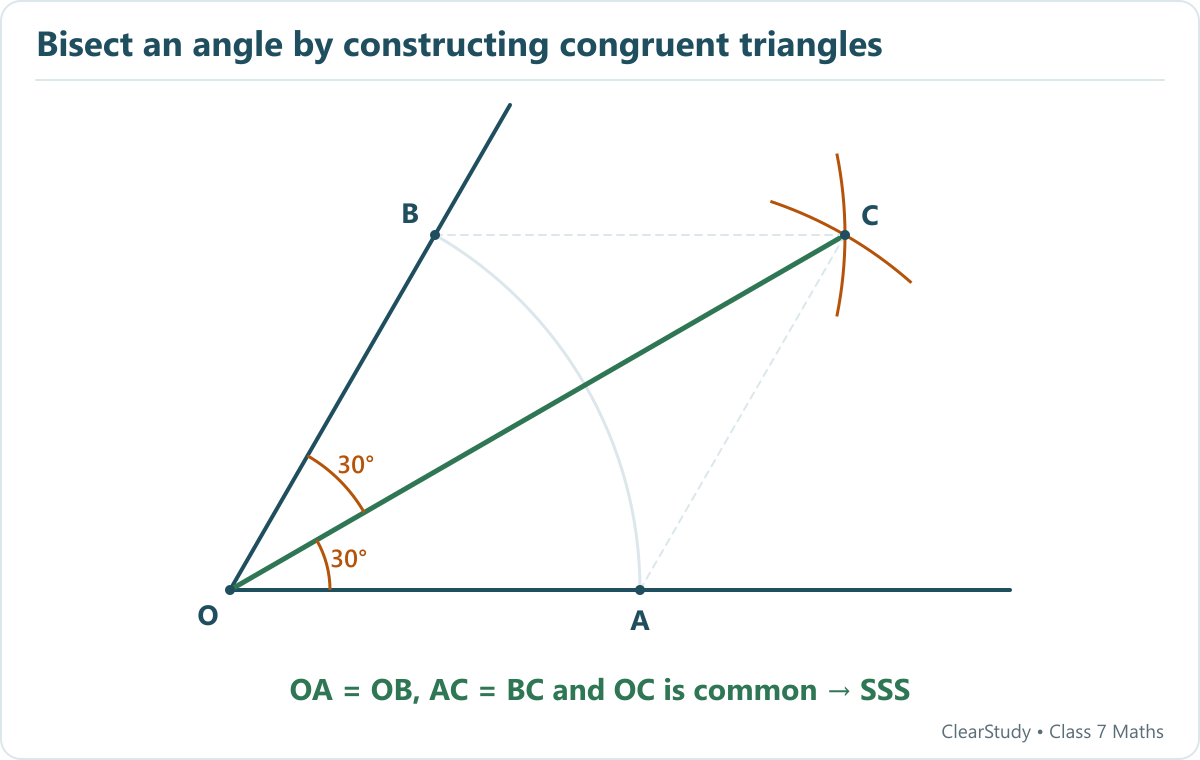
Angle bisector of ∠AOB: mark A, B with OA = OB; cut equal arcs from A and B meeting at C; OC bisects the angle (ΔOBC ≅ ΔOAC by SSS).
60° angle: draw an arc from A; with the same radius cut it from B to get C; ∠CAX = 60° (ΔABC is equilateral).
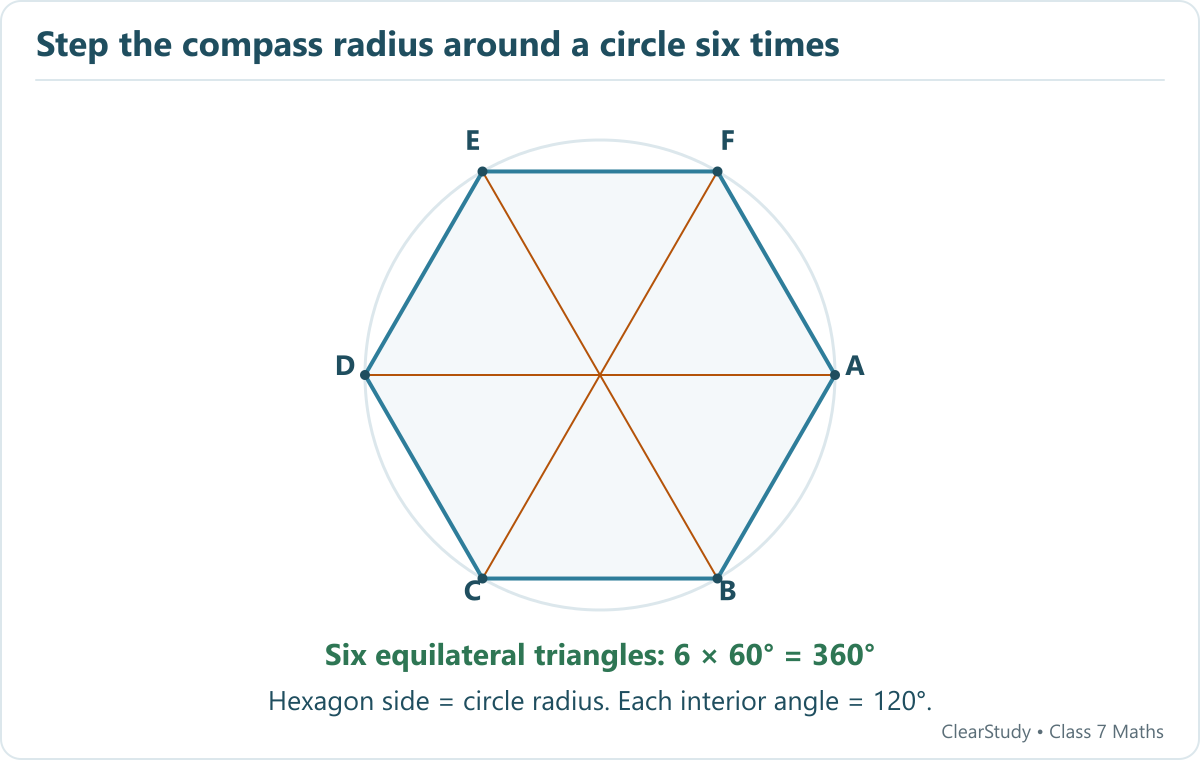
Regular hexagon: six congruent equilateral triangles meet at the centre (6 × 60° = 360°); each interior angle is 60° + 60° = 120°.
Tiling rule (2 × 1 tiles): each tile covers 2 unit squares, so a region must have an even number of unit squares; the colouring test then needs equal black and white squares.
Figure it Out — Perpendicular Bisector (Page 140)
1. When constructing the perpendicular bisector, is it necessary to have the same radius for the arcs above and below XY? Explore this through construction, and then justify your answer.
[Hint 1: Any point that is of the same distance from X and Y lies on the perpendicular bisector.Hint 2: We can draw the whole line if any two of its points are known.]
SOLUTIONNo, it is not necessary. Use one radius (say r₁) for the two arcs that meet above XY at point A, and a different radius (say r₂) for the two arcs that meet below XY at point B.Point A is equidistant from X and Y (both arcs had radius r₁), so AX = AY → A lies on the perpendicular bisector. Point B has BX = BY (both arcs had radius r₂), so B also lies on the perpendicular bisector.By Hint 2, two points fix a unique line. Since both A and B lie on the perpendicular bisector, the line AB is the perpendicular bisector — even though the two pairs used different radii.∴ the radius above and below need not be equal; only the two arcs that meet at the same point must share a radius.
Construct two intersection points using equal radii within each pair. Each radius must exceed half of XY. Joining the points gives the perpendicular bisector.
2. Is it necessary to construct the pairs of arcs above and below XY? Instead, can we construct both the pairs of arcs on the same side of XY? Explore this through construction, and then justify your answer.
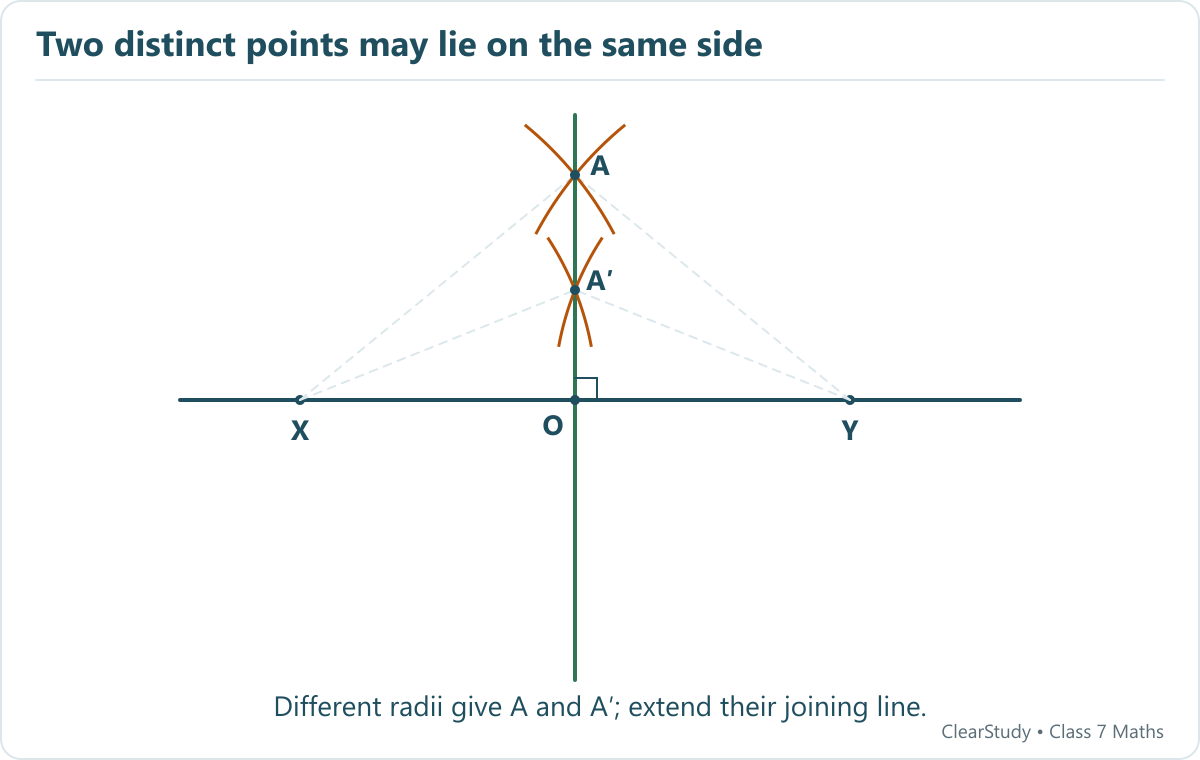
SOLUTIONYes, both pairs can be on the same side. Draw a first pair of equal arcs (radius r₁) from X and Y meeting above XY at A, and a second pair of equal arcs of a different radius (r₂) from X and Y also meeting above XY at a different point, say A′.Both A and A′ are equidistant from X and Y, so both lie on the perpendicular bisector. Joining A and A′ (and extending the line) gives the full perpendicular bisector.∴ we do not need one pair above and one below; any two distinct equidistant points determine the line, even if both lie on the same side. (The above-and-below method is just the most convenient.)
Two pairs of equal-radius arcs can meet at different points A and A prime above XY. Both lie on its perpendicular bisector.
3. While constructing one pair of intersecting arcs, is it necessary that we use the same radii for both of them? Explore this through construction, and then justify your answer.
SOLUTIONYes — for a single intersection point it is necessary. Suppose we draw an arc from X with radius r₁ and an arc from Y with a different radius r₂, and they meet at a point P.Then PX = r₁ and PY = r₂. If r₁ ≠ r₂, then PX ≠ PY, so P is not equidistant from X and Y and does not lie on the perpendicular bisector.∴ the two arcs that intersect at one point must use the same radius, so that the meeting point is equidistant from X and Y. (Question 1 only allowed different radii for different meeting points, not for the two arcs sharing one point.)
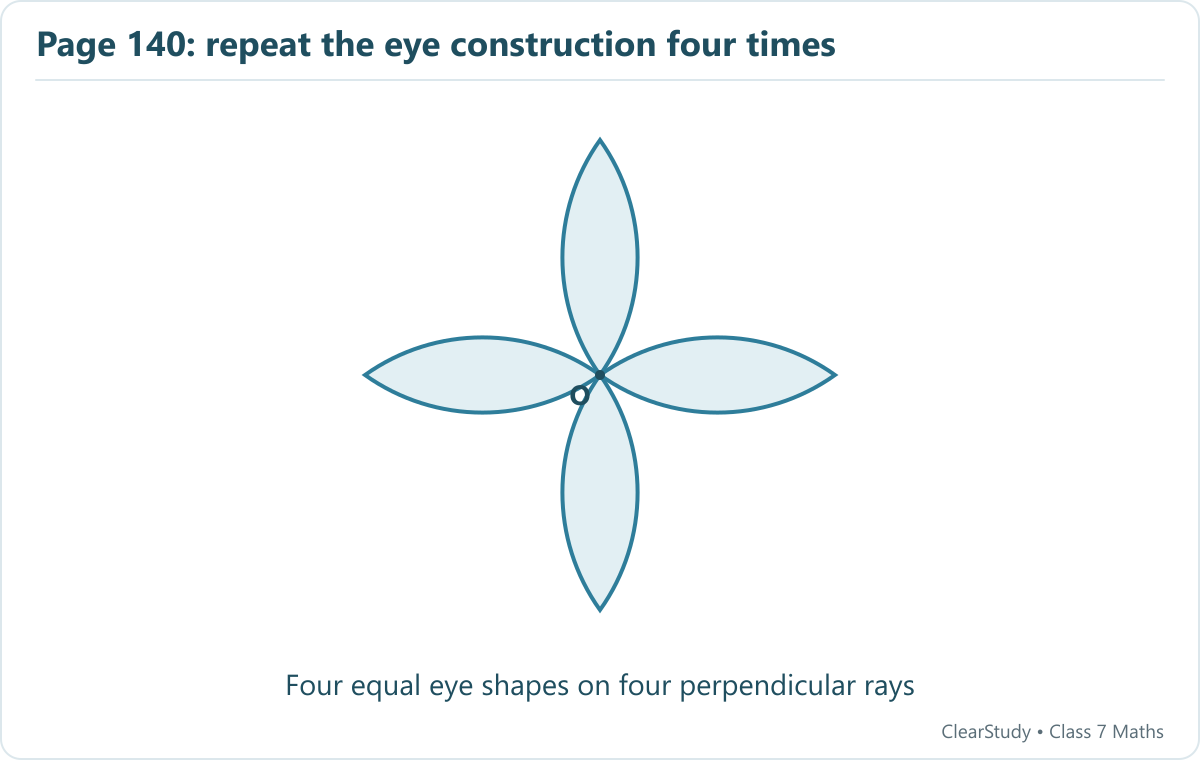
4. Recreate this design using only a ruler and compass —
SOLUTIONDraw two perpendicular lines through O. With one compass opening, mark four points at equal distance from O, one on each ray. These are the four petal tips.For each segment from O to a tip T, construct its perpendicular bisector. Choose two centres on opposite sides of OT at equal distance from its midpoint. Draw the two equal minor arcs through O and T to make an eye-shaped petal.Transfer the same centre offset and compass radius for the other three petals. Keep petals narrow enough that they meet only at O; lightly erase supporting lines and trace the four boundaries.
Four congruent lenses meet at O. Each lens has endpoints O and one of four equally distant points on perpendicular rays.
Figure it Out — Śulba Rope Method (Page 142)
1. Justify why AB in Fig. 6.4 is the perpendicular bisector.
SOLUTIONIn the rope method, the rope is folded in half and its midpoint marked; the two loop-ends are then fixed to the pegs at X and Y. When the midpoint is pulled taut above XY to point A, the two halves of the rope are equal, so AX = AY.Similarly, pulling the midpoint taut below XY to point B keeps the two halves equal, so BX = BY.Thus both A and B are equidistant from X and Y, so each lies on the perpendicular bisector of XY. Two points determine the line, so AB is the perpendicular bisector of XY — exactly the property used in the compass construction.
2. Can you think of different methods to construct a 90° angle at a given point on a line using a rope? (Math Talk)
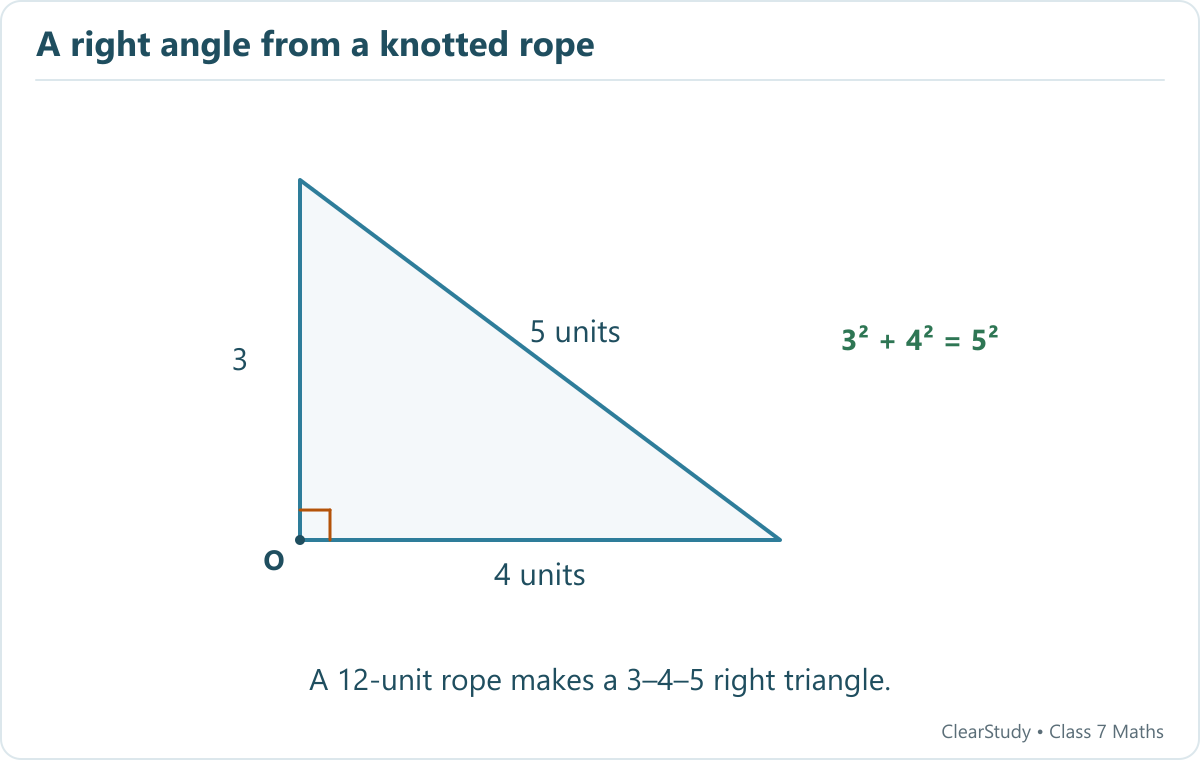
SOLUTIONMethod A (perpendicular bisector idea). On the line, fix pegs at X and Y so that the given point O is exactly the midpoint of XY (fold a rope of length XY to find its midpoint and place O there). Then build the perpendicular bisector of XY with the rope as above; it passes through O and is perpendicular to the line, giving a 90° angle at O.Method B (3–4–5 right-angle rope). Use a rope knotted into 12 equal parts. Peg it as a triangle with sides 3, 4 and 5 units, placing the corner of the 3-unit and 4-unit ropes at O along the line. Because 32 + 42 = 52, the angle at O is exactly 90° — a classic Śulba-style construction.
Place the 3-unit and 4-unit sides together at O; align one of them with the given line. The opposite side is 5 units, so the angle at O is 90 degrees.
Figure it Out — Angle Bisection (Pages 144–145)
1. Construct at least 4 different angles. Draw their bisectors.
SOLUTIONChoose constructible examples 60°, 90°, 120° and 150°. Make 60° from an equilateral triangle, 90° by a perpendicular, 120° as the supplement of 60°, and 150° as the supplement of 30°.For each angle, draw an arc centred at O to mark A and B with OA = OB. Draw equal-radius arcs from A and B meeting at an interior point C distinct from O. Join OC.Since OA = OB, AC = BC and OC is common, triangles OAC and OBC are congruent by SSS. The four bisectors give 30°, 45°, 60° and 75° respectively.
For this 60-degree example, equal distances OA and OB and equal arcs AC and BC create two congruent triangles. Ray OC divides the angle into two 30-degree angles.
2. Construct the 8-petalled figure shown in Fig. 6.5.
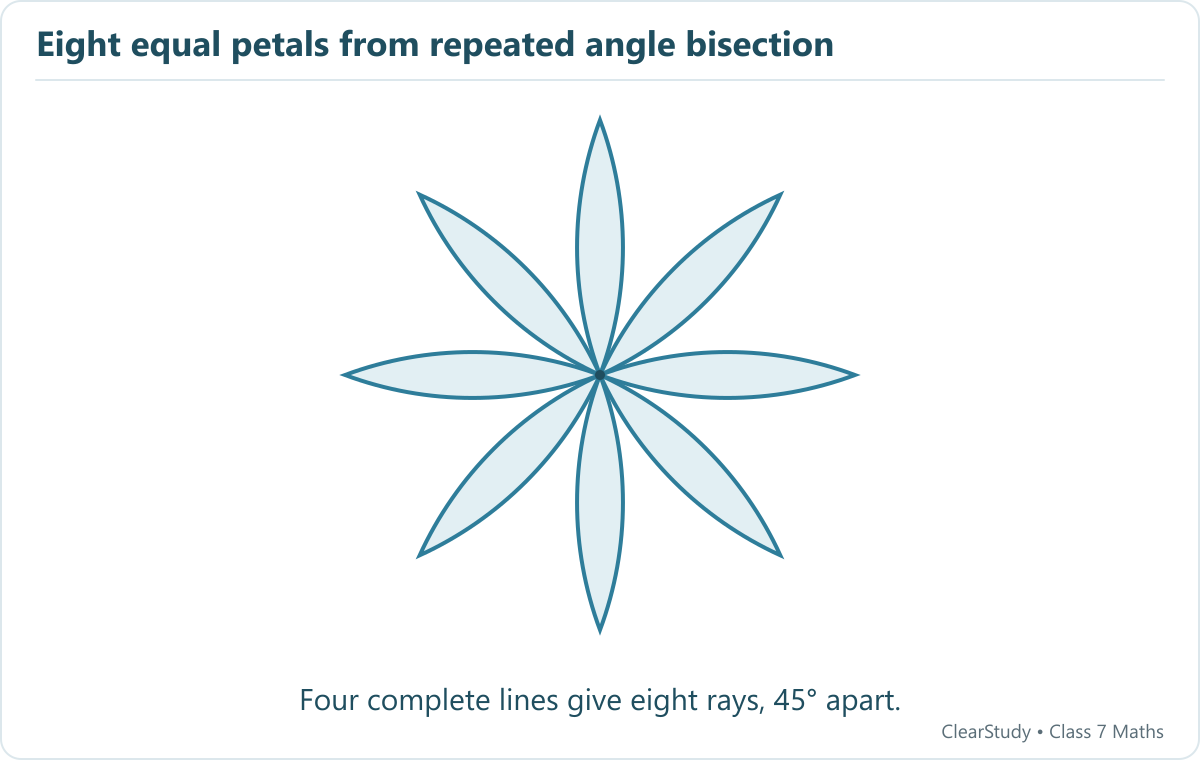
SOLUTIONConstruct two perpendicular lines through O: this gives four rays. Bisect each right angle to obtain eight rays at 45° intervals, lying on four complete lines.Mark a tip at the same distance along each ray. For each segment from O to a tip, construct the same narrow eye-shaped lens as in the four-petal design. Each ray runs through the middle of a petal.Use equal radii and equal centre offsets for every lens; select a narrow shape so adjacent petals do not overlap.
Construct two perpendicular lines and bisect the four right angles. The resulting four lines form eight rays; repeat a narrow congruent eye along each ray.
3. In Step 2 of angle bisection, if arcs of equal radius are drawn on the other side, as shown in the figure, will the line OC still be an angle bisector? Explore this through construction, and then justify your answer.
SOLUTIONYes, the complete line OC is still the same angle-bisector line. Equal distances OA = OB and CA = CB put both O and C on the perpendicular bisector of AB.In the pictured case C is behind O. The ray OC points away from the interior of the smaller angle AOB; its opposite ray bisects that angle. Ray OC instead bisects the reflex angle formed by OA and OB.Thus distinguish the complete line, which works when extended through O, from the ray directed from O toward C. Choose C distinct from O.
4. What are the other angles that can be constructed using angle bisection? Can you construct 65.5° angle? (Math Talk)
SOLUTIONRepeated bisection halves an angle each time. Starting from 90° we get 45°, 22.5°, 11.25°, …; from 60° we get 30°, 15°, 7.5°, …; combining and bisecting standard angles also gives 75°, 105°, 120°, 135°, 150°, etc.In general, by bisecting and adding constructible angles we can build any angle of the form (multiple of 15°) and their repeated halves — e.g. 7.5°, 3.75°, and so on.65.5°: this is not obtainable by bisection of 60°/90°, since 65.5° is not a sum/half of the standard constructible angles (15°, 30°, 45°, … and their halves). So 65.5° cannot be constructed by simple ruler-and-compass angle bisection here.
5. Come up with a method to construct the angle bisector using a rope.
SOLUTIONUse one rope length from O to mark A and B on the two arms, so OA = OB. Stretch a rope between A and B and fold it in half to locate its midpoint M.Stretch a straight rope from O through M. Since OA = OB, AM = BM and OM is common, triangles OAM and OBM are congruent by SSS; OM bisects the angle.Alternatively use equal rope lengths as compass radii from A and B to locate a second equidistant point C inside the angle, then join O to C.
6. Construct the following figure.
How do we construct the petals so that they are of the maximum possible size within a given square?
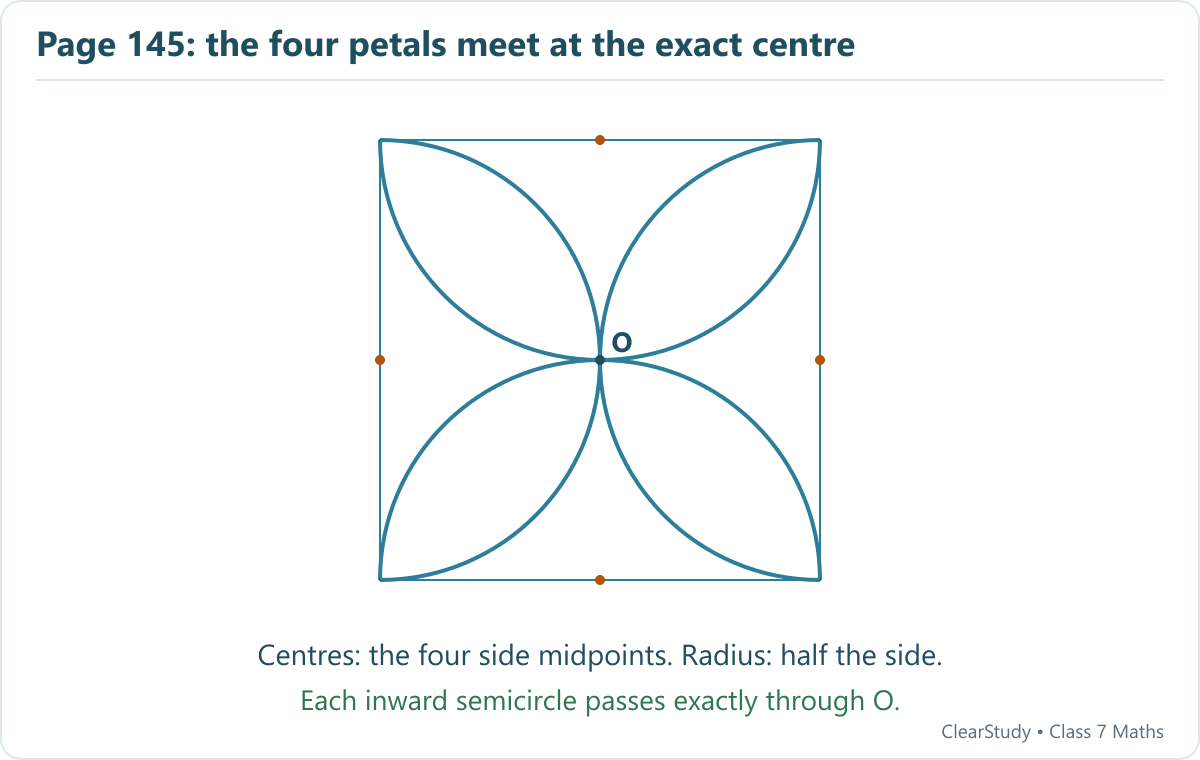
SOLUTIONConstruct the square and bisect each side. Let its side be s; set the compass to s/2.Using each side midpoint as centre, draw the semicircle inside the square with that side as diameter. Each semicircle passes through the two endpoints of its side and the exact square centre O.The intersections of adjacent semicircular regions give four equal corner-to-centre petals. They reach all four corners and meet at O, filling the available corner-to-centre extent. A larger radius with these same side centres would no longer pass through the required corners.
Draw the four inward semicircles whose diameters are the four square sides. The side midpoints are centres and the common radius is half the side length.
Figure it Out — Copying an Angle (Page 147)
1. Construct at least 4 different angles in different orientations without taking any measurement. Make a copy of all these angles.
SOLUTION (method)Draw four arbitrary angles at vertex A in different tilts. To copy each angle to a new vertex X on a ray XZ:1. From A, draw an arc cutting both arms at B and C (this gives the isosceles triangle ΔABC).2. With the same radius, draw an arc from X cutting the ray at Z.3. Open the compass to the chord length BC and, from Z, cut the new arc at Y so that YZ = BC.4. Join XY. By SSS, ΔABC ≅ ΔXYZ, so ∠A = ∠X — the angle is copied exactly, with no measuring.
Draw equal-radius arcs at A and X, then transfer chord BC to YZ. The triangles ABC and XYZ are congruent by SSS.
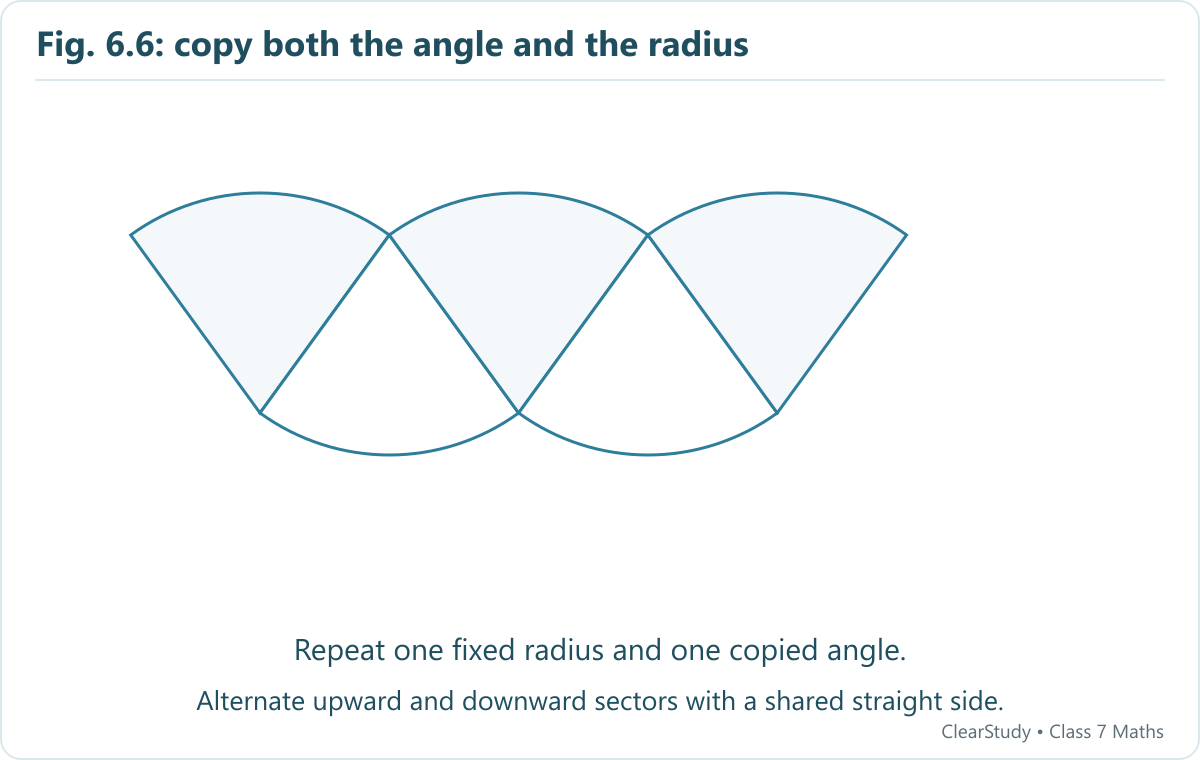
2. Construct the Fig. 6.6.
SOLUTIONThe repeating unit is a circular sector, bounded by two equal radii and an arc. Construct one sector with a chosen radius and angle; for an exact copy of a given unit, transfer its radius and copy its angle by the chord method.Attach another congruent sector along the next radius, with its vertex on the opposite row. Continue alternating upward and downward sectors. Every unit keeps the same radius and included angle.Trace the outer arcs and shared straight sides. Shade alternate sectors as shown.
A circular sector is repeated in alternating orientations. Each sector has the same radius and angle, so corresponding units are congruent.
Figure it Out — Parallel Lines (Page 148)
1. Construct 4 pairs of parallel lines in different orientations.
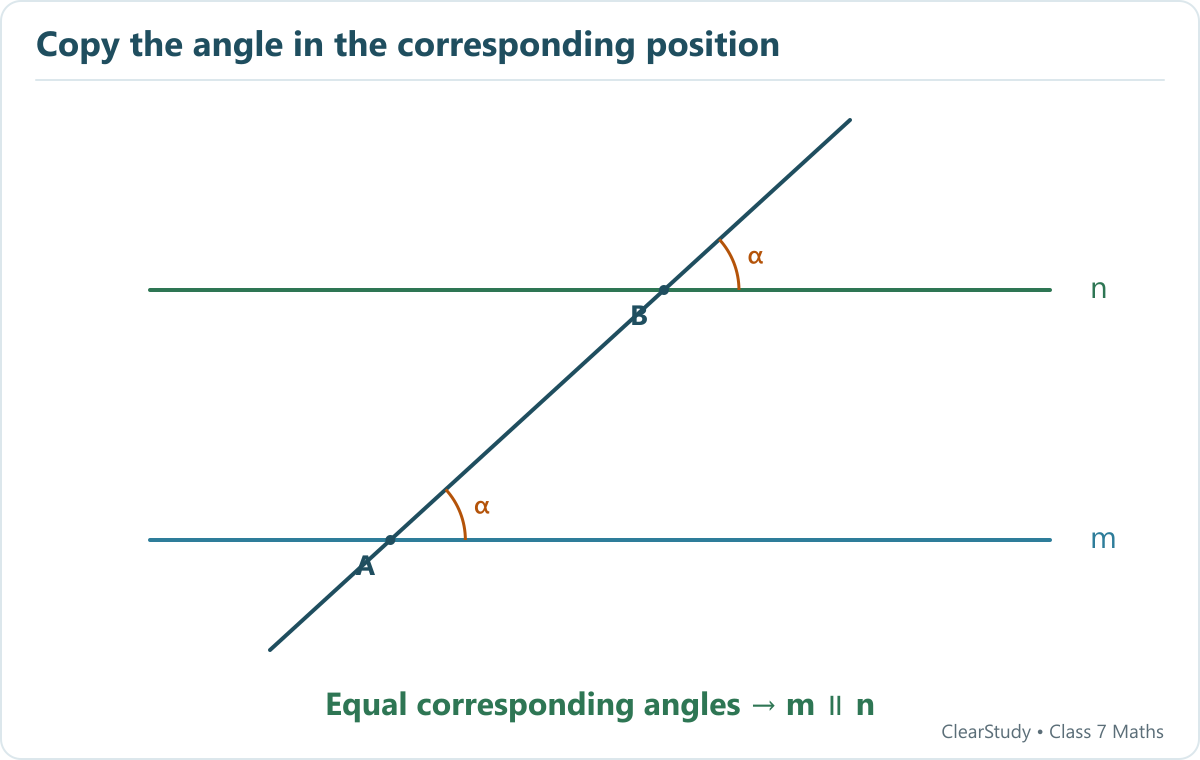
SOLUTION (method)For each pair, draw a line m and a transversal l meeting m at A. Choose a point B on l where the parallel line should pass.1. At A, draw an arc cutting m at C and l at D (the angle between m and l). 2. With the same radius, draw an arc from B cutting l at E. 3. Transfer the chord length CD onto this arc from E to get F (EF = CD).4. Draw the line through B and F, call it n. Then n makes the same corresponding angle with l as m does, so by the corresponding-angles test m ∥ n. Repeat with four different tilts of l and m.
A transversal meets m at A and the new line n at B. Copying the corresponding angle at B makes n parallel to m.
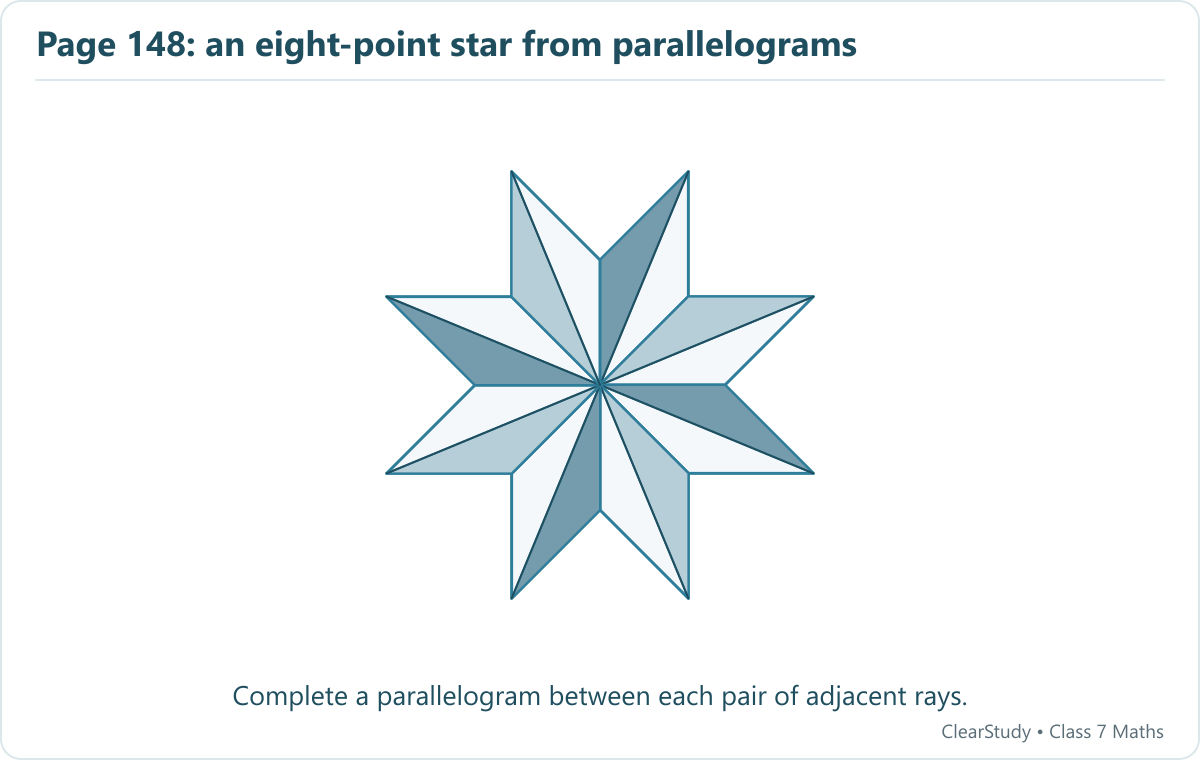
2. Construct the following figure.
(the design lettered S T A B U V W X Y Z … F G H, built from parallel lines)
SOLUTIONDraw four lines through O at 45° intervals and mark A, B, C, D, E, F, G, H at equal distances from O, in order.For each adjacent pair, such as A and B, draw through A a line parallel to OB and through B a line parallel to OA. Their intersection T completes parallelogram OATB. Repeat to obtain the eight outer tips.Connect each tip to O. Trace the outer star boundary and shade the corresponding half of each parallelogram. Equal radial lengths and copied angles keep the eight units congruent.
Eight equally spaced inner points surround O. Through adjacent points draw parallels to the opposite radial segment; their intersection gives each outer tip. Join tips to O and shade alternate halves.
Figure it Out — Pointed Arch (Page 151)
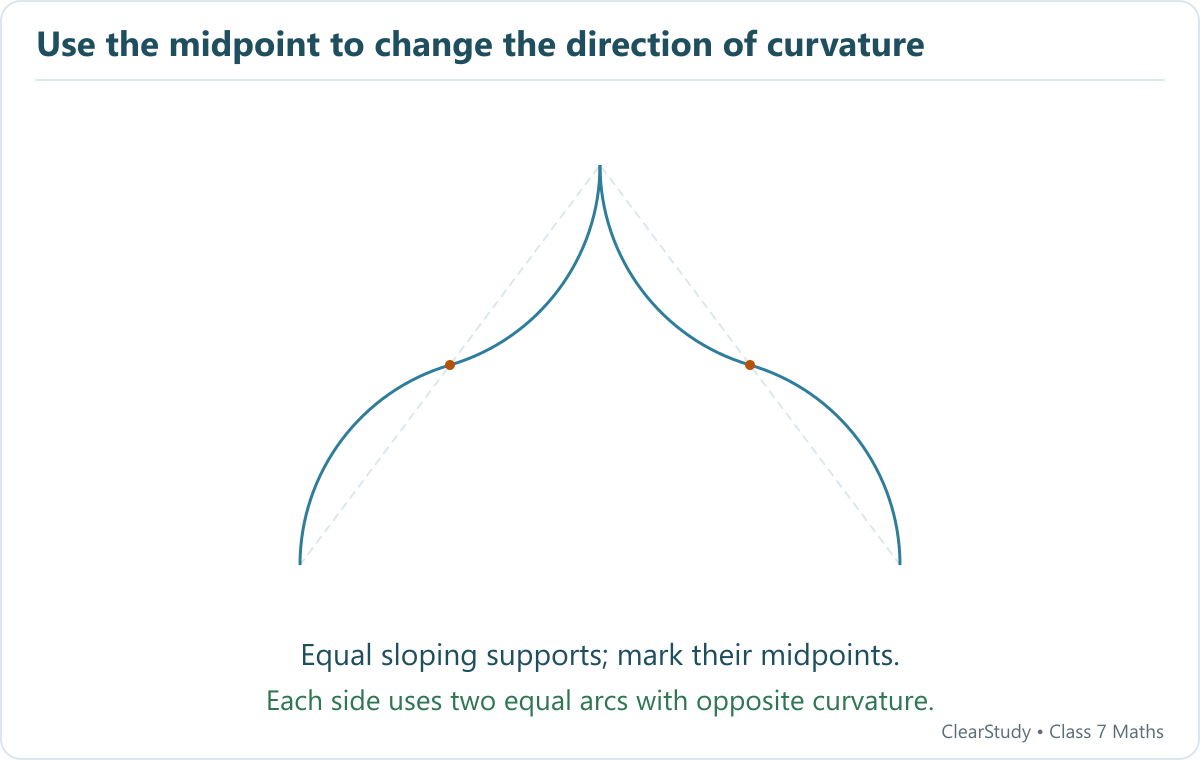
1. Use support lines in Fig. 6.11 to construct a pointed arch. Make different arches, by changing the radius of the arcs.
SOLUTIONDraw equal sloping segments LP and RP meeting at the top P. Bisect them at M and N. Each side of this arch is an S-shaped pair of arcs, changing curvature at its midpoint.For one exact construction on the left, draw the perpendicular bisector of PM and a horizontal line through P. Let them meet at C. With centre C and radius CP, draw the minor arc from P to M.Reflect C through M to obtain D (extend CM by the same length). With centre D and the same radius, draw the arc from M to L. The two arcs meet smoothly because C, M and D are collinear. Reflect this complete left construction across the vertical symmetry line to obtain the right side.To explore other arches, choose a suitable different centre on the perpendicular bisector of PM, reflect it through M for the second centre, and mirror the left design. Check that the chosen arcs stay on their intended sides and do not cross.
A symmetric four-arc pointed arch follows the two equal support segments of Fig. 6.11. Each support is divided in half; paired circular arcs meet at its midpoint.
2. Make your own arch designs.
SOLUTION (method)Combine the techniques above to invent new arches. For a trefoil arch, construct equal angles at the two base points A and D, mark B and C with AB = CD, then draw three equal arcs between them. For a multi-lobed arch, add more equidistant centres along the springing line and draw equal arcs.Keep symmetry by using equal radii on the left and right and by placing the centres symmetrically about the perpendicular bisector of the base — then adjust the radii until the arch looks aesthetically pleasing.
Figure it Out — Designs & Perpendicular through P (Pages 154–155)
1. Construct the following figures:
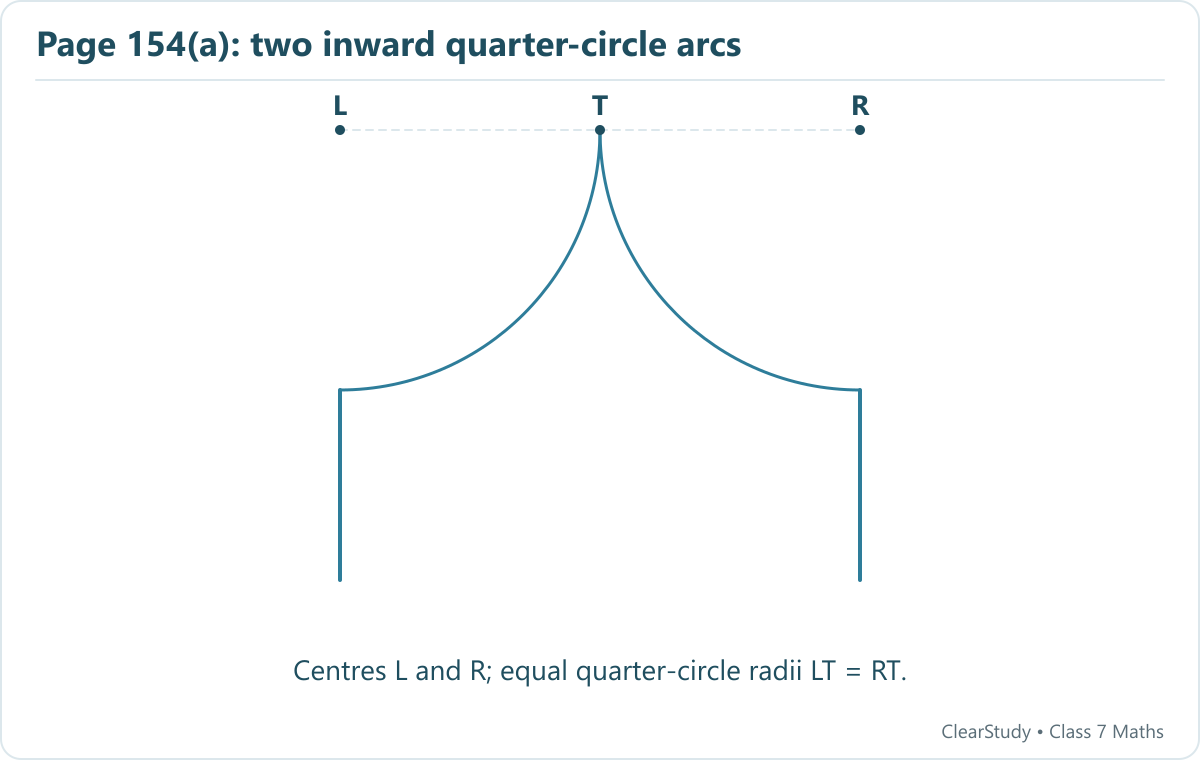
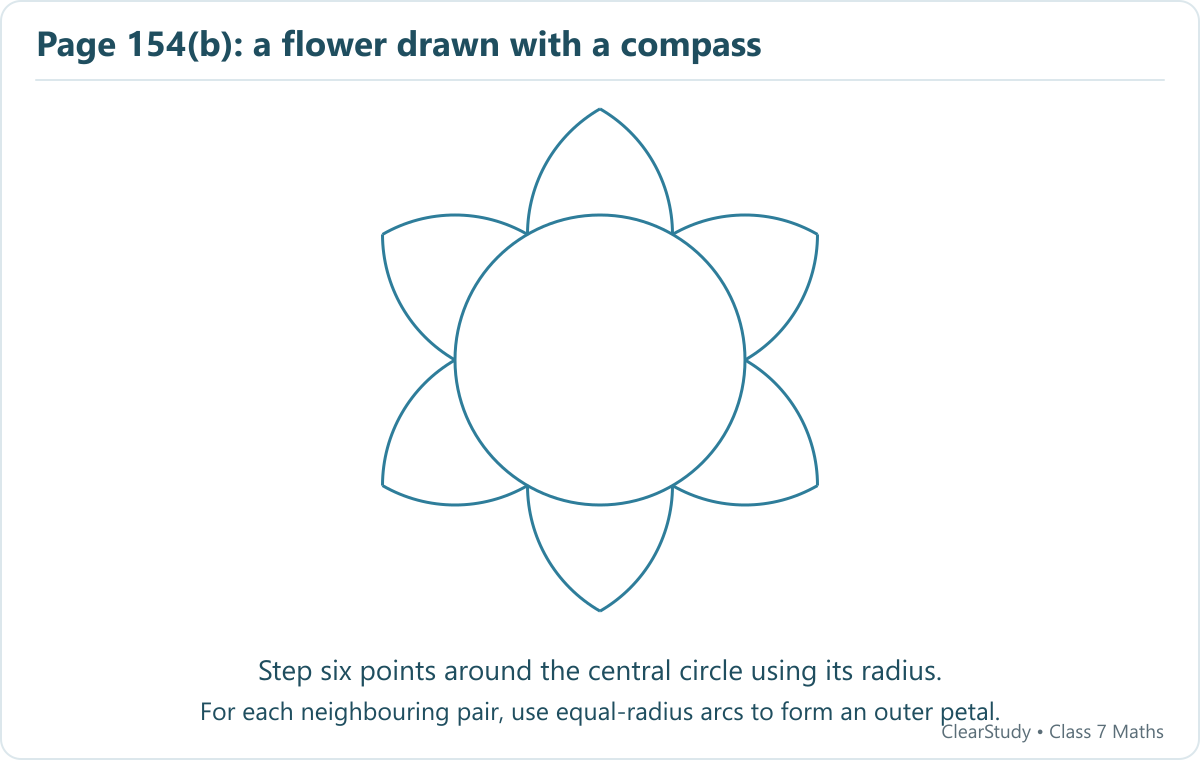
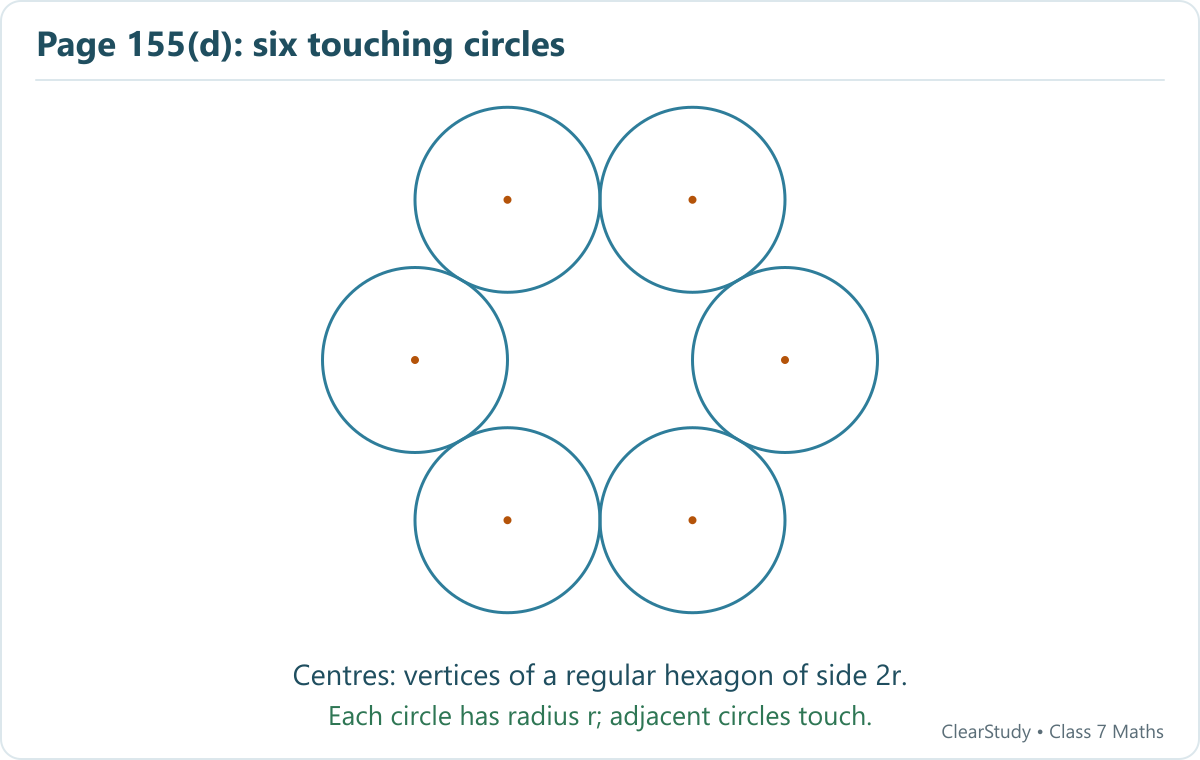
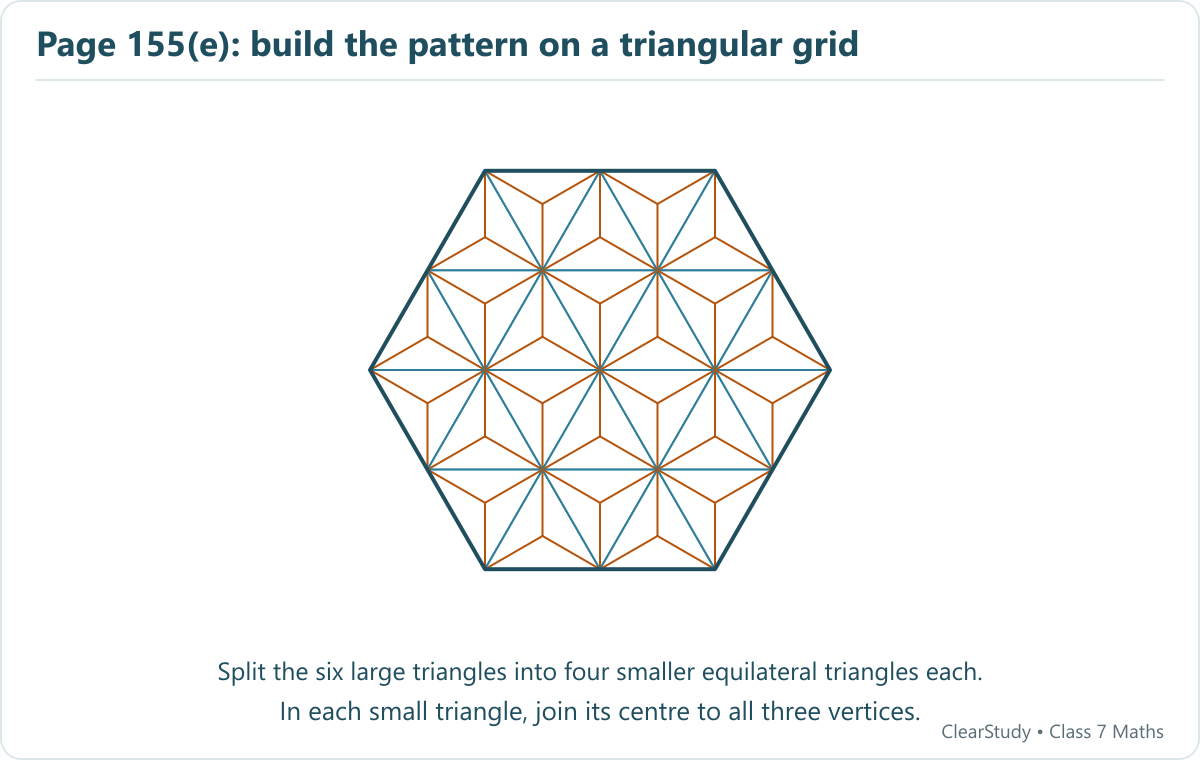
(a) An Inflexed Arc(b) The fun part about this figure is that it can also be constructed using only a compass! Can you do it?(c) (d) (e)
SOLUTION(a) Inflexed arc: draw horizontal LR with midpoint T. Drop equal perpendicular lengths LT from L and R to side endpoints. With centres L and R and radius LT, draw the inward quarter-circle arcs to T, then extend the vertical sides down.(b) Compass flower: draw a circle of radius r and step that radius around it to mark six equally spaced points. For every neighbouring pair A and B, draw circles/arcs of radius r centred at A and B. Besides O they meet at an outward point P. Retain the outer arcs AP (centre B) and PB (centre A), and retain the original central circle. Repeat six times; no straight boundary is needed.(c) Draw a circle, step its radius around it six times, and join consecutive points for an inscribed regular hexagon.(d) Construct a regular hexagon of side 2r; draw a circle of radius r at each vertex. Adjacent circles touch.(e) Divide a regular hexagon into six equilateral triangles. Join each triangle’s side midpoints to divide it into four smaller equilateral triangles. Find each small triangle’s centre by intersecting two medians, and join that centre to all three vertices.
Use a horizontal segment LR with midpoint T. With centres L and R and radius LT, draw quarter-circle arcs from the lower side endpoints to T; extend the sides downwards.The six outer petals are made from arcs with centres at neighbouring points of a regular hexagon. A central circle completes the flower; straight edges are unnecessary.Place six circle centres at the vertices of a regular hexagon with side twice the circle radius. Adjacent circles then touch without overlap.A regular hexagon is divided into 24 small equilateral triangles. Joining each small triangle centre to its vertices reproduces the repeated three-arm motif.
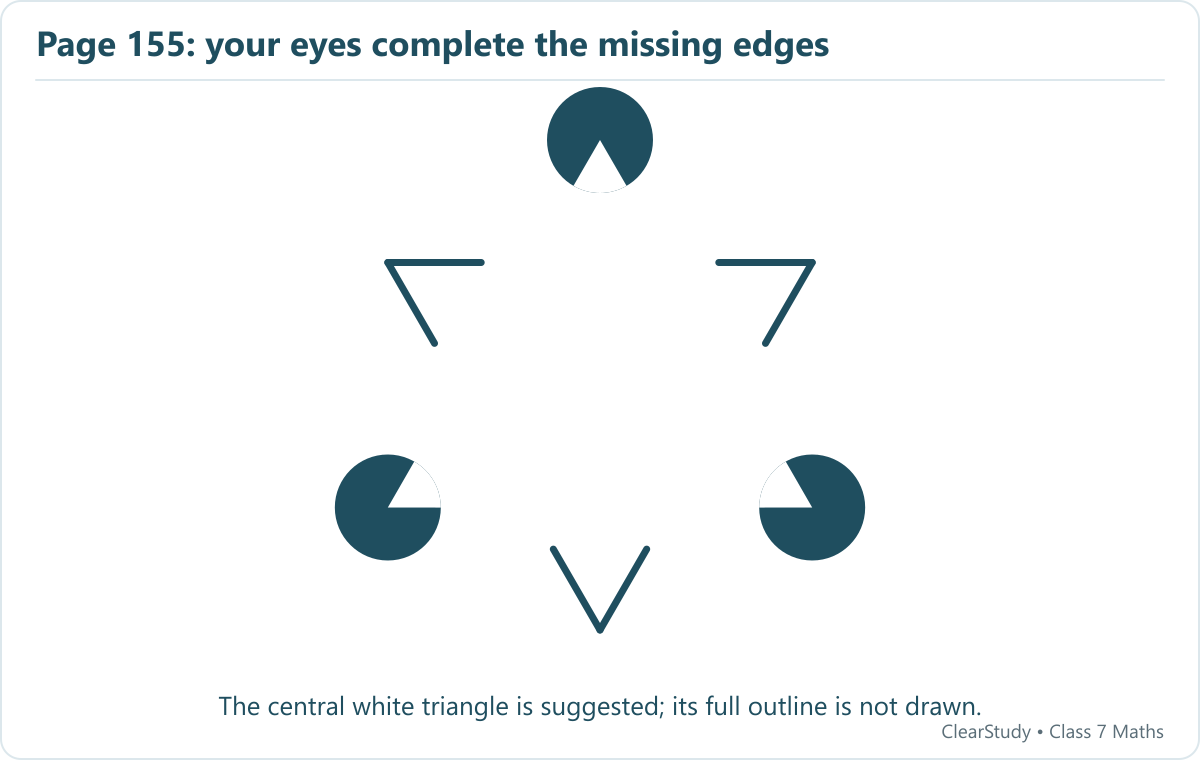
2. Optical Illusion: Do you notice anything interesting about the following figure? How does this happen? Recreate this in your notebook.
SOLUTIONThe picture suggests a bright white triangle over another triangle, even though the white triangle’s complete boundary is not drawn. Our visual system fills in the missing edges. It is an illusion of contours, not bent parallel lines.Construct two overlapping equilateral triangles as light guides. At the three vertices of one triangle, draw equal disks and remove the inward-facing 60° sectors. Retain only short corner strokes of the other triangle. Erase the remaining guide lines.The aligned gaps and angle fragments suggest the missing triangular boundaries.
Three disks with inward-facing sectors removed and three interrupted angle corners suggest overlapping triangles. The central triangle has illusory contours.
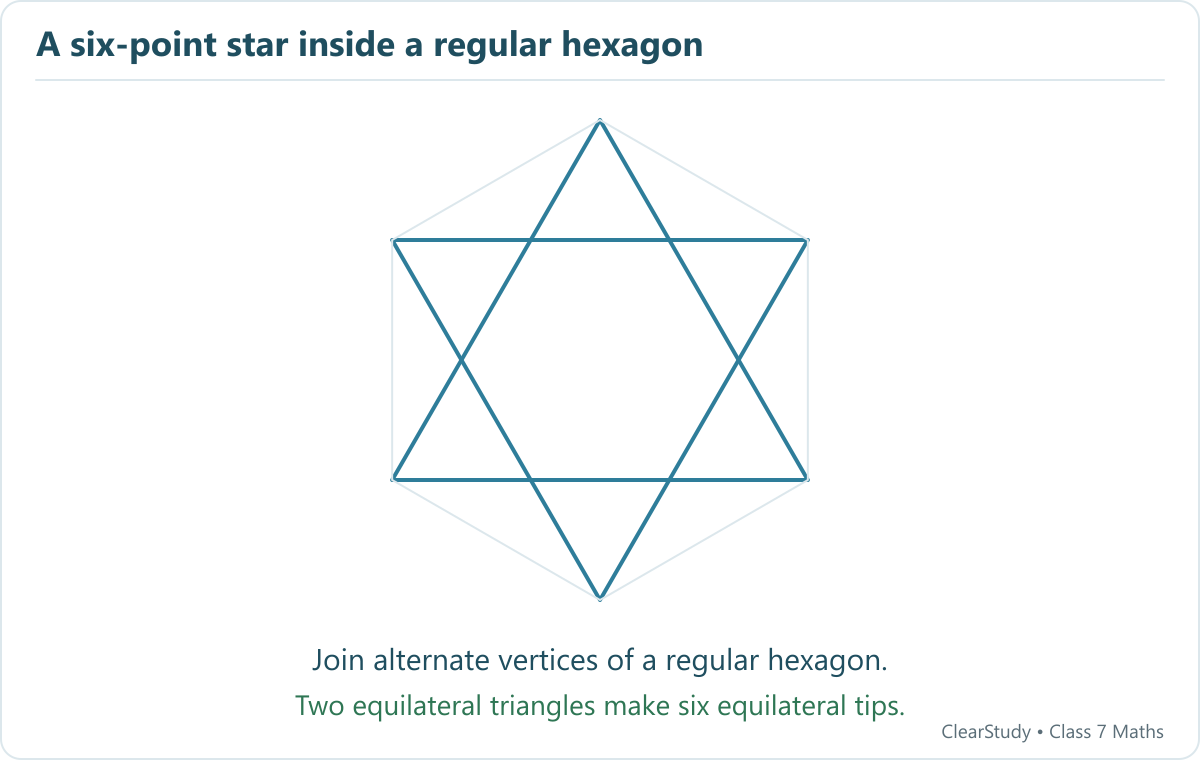
3. Construct this figure.
[Hint: Find the angles in this figure.]
SOLUTIONConstruct a regular hexagon. Join alternate vertices to obtain two overlapping equilateral triangles. Their outer boundary forms a six-point star inside the hexagon.Keep the outer hexagon visible. Trace the twelve short segments that form the star boundary and erase the internal parts of the two large triangles if matching the printed outline.Each star tip is 60°, each outer hexagon interior angle is 120°, and the re-entrant angles of the star are 240°. These angles determine the construction.
Join alternate vertices of the outer regular hexagon to make two equilateral triangles. Their intersections form a smaller regular hexagon and six equilateral star tips.
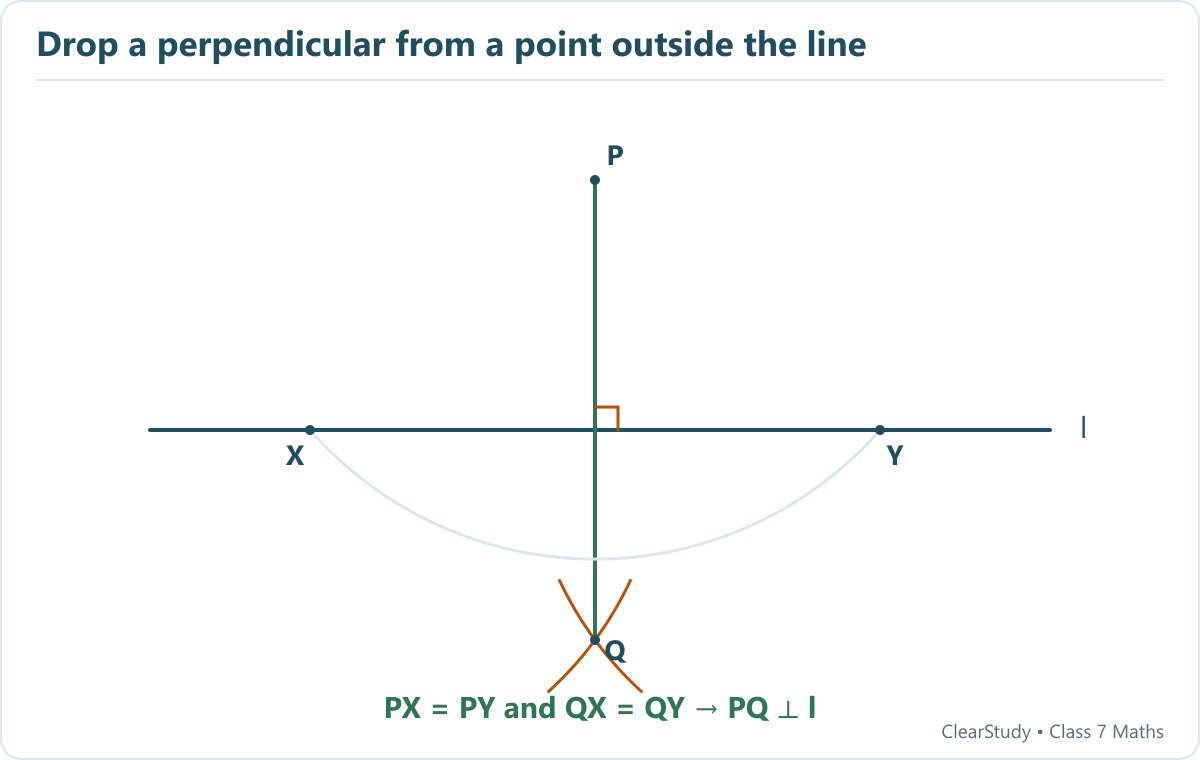
4. Draw a line l and mark a point P anywhere outside the line. Construct a perpendicular to the given line l through P.
[Hint: Find a line segment on l whose perpendicular bisector passes through P.](Try This)
SOLUTION (method)1. With P as centre and a suitable radius, draw an arc that cuts the line l at two points, say X and Y. Then PX = PY (both are the same radius), so P is equidistant from X and Y.2. By the key property, P lies on the perpendicular bisector of XY. Construct that perpendicular bisector: from X and Y draw equal arcs that meet at a point Q on the other side of l.3. Draw the line PQ. Since both P and Q are equidistant from X and Y, PQ is the perpendicular bisector of XY, hence PQ ⊥ l and passes through P — the required perpendicular from the external point P.
An arc centred at P meets l at X and Y. Equal arcs from X and Y meet at Q below the line. PQ is the perpendicular bisector of XY.
Figure it Out — Tangram (Page 156)
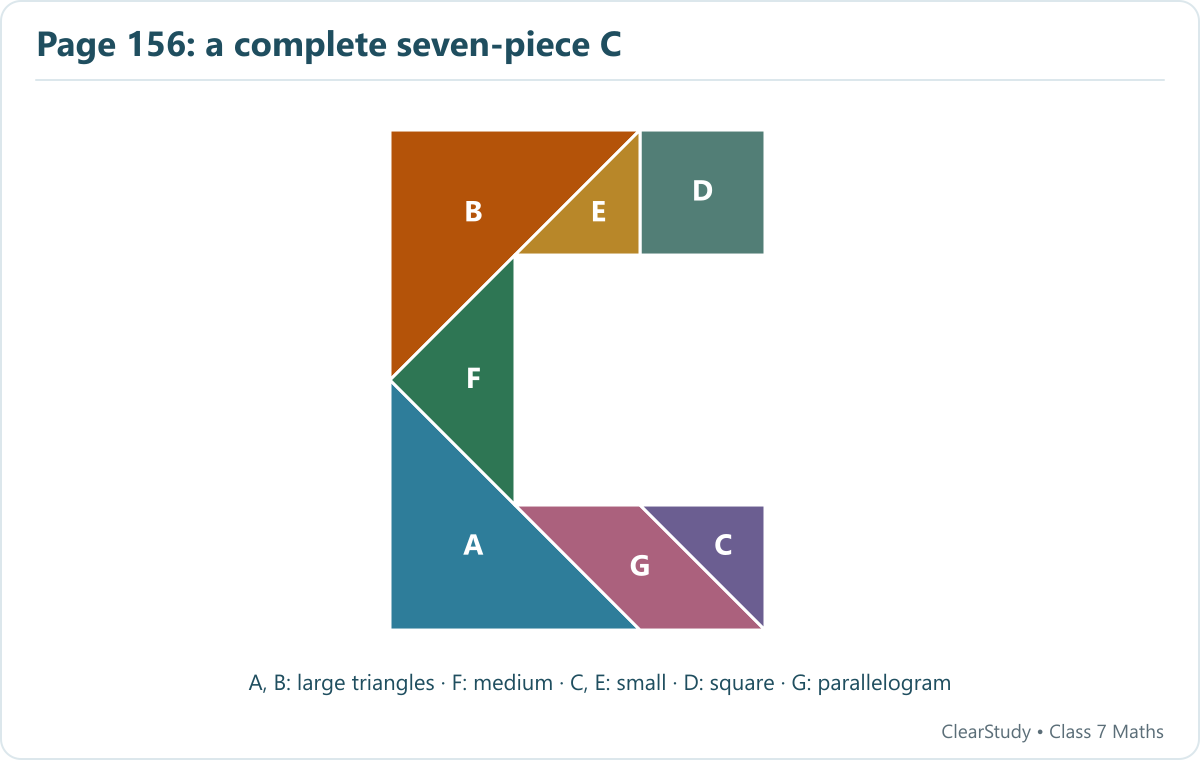
How can the tangram pieces be rearranged to form each of the following figures?
SOLUTIONUse all seven pieces without gaps or overlaps: two large triangles, one medium triangle, two small triangles, a square and a parallelogram. Rotations and flips are allowed.The diagram below is a complete solution for the first, C-shaped silhouette. Match each labelled piece with its shape in the original tangram. The seven areas total the area of the original square.For the other silhouettes, first place the large triangles against long diagonal or straight boundaries, then fit the remaining pieces. Treat these as practice challenges; an area check alone cannot determine their arrangements.
One verified solution of the first C-shaped tangram silhouette uses all seven original shapes exactly once, with no overlap. Piece labels match the textbook’s seven-piece set.
Figure it Out — Are the Tilings Possible? (Page 160)
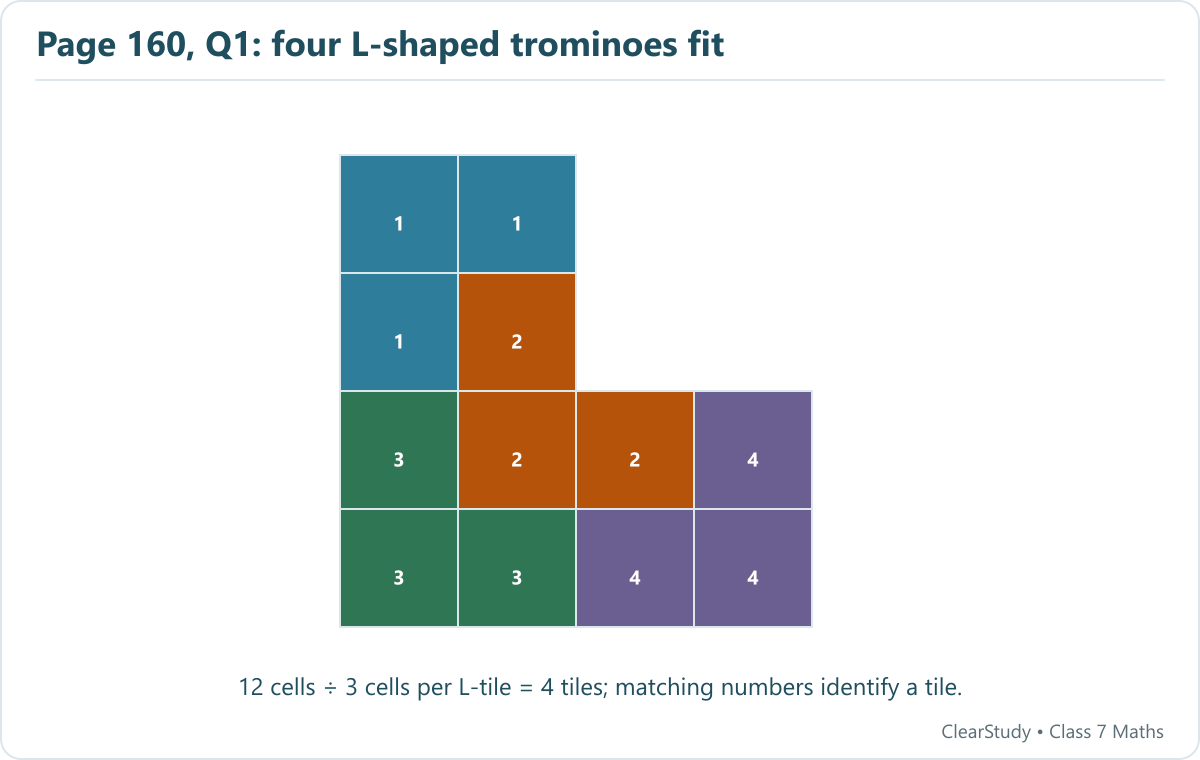
1. Are the following tilings possible? (Region to be tiled / Tile shown)
SOLUTIONYes. This question uses L-shaped three-cell tiles (L-trominoes), not dominoes. The region contains 12 cells, so it needs four tiles.The diagram gives a complete placement. Equal numbers identify the three cells of each tile. Each is an L, and every region cell belongs to exactly one tile.Area divisibility alone is only a necessary check; this explicit arrangement proves that the tiling exists.
The L-shaped region contains 12 unit cells and is tiled by four L-trominoes. Each colour and number identifies one connected three-cell L-shaped piece.
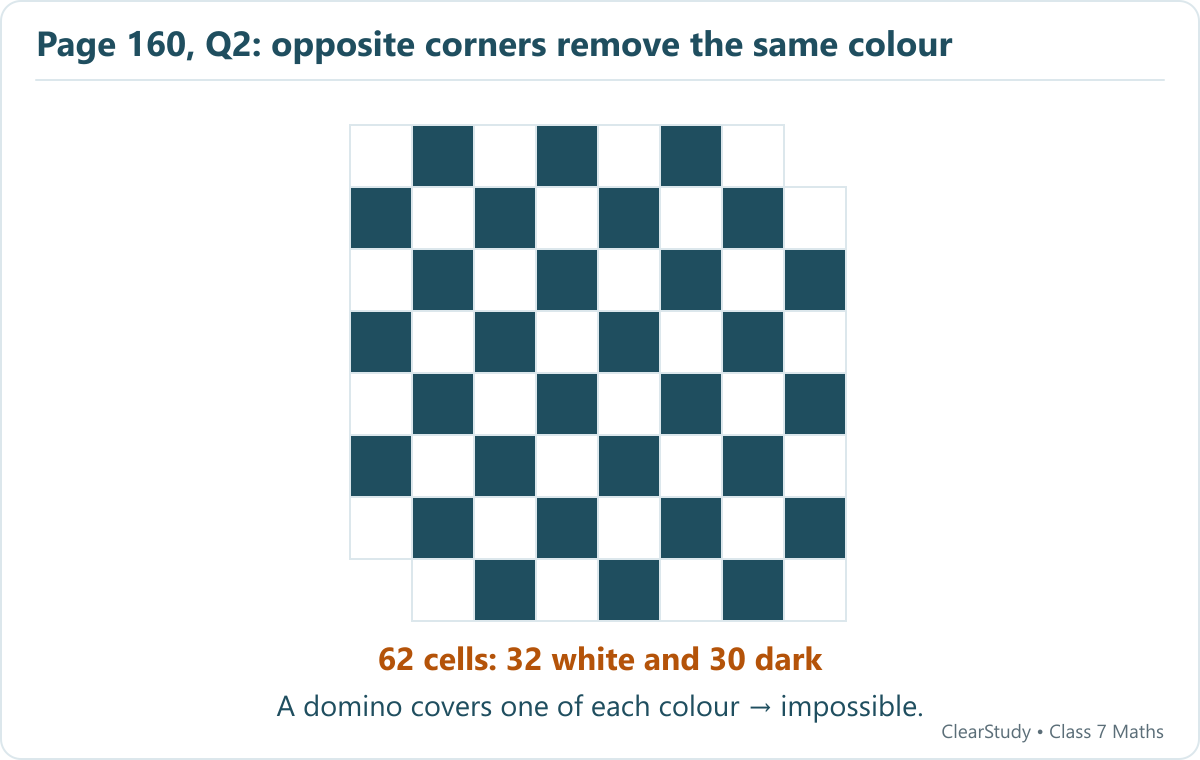
2. Are the following tilings possible? (Region to be tiled / Tile shown)
SOLUTIONNo. The region is an 8 × 8 square with the top-right and bottom-left corner cells removed. It contains 64 − 2 = 62 cells.Colour the full board alternately. It has 32 cells of each colour. The two removed opposite corners have the same colour, leaving 32 of one colour and 30 of the other.Every domino covers one cell of each colour. Unequal counts make a tiling impossible, despite the even area.
An 8 by 8 board with the top-right and bottom-left corners removed has 32 white cells and 30 dark cells. No set of dominoes can cover unequal colour counts.
Math Talk & Try This — Answered
These are the in-text Math Talk and Try This tasks in the chapter; the determinate ones are answered, the open ones are guided.
Try This — Regular pentagon & hexagonHow do we construct a regular pentagon (5-sided figure) and a regular hexagon (6-sided figure)? To begin with, try to construct a pentagon and hexagon with equal sidelengths.Answer. A regular hexagon is within reach: it is made of 6 congruent equilateral triangles meeting at the centre (6 × 60° = 360°), so construct a 60° angle (equilateral-triangle method) and repeat. The regular pentagon needs deeper triangle/pentagon theory studied in later years, so its exact construction is beyond this chapter’s scope. Equal side lengths alone do not guarantee that a pentagon is regular.
A regular hexagon is divided into six congruent equilateral triangles. Set the radius to the required side length: 4 cm or 5 cm for the textbook tasks.
Math Talk — Will the 70° angle fit the gap?Will the 70° angle fit into the gap? What is the gap angle ∠AOI? (Given 40° + 60° + 50° + 30° + 40° + 90° + gap angle = 360°.)Answer. Add the known angles: 40 + 60 + 50 + 30 + 40 + 90 = 310°. So the gap angle ∠AOI = 360° − 310° = 50°. Since the spare angle is 70° but the gap is only 50°, the 70° angle does NOT fit — it would overlap by 20°. (Angles fit around a point only when they add up to exactly 360°.)
Why AOD, BOE, COF are straight lines (Fig. 6.12)In Fig. 6.12 can you explain why AOD, BOE and COF are straight lines?Answer. At the centre O, the six equilateral triangles each contribute a 60° angle. For a pair of opposite triangles, the three consecutive central angles on either side add to 60° + 60° + 60° = 180° on each side, i.e. the angle AOD is a straight angle (180°). So A, O, D are collinear; the same holds for B, O, E and C, O, F. These are the three ‘diagonals’ joining opposite vertices of the hexagon.
Math Talk — Copy an angleDraw an angle. Create a copy of this angle using only a ruler and compass.Answer. Draw an arc from the vertex cutting both arms (isosceles ΔABC). Draw an equal-radius arc from the new vertex X cutting its ray at Z. Transfer the chord BC onto that arc from Z to get Y (YZ = BC). Join XY. By SSS, ΔABC ≅ ΔXYZ, so ∠X = ∠A — an exact copy with no protractor.
6-Pointed Star — are the six triangles equilateral?Are the six triangles forming the 6 points of the star — ΔAGH, ΔBHI, ΔCIJ, ΔDJK, ΔELK, ΔFLG — equilateral? Why? [Hint: Find the angles.]Answer.Yes, all six are equilateral. The star is a regular hexagon (GHIJKL) with an equilateral triangle built on each side. Each side of the inner hexagon is equal, and the points are formed so that every angle of each small triangle is 60°. With all three angles 60° (and equal sides), each ΔAGH, ΔBHI, … is equilateral — which is why the star has 6-fold rotational symmetry.
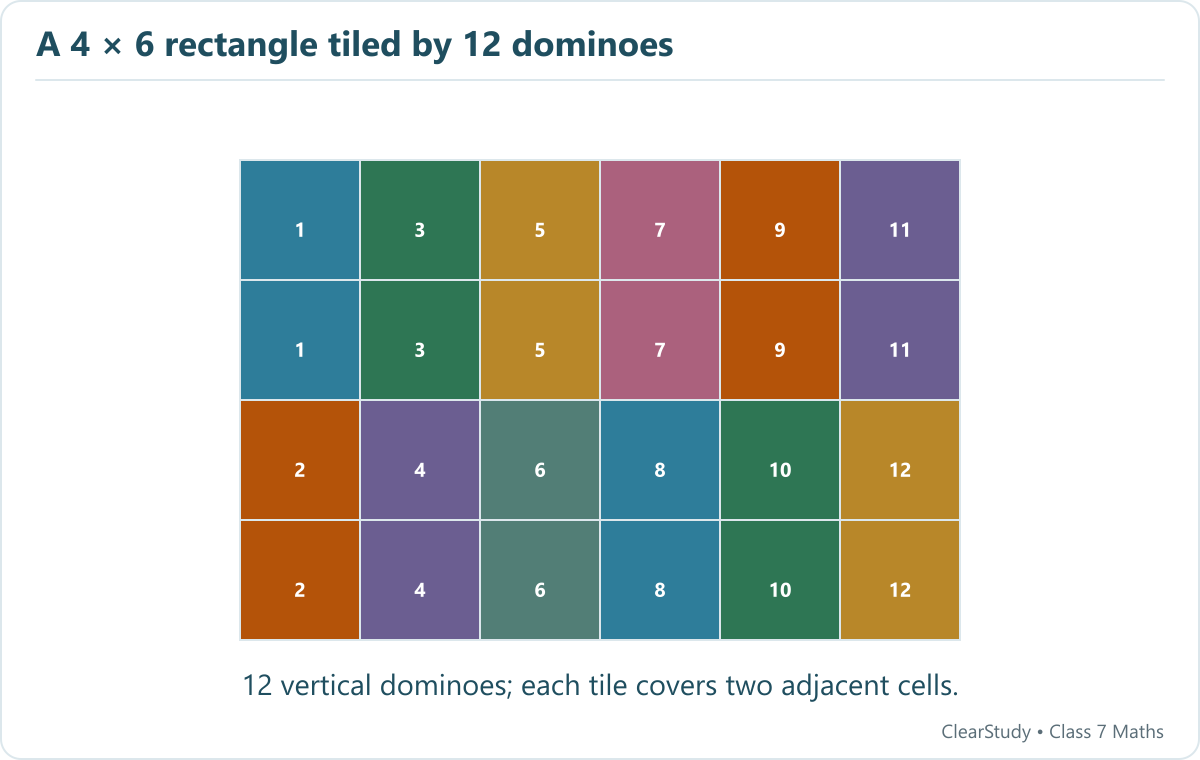
Math Talk — Tile a 4 × 6 grid with 2 × 1 tiles?Can a 4 × 6 grid be tiled using multiple copies of 2 × 1 tiles? (We may rotate a tile.)Answer.Yes. A 4 × 6 grid has 24 unit squares = 12 tiles. The simplest way: fill each of the 6 columns with two vertical 2 × 1 tiles (4 rows = 2 tiles per column). It works because the number of rows (4) is even. Many other arrangements are also possible.
Each column is covered by two vertical dominoes. A full rectangular grid is domino-tileable whenever at least one dimension is even.
Math Talk — 4 × 7 and 5 × 7 gridsCan a 4 × 7 grid be tiled using 2 × 1 tiles? What about a 5 × 7 grid?Answer.4 × 7: Yes — 28 squares = 14 tiles; fill each of the 7 columns with two vertical tiles (4 rows are even). 5 × 7: No — it has 35 unit squares, an odd number. Each tile covers exactly 2 squares, and tiles can only cover an even total, so 35 squares can never be tiled by 2 × 1 tiles.
Math Talk — m × n grids (even/odd cases)Is an m × n grid tileable with 2 × 1 tiles if both m and n are even? If one is even and the other odd? If both are odd?Answer.Both even: Yes — cover each column with vertical tiles (even rows). One even, one odd: Yes — if the number of rows is even use vertical tiles in each column; if the number of columns is even use horizontal tiles in each row. Both odd: No — m × n is then odd (odd × odd = odd), and an odd number of squares can never be split into 2 × 1 tiles.
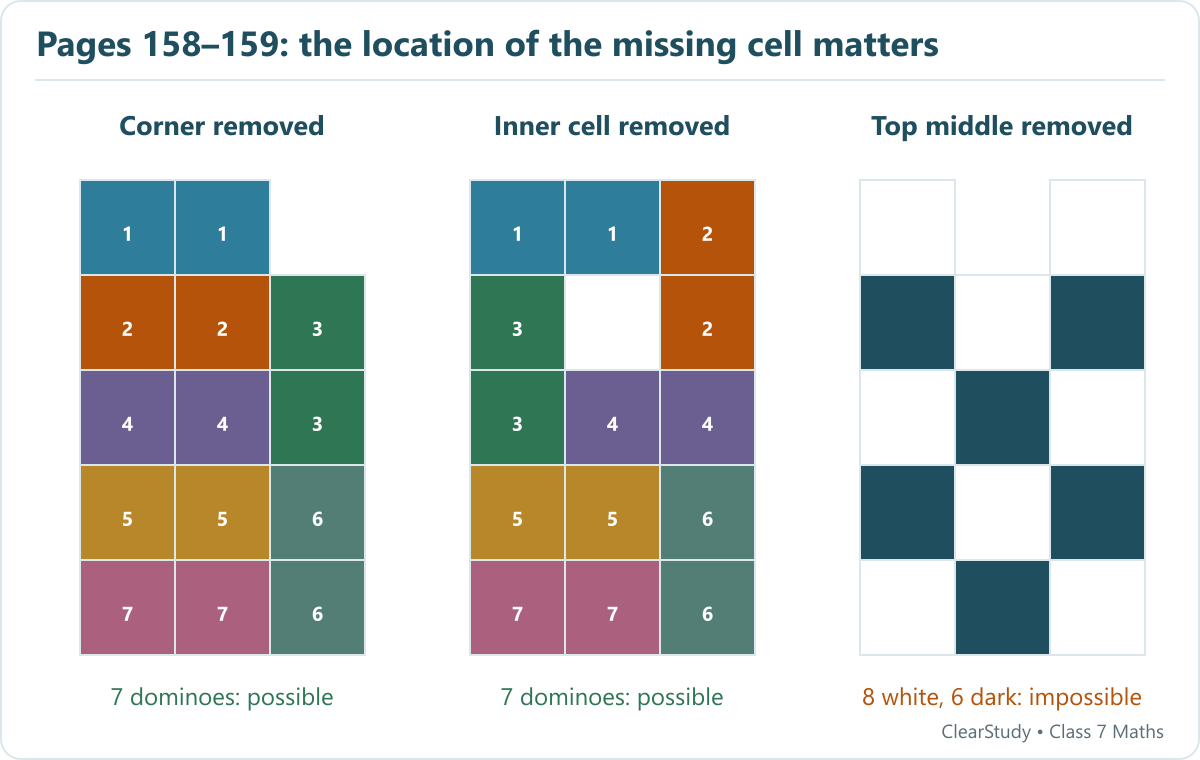
Math Talk — 5 × 3 grid with one square removedHere is a 5 × 3 grid with a unit square removed. Now it has an even number of unit squares. Is it tileable with 2 × 1 tiles?Answer.The first printed region removes the top-right corner and can be tiled with seven dominoes, as shown below. The second removes the central cell of the second row and also has a seven-domino tiling.The next region, Fig. 6.13, removes the top-middle cell and has 8 white and 6 dark cells, so it is impossible.Equal checkerboard counts are necessary but not sufficient for every arbitrary region. For a region that passes the count test, give an actual arrangement or another proof.
The first two printed 5 by 3 regions have explicit seven-domino tilings. Removing the top middle square gives unequal checkerboard counts and is impossible.
Math Talk — Fig. 6.13 region; black-and-white argumentWere you able to tile Fig. 6.13? How can we be sure that this is not tileable? If the plain grid is tileable, is the black-and-white grid tileable, and vice versa?Answer. The region of Fig. 6.14 has 8 white and 6 black squares. Every 2 × 1 tile covers exactly one black and one white square, so any tileable region must have equal black and white squares. Since 8 ≠ 6, this region can never be tiled. And yes — the plain grid is tileable exactly when the black-and-white grid is tileable; the colouring just makes the obstruction easy to see.
Math Talk — Another non-tileable removalUse this idea to find another unit square that, when removed from a 5 × 3 grid, makes it non-tileable.Answer. In a chessboard-coloured 5 × 3 grid the corners share the majority colour (8 of one colour, 7 of the other). Removing any square of the minority colour (one of the 7) leaves 8 vs 6 squares, which can never be tiled. For example, removing a square that is the same colour as the centre square (a minority-colour cell) makes the grid non-tileable.
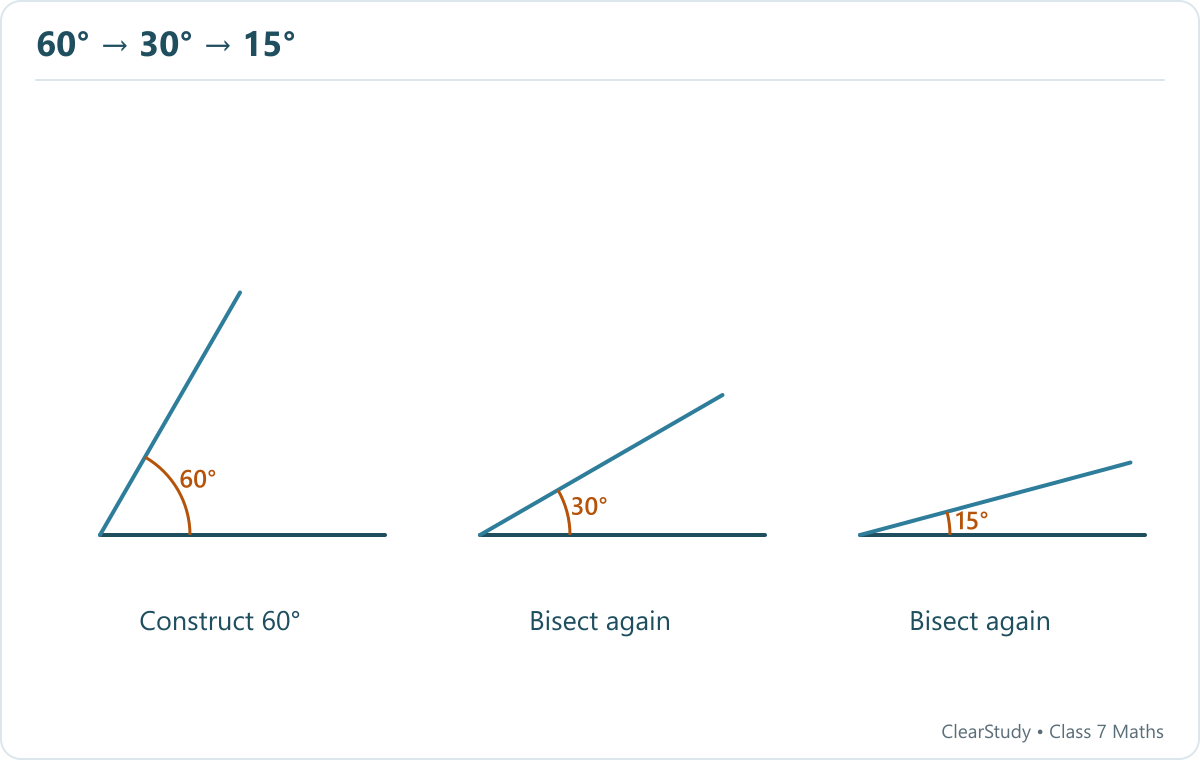
Constructing 30° and 15° (p. 154)
Build an equilateral triangle to obtain 60°. Bisect that angle to get 30°, and bisect again to get 15°.
Construct 60 degrees using an equilateral triangle; bisect to make 30 degrees and bisect once more to make 15 degrees.
Regular polygons that tile the plane (pp. 160–162)
Equilateral triangles, squares and regular hexagons tile the plane by themselves. Around each vertex, 6 × 60° = 360°, 4 × 90° = 360°, or 3 × 120° = 360°. A regular pentagon has 108° angles: three leave a 36° gap, while four overlap. Mixtures of shapes and some non-regular polygons can also tile.
Common Mistakes to Avoid
Watch out for these
Using different radii for the two arcs that meet at one point — that point will not be equidistant from X and Y, so it will not lie on the perpendicular bisector.
Changing the compass setting between the two arms when copying an angle — OA must equal OB, and the transferred chord must equal BC, or SSS congruence fails.
Confusing the supporting (construction) lines with the final figure — only the boundary should be inked; arcs and centres are guides.
Thinking an even number of squares guarantees a tiling — equal black and white counts are another necessary domino test, and even those equal counts do not guarantee every irregular region can be tiled.
Forgetting that a 2 × 1 tile may be rotated (vertical or horizontal) — both orientations are allowed.
Believing every angle is constructible — angles like 65.5° cannot be built from 60°/90° by bisection.
Practice MCQs & Assertion–Reason
1. The perpendicular bisector of a segment XY is the set of all points that are:
(a) closer to X (b) closer to Y (c) equidistant from X and Y (d) on the segment XY
2. To construct a 45° angle with ruler and compass, you first construct a 90° angle and then:
(a) copy it (b) bisect it (c) double it (d) add 60°
3. A 60° angle is constructed by drawing:
(a) a square (b) a perpendicular bisector (c) an equilateral triangle (d) two parallel lines
4. The angle-bisection and angle-copy constructions are justified using:
(a) area formulas (b) the SSS congruence condition (c) the Pythagoras rule only (d) measurement with a protractor
5. Each interior angle of a regular hexagon is:
(a) 60° (b) 90° (c) 108° (d) 120°
6. A regular hexagon can be split into how many congruent equilateral triangles?
(a) 3 (b) 4 (c) 6 (d) 8
7. A 5 × 7 grid cannot be tiled by 2 × 1 tiles because it has:
(a) 35 (an odd number of) unit squares (b) too few rows (c) curved edges (d) 36 unit squares
8. In a chessboard colouring, every 2 × 1 tile always covers:
(a) two black squares (b) two white squares (c) one black and one white square (d) no square
9. “Covering a region using shapes without gaps or overlaps” is called:
For each Assertion–Reason question, choose: (A) Both Assertion and Reason are true and the Reason is the correct explanation of the Assertion; (B) Both are true but the Reason is not the correct explanation; (C) Assertion is true but Reason is false; (D) Assertion is false but Reason is true.
A-R 1. Assertion: Any point equidistant from X and Y lies on the perpendicular bisector of XY.
Reason: Such a point forms two congruent triangles with X and Y, giving equal angles at the foot of the perpendicular.
A-R 2. Assertion: When copying an angle, the line OC bisects the angle.
Reason: Copying an angle uses the SSS congruence condition to reproduce the same angle measure.
A-R 3. Assertion: A 60° angle can be constructed using only a ruler and a compass.
Reason: Constructing an equilateral triangle creates an angle of 60° at each vertex.
A-R 4. Assertion: A 5 × 7 grid cannot be tiled with 2 × 1 tiles.
Reason: It has 35 unit squares, and each tile covers exactly 2 squares, so an odd total cannot be tiled.
A-R 5. Assertion: A full rectangular m × n grid with an even number of unit squares can always be tiled by 2 × 1 tiles.
Reason: Every 2 × 1 tile covers one black and one white square in a chessboard colouring.
Answer key: 1-(A), 2-(D), 3-(A), 4-(A), 5-(B).
Quick Revision Summary
Bisection splits a segment (or object) into two identical parts; the perpendicular bisector is perpendicular and passes through the midpoint.
Any point equidistant from the endpoints of a segment lies on its perpendicular bisector — this is the basis of the ruler-and-compass construction.
A 90° angle is built by the perpendicular-bisector method; bisecting angles gives 45°, 30°, 15°, etc.
Angles can be bisected and copied using SSS/SAS triangle congruence; copying an angle lets us draw parallel lines.
A 60° angle comes from an equilateral triangle; six equilateral triangles (6 × 60° = 360°) make a regular hexagon (interior angle 120°).
Tiling covers a region without gaps or overlaps; 2 × 1 tiles need an even number of squares and equal black/white squares.
The black-and-white (chessboard) colouring is a quick way to prove some regions cannot be tiled.
How to score full marks in this chapter
For every construction, write the steps in order and state the congruence (SSS/SAS) that makes it correct — examiners give marks for the reason, not just the drawing. Keep arcs faint and ink only the final figure. For special angles, show how you reached them (90° → 45°, 60° → 30° → 15°). In tiling questions, always do the two-step check: first count the squares (must be even), then chessboard-colour and compare black vs white — these tests can rule a domino tiling out, but passing them does not by itself prove existence. For other tile shapes, use the actual tile’s area and geometry.
Frequently Asked Questions
What is Class 7 Maths Ganita Prakash Chapter 14 about?
Chapter 14, Constructions and Tilings (Ganita Prakash Part II, Chapter 6), teaches ruler-and-compass constructions — the perpendicular bisector, 90° and 60° angles, angle bisection, copying an angle, parallel lines and a regular hexagon — along with arch and star designs, the Śulba-Sūtra rope methods, tangrams, and tiling regions and the plane.
How many Figure it Out exercises are in Chapter 14?
There are several “Figure it Out” sets across the chapter (on the perpendicular bisector, the Śulba rope method, angle bisection, copying an angle, parallel lines, the pointed arch, designs and the perpendicular through an external point, the tangram, and tiling), plus many Math Talk and Try This tasks with worked examples and guidance on this page.
How do you construct a perpendicular bisector with a compass?
With a fixed radius greater than half the segment length, draw arcs from each endpoint of the segment above the line meeting at a point A, and below the line meeting at a point B. Both A and B are equidistant from the endpoints, so the line through A and B is the perpendicular bisector.
When can a region be tiled with 2 × 1 tiles?
The region must have an even number of unit squares (each tile covers 2), and when chessboard-coloured it must have equal numbers of black and white squares (each tile covers one of each). If either test fails, the region cannot be tiled.