
Class 7 Maths Ganita Prakash Chapter 8 Solutions (NCERT 2026–27) – Working with Fractions
These Class 7 Maths Ganita Prakash Chapter 8 solutions cover Working with Fractions from the new NCF-2023 textbook (Reprint 2026–27). Every Figure it Out question, Math Talk and Try This task is solved step by step — with worked multiplication of fractions, division using reciprocals, area-of-rectangle models and Brahmagupta’s formulas — so you can master the chapter and revise it quickly.
- Chapter overview
- Key concepts & definitions
- Important formulas & patterns
- Figure it Out (Pages 176–177)
- Figure it Out (Pages 180–181)
- Figure it Out (Pages 183–184)
- Figure it Out (Pages 196–198)
- Math Talk & Try This (answered)
- Common mistakes to avoid
- Practice MCQs & Assertion–Reason
- Quick revision summary
- FAQs
Chapter 8 Overview
Chapter 8 of Ganita Prakash, Working with Fractions, builds the complete toolkit for calculating with fractions. It starts with the multiplication of fractions — first a whole number times a fraction (through Aaron and his tortoise covering distances), then a fraction times a fraction using the unit-square area model, leading to Brahmagupta’s rule a⁄b × c⁄d = (a×c)⁄(b×d) and cancelling common factors. It then explores when a product is greater than, between, or smaller than the numbers multiplied, and the division of fractions using reciprocals. The Class 7 Maths Ganita Prakash Chapter 8 solutions below work through every Figure it Out, Math Talk and Try This question step by step.
Key Concepts & Definitions
Multiplying a whole number by a fraction: repeated addition — e.g. 3 × 1⁄4 = 1⁄4 + 1⁄4 + 1⁄4 = 3⁄4.
Multiplying two fractions: the product equals the area of a rectangle whose sides are the two fractions. On a unit square, multiplying 1⁄b × 1⁄d splits the whole into b × d equal parts, so the product is 1⁄(b×d).
Cancelling common factors: before multiplying, a numerator and denominator that share a common factor can be divided by it (also called apavartana) — this keeps the value unchanged and simplifies the work.
Reciprocal: zero has no reciprocal. For non-zero a and b, the reciprocal of a fraction a⁄b is b⁄a. A fraction multiplied by its reciprocal gives 1.
Dividing by a fraction: dividing is the inverse of multiplying. To divide, multiply the dividend by the reciprocal of the divisor.
Order of multiplication: multiplication of fractions is commutative — a⁄b × c⁄d = c⁄d × a⁄b — because a rectangle’s area is unchanged if its length and breadth are swapped.
Important Formulas & Patterns (Chapter 8)
Conditions: denominators are non-zero, and division by zero is undefined. The area models and size comparisons below concern positive numbers.
Whole number × fraction: n × p⁄q = (n×p)⁄q; write the whole number as n⁄1 when needed.
Unit fractions: 1⁄b × 1⁄d = 1⁄(b×d).
Brahmagupta’s multiplication formula (628 CE): a⁄b × c⁄d = (a×c)⁄(b×d).
Area model: product of two fractions = area of the rectangle with those fractions as its sides.
Brahmagupta’s division formula: a⁄b ÷ c⁄d = a⁄b × d⁄c = (a×d)⁄(b×c).
Size rule (multiplication): if one factor lies between 0 and 1, the product is less than the other number; if one factor is greater than 1, the product is greater than the other number.
Size rule (division): if the divisor lies between 0 and 1, the quotient is greater than the dividend; if the divisor is greater than 1, the quotient is less than the dividend.
Figure it Out — Multiplication with a Whole Number (Pages 176–177)
1. Tenzin drinks 1⁄2 glass of milk every day. How many glasses of milk does he drink in a week? How many glasses of milk did he drink in the month of January?
2. A team of workers can make 1 km of a water canal in 8 days. So, in one day, the team can make ___ km of the water canal. If they work 5 days a week, they can make ___ km of the water canal in a week.
3. Manju and two of her neighbours buy 5 litres of oil every week and share it equally among the 3 families. How much oil does each family get in a week? How much oil will one family get in 4 weeks?
4. Safia saw the Moon setting on Monday at 10 pm. Her mother, who is a scientist, told her that every day the Moon sets 5⁄6 hour later than the previous day. How many hours after 10 pm will the moon set on Thursday?
5. Multiply and then convert it into a mixed fraction: (a) 7 × 3⁄5 (b) 4 × 1⁄3 (c) 9⁄7 × 6 (d) 13⁄11 × 6
Figure it Out — Multiplying Two Fractions (Pages 180–181)
1. Find the following products. Use a unit square as a whole for representing the fractions: (a) 1⁄3 × 1⁄5 (b) 1⁄4 × 1⁄3 (c) 1⁄5 × 1⁄2 (d) 1⁄6 × 1⁄5 Now, find 1⁄12 × 1⁄18.
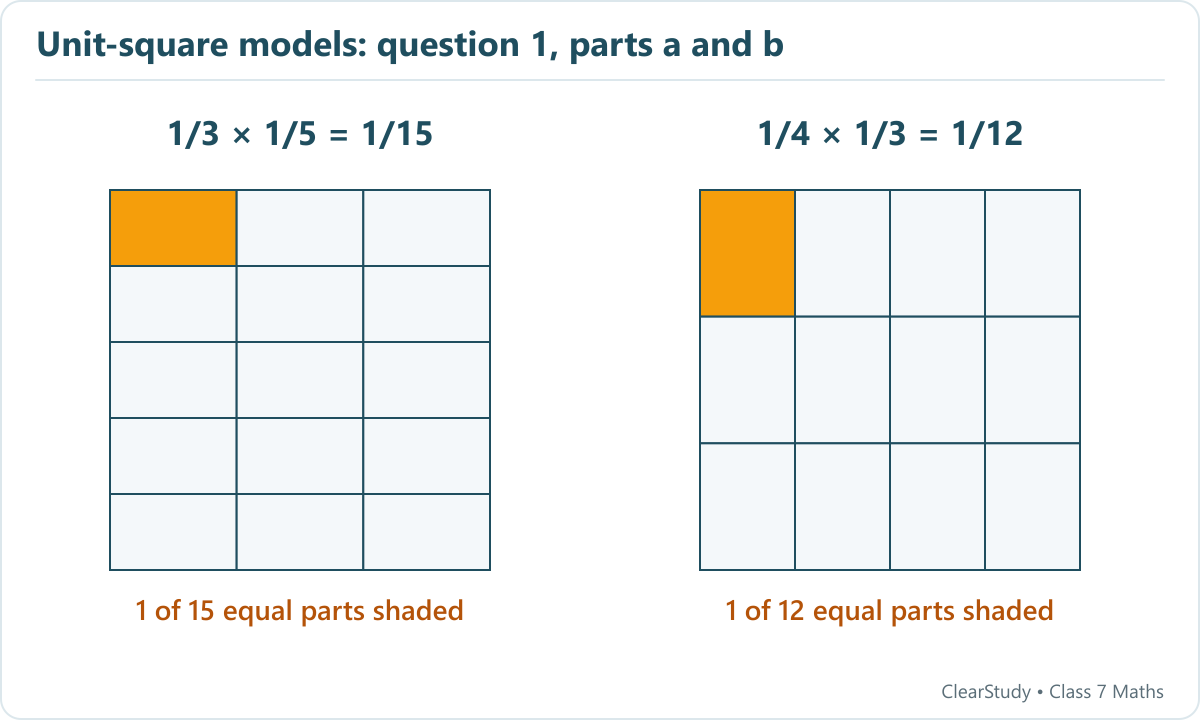
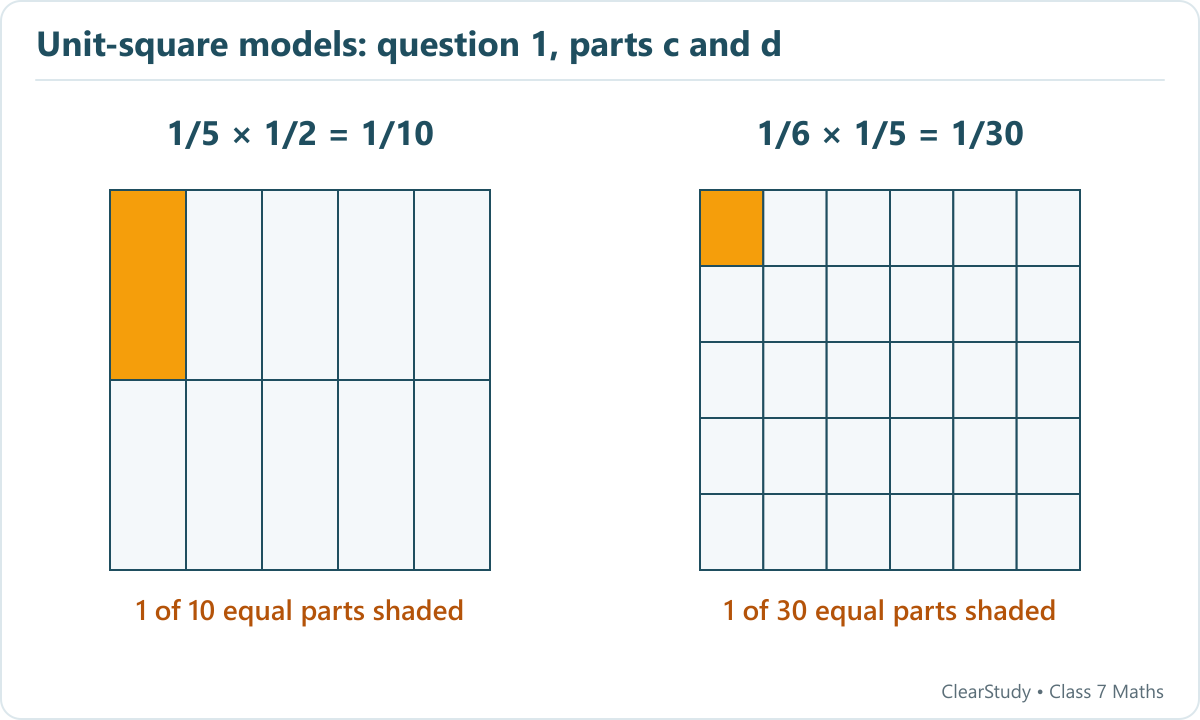
2. Find the following products. Use a unit square as a whole for representing the fractions and carrying out the operations. (a) 2⁄3 × 4⁄5 (b) 1⁄4 × 2⁄3 (c) 3⁄5 × 1⁄2 (d) 4⁄6 × 3⁄5
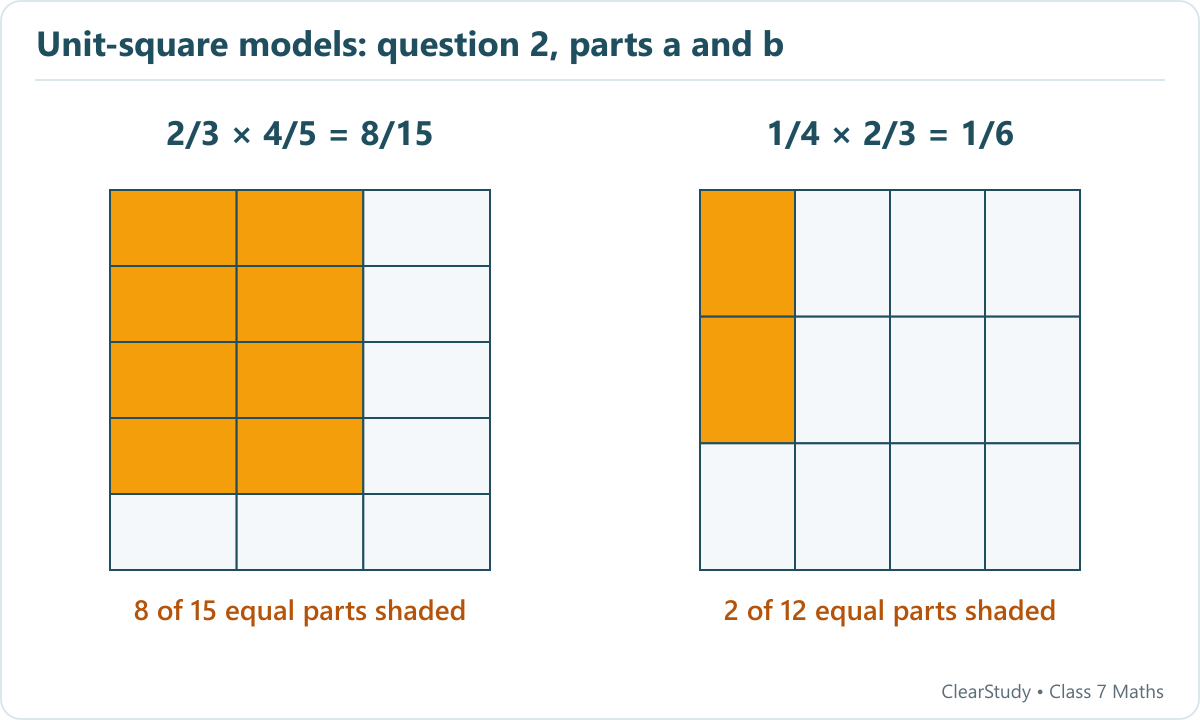
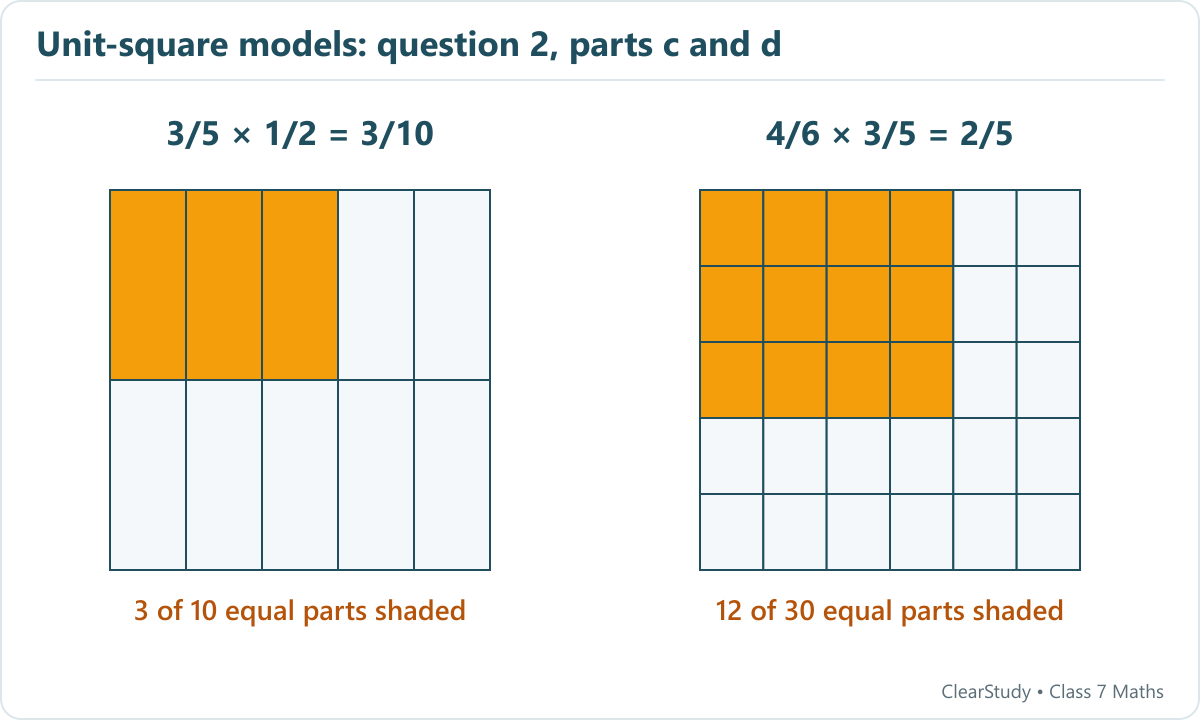
Figure it Out — Multiplying Fractions in Context (Pages 183–184)
1. A water tank is filled from a tap. If the tap is open for 1 hour, 7⁄10 of the tank gets filled. How much of the tank is filled if the tap is open for (a) 1⁄3 hour (b) 2⁄3 hour (c) 3⁄4 hour (d) 7⁄10 hour (e) For the tank to be full, how long should the tap be running?
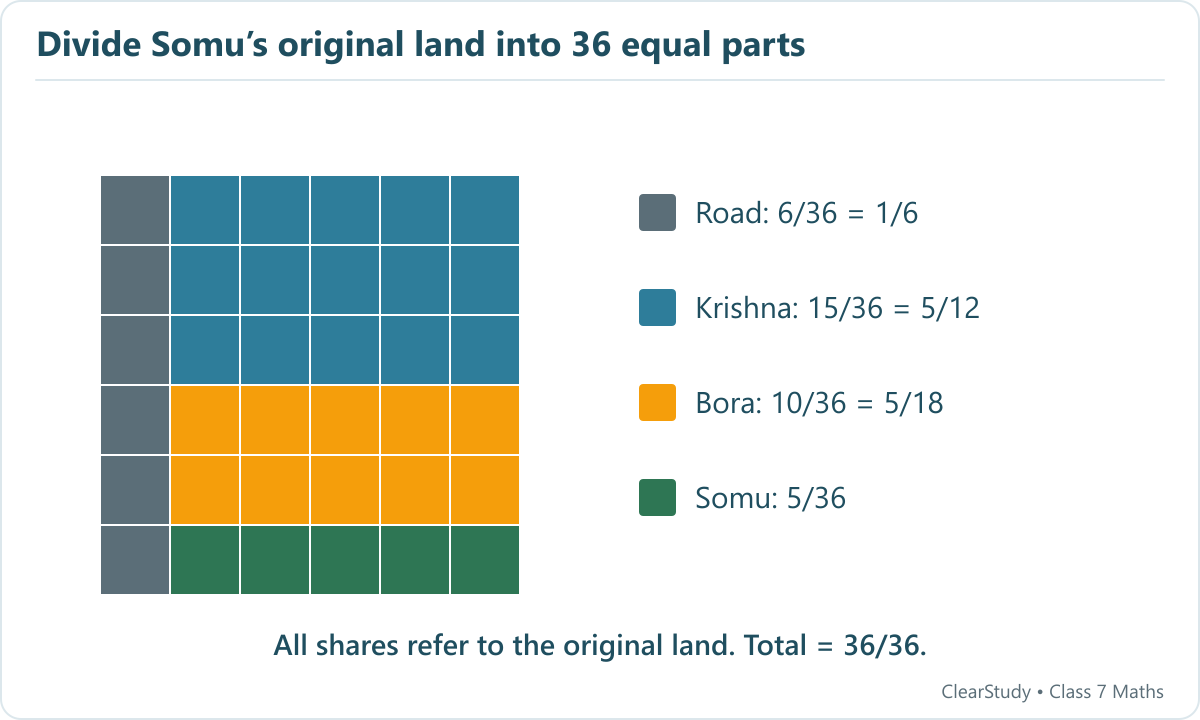
2. The government has taken 1⁄6 of Somu’s land to build a road. What part of the land remains with Somu now? She gives half of the remaining part of the land to her daughter Krishna and 1⁄3 of it to her son Bora. After giving them their shares, she keeps the remaining land for herself. (a) What part of the original land did Krishna get? (b) What part of the original land did Bora get? (c) What part of the original land did Somu keep for herself?
3. Find the area of a rectangle of sides 33⁄4 ft and 93⁄5 ft.
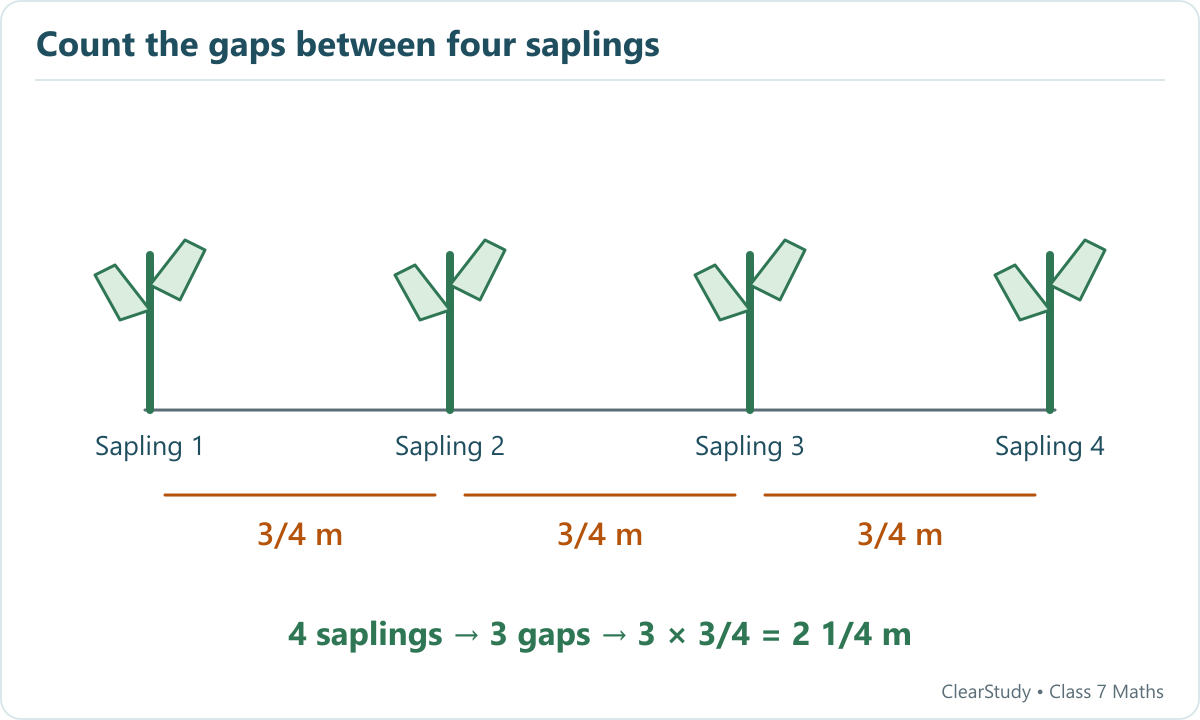
4. Tsewang plants four saplings in a row in his garden. The distance between two saplings is 3⁄4 m. Find the distance between the first and last sapling. [Hint: Draw a rough diagram with four saplings with distance between two saplings as 3⁄4 m]
5. Which is heavier: 12⁄15 of 500 grams or 3⁄20 of 4 kg?
Figure it Out — Division of Fractions & Mixed Problems (Pages 196–198)
1. Evaluate the following: (a) 3 ÷ 7⁄9 (b) 14⁄4 ÷ 2 (c) 2⁄3 ÷ 2⁄3 (d) 14⁄6 ÷ 7⁄3 (e) 4⁄3 ÷ 3⁄4 (f) 7⁄4 ÷ 1⁄7 (g) 8⁄2 ÷ 4⁄15 (h) 1⁄5 ÷ 1⁄9 (i) 1⁄6 ÷ 11⁄12 (j) 32⁄3 ÷ 13⁄8
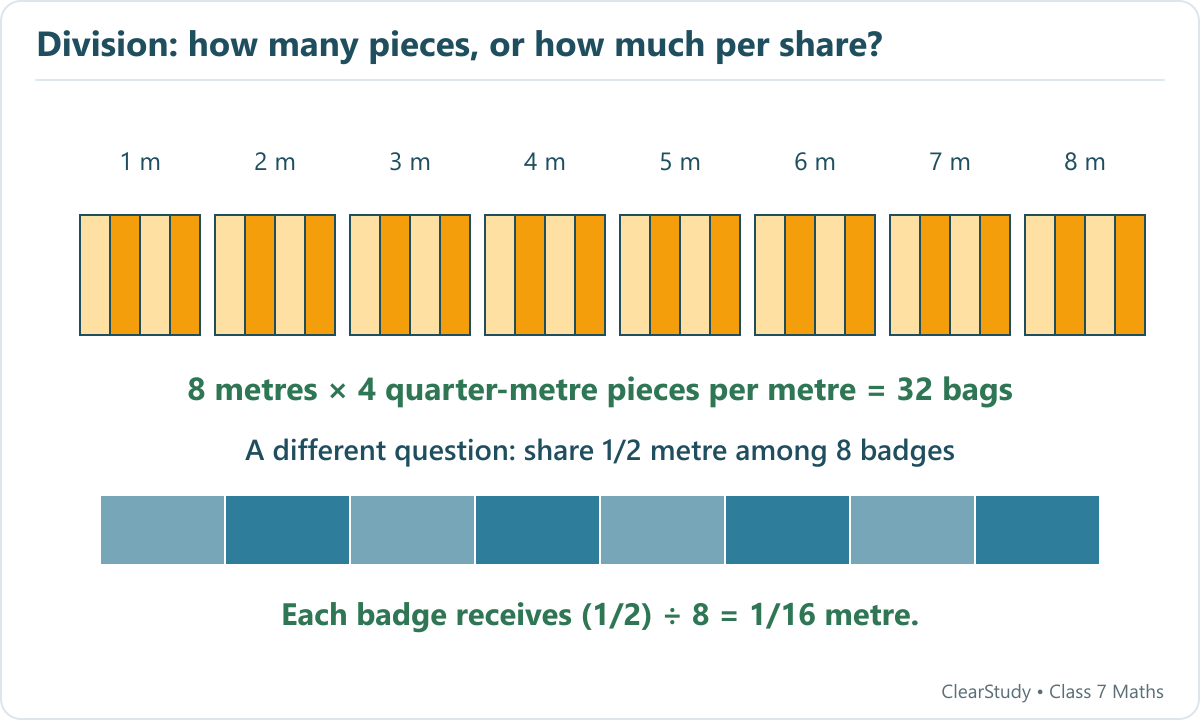
2. For each of the questions below, choose the expression that describes the solution. Then simplify it. (a) Maria bought 8 m of lace to decorate the bags she made for school. She used 1⁄4 m for each bag and finished the lace. How many bags did she decorate? (i) 8 × 1⁄4 (ii) 1⁄8 × 1⁄4 (iii) 8 ÷ 1⁄4 (iv) 1⁄4 ÷ 8 (b) 1⁄2 meter of ribbon is used to make 8 badges. What is the length of the ribbon used for each badge? (i) 8 × 1⁄2 (ii) 1⁄2 ÷ 1⁄8 (iii) 8 ÷ 1⁄2 (iv) 1⁄2 ÷ 8 (c) A baker needs 1⁄6 kg of flour to make one loaf of bread. He has 5 kg of flour. How many loaves of bread can he make? (i) 5 × 1⁄6 (ii) 1⁄6 ÷ 5 (iii) 5 ÷ 1⁄6 (iv) 5 × 6
3. If 1⁄4 kg of flour is used to make 12 rotis, how much flour is used to make 6 rotis?
4. Pāṭīgaṇita, a book written by Sridharacharya in the 9th century CE, mentions this problem: “Friend, after thinking, what sum will be obtained by adding together 1 ÷ 1⁄6, 1 ÷ 1⁄10, 1 ÷ 1⁄13, 1 ÷ 1⁄9, and 1 ÷ 1⁄2.” What should the friend say?
5. Mira is reading a novel that has 400 pages. She read 1⁄5 of the pages yesterday and 3⁄10 of the pages today. How many more pages does she need to read to finish the novel?
6. A car runs 16 km using 1 litre of petrol. How far will it go using 23⁄4 litres of petrol?
7. Amritpal decides on a destination for his vacation. If he takes a train, it will take him 51⁄6 hours to get there. If he takes a plane, it will take him 1⁄2 hour. How many hours does the plane save?
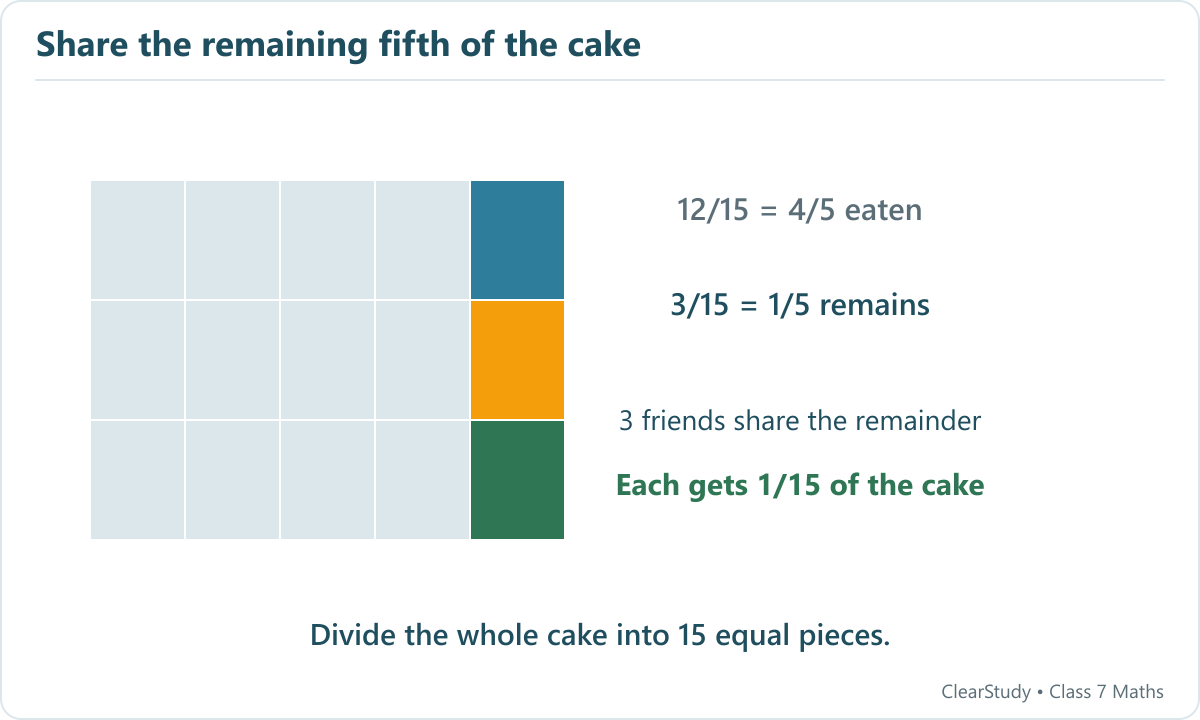
8. Mariam’s grandmother baked a cake. Mariam and her cousins finished 4⁄5 of the cake. The remaining cake was shared equally by Mariam’s three friends. How much of the cake did each friend get?
9. Choose the option(s) describing the product of (565⁄465 × 707⁄676): (a) > 565⁄465 (b) < 565⁄465 (c) > 707⁄676 (d) < 707⁄676 (e) > 1 (f) < 1
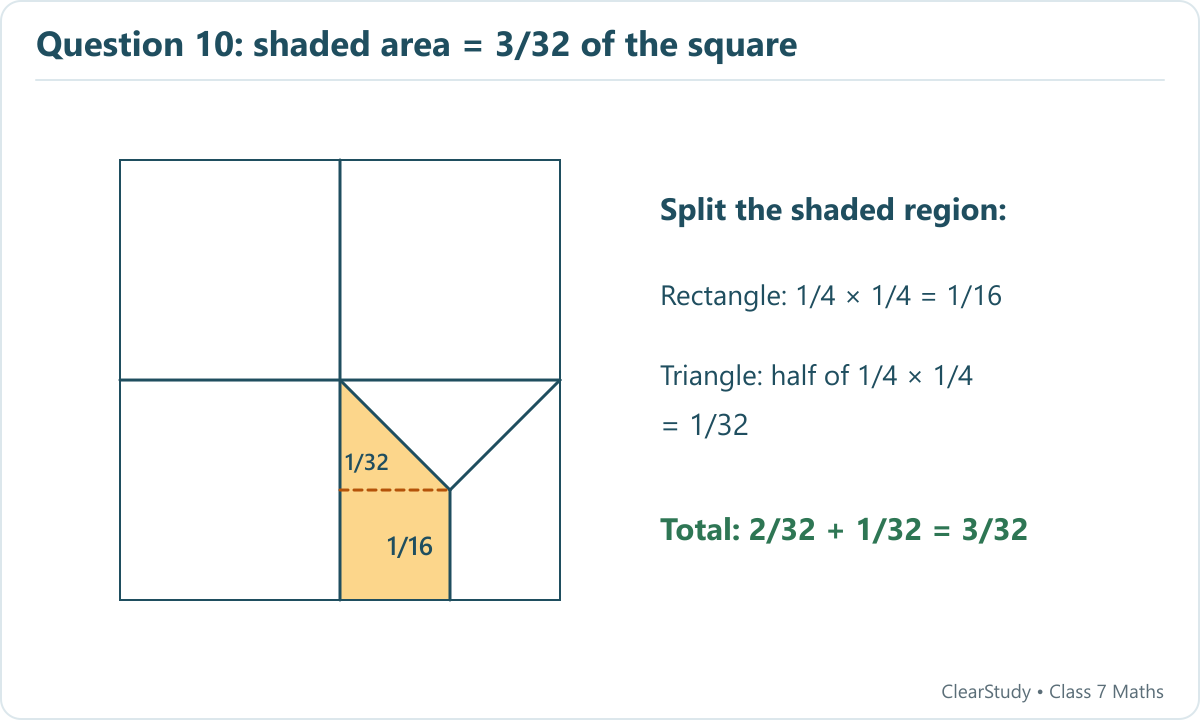
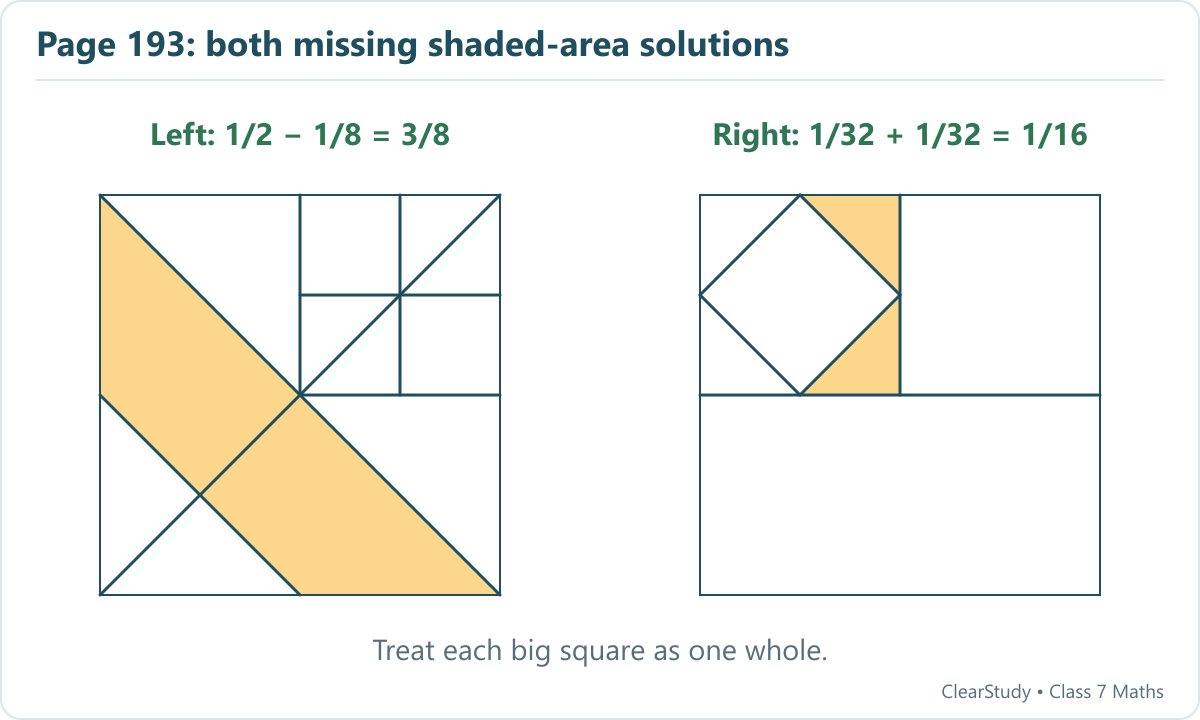
10. What fraction of the whole square is shaded?
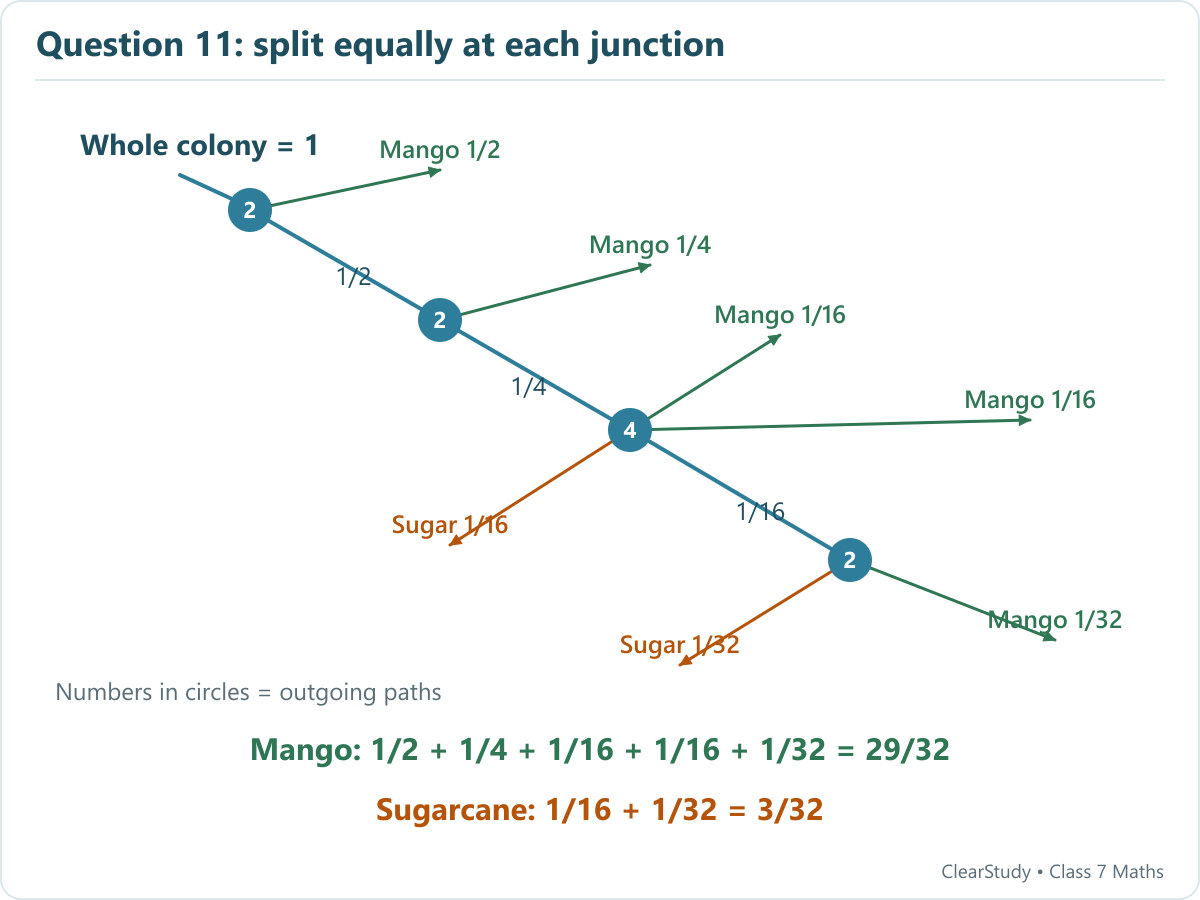
11. A colony of ants set out in search of food. As they search, they keep splitting equally at each point (as shown in the Fig. 8.7) and reach two food sources, one near a mango tree and another near a sugarcane field. What fraction of the original group reached each food source?
12. What is 1 − 1⁄2? (1 − 1⁄2) × (1 − 1⁄3)? (1 − 1⁄2) × (1 − 1⁄3) × (1 − 1⁄4) × (1 − 1⁄5)? (1 − 1⁄2) × (1 − 1⁄3) × (1 − 1⁄4) × (1 − 1⁄5) × (1 − 1⁄6) × (1 − 1⁄7) × (1 − 1⁄8) × (1 − 1⁄9) × (1 − 1⁄10)? Make a general statement and explain.
Math Talk & Try This — Answered
These are the in-text reflective and short tasks in the chapter; the determinate ones are answered, the open ones are guided.
Common Mistakes to Avoid
Watch out for these
- Adding instead of multiplying when a quantity is a fraction of another — “of” means multiply (e.g. 1⁄2 of 5⁄6 = 1⁄2 × 5⁄6).
- Forgetting to convert mixed numbers to improper fractions before multiplying or dividing.
- Dividing by a fraction without flipping it — always multiply by the reciprocal of the divisor, not the dividend.
- Cancelling across an addition/subtraction sign — you may cancel common factors only between a numerator and a denominator that are multiplied.
- Thinking the product of two fractions is always bigger — if a factor is between 0 and 1 the product is smaller than the other number.
- In the “saplings in a row” type question, counting saplings instead of gaps (n saplings give n − 1 gaps).
Practice MCQs & Assertion–Reason
1. 2⁄3 × 4⁄5 equals:
(a) 6⁄8 (b) 8⁄15 (c) 6⁄15 (d) 8⁄8
2. The reciprocal of 7⁄9 is:
(a) 7⁄9 (b) 9⁄7 (c) 1⁄7 (d) 1⁄9
3. 1⁄5 ÷ 1⁄2 equals:
(a) 1⁄10 (b) 5⁄2 (c) 2⁄5 (d) 2⁄10
4. 6 ÷ 1⁄4 equals:
(a) 3⁄2 (b) 6⁄4 (c) 24 (d) 1⁄24
5. The product 1⁄12 × 1⁄18 is:
(a) 1⁄30 (b) 2⁄30 (c) 1⁄216 (d) 1⁄6
6. When a positive number is multiplied by a fraction between 0 and 1, the product is:
(a) greater than the number (b) less than the number (c) equal to the number (d) always 1
7. The general formula for multiplying fractions, a⁄b × c⁄d = (a×c)⁄(b×d), is attributed in this NCERT chapter to:
(a) Aryabhata (b) Brahmagupta (c) Bhaskara II (d) Sridharacharya
8. The area of a rectangle of sides 3⁄4 m and 2⁄3 m is:
(a) 1⁄2 m2 (b) 5⁄7 m2 (c) 6⁄7 m2 (d) 17⁄12 m2
9. For a positive dividend, when the divisor is between 0 and 1, the quotient is:
(a) less than the dividend (b) greater than the dividend (c) equal to the dividend (d) always 0
10. 33⁄4 ft × 93⁄5 ft equals an area of:
(a) 27 sq ft (b) 32 sq ft (c) 36 sq ft (d) 40 sq ft
For each Assertion–Reason question, choose: (A) Both Assertion and Reason are true and the Reason is the correct explanation of the Assertion; (B) Both are true but the Reason is not the correct explanation; (C) Assertion is true but Reason is false; (D) Assertion is false but Reason is true.
A-R 1. Assertion: 2⁄3 ÷ 2⁄3 = 1.
Reason: Any non-zero number divided by itself equals 1, and dividing by a fraction means multiplying by its reciprocal.
A-R 2. Assertion: 1⁄4 × 8 = 2 is less than 8.
Reason: For positive numbers, when one of the numbers multiplied is between 0 and 1, the product is less than the other number.
A-R 3. Assertion: To divide 1⁄5 by 1⁄2, we compute 1⁄5 × 1⁄2.
Reason: Division of a fraction is done by multiplying the dividend by the reciprocal of the divisor.
A-R 4. Assertion: The product of two fractions equals the area of the rectangle whose sides are those fractions.
Reason: The order of multiplication does not matter, so a⁄b × c⁄d = c⁄d × a⁄b.
A-R 5. Assertion: 6 ÷ 1⁄4 = 24, which is greater than 6.
Reason: When the divisor is greater than 1, the quotient is greater than the dividend.
Quick Revision Summary
- To multiply a whole number and a fraction, multiply the whole number by the numerator and keep the denominator: n × p⁄q = (n×p)⁄q.
- Brahmagupta’s rule: a⁄b × c⁄d = (a×c)⁄(b×d); cancel common factors before multiplying.
- The product of two fractions equals the area of the rectangle formed with those fractions as sides.
- If a factor is between 0 and 1 the product is smaller than the other number; if a factor is greater than 1 the product is larger.
- The reciprocal of a⁄b is b⁄a; a fraction times its reciprocal is 1.
- To divide, multiply by the reciprocal: a⁄b ÷ c⁄d = a⁄b × d⁄c.
- If the divisor is between 0 and 1 the quotient is greater than the dividend; if it is greater than 1 the quotient is smaller.
How to score full marks in this chapter
Convert every mixed number to an improper fraction first, then cancel common factors before multiplying to keep numbers small and avoid errors. For word problems, decide whether the situation is “a fraction of a quantity” (multiply) or “sharing/how many fit” (divide), and write the expression before computing. Always reduce your final answer to lowest terms and, where the answer is improper, give the mixed-number form so each step earns its mark.
Frequently Asked Questions
What is Class 7 Maths Ganita Prakash Chapter 8 about?
Chapter 8, Working with Fractions, covers multiplication of fractions (whole number times a fraction and fraction times a fraction using the area model), Brahmagupta’s formula, cancelling common factors, when a product is bigger or smaller than the numbers multiplied, and division of fractions using reciprocals.
How many Figure it Out exercises are there in Chapter 8?
There are four “Figure it Out” sets — on pages 176–177, 180–181, 183–184 and 196–198 — plus Math Talk and Try This tasks, all solved step by step on this page.
How do you divide one fraction by another?
Find the reciprocal of the divisor (swap its numerator and denominator) and multiply it by the dividend. For example, 1⁄5 ÷ 1⁄2 = 1⁄5 × 2⁄1 = 2⁄5. This rule was stated by Brahmagupta in 628 CE.
Are these Class 7 Maths Ganita Prakash Chapter 8 solutions free?
Yes. All solutions are free and follow the official NCERT Ganita Prakash (Part I) textbook for the 2026–27 session, with every answer worked out and verified.
Textbook reference: NCERT Ganita Prakash, Chapter 8 (official PDF). ClearStudy diagrams and worked explanations are original teaching aids.