
NCERT Solutions for Class 7 Science (Curiosity) Chapter 3: Electricity: Circuits and Their Components (NCERT 2026–27)
These Class 7 Science Curiosity Chapter 3 solutions cover Electricity: Circuits and Their Components from the new NCF-2023 textbook (2026–27). Every question of the end-of-chapter exercise “Let Us Enhance Our Learning” is reproduced verbatim and solved step by step, along with key concepts, extra practice, MCQs, Assertion–Reason questions and FAQs — everything you need to master electric cells, batteries, lamps, switches, circuits and conductors.
Class 7 Science Curiosity Chapter 3 Solutions – Overview
Chapter 3 of Curiosity, Electricity: Circuits and Their Components, begins with the many uses of electricity and then explores how a simple device like a torchlight works. You learn about the electric cell (a portable source of electrical energy with a positive and a negative terminal), the battery (two or more cells joined positive-to-negative), the electric lamp (incandescent lamps with a glowing filament and modern LED lamps), the electrical circuit (a complete path for current to flow), the switch (which completes or breaks a circuit), circuit diagrams drawn using standard symbols, and finally conductors and insulators. The chapter stresses safety — only batteries or cells should be used for experiments, never the mains supply, because our body is itself a conductor of electricity.
Key Concepts & Definitions
Electric cell: a portable source of electrical energy with two terminals — the metal cap is the positive (+ve) terminal and the flat metal disc is the negative (−ve) terminal.
Battery: a combination of two or more cells in which the positive terminal of one cell is joined to the negative terminal of the next. (The term “battery” is also used for a single cell, e.g. a mobile phone battery.)
Incandescent lamp: a lamp with a thin wire called a filament inside a glass bulb; the filament gets hot and glows when current passes through it. It can be connected either way round.
LED (Light Emitting Diode): a lamp with no filament and two terminals — positive (longer wire) and negative (shorter wire). Current passes through an LED in one direction only, so it must be connected the right way to glow.
Electrical circuit: a complete, closed path that allows electric current to flow. Conventional current flows from the cell’s positive terminal through the external circuit to its negative terminal.
Switch: a simple device that completes (ON / closed) or breaks (OFF / open) a circuit. In the OFF position there is an air gap between its terminals.
Circuit diagram: a representation of an electrical circuit using standard symbols for its components.
Conductors: materials (mainly metals such as copper, silver, gold) through which electric current flows easily.
Insulators: materials (plastic, rubber, glass, wood, ceramics) through which current does not pass easily under normal conditions; they are used to cover wires, plugs and switches for safety.
“Let Us Enhance Our Learning” – NCERT Solutions
Original answers for Questions 1–11 on pages 37–39 of NCERT Curiosity, Reprint 2026–27. Circuit connections have been checked against Figs. 3.16–3.21.
1. Choose the incorrect statement. (i) A switch is the source of electric current in a circuit. (ii) A switch helps to complete or break the circuit. (iii) A switch helps us to use electricity as per our requirement. (iv) When the switch is in ‘OFF’ position, there is an air gap between its terminals.
2. Observe Fig. 3.16. With which material connected between the ends A and B, the lamp will not glow?
3. In Fig. 3.17, if the filament of one of the lamps is broken, will the other glow? Justify your answer.
4. A student forgot to remove the insulator covering from the connecting wires while making a circuit. If the lamp and the cell are working properly, will the lamp glow?
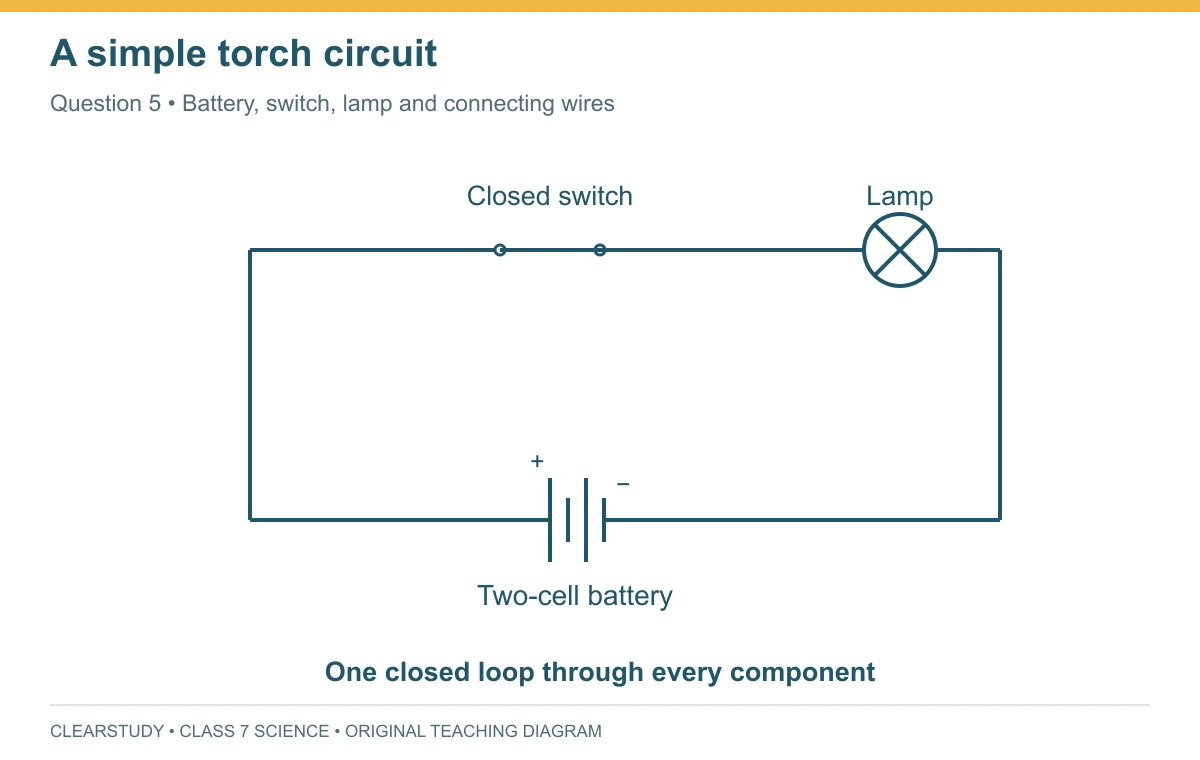
5. Draw a circuit diagram for a simple torch using symbols for electric components.
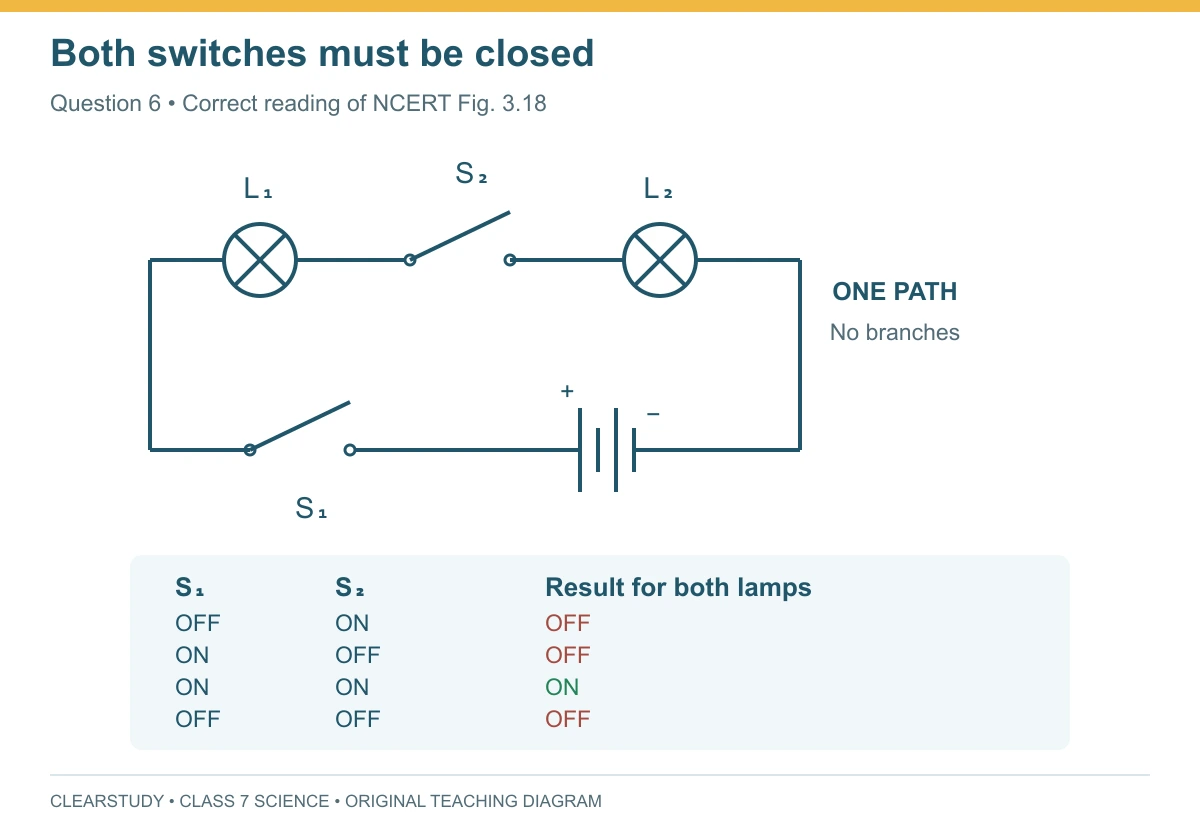
6. In Fig. 3.18: (i) If S2 is in ‘ON’ position, S1 is in ‘OFF’ position, which lamp(s) will glow? (ii) If S2 is in ‘OFF’ position, S1 is in ‘ON’ position, which lamp(s) will glow? (iii) If S1 and S2 both are in ‘ON’ position, which lamp(s) will glow? (iv) If both S1 and S2 are in ‘OFF’ position, which lamp(s) will glow?
7. Vidyut has made the circuit as shown in Fig. 3.19. Even after closing the circuit, the lamp does not glow. What can be the possible reasons? List as many possible reasons as you can for this faulty operation. What will you do to find out why the lamp did not glow?
8. In Fig. 3.20, in which case(s) the lamp/LED will not glow when the switch is closed?
9. Suppose the ‘+’ and ‘−’ symbols cannot be read on a battery. Suggest a method to identify the two terminals of this battery.
10. You are given six cells marked A, B, C, D, E, and F. Some of these are working and some are not. Design an activity to identify which of them are working. (i) List the items that you require. (ii) Write the procedure that you will follow. (iii) With the items, carry out the activity to identify the cells that are working.
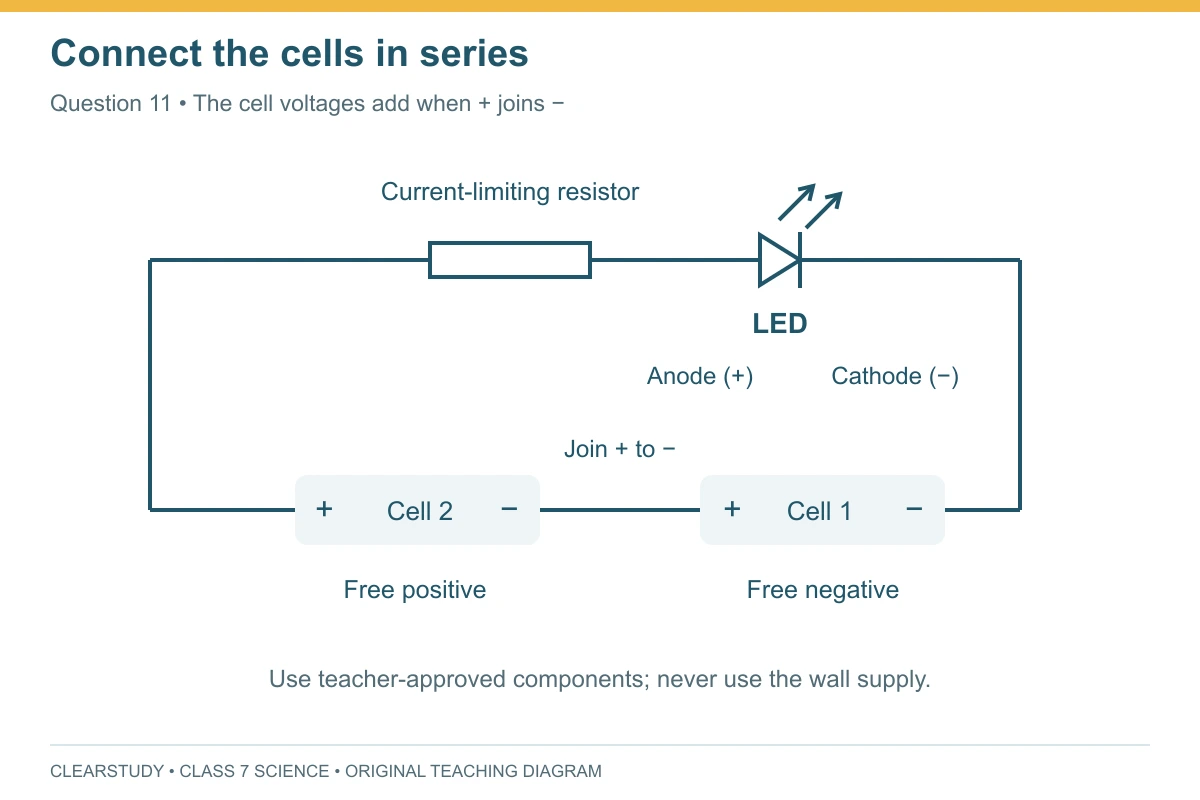
11. Using an LED that requires two cells in series to glow, Tanya made the circuit as shown in Fig. 3.21. Will the lamp glow? If not, draw the wires for correct connections.
Extra Practice Questions
These questions and MCQs are ClearStudy practice, separate from the NCERT exercise.
Short Answer Type Questions
Q1. What is an electric cell? Name its two terminals.
Q2. How is a battery made from cells?
Q3. What is the filament of an incandescent lamp and what does it do?
Q4. Why must an LED be connected the right way in a circuit, unlike an incandescent lamp?
Q5. Why are electric wires covered with plastic or rubber?
Long Answer Type Questions
Q1. Explain how a switch turns a torchlight on and off. What happens to the circuit in each case?
Q2. Distinguish between conductors and insulators with examples, and explain why both are important in electrical appliances.
Q3. What is an electrical circuit? Explain the conditions under which a lamp glows, including the agreed direction of current.
Multiple Choice Questions (MCQs)
1. The metal cap of an electric cell is its:
(a) negative terminal (b) positive terminal (c) switch (d) filament
2. A combination of two or more cells is called a:
(a) circuit (b) switch (c) battery (d) conductor
3. In an incandescent lamp, light is produced by the glowing:
(a) glass bulb (b) metal case (c) filament (d) holder
4. The longer wire of an LED is its:
(a) negative terminal (b) positive terminal (c) filament (d) insulator
5. A device that completes or breaks a circuit is a:
(a) cell (b) lamp (c) switch (d) battery
6. The direction of current in a circuit is taken from the:
(a) negative to positive terminal (b) positive to negative terminal (c) lamp to switch (d) switch to wire
7. Which of the following is a good conductor of electricity?
(a) rubber (b) plastic (c) copper (d) glass
8. Which material is an electrical insulator?
(a) iron (b) aluminium (c) silver (d) plastic
9. When a switch is in the ‘OFF’ position, the circuit is said to be:
(a) closed (b) open (c) short (d) complete
10. An incandescent lamp does not glow even when connected to a cell. One possible cause is:
(a) too bright (b) fused (broken filament) (c) an LED (d) a conductor
Assertion–Reason Questions
For each Assertion–Reason question, choose: (A) Both true and the Reason correctly explains the Assertion; (B) Both true but the Reason is not the correct explanation; (C) Assertion true, Reason false; (D) Assertion false, Reason true.
A-R 1. Assertion: An LED glows only when it is connected the correct way round in a circuit.
Reason: Electric current can pass through an LED in one direction only.
A-R 2. Assertion: A switch is the source of electric current in a circuit.
Reason: A switch only completes or breaks the circuit; the source of energy is the cell or battery.
A-R 3. Assertion: Electric wires are covered with plastic or rubber.
Reason: Plastic and rubber are insulators and protect people from electric shocks.
A-R 4. Assertion: An incandescent lamp will glow whichever way its terminals are connected to a cell.
Reason: Current can pass through the filament of an incandescent lamp in both directions as long as the circuit is complete.
A-R 5. Assertion: A fused incandescent lamp does not glow even when connected to a good cell.
Reason: A broken filament stops the flow of current through the lamp.
How to write a clear answer
Remember the key rule for circuits: a lamp glows only when the circuit is complete (closed). For LED questions, always check the direction — longer wire (positive) to the positive terminal of the battery. When asked to find why a lamp does not glow, list several reasons (dead cell, fused lamp, insulation not removed, loose/broken connection, faulty switch) and explain how you would test them. Learn the standard symbols from Table 3.2 so you can quickly draw and read circuit diagrams. State that current flows from the positive to the negative terminal of the cell.
Common mistakes to avoid
- Calling the switch a source of current — the cell/battery is the source; the switch only opens or closes the circuit.
- Forgetting that an LED works in one direction only — reversing it keeps it off even with the switch closed.
- Not removing the insulating cover from the ends of wires, so no contact is made.
- Thinking a lamp can glow in an open (incomplete) circuit — it cannot.
- Mixing up cell terminals: the metal cap = positive, the flat metal disc = negative.
- Performing experiments with the mains/wall supply — never do this; use only cells or batteries.
Frequently Asked Questions
What is Class 7 Science Curiosity Chapter 3 about?
Chapter 3, Electricity: Circuits and Their Components, explains how electricity is used and how a torchlight works. It covers the electric cell, battery, incandescent lamp and LED, the electrical circuit, the switch, circuit diagrams drawn with standard symbols, and conductors versus insulators, along with important electrical safety.
What is the difference between a conductor and an insulator?
Conductors, such as copper, silver and gold (mainly copper for wires), allow electric current to flow easily. Insulators, such as plastic, rubber, glass and wood, do not allow current to pass and are used to cover wires, plugs and switches to protect us from electric shocks.
Why does an LED glow only one way but a bulb glows either way?
An LED allows current to pass in one direction only, so it glows only when its longer (positive) wire is joined to the positive terminal of the battery. An incandescent lamp has a filament that current can pass through in both directions, so it glows whichever way it is connected, as long as the circuit is complete.
Are these Class 7 Science Curiosity Chapter 3 solutions free?
Yes. All solutions are free and follow the official NCERT Curiosity textbook for 2026–27.