
NCERT Solutions for Class 7 Science (Curiosity) Chapter 7: Heat Transfer in Nature (NCERT 2026–27)
These Class 7 Science Curiosity Chapter 7 solutions cover Heat Transfer in Nature from the new NCF-2023 textbook (session 2026–27). The chapter explains the three ways heat moves — conduction, convection and radiation — and connects them to everyday nature: land and sea breezes, the water cycle, infiltration of rainwater and groundwater. Every question of the end-of-chapter exercise “Let Us Enhance Our Learning” is reproduced verbatim and solved step by step below.
Class 7 Science Curiosity Chapter 7 Solutions – Overview
Chapter 7 of Curiosity, Heat Transfer in Nature, begins with Pema and Palden wondering why some places are hot and others cold. Through simple activities the chapter builds up the three modes of heat transfer. Conduction is heat moving from the hotter part of an object to its colder part without the particles changing position (a metal strip dropping pinned wax). Convection is heat carried by the actual movement of particles in liquids and gases (hot air rising under a paper cup, a coloured streak circulating in heated water). Radiation is heat travelling without any medium — the warmth of a fire or the Sun. These ideas explain land and sea breezes, the use of good and poor conductors in cooking utensils and clothing, the water cycle, the infiltration of rainwater, and groundwater stored in aquifers.
Key Concepts & Definitions
Conduction: the process of heat transfer from the hotter part of an object to its colder part. The heated particle passes heat to its neighbour and so on, but the particles do not move from their positions. It is the main way heat moves in solids.
Good conductors: materials such as metals that allow heat to pass through them easily — used for cooking utensils.
Poor conductors (insulators): materials such as wood, glass, clay, porcelain and air that do not allow heat to pass through easily — used to keep things warm or cool.
Convection: heat transfer by the actual movement of particles. When a liquid or gas is heated it expands, becomes lighter and rises, while cooler, heavier fluid sinks to take its place, setting up a cycle. It is the main way heat moves in liquids and gases.
Radiation: heat transfer that does not need any medium; heat travels directly from a hot object, e.g. the Sun or a fire, to us.
Sea breeze / land breeze: land heats and cools faster than water. By day, warm air over the land rises and cooler air moves from sea to land (sea breeze); by night the reverse happens (land breeze).
Water cycle: the continuous movement of water — upward as water vapour (evaporation, transpiration) and downward as precipitation — through soil, rocks and plants, finally returning to water bodies.
Infiltration: the process of surface water seeping through soil and rocks; water moves more readily where spaces are wide, open and connected.
Aquifer: the underground layer of sediments and rocks that stores water (groundwater) in its pore spaces.
“Let Us Enhance Our Learning” – NCERT Solutions
All questions below are reproduced verbatim from the NCERT Curiosity textbook (Reprint 2026–27); the answers are original and exam-ready.
1. Choose the correct option in each case. (i) Your father bought a saucepan made of two different materials, A and B, as shown in Fig. 7.14. The materials A and B have the following properties — (a) Both A and B are good conductors of heat (b) Both A and B are poor conductors of heat (c) A is a good conductor and B is a poor conductor of heat (d) A is a poor conductor and B is a good conductor of heat
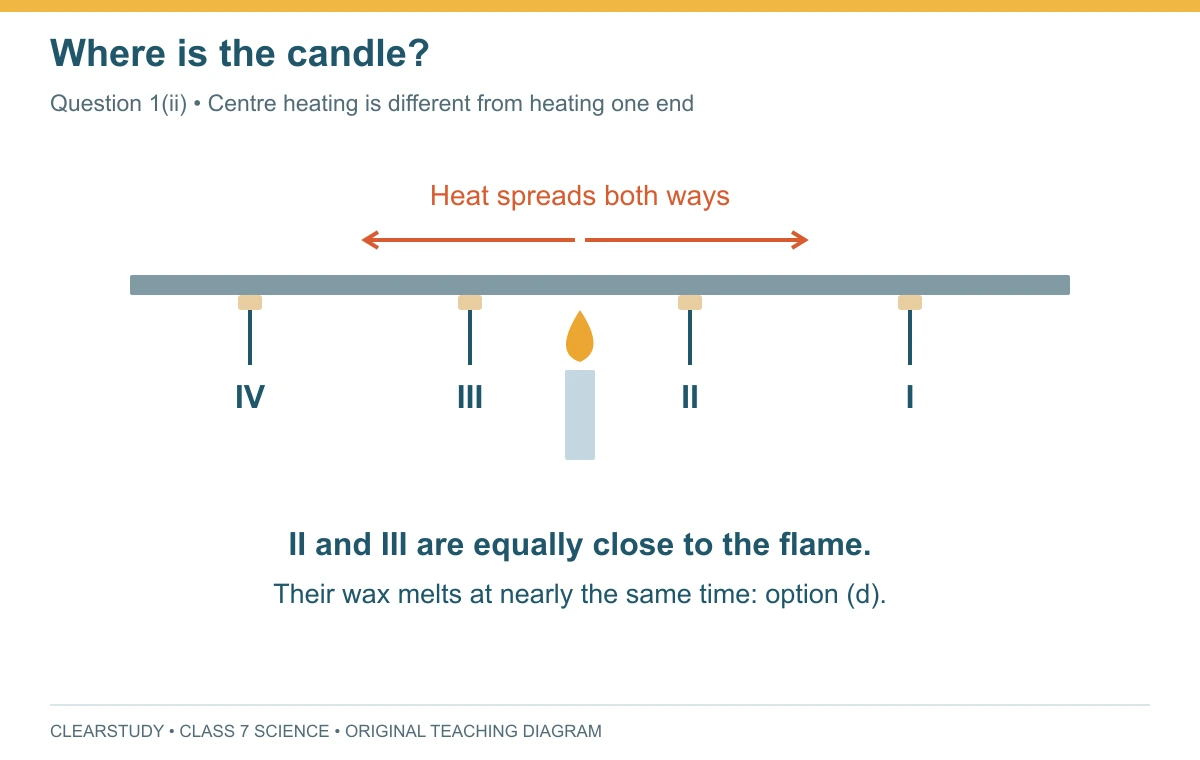
(ii) Pins are stuck to a metal strip with wax and a burning candle is kept below the rod, as shown in Fig. 7.15. Which of the following will happen? (a) All the pins will fall almost at the same time (b) Pins I and II will fall earlier than pins III and IV (c) Pins I and II will fall later than pins III and IV (d) Pins II and III will fall almost at the same time
(iii) A smoke detector is a device that detects smoke and sounds an alarm. Suppose you are fitting a smoke detector in your room. The most suitable place for this device will be: (a) Near the floor (b) In the middle of a wall (c) On the ceiling (d) Anywhere in the room
2. A shopkeeper serves you cold lassi in a tumbler. By chance, the tumbler had a small leak. You were given another tumbler by the shopkeeper to put the leaky tumbler in it. Will this arrangement help to keep the lassi cold for a longer time? Explain.
3. State with reason(s) whether the following statements are True [T] or False [F]. (i) Heat transfer takes place in solids through convection. [ ] (ii) Heat transfer through convection takes place by the actual movement of particles. [ ] (iii) Areas with clay materials allow more seepage of water than those with sandy materials. [ ] (iv) The movement of cooler air from land to sea is called land breeze. [ ]
4. Some ice cubes placed in a dish melt into water after sometime. Where do the ice cubes get heat for this transformation?
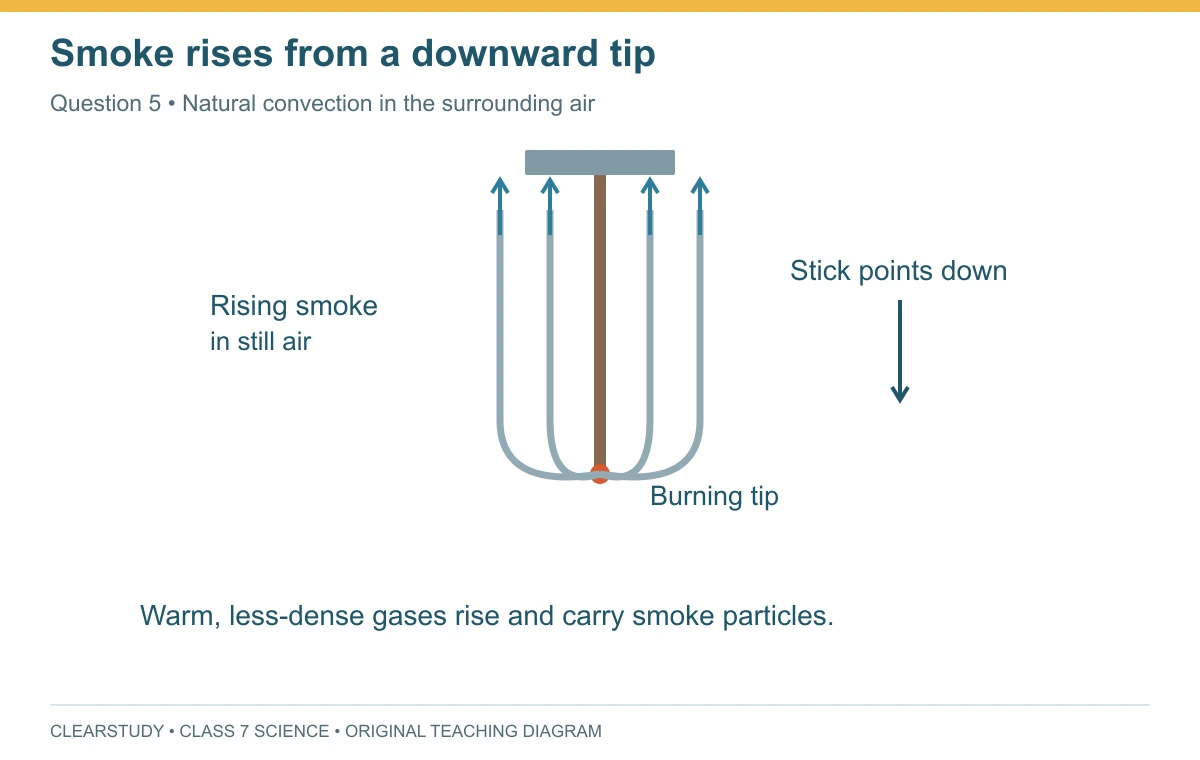
5. A burning incense stick is fixed, pointing downwards. In which direction would the smoke from the incense stick move? Show the movement of smoke with a diagram.
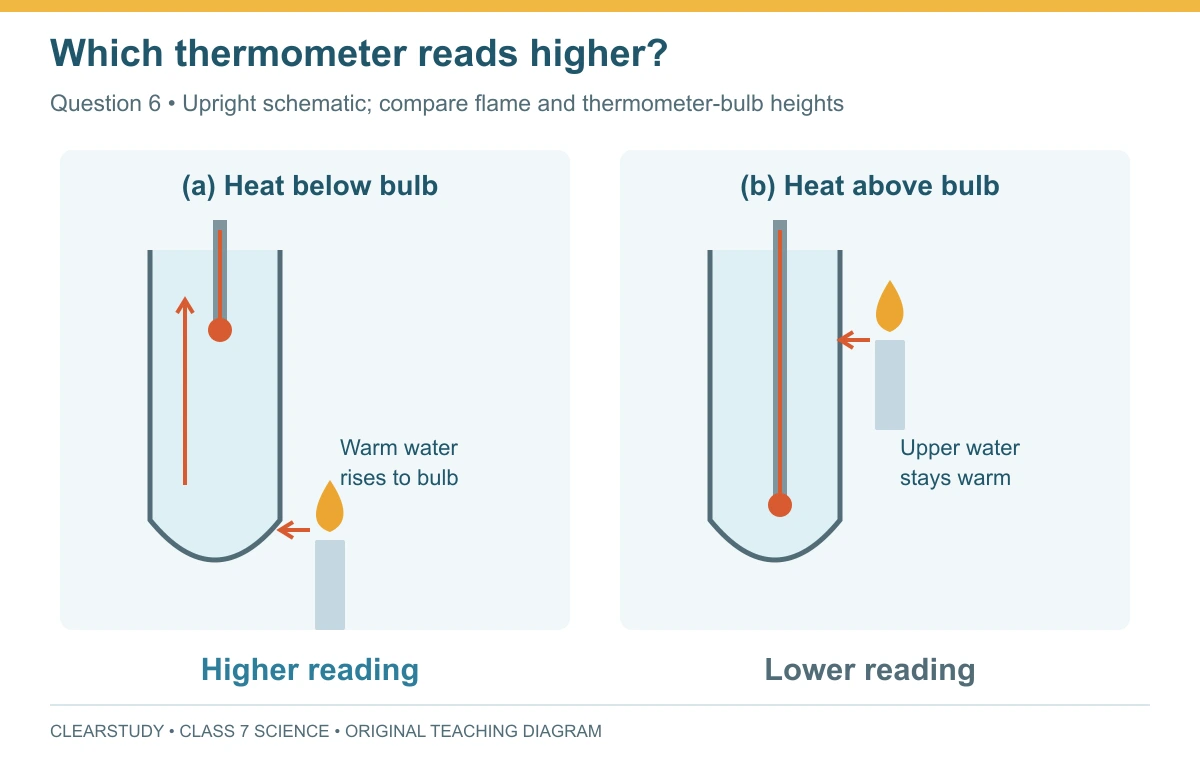
6. Two test tubes with water are heated by a candle flame as shown in Fig. 7.16. Which thermometers (Fig. 7.16a or Fig. 7.16b) will record a higher temperature? Explain.
7. Why are hollow bricks used to construct the outer walls of houses in hot regions?
8. Explain how large water bodies prevent extreme temperature in areas around them.
9. Explain how water seeps through the surface of the Earth and gets stored as groundwater.
10. The water cycle helps in the redistribution and replenishment of water on the Earth. Justify the statement.
Exploratory Projects
These are open-ended project tasks; suggested approaches are given below. Flame, hot-metal and glassware activities require a teacher or adult, a heatproof surface and eye protection. Keep paper clear of flames and never touch hot equipment.
Society: Visit a site of water harvesting or a recharge pit. Find out from people how they are constructed and how they work. Prepare a report with illustrations. — Visit a rooftop rainwater-harvesting tank or a recharge pit, note how rainwater is collected, filtered and directed into the ground to recharge groundwater, and draw a labelled diagram in your report.
Activity: Tightly wrap a thin paper strip around a metallic rod. Try to burn the paper with a candle while rotating the rod continuously. Does the paper burn? Explain your observations. — The paper does not burn easily, because the metal rod is a good conductor and quickly carries the heat away from the paper, so the paper does not reach its burning temperature.
Activity: Take a sheet of paper. Draw a spiral on it, cut along the spiral and suspend it above a burning candle. Observe what happens and explain. — The paper spiral rotates. Hot air above the candle rises by convection, and as it moves up past the slanted strips of the spiral it pushes them, making the spiral spin.
Extra Practice Questions
These questions and MCQs are ClearStudy practice, separate from the NCERT exercise.
Short Answer Type Questions
Q1. Define conduction of heat.
Q2. Why do we prefer two thin blankets over one thick blanket to keep warm?
Q3. Why are cooking utensils generally made of metals?
Q4. Heat from the Sun reaches the Earth even through empty space. Which process makes this possible?
Q5. Why do clothes dry faster on a sunny day?
Long Answer Type Questions
Q1. Describe an activity to show that heat travels through a metal by conduction.
Q2. Explain the formation of sea breeze and land breeze with the help of heat transfer.
Q3. Explain conduction, convection and radiation using the single example of heating water in a pan over a flame.
MCQs & Assertion–Reason
1. The transfer of heat from the hotter part of a solid to its colder part is called:
(a) convection (b) radiation (c) conduction (d) evaporation
2. Which of the following is the best conductor of heat?
(a) wood (b) aluminium (c) glass (d) clay
3. In liquids and gases, heat is transferred mainly by:
(a) conduction (b) convection (c) radiation (d) infiltration
4. The mode of heat transfer that does not require any medium is:
(a) conduction (b) convection (c) radiation (d) condensation
5. During the day, the movement of cooler air from the sea towards the land is called:
(a) land breeze (b) sea breeze (c) monsoon (d) cyclone
6. Woollen clothes keep us warm in winter because:
(a) wool produces heat (b) wool traps air, a poor conductor (c) wool is a good conductor (d) wool radiates heat to us
7. Water seeps fastest through:
(a) clay (b) sand (c) gravel (d) all equally
8. The underground layer of sediments and rocks that stores water in its pore spaces is called:
(a) aquifer (b) glacier (c) reservoir (d) infiltration
9. The process of surface water seeping through soil and rocks is called:
(a) evaporation (b) condensation (c) infiltration (d) precipitation
10. Smoke from a fire rises up because hot smoke is:
(a) heavier than air (b) lighter than the surrounding air (c) a good conductor (d) solid
For each Assertion–Reason question, choose: (A) Both true and the Reason correctly explains the Assertion; (B) Both true but the Reason is not the correct explanation; (C) Assertion true, Reason false; (D) Assertion false, Reason true.
A-R 1. Assertion: We prefer clay or porcelain cups for hot tea and coffee.
Reason: Clay and porcelain are poor conductors of heat, so the drink stays hot longer.
A-R 2. Assertion: Heat from the Sun reaches the Earth by radiation.
Reason: Radiation does not require any material medium for heat transfer.
A-R 3. Assertion: In conduction, the particles of the solid move from the hot end to the cold end carrying heat.
Reason: In conduction, each heated particle passes heat to its neighbour without leaving its own position.
A-R 4. Assertion: A sea breeze blows from the sea towards the land during the day.
Reason: During the day the land heats faster than the sea, so warm air over the land rises and cooler sea air moves in.
A-R 5. Assertion: Hollow bricks help keep houses cool in summer and warm in winter.
Reason: The air trapped inside hollow bricks is a good conductor of heat.
Quick Revision Summary
- Heat is transferred in three ways: conduction, convection and radiation.
- Conduction — heat moves from the hotter to the colder part of an object; particles vibrate about fixed positions without bulk movement; main mode in solids.
- Good conductors (metals) let heat pass easily; poor conductors / insulators (wood, glass, clay, air) do not.
- Convection — heat carried by the actual movement of particles; main mode in liquids and gases; explains land and sea breezes.
- Radiation — heat transfer needing no medium; brings the Sun’s and a fire’s heat to us.
- Land heats and cools faster than water, giving milder climates near large water bodies.
- Water cycle redistributes and replenishes water; infiltration stores it as groundwater in aquifers.
Common Mistakes to Avoid
Watch out for these
- Saying particles move in conduction — in conduction the particles stay in place; they vibrate in a solid, while convection involves bulk movement of a fluid.
- Calling air a good conductor — trapped air is actually a poor conductor, which is why it insulates blankets, woollens and hollow bricks.
- Mixing up land and sea breeze — sea breeze blows from sea to land (day); land breeze from land to sea (night).
- Thinking radiation needs a medium — only conduction and convection need a medium; radiation does not.
- Writing that clay allows the most seepage — gravel allows the fastest, clay the slowest.
- Confusing infiltration with evaporation — infiltration is water seeping down into the ground, not rising as vapour.
How to write a clear answer
Always name the mode of heat transfer and give its reason in your answer — e.g. “by convection, because hot air rises and cool air sinks.” Remember the rule: solids → conduction, liquids & gases → convection, no medium → radiation. Use the textbook’s own examples (the pin-and-wax strip, the paper-cup activity, the coloured streak in water, hollow bricks, two thin blankets) to support your explanations, and learn the breeze diagrams and the water-cycle terms (evaporation, transpiration, condensation, precipitation, infiltration, aquifer).
Frequently Asked Questions
What is Class 7 Science Curiosity Chapter 7 about?
Chapter 7, Heat Transfer in Nature, explains the three ways heat moves — conduction, convection and radiation — and links them to good and poor conductors, land and sea breezes, the water cycle, infiltration of rainwater and groundwater stored in aquifers.
What is the difference between conduction, convection and radiation?
In conduction, heat passes from particle to particle without the particles moving (mainly in solids). In convection, heat is carried by the actual movement of heated particles (mainly in liquids and gases). In radiation, heat travels directly without any medium, as from the Sun or a fire.
Why does smoke from an incense stick rise in still air?
Smoke contains tiny particles carried in hot gases; this warm mixture is less dense than the surrounding air, so by convection it initially rises upward in still air — even if the burning incense stick is pointed downwards.
Are these Class 7 Science Curiosity Chapter 7 solutions free?
Yes. All solutions are free and follow the official NCERT Curiosity textbook for session 2026–27.