
NCERT Solutions for Class 7 Social Science (Exploring Society) Part 2 Chapter 1: The Story of Indian Farming
These Class 7 Social Science Exploring Society Part 2 Chapter 1 solutions cover The Story of Indian Farming from Exploring Society: India and Beyond (Part 2), the NCERT textbook (first edition, November 2025), used here for the 2026–27 session. The chapter belongs to the theme India and the World: Land and the People and explains the main characteristics of Indian agriculture, how farming is linked to climate, soil and water, the three cropping seasons — kharif, rabi and zaid — the six major soil types of India, traditional and modern irrigation, seeds, the Green Revolution, sustainable farming and the challenges farmers face today. Below you get step-by-step answers to all Questions and activities, clear notes on key terms, extra practice, MCQs, Assertion–Reason and FAQs.
Numbering note: this is Chapter 1 in NCERT Part 2. ClearStudy previously called it Chapter 13 by continuing the Part 1 sequence; the existing page address is retained.
The Story of Indian Farming – Overview
Part 2 Chapter 1, The Story of Indian Farming, traces agriculture from prehistory to the present. It explains that farming — the preparation of soil, cultivation of plants, rearing of livestock and growing of trees — is one of humankind’s oldest occupations and that agriculture and allied activities contribute a little over 18 per cent of India’s GDP and employ about 46 per cent of its working population (2022–23). Archaeology shows rice in the Ganga Plain by the 7th–8th millennium BCE and barley/wheat among the Harappans, while ancient texts such as the Arthaśhāstra, Kṛiṣhi Parāśhara and Vṛikṣhāyurveda record deep agricultural knowledge. The chapter then shows how climate, soil and water decide what grows where, describing India’s seven climates and 15 agroclimatic zones, the role of the monsoons, the three cropping seasons (kharif, rabi, zaid), six major soil types, rain-fed versus irrigated farming, seeds, the Green Revolution and its limits, and the need to blend traditional wisdom with modern innovation for sustainable agriculture — while farmers face challenges of small landholdings, climate change and debt.
Key Terms & Concepts
Agriculture and allied activities: broadly includes farming, animal husbandry (raising livestock), forestry and horticulture, plus beekeeping (apiculture), fisheries, rearing of silkworms (sericulture) and fibre production such as cotton and hemp. The word agriculture comes from Latin — agri (field) and cultura (to cultivate).
Threshing: separating grain from harvested stalks and ears. Winnowing separates lighter chaff from grain; removing a grain’s husk can require a separate dehusking process.
Intercropping: the practice of growing two or more different crops simultaneously (seen at the Harappan site of Kalibangan around 2800 BCE).
Grafting: a technique that joins one plant with another to grow as a single plant, combining desirable traits like pest resistance or sweetness of fruit.
Agroclimatic zones: India is divided into 15 such zones by combining climate, soil, terrain and vegetation — for example the Upper Gangetic Plain Region and the Western Dry Region.
Cropping seasons: kharif generally follows the monsoon (rice, maize, bajra, cotton); rabi follows the cool season (wheat, barley, gram, mustard); zaid is the short summer season between them (watermelon, cucumber, muskmelon). Dates and crop calendars vary by region. Sugarcane is a long-duration crop, so it does not fit neatly into one short season.
Soil & humus: soil is the thin upper layer of the Earth’s crust that supports plant life, formed over a century to several millennia. Humus is the dark organic matter formed by decomposition of plant and animal matter; it is rich in nutrients and retains moisture. Weathering is the breaking down of rocks into soil particles by physical, chemical or biological means.
Six major soil types of India: alluvial, black (cotton) soil, red soil, laterite soil, desert soil and mountain / alpine soil.
Rain-fed vs irrigated agriculture: rain-fed farming relies entirely on rainfall; irrigated farming uses artificial methods such as canals, wells, phad systems, bamboo drip irrigation, and modern drip and sprinkler irrigation.
Green Revolution: the expansion of high-yielding crop varieties, irrigation, fertilisers and supporting farm services from the 1960s, strongly associated in India with M.S. Swaminathan. It increased wheat and rice production and reduced dependence on foodgrain imports. Gains varied across regions; intensive and poorly managed inputs also contributed to groundwater and environmental problems.
Sustainable agriculture: farming that maintains production and livelihoods while protecting soil, water and biodiversity. Crop rotation, suitable manure, soil testing, integrated pest management and efficient irrigation can contribute. Assess practices by evidence and local conditions, not simply whether they are labelled traditional or modern.
Landholding and hectare: one hectare equals 10,000 m². Distinguish land owned from an operational holding, which may include leased land. The textbook’s approximate three-fourths-hectare figure lacks a stated statistical definition and year here; it should not be treated as a timeless national average. The main lesson is the challenge of small and fragmented farms.
“The Big Questions” — Answered
The chapter opens with three Big Questions. Here are concise, exam-ready answers based on the chapter.
1. What are the main characteristics of Indian agriculture?
2. How are farming, climate, soil, and water interrelated?
3. How can traditional practices and contemporary ones complement each other?
“Questions and activities” — Full Solutions
All questions below are reproduced verbatim from the NCERT textbook’s end-of-chapter Questions and activities section. Answers are original, written in exam-ready style.
1. Why do farmers in Kerala grow rice while farmers in Punjab grow mostly wheat? What would happen if they swapped?
2. Match the following:
| Column A | Column B (correct match) |
|---|---|
| (a) Kharif crops | (ii) Crops grown during the monsoon |
| (b) Rabi crops | (i) Crops during the winter |
| (c) Alluvial soil | (v) Soil rich in nutrients deposited by rivers |
| (d) Terrace farming | (vi) Method of farming on hillsides |
| (e) Alpine soil | (iii) Thin, rough, and rocky soil found in mountainous regions |
| (f) Zaid crops | (iv) Crops grown in summer |
3. Why do certain crops thrive in specific regions?
4. How has modern technology helped farmers?
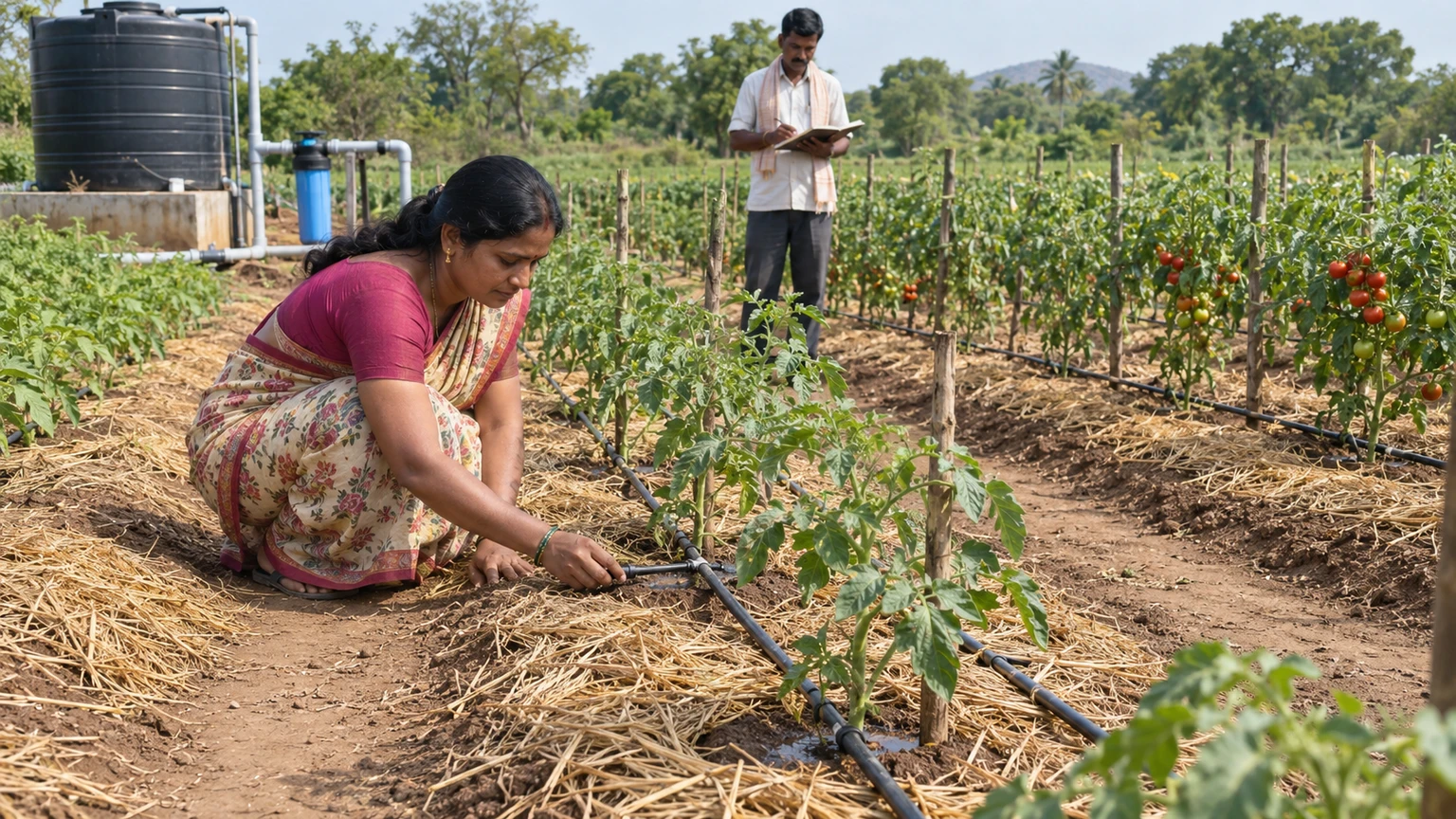
5. Why is sustainable agriculture important? Write a short note on this.
6. Name some challenges that farmers face today. What might be their impact for people?
7. Have a debate in class on the topic “Traditional irrigation methods are better than modern ones.”
8. Write a short essay describing what farming might be like when you are 60 years old. You could also draw / paint a picture to illustrate what you envision.
9. Form small groups and discuss the issues affecting the Ganga basin. Prepare a presentation proposing your solutions and their rationale (your reasons). Share and discuss in class. Your teacher will guide you in this exercise.
| Pressure | Proposed response | Reason |
|---|---|---|
| Pollution | Treat sewage and industrial discharges; improve nutrient and waste management | Protect water quality and ecosystems |
| Excessive abstraction | Measure use, choose suitable crops and improve irrigation scheduling | Reduce pressure on surface water and connected aquifers |
| Altered river flows | Assess environmental-flow needs and manage infrastructure accordingly | Support aquatic life and downstream users |
| Climate and flood risks | Improve monitoring, early warnings and floodplain planning | Reduce exposure and support adaptation |
10. Looking at the crops listed in the section ‘Echoes from the Past’, which ones do you find in use in your home? What conclusion can you draw from your observations?
Extra Practice Questions
These questions and MCQs are ClearStudy practice, separate from the NCERT exercise.
Short Answer Type Questions
Q1. What does the term ‘agriculture and allied activities’ include?
Q2. Name the three cropping seasons of India and give one crop of each.
Q3. What are the six major soil types of India?
Q4. What is the difference between rain-fed and irrigated agriculture?
Q5. What was the Green Revolution and who is called its architect?
Long Answer Type Questions
Q1. Describe the rhythm of the three cropping seasons — kharif, rabi and zaid — with their crops.
Q2. Explain how ancient Indian texts and archaeology reveal a long, rich history of farming in India.
Q3. Discuss the trade-off between traditional and modern farming methods and why a balance is needed.
MCQs & Assertion–Reason
1. The word ‘agriculture’ comes from Latin words meaning:
(a) water and land (b) field and to cultivate (c) seed and harvest (d) soil and rain
2. Approximately what percentage of India’s working population is engaged in agriculture and allied activities (2022–23)?
(a) 18% (b) 36% (c) 46% (d) 75%
3. Wheat, barley, gram and mustard are examples of:
(a) kharif crops (b) rabi crops (c) zaid crops (d) plantation crops
4. Rice, maize, bajra and cotton, which depend on the monsoon, are:
(a) rabi crops (b) zaid crops (c) kharif crops (d) winter crops
5. Into how many agroclimatic zones is India divided?
(a) 6 (b) 7 (c) 12 (d) 15
6. Which of these is NOT one of the six major soil types of India?
(a) Alluvial soil (b) Black soil (c) Clay-brick soil (d) Laterite soil
7. The dark organic matter in soil formed by the decomposition of plant and animal matter is called:
(a) humus (b) silt (c) bedrock (d) laterite
8. Drip and sprinkler irrigation are examples of:
(a) rain-fed farming (b) modern irrigation methods (c) traditional phad systems (d) intercropping
9. Who is regarded as the architect of the Green Revolution in India?
(a) Verghese Kurien (b) M.S. Swaminathan (c) Kauṭilya (d) Surapāla
10. Which Indian state is the world’s first 100 per cent organic state?
(a) Punjab (b) Kerala (c) Sikkim (d) Maharashtra
For each Assertion–Reason question, choose: (A) Both true and the Reason correctly explains the Assertion; (B) Both true but the Reason is not the correct explanation; (C) Assertion true, Reason false; (D) Assertion false, Reason true.
A-R 1. Assertion: Crop suitability differs between regions such as Kerala and Punjab.
Reason: The crops grown in a region depend on its climate, soil and availability of water.
A-R 2. Assertion: The Green Revolution had no harmful effects on the environment.
Reason: The Green Revolution led to depletion of groundwater and contamination of soil and water by chemicals.
A-R 3. Assertion: Kharif crops are dependent on the timely arrival of the monsoon.
Reason: Kharif is the monsoon cropping season, with crops sown at the start of the rains.
A-R 4. Assertion: The average size of landholdings in India is decreasing.
Reason: Land gets divided among family members over generations.
A-R 5. Assertion: Sustainable agriculture combines modern productivity with traditional wisdom.
Reason: Traditional methods like crop rotation and organic manure work in harmony with Nature.
In-text activities and checks
Food-to-farm chart: list foods actually eaten at home, their crop ingredients and confirmed growing regions. For example, roti → wheat → a suitable producing region; do not assume the flour was grown locally without checking.
Soil observations: record colour, texture, visible organic matter and possible human disturbance. Colour alone cannot establish nutrient content. The six groups in the textbook are a simplified classification; soils vary within states.
Illustrative state examples: alluvial — Uttar Pradesh and Bihar; black — Maharashtra and Madhya Pradesh; red — Tamil Nadu and Karnataka; laterite — Kerala and Karnataka; desert — Rajasthan and Gujarat; mountain — Himachal Pradesh and Uttarakhand. These indicate occurrences, not exclusive soil types throughout each state.
Two weak monsoons: yields, fodder, irrigation supplies and food prices may be affected; storage and trade can partly offset local shortages. Do not predict that a named food must disappear entirely.
Rainfall and crop stages: timely moisture helps sowing and growth, while excessive rain near harvest can cause damage. Read the textbook’s one-third as the combined beginning-and-end share, plus two-thirds in the middle, rather than adding three separate shares above 100%.
Farm programme report: record the date, broadcaster, crop/region, advice and questions. Verify local advice with an agricultural extension service. Government schemes have eligibility and claim rules; they do not automatically cover every loss.
Connections: revisit Climates of India and Understanding Markets.
Reviewed against NCERT Exploring Society: India and Beyond, Class 7, Part 2, Chapter 1, pp. 1–28 (first edition, November 2025). Review date: 10 October 2026. Textbook question wording is retained, with factual qualifications in the answers.
Exam Tips & Common Mistakes
How to write a clear answer
Memorise the three cropping seasons (kharif/rabi/zaid) with two crops each, and the six soil types. For “why a crop grows in a region” questions, always link to climate, soil, water and terrain. When using figures, state that the textbook’s GDP and workforce shares refer to 2022–23; check definitions before comparing landholding statistics. Learn the textbook’s 15 agroclimatic zones and seven broad climate types. Use the textbook’s own examples — Kallanai anicut, phad and bamboo drip irrigation, panchagavya/beejamrit, Sikkim organic state, M.S. Swaminathan and the Green Revolution — to show you have studied the chapter. For activity questions (debate, essay, Ganga project), write structured points; do not leave them blank.
Common mistakes to avoid
- Mixing up kharif (monsoon/summer-sown) and rabi (winter) crops — rice is kharif, wheat is rabi.
- Forgetting the third season, zaid (summer crops like watermelon and cucumber).
- Confusing weathering (rocks breaking into soil) with humus (organic matter in soil).
- Calling the Green Revolution wholly good — note its harms (soil, groundwater, chemical pollution, health).
- Listing fewer than six soil types, or inventing soil names not in the textbook.
- Leaving the match-the-following or activity questions incomplete — attempt every part.
Frequently Asked Questions
What is Part 2 Chapter 1 of Class 7 Social Science Exploring Society about?
Part 2 Chapter 1, The Story of Indian Farming, traces agriculture from prehistory to today. It explains the main characteristics of Indian agriculture, how farming is linked to climate, soil and water, the three cropping seasons (kharif, rabi, zaid), the six major soil types, traditional and modern irrigation, seeds, the Green Revolution and its limits, sustainable farming, and the challenges farmers face such as small landholdings, climate change and debt.
What are the three cropping seasons of India?
The three cropping seasons are kharif (monsoon crops such as rice, maize, bajra and cotton, sown around June–July), rabi (winter crops such as wheat, barley, gram and mustard, sown around October–November), and zaid (short summer crops such as watermelon, muskmelon and cucumber). These Arabic terms have been used since Mughal times.
What is the exercise heading for Part 2 Chapter 1 of Exploring Society Part 2?
The end-of-chapter exercise in Exploring Society: India and Beyond (Part 2) Part 2 Chapter 1 is headed Questions and activities and contains 10 questions, all answered step by step on this page, along with the chapter’s three Big Questions.