
Class 8 Science Curiosity Chapter 11 Solutions (NCERT 2026–27) – Keeping Time with the Skies
These Class 8 Science Curiosity Chapter 11 solutions cover Keeping Time with the Skies from the new NCF-2023 textbook (2026–27), with every “Keep the curiosity alive” question answered step by step.
Class 8 Science Curiosity Chapter 11 Solutions – Overview
Chapter 11 of Curiosity, Keeping Time with the Skies, explains how the sky helps us measure time. It shows why the Moon changes its shape (phases) — from new Moon to crescent, half, gibbous and full Moon — because we see different fractions of its illuminated half as it revolves around the Earth in about a month. The Moon’s phases are not caused by Earth’s shadow. The chapter then builds the units of time — the day (Earth’s rotation), the month (Moon’s phase cycle) and the year (Earth’s revolution and seasons) — and how these gave rise to lunar, solar and luni-solar calendars, the Indian National Calendar, festival dates, and modern artificial satellites. These Class 8 Science Curiosity Chapter 11 solutions answer every textbook question.
Key Concepts & Definitions
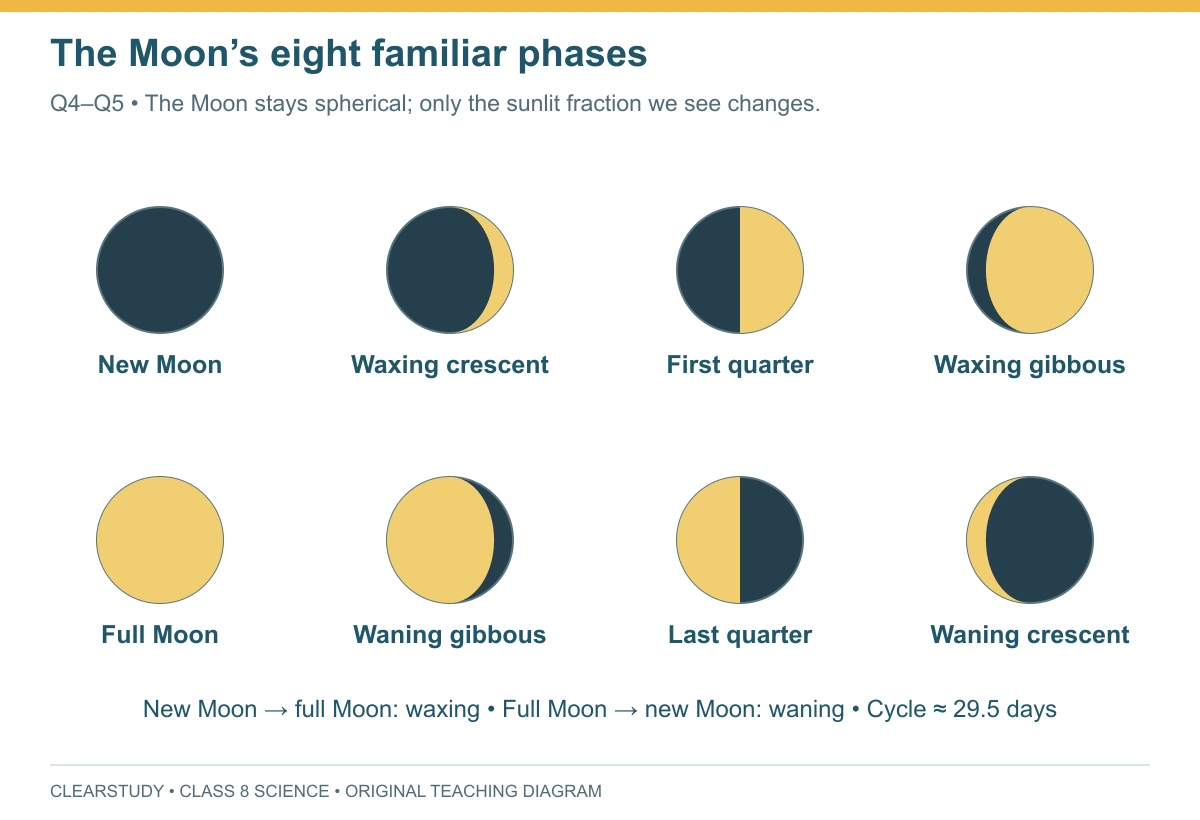
Phases of the Moon: the changing shapes of the bright (illuminated) portion of the Moon as seen from Earth from one day to the next.
Why phases happen: the Moon shines by reflecting sunlight; only the half facing the Sun is lit. As the Moon revolves around the Earth, we see different fractions of that lit half — so its shape appears to change. (Phases are NOT due to Earth’s shadow.)
Waxing & waning: waxing = bright part growing (Shukla Paksha); waning = bright part shrinking (Krishna Paksha). Full Moon = Purnima; New Moon = Amavasya. One full cycle ≈ one month (about 29.5 days).
Gibbous & crescent: gibbous = more than half lit portion visible; crescent = less than half visible.
Mean solar day: the average time (24 hours) for the Sun to return to its highest point in the sky — due to Earth’s rotation.
Calendars: lunar (follows Moon’s phases, ≈354-day year), solar (follows seasons, 365¼ days, e.g. Gregorian), luni-solar (uses Moon’s phases but adds an extra month, Adhika Maasa, to stay in step with seasons).
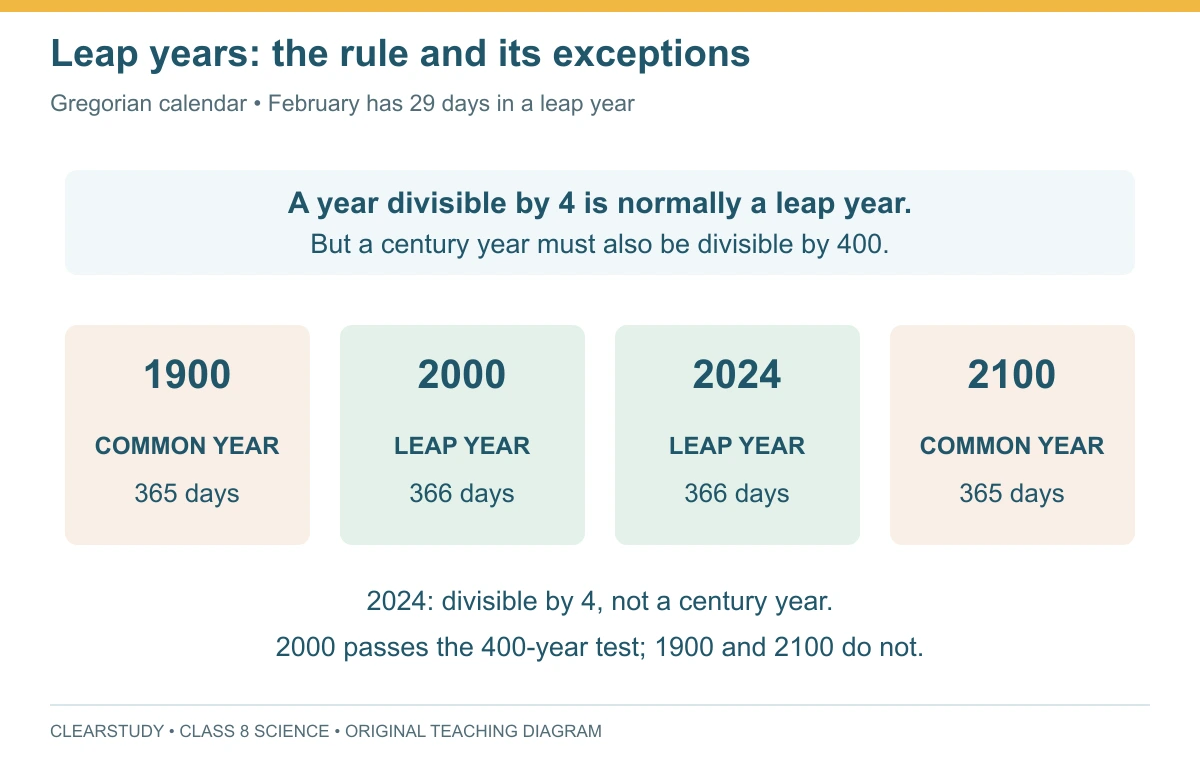
Leap year: an extra day (29 February) usually added every four years in the Gregorian calendar; century years must be divisible by 400. This keeps dates close to the seasonal year. Artificial satellite: a human-made object launched to orbit the Earth.
“Probe and Ponder” & Activity Answers
Have you ever seen the Moon during the day? Why do you think it is sometimes visible when the Sun is up?
Imagine you lived on the Moon instead of Earth. What would you mean by a day, a month or a year?
What would happen if Earth had two moons instead of one? How would that change the night sky?
If we didn’t have clocks or calendars, how else could we measure time?
Activity 11.1 & 11.2 (key conclusions)
Activity 11.1: After observing the Moon at sunrise/sunset for a month, did the Moon appear different each day, and at the same position?
Activity 11.2: Why does the illuminated portion of the Moon seen from the Earth decrease when it appears closer to the Sun?
Class 8 Science Curiosity Chapter 11 Solutions — Keep the Curiosity Alive
1. State whether the following statements are True or False. (i) We can only see that part of the Moon which reflects sunlight towards us. (ii) The shadow of Earth blocks sunlight from reaching the Moon causing phases. (iii) Calendars are based on various astronomical cycles which repeat in a predictable manner. (iv) The Moon can only be seen at night.
2. Amol was born on 6th of May on a full Moon day. Does his birthday fall on the full Moon day every year? Explain your answer.
3. Name two things that are incorrect in Fig. 11.10.
4. Look at the pictures of the Moon in Fig. 11.11, and answer the following questions. (i) Write the correct panel number corresponding to the phases of the Moon shown in the pictures above. (ii) List the picture labels of the phases of the Moon that are never seen from Earth. Hint: You can use your observations from Activity 11.1 or Fig. 11.2 as reference.
| Phase requested | NCERT Fig. 11.11 label |
|---|---|
| Three days after new Moon: crescent | D |
| Full Moon | E |
| Three days after full Moon: gibbous | A |
| A week after full Moon: half Moon | C |
| New Moon | B |
5. Malini saw the Moon overhead in the sky at sunset. (i) Draw the phase of the Moon that Malini saw. (ii) Is the Moon in the waxing or the waning phase?
For phase names and approximate timing, see NASA’s Moon phases guide.
6. Ravi said, “I saw a crescent Moon, and it was rising in the East, when the Sun was setting.” Kaushalya said, “Once I saw the gibbous Moon during the afternoon in the East.” Who out of the two is telling the truth?
7. Scientific studies show that the Moon is getting farther away from the Earth and slower in its revolution. Will luni-solar calendars need an intercalary month more often or less often?
8. A total of 37 full Moons happen during 3 years in a solar calendar. Show that at least two of the 37 full moons must happen during the same month of the solar calendar.
9. On a particular night, Vaishali saw the Moon in the sky from sunset to sunrise. What phase of the Moon would she have noticed?
10. If we stopped having leap years, in approximately how many years would the Indian Independence day happen in winter?
11. What is the purpose of launching artificial satellites?
12. On which periodic phenomenon are the following measures of time based: (i) day (ii) month (iii) year?
| Measure of time | Periodic phenomenon it is based on |
|---|---|
| (i) Day | The rotation of the Earth on its own axis — the Sun returning to its highest point in the sky (about 24 hours). |
| (ii) Month | The cycle of the phases of the Moon as it revolves around the Earth (about 29.5 days). |
| (iii) Year | The revolution of the Earth around the Sun and the resulting cycle of seasons (about 365¼ days). |
The Indian National Calendar begins Chaitra on 22 March, or 21 March in Gregorian leap years: IMD Positional Astronomy Centre.
Common Misconceptions to Avoid
Watch out for these
- Thinking the Moon’s phases are caused by Earth’s shadow — they are caused by seeing different parts of the lit half as the Moon revolves; Earth’s shadow causes a lunar eclipse.
- Believing the Moon’s actual shape changes — only the visible lit portion changes; the Moon stays a sphere.
- Assuming the Moon is seen only at night — it rises about 50 minutes later each day and is often visible by day.
- Thinking the Moon rises exactly when the Sun sets — only the full Moon does; other phases rise and set at different times.
- Confusing waxing and waning — waxing (Shukla Paksha) grows, best seen at sunset; waning (Krishna Paksha) shrinks, best seen at sunrise.
- Mixing up calendars — lunar follows the Moon (≈354 days), solar follows seasons (365 days), luni-solar adds an extra month to match both.
Extra Practice Questions
These questions and MCQs are ClearStudy practice, separate from the NCERT exercise.
Very Short Answer Type Questions
Q1. What is the day when the Moon appears as a full bright circle called in India?
Q2. About how many days does the Moon take to cycle through all its phases?
Q3. Name the natural satellite of the Earth.
Short Answer Type Questions
Q1. Why does the Moon rise about 50 minutes later each day?
Q2. Why does a lunar calendar slowly fall out of step with the seasons?
Long Answer Type Question
Q1. Explain how the day, the month and the year are each defined from natural sky cycles, and how leap years keep the solar calendar accurate.
MCQs & Assertion–Reason
1. The phases of the Moon are caused by:
(a) Earth’s shadow on the Moon (b) the Moon changing its real shape (c) seeing different parts of the lit half as the Moon revolves around Earth (d) clouds covering the Moon
2. The day when the Moon is not visible is called:
(a) Purnima (b) Amavasya (new Moon) (c) full Moon (d) gibbous day
3. The Moon takes about how long to complete one cycle of phases?
(a) one day (b) one week (c) about 29.5 days (d) one year
4. Each day, the Moon rises approximately:
(a) at the same time (b) 50 minutes earlier (c) 50 minutes later (d) exactly when the Sun sets
5. The mean solar day is based on the:
(a) revolution of the Earth around the Sun (b) rotation of the Earth on its axis (c) phases of the Moon (d) movement of the stars
6. The Gregorian calendar is an example of a:
(a) lunar calendar (b) solar calendar (c) luni-solar calendar (d) sidereal-only calendar
7. In a leap year an extra day is added to:
(a) January (b) February (c) June (d) December
8. The extra month added to a luni-solar calendar to match the seasons is called:
(a) Shukla Paksha (b) Krishna Paksha (c) Adhika Maasa (intercalary month) (d) Uttarayan
9. When the Moon shows more than half of its lit portion, the phase is called:
(a) crescent (b) gibbous (c) new Moon (d) half Moon
10. The Indian National Calendar begins its year on:
(a) 1 January (b) 22 March normally; 21 March in a Gregorian leap year (c) 21 June (d) 14 November
For each Assertion–Reason question, choose: (A) Both true and the Reason correctly explains the Assertion; (B) Both true but the Reason is not the correct explanation; (C) Assertion true, Reason false; (D) Assertion false, Reason true.
A-R 1. Assertion: The Moon shines because it reflects sunlight.
Reason: Sunlight strikes the Moon and some of it is reflected towards Earth.
A-R 2. Assertion: A full Moon is visible in the sky the whole night, from sunset to sunrise.
Reason: On full Moon day the Moon is nearly opposite the Sun in the sky.
A-R 3. Assertion: The phases of the Moon are caused by Earth’s shadow falling on the Moon.
Reason: We see different fractions of the Moon’s illuminated half as it revolves around the Earth.
A-R 4. Assertion: In the Gregorian calendar, a leap day is usually added every four years, with century-year exceptions.
Reason: The Earth takes about 365 and a quarter days to revolve once around the Sun.
A-R 5. Assertion: A purely lunar calendar always keeps the seasons in the same months.
Reason: A lunar year of 354 days is shorter than the solar year of about 365 days.
Quick Revision Summary
- The lit part of the Moon changes shape from day to day through phases — new Moon, crescent, half, gibbous and full Moon.
- Phases happen because we see different parts of the Moon’s illuminated half as it moves around the Earth (not due to Earth’s shadow).
- One full cycle of the Moon’s phases takes about a month (≈29.5 days); the Moon rises about 50 minutes later each day.
- Natural cycles give the units of time: day (Earth’s rotation), month (Moon’s phases), year (Earth’s revolution and seasons).
- Lunar calendars follow the Moon; solar calendars (e.g. Gregorian, Indian National Calendar) follow the seasons; luni-solar calendars add an extra month (Adhika Maasa) to match both. Gregorian leap years add 29 February: years divisible by 4 qualify, except century years unless divisible by 400.
- Artificial satellites are human-made objects orbiting Earth, used for communication, navigation, weather, mapping and research.
Real-life Applications
Sky timekeeping shapes daily Indian life. Lunar and luni-solar calendars set the dates of festivals — Diwali on the new Moon of Kartika, Holi and Buddha Purnima on full Moons, Eid-ul-Fitr after the crescent is sighted — which is why their Gregorian dates shift each year. Solar festivals like Makar Sankranti and Pongal stay near the same date. Farmers use seasonal (solar) calendars to plan sowing and harvest, fishers and coastal communities track the Moon to predict tides, and the Indian National Calendar and the Rashtriya Panchang fix official festival holidays. Earth-orbiting satellites support services such as weather observation, navigation and mapping. Cartosat is associated with Earth observation and AstroSat with astronomy; Chandrayaan and Mangalyaan are planetary exploration missions and should not be grouped as routine weather or navigation satellites.
How to write a clear answer
Always state clearly that phases are due to the Moon’s revolution (not Earth’s shadow). Learn which phase rises/sets when: full Moon all night, waxing best at sunset, waning best at sunrise. Remember the three cycles — day (rotation), month (Moon’s phases ≈29.5 days), year (revolution ≈365¼ days) — and the difference between lunar (354 days), solar (365 days) and luni-solar calendars. For numerical questions (full-Moon counting, leap-year drift) use the pigeonhole idea and the quarter-day per year, and show your working.
Frequently Asked Questions
What is Class 8 Science Curiosity Chapter 11 about?
Chapter 11, Keeping Time with the Skies, explains the phases of the Moon, why the Moon’s appearance changes, how the day, month and year are defined from sky cycles, lunar, solar and luni-solar calendars, the Indian National Calendar, festival dates and artificial satellites.
Why does the Moon change its shape?
The Moon shines by reflecting sunlight, so only the half facing the Sun is lit. As the Moon revolves around the Earth, we see different fractions of that lit half, so its shape appears to change. This is what we call the phases of the Moon — it is not caused by Earth’s shadow.
How many questions are in the “Keep the curiosity alive” exercise of Chapter 11?
There are 12 questions in the “Keep the curiosity alive” exercise, all solved on this page, along with the “Probe and ponder” prompts and activity conclusions.
Are these Class 8 Science Curiosity Chapter 11 solutions free?
Yes. All solutions are free and follow the official NCERT Curiosity textbook for Grade 8, session 2026–27.