
Class 8 Science Curiosity Chapter 3 Solutions (NCERT 2026–27) – Health: The Ultimate Treasure
These Class 8 Science Curiosity Chapter 3 solutions cover Health: The Ultimate Treasure from the new NCF-2023 textbook (2026–27), with every “Keep the curiosity alive” question solved step by step.
Class 8 Science Curiosity Chapter 3 Solutions – Overview
Chapter 3 of Curiosity, Health: The Ultimate Treasure, explains that health is a state of complete physical, mental and social well-being – not merely the absence of disease (the WHO definition). It shows how a healthy lifestyle and a clean environment keep us well, the difference between signs and symptoms, and how diseases are grouped into communicable (caused by pathogens that spread) and non-communicable (conditions such as diabetes and asthma) diseases. It covers how communicable diseases spread (air, water/food, vectors), immunity, vaccines, antibiotics and the growing problem of antibiotic resistance. These Class 8 Science Curiosity Chapter 3 solutions answer every textbook question accurately and in exam-ready language.
Key Concepts & Definitions
Health: a state of complete physical, mental and social well-being, not just the absence of disease (WHO).
Disease: a condition that affects the normal working of the body or mind. Pathogens are disease-causing organisms – bacteria, viruses, fungi, worms or protozoa.
Symptom vs sign: a symptom is what we feel (pain, tiredness); a sign is what can be seen or measured (fever, rash, high blood pressure).
Communicable diseases: infections whose pathogens can pass between hosts directly or indirectly, such as flu, typhoid and dengue. Non-communicable diseases: conditions such as diabetes and asthma that are not passed from person to person. Their causes can include genetic, physiological, environmental and behavioural factors.
Deficiency diseases: caused by inadequate nutrients, for example scurvy from too little vitamin C. Some anaemia is due to iron deficiency and some goitre to iodine deficiency, but both have other possible causes. Chronic: lasting a long time; the textbook uses more than three months. Chronic does not mean non-infectious: some infections are chronic too.
Vectors: insects such as mosquitoes and houseflies that carry pathogens. Immunity: the body’s natural ability to fight diseases, through the immune system.
Vaccine: trains the immune system to recognise and fight a germ, giving acquired immunity; preventive, not curative. Antibiotics: medicines used for certain bacterial infections; they kill susceptible bacteria or inhibit their growth. They do not treat viral colds or flu. Different infections require different medicines chosen by a clinician. Antibiotic resistance: bacteria surviving and multiplying despite antibiotic treatment.
“Probe and ponder” — Answers
How does your body respond to an infection such as common cold?
We rarely see cases of smallpox or polio these days, but diseases like diabetes and heart problems are more common. Why?
Could climate change lead to new types of diseases?
How do emotions like stress or worry affect us and make us sick?
Why do some groups of people get affected more than others during disease outbreaks?
Class 8 Science Curiosity Chapter 3 Solutions — Keep the Curiosity Alive
1. Group the diseases shown in the images as communicable or non-communicable. Cold and flu Typhoid Diabetes Asthma Chickenpox
| Communicable (spread by pathogens) | Non-communicable (lifestyle/other) |
|---|---|
| Cold and flu, Typhoid, Chickenpox | Diabetes, Asthma |
2. Diseases can be broadly grouped into communicable and non-communicable diseases. From the options given below, identify the non-communicable diseases. (i) Typhoid (ii) Asthma (iii) Diabetes (iv) Measles (a) (i) and (ii) (b) (ii) and (iii) (c) (i) and (iv) (d) (ii) and (iv)
3. There is a flu outbreak in your school. Several classmates are absent, while some are still coming to school coughing and sneezing. (i) What immediate actions should the school take to prevent further spread? (ii) If your classmate, who shares the bench with you, starts showing symptoms of the flu, how can you respond in a considerate way without being rude or hurtful? (iii) How can you protect yourself and others from getting infected in this situation?
4. Your family is planning to travel to another city where malaria is prevalent. (i) What precautions should you take before, during, and after the trip? (ii) How can you explain the importance of mosquito nets or repellents to your sibling? (iii) What could happen if travellers ignore health advisories in such areas?
5. Your uncle has started smoking just to fit in with his friends, even though it is well known that smoking can seriously harm health and even cause death. (i) What would you say to him to make him stop, without being rude? (ii) What would you do if your friend offers you a cigarette at a party? (iii) How can schools help prevent students from indulging in such harmful habits?
6. Saniya claims to her friend Vinita that “Antibiotics can cure any infection, so we don’t need to worry about diseases.” What question(s) can Vinita ask her to help Saniya understand that her statement is incorrect?
7. The following table contains information about the number of dengue cases reported in a hospital over a period of one year: Jan 10, Feb 12, Mar 15, Apr 18, May 22, Jun 40, Jul 65, Aug 65, Sep 65, Oct 30, Nov 30, Dec 20. Make a bar graph of the number of cases on the Y-axis and the month on the X-axis. Critically analyse your findings and answer the following: (i) In which three months were the dengue cases highest? (ii) In which month(s) were the cases lowest? (iii) What natural or environmental factors during the peak months might contribute to the increase in dengue cases? (iv) Suggest a few preventive steps that the community or government can take before the peak season to reduce the spread of dengue.
| Month | Cases | Month | Cases |
|---|---|---|---|
| January | 10 | July | 65 |
| February | 12 | August | 65 |
| March | 15 | September | 65 |
| April | 18 | October | 30 |
| May | 22 | November | 30 |
| June | 40 | December | 20 |
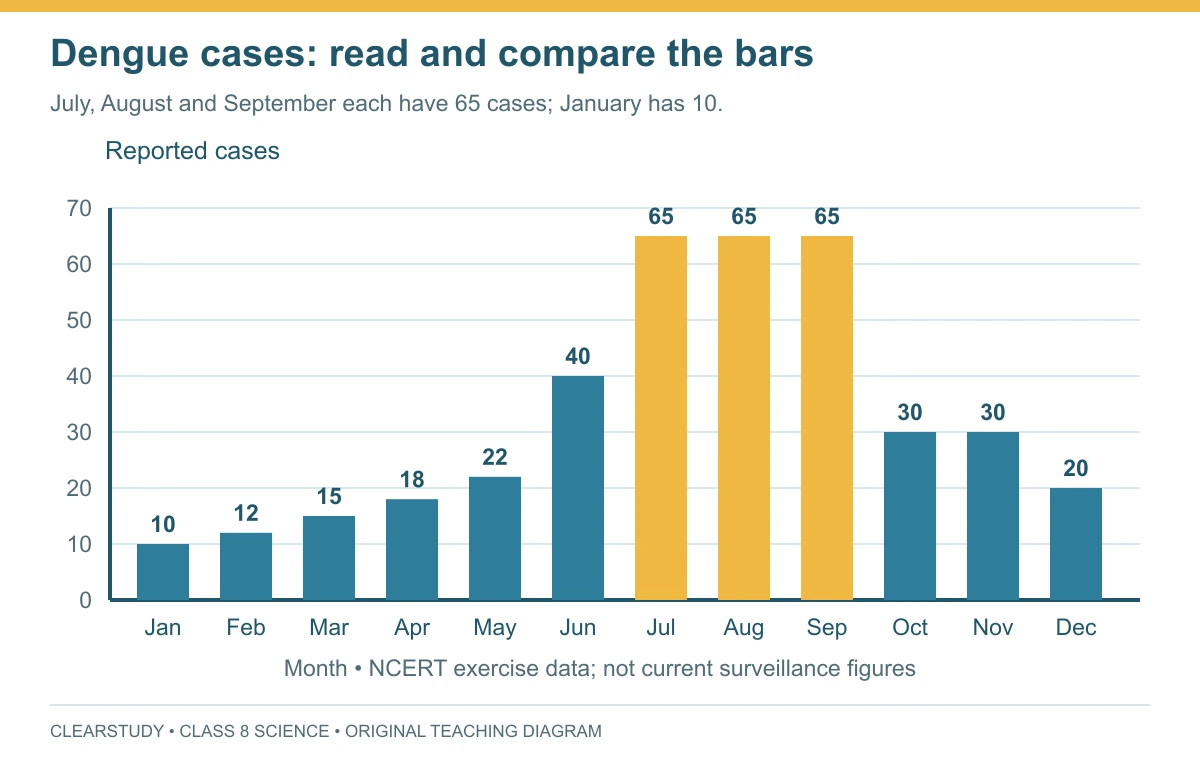
The data are a textbook exercise, not a current dengue surveillance report. Prevention reference: WHO dengue guidance.
8. Imagine you are in charge of a school health campaign. What key messages would you use to reduce communicable and non-communicable diseases?
9. It is recommended that we should not take an antibiotic for a viral infection like a cold, a cough, or flu. Can you provide the possible reason for this recommendation?
10. Which disease(s) among the following may spread if drinking water gets contaminated by the excreta from an infected person? Hepatitis A, Tuberculosis, Poliomyelitis, Cholera, Chickenpox.
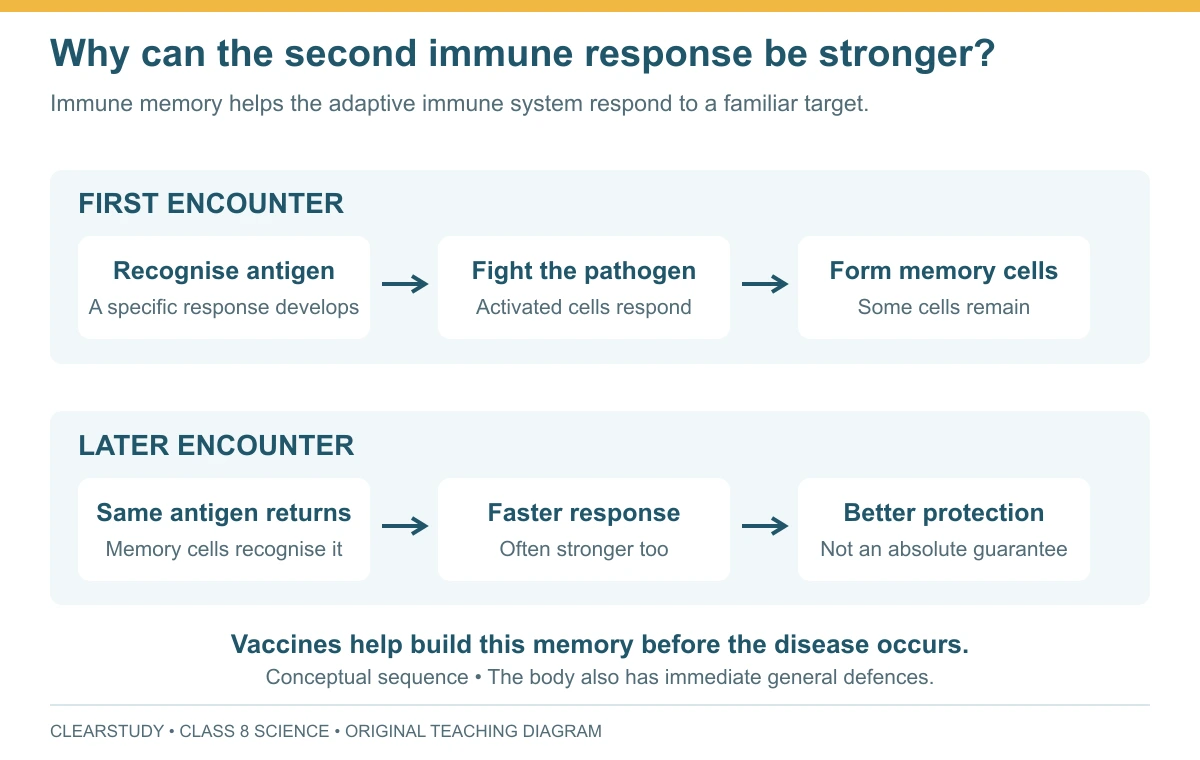
11. When our body encounters a pathogen for the first time, the immune response is generally low but on exposure to the same pathogen again, the immune response by the body is much more compared to the first exposure. Why is it so?
Common Misconceptions to Avoid
Watch out for these
- Thinking health means only “not being sick” — it includes physical, mental and social well-being.
- Confusing a sign with a symptom — a symptom is felt (pain); a sign can be seen or measured (fever, rash).
- Believing antibiotics cure all infections — they do not treat viral colds or flu; suitable treatment depends on the infection.
- Thinking vaccines treat a disease — vaccines are preventive, not curative.
- Assuming all illness is caused by germs or unhealthy choices — genetics, nutrition, environment and other factors also matter.
- Changing prescribed antibiotic treatment yourself or using leftovers — follow the clinician’s dose and duration, and seek advice about side effects or concerns.
Extra Practice Questions
These questions and MCQs are ClearStudy practice, separate from the NCERT exercise.
Very Short Answer Type Questions
Q1. Define a pathogen.
Q2. What are vectors? Give two examples.
Q3. Who discovered the first vaccine, and against which disease?
Short Answer Type Questions
Q1. Differentiate between communicable and non-communicable diseases with one example each.
Q2. How does a vaccine protect us from disease?
Long Answer Type Question
Q1. What is antibiotic resistance? Explain how it develops and how it can be prevented.
MCQs & Assertion–Reason
1. According to the WHO, health is:
(a) only the absence of disease (b) complete physical, mental and social well-being (c) only physical fitness (d) being free from injury
2. Which of the following is a non-communicable disease?
(a) typhoid (b) dengue (c) diabetes (d) chickenpox
3. Malaria is caused by a:
(a) virus (b) bacterium (c) protozoan (d) worm
4. Which disease spreads through contaminated water and food?
(a) cholera (b) tuberculosis (c) measles (d) chickenpox
5. Antibiotics are effective against:
(a) viruses (b) bacteria (c) all pathogens (d) non-communicable diseases
6. The natural ability of the body to fight diseases is called:
(a) infection (b) immunity (c) symptom (d) resistance
7. A sign of being unwell is:
(a) pain (b) tiredness (c) fever (measured temperature) (d) dizziness
8. Insects like mosquitoes and houseflies that spread pathogens are called:
(a) parasites (b) vectors (c) hosts (d) pathogens
9. Edward Jenner developed the first vaccine against:
(a) polio (b) tetanus (c) smallpox (d) cholera
10. Diseases that last for more than three months are called:
(a) acute diseases (b) chronic diseases (c) deficiency diseases (d) communicable diseases
For each Assertion–Reason question, choose: (A) Both true and the Reason correctly explains the Assertion; (B) Both true but the Reason is not the correct explanation; (C) Assertion true, Reason false; (D) Assertion false, Reason true.
A-R 1. Assertion: Vaccines are preventive and not curative.
Reason: A vaccine trains the immune system to fight a germ before infection happens.
A-R 2. Assertion: Antibiotics should not be taken for the common cold.
Reason: The common cold is caused by a virus, against which antibiotics are ineffective.
A-R 3. Assertion: Diabetes is a communicable disease.
Reason: Diabetes is not transmitted from one person to another.
A-R 4. Assertion: Dengue cases often rise during the monsoon season.
Reason: Stagnant rainwater provides breeding sites for mosquitoes that spread dengue.
A-R 5. Assertion: A symptom and a sign are the same thing.
Reason: A symptom is experienced by the person, whereas a sign can be observed or measured.
Quick Revision Summary
- Health means complete physical, mental and social well-being — not just the absence of disease. Health and happiness are closely related.
- A disease affects the normal working of the body or mind. Symptoms are what we feel; signs are what can be seen or measured.
- Non-communicable diseases have varied causes, including genetic and environmental factors. Healthy habits can reduce many risks but do not prevent every case.
- Communicable (infectious) diseases are caused by pathogens — bacteria, viruses or worms — and spread by air, water/food or vectors.
- The immune system protects us; vaccines train it using dead, weakened or harmless parts of a germ to prevent disease.
- Diagnosis and treatment matter; antibiotics are used for certain bacterial infections, and their misuse causes antibiotic resistance.
Real-life Applications
This chapter guides daily life: washing hands with soap, drinking boiled/clean water and eating properly cooked food prevents cholera, typhoid and hepatitis; removing stagnant water and using nets and repellents controls malaria and dengue; getting vaccinated protects against polio, measles and tetanus; and a balanced diet, exercise, sleep and saying NO to tobacco help reduce the risk of type 2 diabetes and cardiovascular disease, while supporting general health. Using antibiotics only as prescribed keeps them effective against bacterial infections for the future.
How to write a clear answer
Memorise the WHO definition of health and the exact difference between a sign and a symptom. Be ready to classify any disease as communicable or non-communicable with its cause and mode of spread. Remember that antibiotics are used for certain bacterial infections and that vaccines are preventive. For data questions like the dengue graph, read values carefully and link the peak to the monsoon.
Further reading: WHO on non-communicable diseases and their wider causes. These are textbook explanations; individual treatment decisions belong with a qualified health professional.
Frequently Asked Questions
What is Class 8 Science Curiosity Chapter 3 about?
Chapter 3, Health: The Ultimate Treasure, explains what health means (physical, mental and social well-being), how to stay healthy, signs versus symptoms, communicable and non-communicable diseases, immunity, vaccines, antibiotics and antibiotic resistance.
What is the difference between communicable and non-communicable diseases?
Communicable diseases are caused by pathogens and spread from person to person (e.g. typhoid, dengue, flu). Non-communicable diseases are not transmitted between people (e.g. diabetes, asthma). Genetic, physiological, environmental and behavioural factors can contribute.
How many questions are in the “Keep the curiosity alive” exercise of Chapter 3?
There are 11 questions, all solved on this page along with the “Probe and ponder” prompts.
Are these Class 8 Science Curiosity Chapter 3 solutions free?
Yes. All solutions are free and follow the official NCERT Curiosity textbook for 2026–27.