
Class 8 Science Curiosity Chapter 9 Solutions (NCERT 2026–27) – The Amazing World of Solutes, Solvents, and Solutions
These Class 8 Science Curiosity Chapter 9 solutions cover The Amazing World of Solutes, Solvents, and Solutions from the new NCF-2023 textbook (2026–27), with every “Keep the curiosity alive” question solved step by step.
Class 8 Science Curiosity Chapter 9 Solutions – Overview
Chapter 9 of Curiosity, The Amazing World of Solutes, Solvents, and Solutions, explains how substances mix together. A uniform mixture, such as salt or sugar in water, is a solution; the dissolved substance is the solute and the dissolving liquid is the solvent. The chapter explores how much solute a fixed amount of solvent can hold (saturated and unsaturated solutions, concentration and solubility), how temperature changes the solubility of solids and gases, and why water is a good solvent. It then turns to floating and sinking, defining density (mass ÷ volume), explaining how to measure mass and volume, and how temperature and pressure affect density. These Class 8 Science Curiosity Chapter 9 solutions answer every textbook question clearly.
Key Concepts & Definitions
Solution: a uniform mixture in which the components are evenly distributed and not visible separately (for example, salt in water).
Solute & solvent: when a solid dissolves in a liquid, the solid is the solute and the liquid is the solvent. When two liquids mix, the one present in smaller amount is the solute and the larger amount is the solvent.
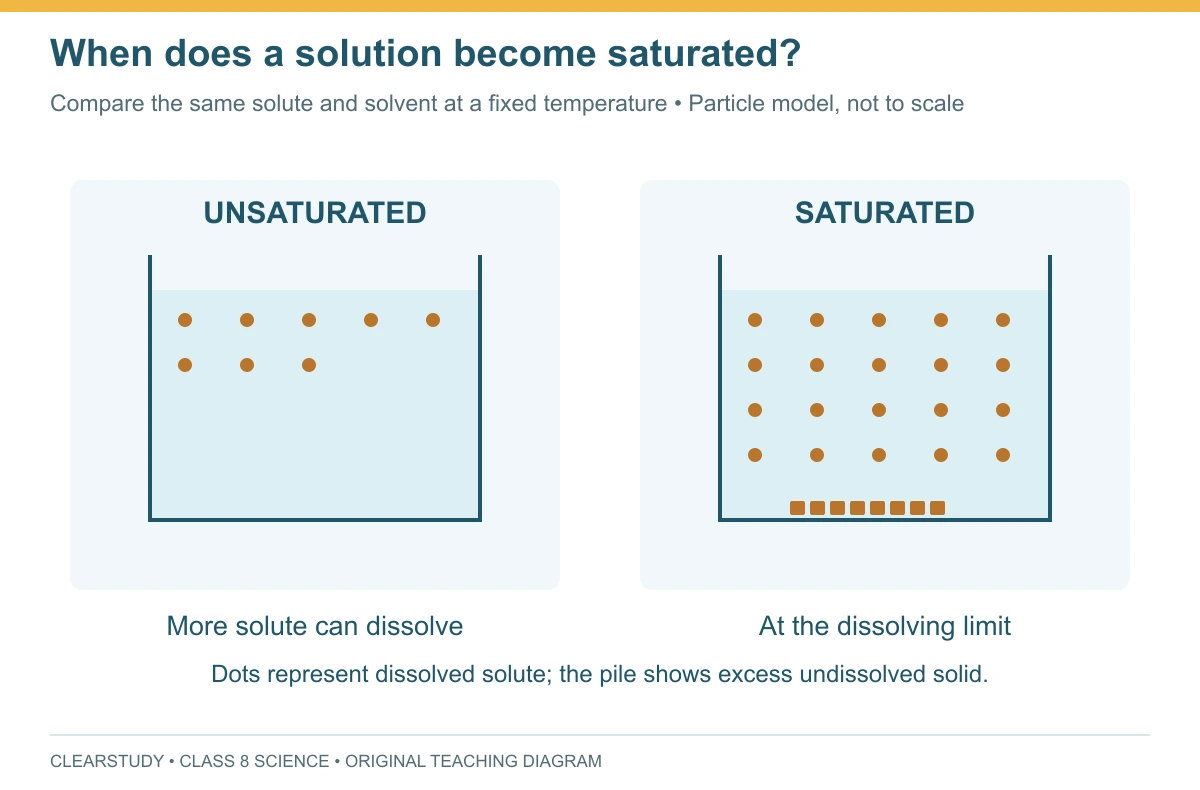
Saturated solution: a solution in which no more solute can dissolve at that temperature (extra solute settles at the bottom). Unsaturated solution: one in which more solute can still dissolve at that temperature.
Concentration: the amount of solute present in a fixed quantity of solution or solvent — a dilute solution has less solute, a concentrated solution has more.
Solubility: the maximum amount of solute that dissolves in a fixed quantity of solvent at a particular temperature. For most solids, solubility increases with temperature; for gases it generally decreases with temperature.
Density: mass per unit volume (Density = Mass ÷ Volume). SI unit kg/m³; for liquids/solids g/mL or g/cm³ are convenient. Density generally decreases on heating and is affected by pressure (mostly for gases).
Relative density: the density of a substance compared with the density of water at the same temperature; it has no units.
In-text & “Probe and ponder” Questions — Answers
What happens when you add too much sugar to your tea and it stops dissolving? How can you solve this problem?
Why do sugar and salt dissolve in water but not in oil? Why is water considered a good solvent?
Why are water bottles usually tall and cylindrical in shape instead of spherical?
Would a mixture of gases also be considered a solution?
Can you now reflect — which solution is more concentrated; 2 spoons of salt in 100 mL of water or 4 spoons of salt in 50 mL of water?
Does temperature affect the solubility of gases in liquids also? If so, how?
Think like a scientist: Some packets of ghee or oil are labelled with a volume of 1 litre but a weight of only about 910 grams. What does this tell us about the density of the oil, and is it less or more than that of water?
Think like a scientist: A raw whole egg sinks in tap water. What change can you make to this setup to make the egg float in water instead of sinking?
Class 8 Science Curiosity Chapter 9 Solutions — Keep the curiosity alive
1. State whether the statements given below are True [T] or False [F]. Correct the false statement(s). (i) Oxygen gas is more soluble in hot water rather than in cold water. (ii) A mixture of sand and water is a solution. (iii) The amount of space occupied by any object is called its mass. (iv) An unsaturated solution has more solute dissolved than a saturated solution. (v) The presence of different gases in the atmosphere is also a uniform mixture.
2. Fill in the blanks. (i) The volume of a solid can be measured by the method of displacement, where the solid is __________ in water and the __________ in water level is measured. (ii) The maximum amount of __________ dissolved in __________ at a particular temperature is called solubility at that temperature. (iii) Generally, the density __________ with increase in temperature. (iv) The solution in which glucose has completely dissolved in water, and no more glucose can dissolve at a given temperature, is called a __________ solution of glucose.
3. You pour oil into a glass containing some water. The oil floats on top. What does this tell you? (i) Oil is denser than water (ii) Water is denser than oil (iii) Oil and water have the same density (iv) Oil dissolves in water
4. A stone sculpture weighs 225 g and has a volume of 90 cm³. Calculate its density and predict whether it will float or sink in water.
5. Which one of the following is the most appropriate statement, and why are the other statements not appropriate? (i) A saturated solution can still dissolve more solute at a given temperature. (ii) An unsaturated solution has dissolved the maximum amount of solute possible at a given temperature. (iii) No more solute can be dissolved into the saturated solution at that temperature. (iv) A saturated solution forms only at high temperatures.
6. You have a bottle with a volume of 2 litres. You pour 500 mL of water into it. How much more water can the bottle hold?
7. An object has a mass of 400 g and a volume of 40 cm³. What is its density?
8. Analyse Fig. 9.25a and 9.25b. Why does the unpeeled orange float, while the peeled one sinks? Explain.
9. Object A has a mass of 200 g and a volume of 40 cm³. Object B has a mass of 240 g and a volume of 60 cm³. Which object is denser?
10. Reema has a piece of modeling clay that weighs 120 g. She first moulds it into a compact cube that has a volume of 60 cm³. Later, she flattens it into a thin sheet. Predict what will happen to its density.
11. A block of iron has a mass of 600 g and a density of 7.9 g/cm³. What is its volume?
12. You are provided with an experimental setup as shown in Fig. 9.26a and 9.26b. On keeping the test tube (Fig 9.26b) in a beaker containing hot water (~70 °C), the water level in the glass tube rises. How does it affect the density?
Common Misconceptions to Avoid
Watch out for these
- Thinking a mixture of sand or chalk in water is a solution — it is a non-uniform mixture (suspension) because the solid does not dissolve.
- Confusing an unsaturated solution with a saturated one — a saturated solution holds the maximum solute; an unsaturated one can still dissolve more.
- Believing solubility of gases increases with temperature — gas solubility actually decreases as temperature rises (only most solids increase).
- Mixing up mass and volume — mass is the quantity of matter (g, kg); volume is the space occupied (mL, cm³).
- Thinking density changes when an object is reshaped — simply reshaping compact material leaves its density unchanged if mass, material volume and conditions stay the same. Creating hollow spaces can change an object’s average density.
- Assuming floating objects are always “lighter” — what matters is density compared with the liquid, not weight alone.
Extra Practice Questions
These questions and MCQs are ClearStudy practice, separate from the NCERT exercise.
Very Short Answer Type Questions
Q1. What is the SI unit of density?
Q2. In a sugar solution, name the solute and the solvent.
Q3. Which instrument is used to measure the volume of a liquid?
Short Answer Type Questions
Q1. Differentiate between a uniform mixture and a non-uniform mixture with one example each.
Q2. Why does ice float on water?
Long Answer Type Question
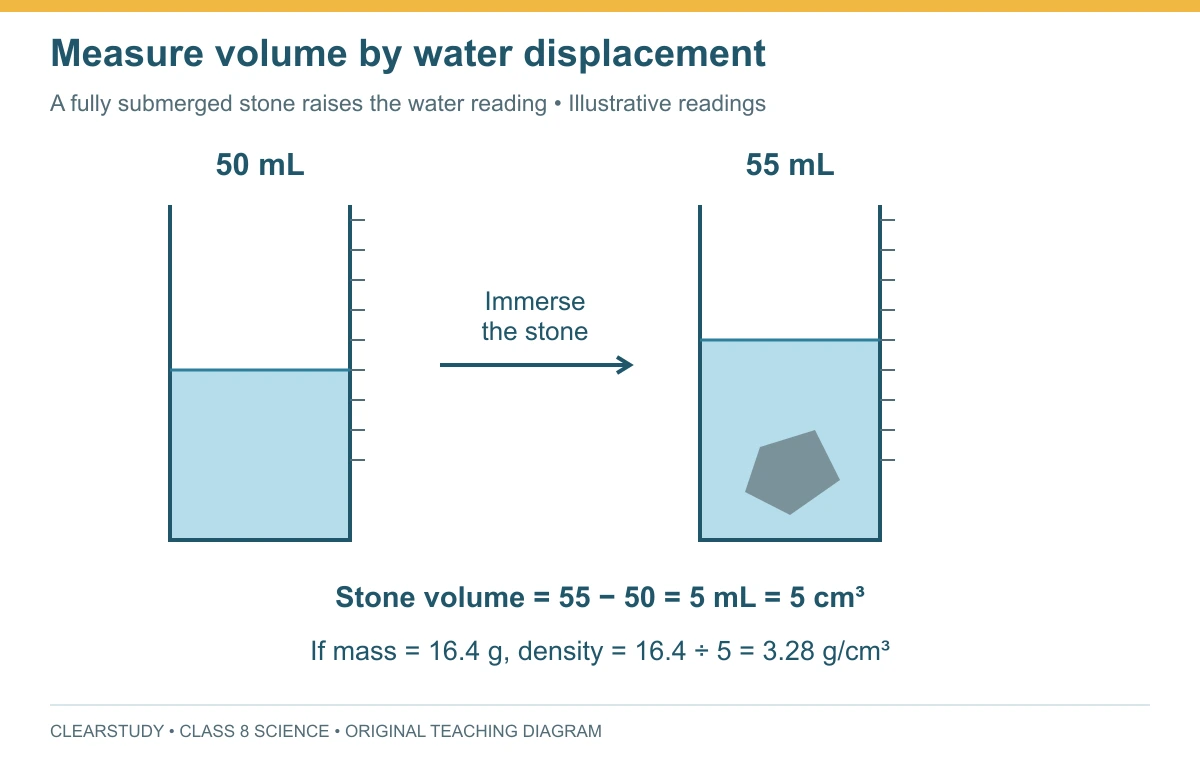
Q1. Explain how the density of an irregular solid such as a stone can be determined experimentally.
MCQs & Assertion–Reason
1. A uniform mixture of a solute and a solvent is called a:
(a) suspension (b) solution (c) compound (d) element
2. In a solution of sugar in water, the solvent is:
(a) sugar (b) water (c) the solution (d) air
3. A solution in which no more solute can dissolve at a given temperature is:
(a) dilute (b) unsaturated (c) saturated (d) concentrated by heating
4. For most solids, the solubility in water as temperature increases:
(a) increases (b) decreases (c) stays the same (d) becomes zero
5. The solubility of a gas in water as temperature rises generally:
(a) increases (b) decreases (c) is unaffected (d) doubles
6. Density is defined as:
(a) mass × volume (b) volume ÷ mass (c) mass ÷ volume (d) mass + volume
7. The SI unit of density is:
(a) g/mL (b) kg/m³ (c) g/cm³ (d) kg only
8. An object will float partly above the water surface at equilibrium if its average density is:
(a) greater than that of water (b) equal to that of water (c) less than that of water (d) zero
9. The volume of an irregular solid is best found using a:
(a) ruler (b) weighing balance (c) measuring cylinder (water displacement) (d) thermometer
10. On heating, the density of most substances generally:
(a) increases (b) decreases (c) remains constant (d) becomes infinite
For each Assertion–Reason question, choose: (A) Both true and the Reason correctly explains the Assertion; (B) Both true but the Reason is not the correct explanation; (C) Assertion true, Reason false; (D) Assertion false, Reason true.
A-R 1. Assertion: Oil floats on the surface of water.
Reason: Oil is less dense than water.
A-R 2. Assertion: Cold water holds more dissolved oxygen than warm water.
Reason: The solubility of gases in water decreases as temperature increases.
A-R 3. Assertion: A mixture of sand and water is a solution.
Reason: In a solution the components are evenly distributed and not visible separately.
A-R 4. Assertion: Merely reshaping compact clay, without changing its mass, material volume or temperature, changes its density.
Reason: Density depends on the mass and volume of the substance.
A-R 5. Assertion: A saturated sugar solution can dissolve more sugar when warmed, provided no water is lost.
Reason: The solubility of most solids increases with an increase in temperature.
Quick Revision Summary
- A solution is a uniform mixture; the dissolved solid is the solute and the dissolving liquid is the solvent.
- In two liquids, the smaller amount is the solute and the larger is the solvent.
- Saturated solution = no more solute dissolves at that temperature; unsaturated = more can still dissolve.
- Solubility = maximum solute that dissolves in a fixed quantity of solvent at a temperature; for many solids it rises with temperature, while for most gases it falls at a fixed gas pressure.
- Devices: weighing balance for mass, measuring cylinder for volume.
- Density = Mass ÷ Volume; it generally decreases on heating and depends on the material, not shape; objects float when less dense than the liquid.
Real-life Applications
Solutions and density shape everyday life: ORS keeps every sip the same because it is a uniform solution; cold rivers and lakes hold more dissolved oxygen, supporting aquatic life. Ships made of iron float because their overall density (with hollow spaces) is less than water, while a solid iron block sinks. Hot-air balloons rise because hot air is less dense than the surrounding cool air, and ice floats on ponds — forming an insulating layer — because ice is less dense than liquid water. Salt is still harvested by evaporating salt-water solutions in traditional Indian villages.
How to write a clear answer
Always write the formula Density = Mass ÷ Volume first, then substitute with correct units (g and cm³) and compare with water (1 g/cm³) to decide float or sink. Remember the opposite trends: solid solubility increases with temperature, gas solubility decreases. State definitions of saturated, unsaturated, concentration and solubility precisely, and show every numerical step.
Frequently Asked Questions
What is Class 8 Science Curiosity Chapter 9 about?
It is about solutes, solvents and solutions — uniform mixtures, saturated and unsaturated solutions, concentration and solubility, how temperature affects solubility of solids and gases, and density (why objects float or sink).
What is the difference between a saturated and an unsaturated solution?
A saturated solution cannot dissolve any more solute at a given temperature, while an unsaturated solution can still dissolve more solute at that temperature.
How do you decide whether an object will float or sink in water?
Compare its density with water (1 g/cm³). If the object is less dense than water it floats; if it is denser than water it sinks. Use Density = Mass ÷ Volume to calculate.
Are these Class 8 Science Curiosity Chapter 9 solutions free?
Yes. All solutions are free and follow the official NCERT Curiosity textbook for 2026–27.